


This browser is too old to run Achievable.

Update it, or open this page in a current version of Chrome, Safari, Firefox or Edge. On an iPhone or iPad, update iOS: every browser there runs on the version of Safari that comes with it.

Achievable logoAchievable logo
ASVAB
Sign in
Sign up
Purchase
Textbook
Practice exams
Support
How it works
Resources
Exam catalog
Mountain with a flag at the peak
Textbook
Introduction
1. Word Knowledge
2. Mathematics Knowledge
3. Paragraph Comprehension
4. Arithmetic Reasoning
5. General Science
5.1 Life Science
5.2 Chemistry
5.3 Environmental Science
6. Mechanical Comprehension
7. Electronics Information
8. Shop Information
9. Auto Information
10. Assembling Objects
Wrapping up
Achievable logoAchievable logo
5.3 Environmental Science
Achievable ASVAB
5. General Science
Our ASVAB course is currently in development and is a work-in-progress.

Environmental Science

11 min read
Font
Discuss
Share
Feedback

The Universe

Planet: A large, round celestial body that orbits a star

Satellite: An object that orbits a planet, such as a moon. It can be natural or artificial.

Star: A large sphere of plasma and gas that emits light and is held together by its own gravity

Star System: A star and all the planets, asteroids, satellites, comets, and other objects that orbit it

Galaxy: A collection of stars, planets, dust, and other matter held together by gravity

The universe is the totality of existence: all of space, time, matter, and energy. It’s approximately 13.8 billion years old.

Space is the enormous, near-perfect vacuum between celestial objects. It is extremely cold, effectively frictionless, and incredibly vast.

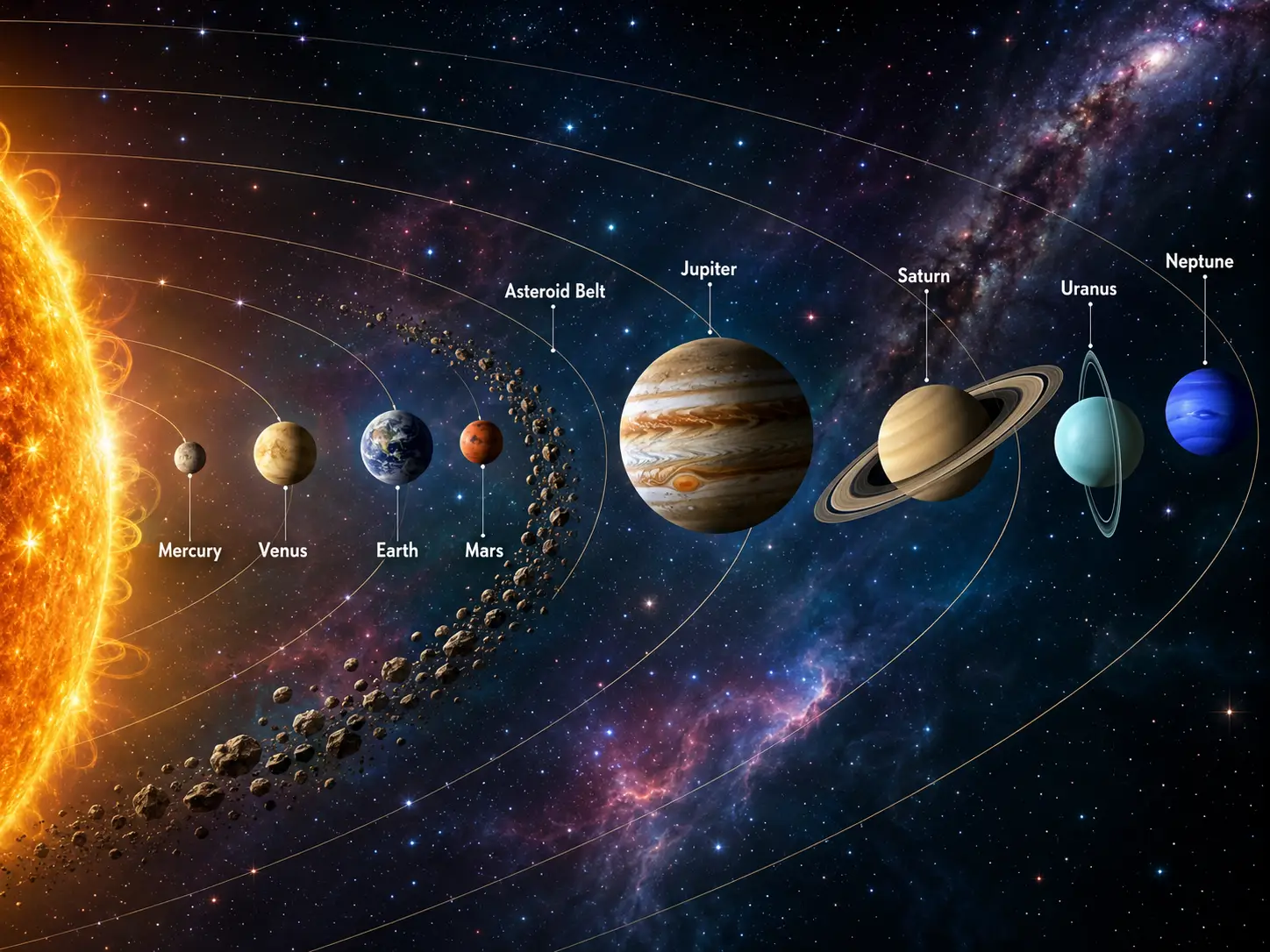
Our home galaxy, the Milky Way, contains our Solar System, which has 8 planets and hundreds of moons orbiting them.

The Sun and planets arranged in order within the solar system.
Solar System
Achievable

The Earth

The Earth is the third planet from the sun in the Solar System. It spins on its own axis once every 24 hours, creating our day and the appearance of the sun rising and setting.

While rotating on its axis, the Earth also orbits the sun in an elliptical pattern, taking approximately 365 days and creating our calendar year.

The Earth’s rotational axis is tilted about 23.5°, causing different parts of the planet to get more or less sun exposure throughout the year. This creates our changing seasons and is why the Northern and Southern Hemispheres have opposite seasons to one another. This tilt also keeps weather near the equator warm year-round because it has about the same amount of sun exposure all year.

Moons and Satellites

A moon is a natural satellite that orbits a planet.

A moon spins along its own axis while also orbiting its planet. Our moon orbits the Earth in approximately 27 days and also completes one full rotation in the same amount of time. Because both actions take the same amount of time, this means that we only ever see one side of the moon from Earth.

This kind of joint rotation is called “synchronous rotation” or being “tidally locked.”

Moon Phases

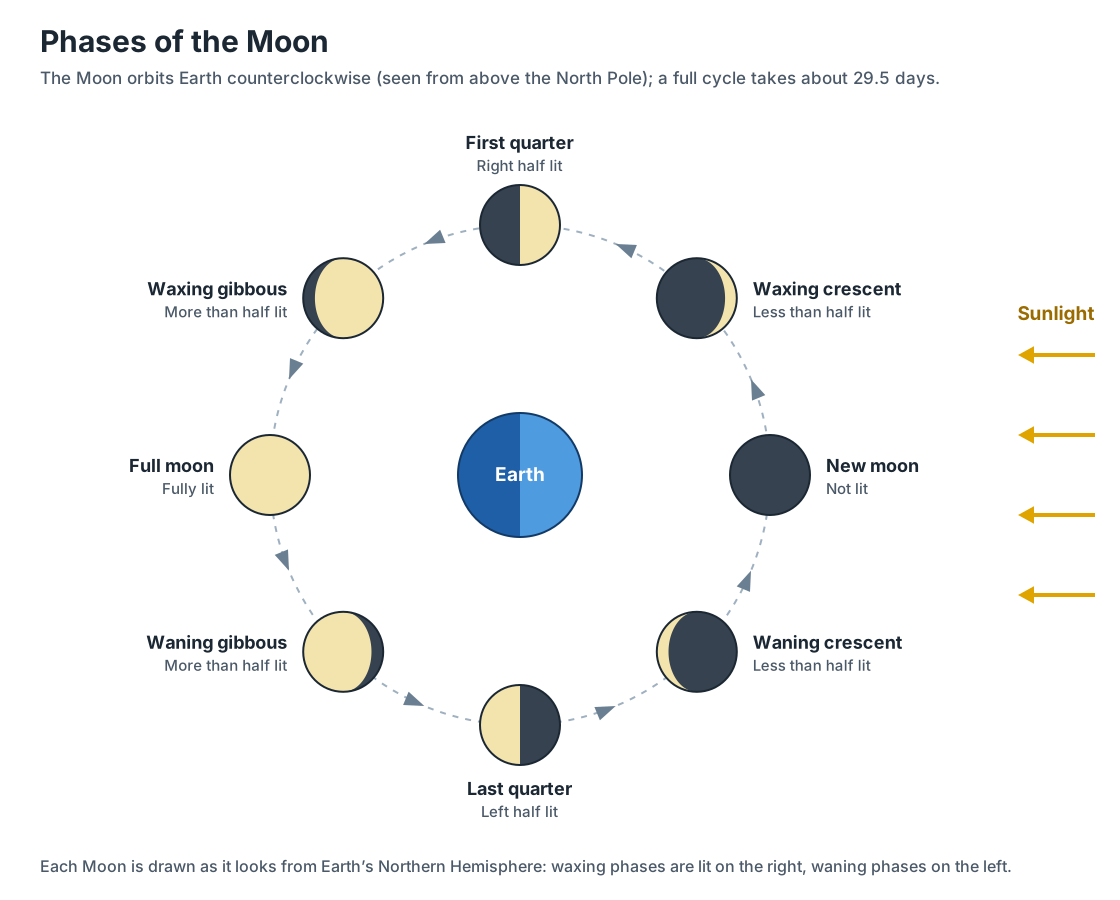
The moon doesn’t produce its own light. It appears bright because it reflects the sun’s light, and, depending on the positions of the moon, Earth, and sun, it can appear dark, fully lit, or somewhere in between.

The Moon’s orbit around Earth, with sunlight coming from the right. Counterclockwise from the side facing the Sun: new moon (dark), waxing crescent (a sliver lit on the right), first quarter (right half lit), waxing gibbous (mostly lit, dark on the left), full moon (fully lit), waning gibbous (mostly lit, dark on the right), last quarter (left half lit) and waning crescent (a sliver lit on the left).
Moon Phases
Achievable

The various stages of the moon’s appearance are called the “phases of the moon,” and they cycle through a pattern that takes approximately 29.5 days to complete.

Other Satellites

Moons aren’t distributed evenly among the planets. Mercury and Venus have none, while larger planets tend to have more because their stronger gravity can capture and hold them.

Weather and Climate

Weather: The day-to-day atmospheric conditions in a particular location

Climate: The long-term averaging of weather conditions in a particular location

Weather describes a location’s temperature, humidity, precipitation (rain, snow, sleet, and hail), cloud cover, wind, and other atmospheric conditions.

Climate describes a location’s long-term weather patterns, usually looking at data of the past 30 years or more.

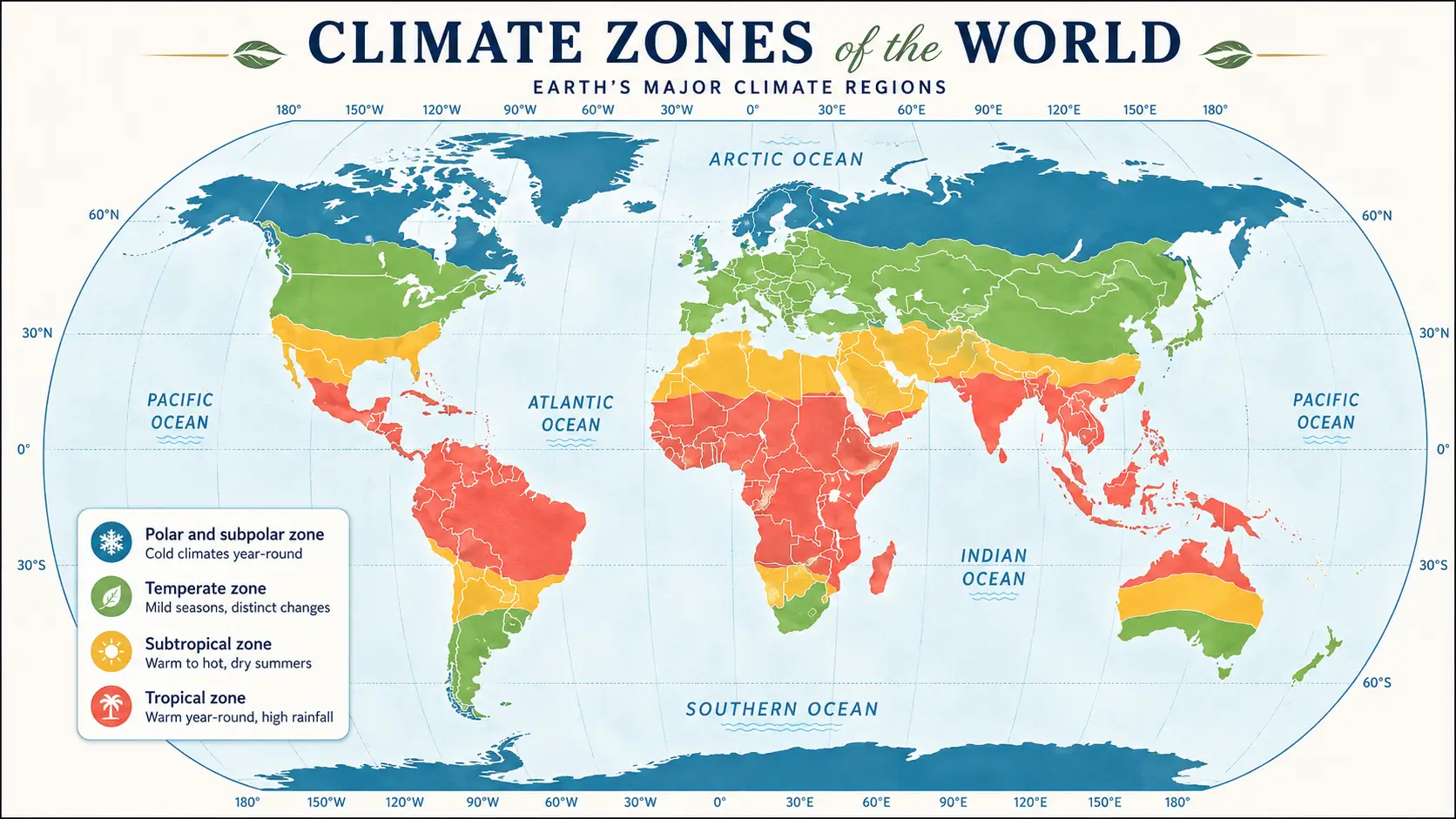
Climates are grouped in a variety of different ways, but we can roughly divide the Earth by latitude into polar, temperate, subtropical, and tropical zones.

Earth’s major climate zones across the world.
Climate Zones on Earth
Achievable

Polar Zones

Polar zones are at the furthest northern and southern parts of the Earth and include the Arctic and Antarctic. These regions get the least amount of direct sunlight due to Earth’s axial tilt so the climate is typically frigid year-round, with extensive ice and snow coverage in many areas. These regions also get the most varied amounts of light over the seasons, with 24 hours of sunlight in parts of the summer and 24 hours of darkness in parts of the winter.

Temperate Zones

Temperate zones are warmer than polar zones, with more seasonal variety and direct sunlight. They typically have four distinct seasons (spring, summer, autumn, and winter) as well as moderate rainfall. Due to the Earth’s tilt, day length in these zones varies more than it does near the equator.

Subtropical Zones

Subtropical zones are characterized by hot summers and mild winters, with little frost or snowfall.

Tropical Zones

Tropical zones are areas around the equator. They get the most direct sunlight throughout the year and so are typically warm to hot year-round. These zones have the least variation in temperature between seasons and the least variation of sunlight over the seasons. They average 12 hours of sunlight in both summer and winter.

Geosphere (Rock cycle)

The geosphere includes all of Earth’s rocks, minerals, soil, and fossils, spanning from deep in the Earth’s interior to its surface.

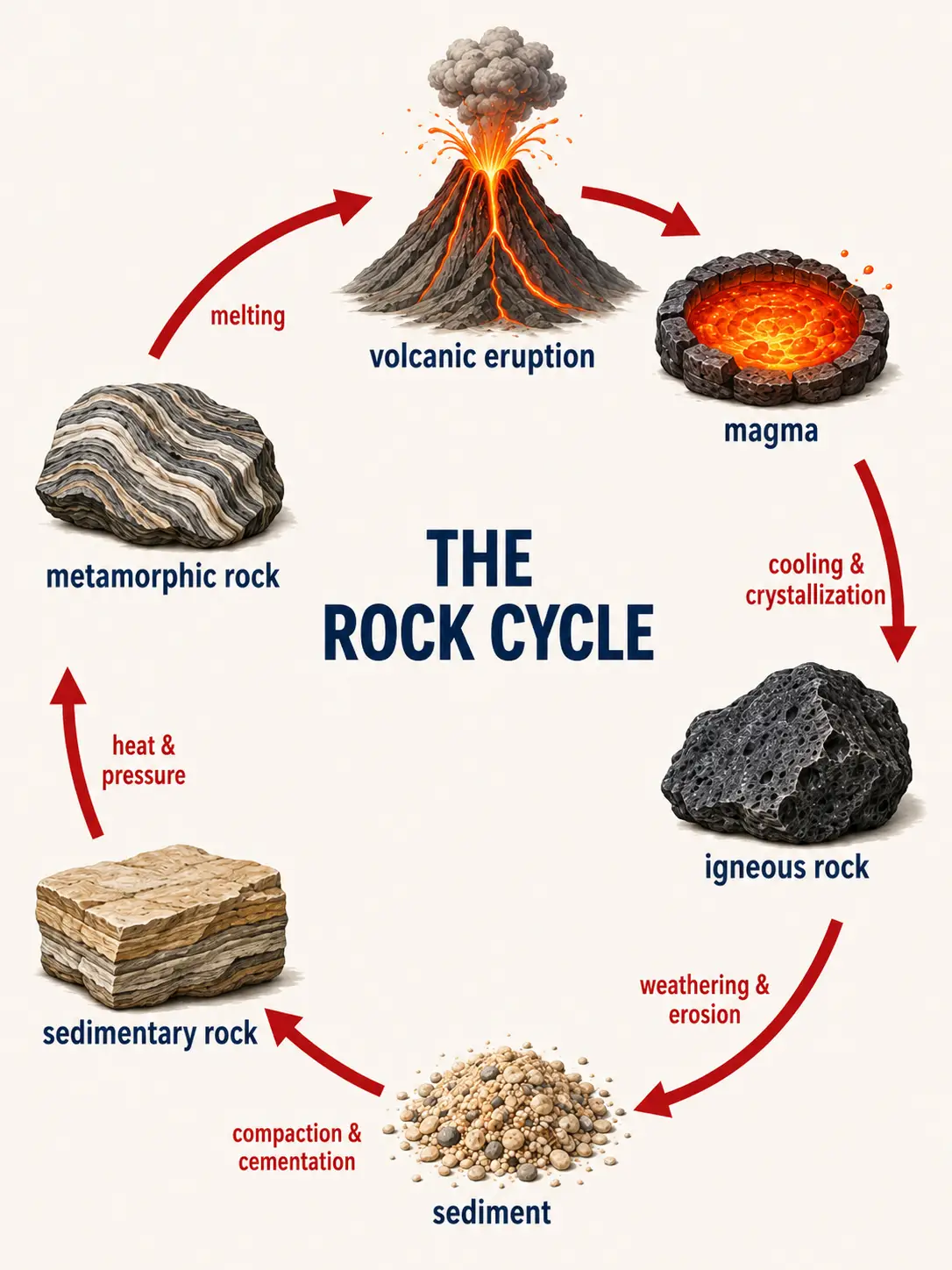
The rock cycle is the continuous transformation and recycling of rocks within the geosphere, a process that can take millions of years.

The processes that transform igneous, sedimentary, and metamorphic rocks.
Rock Cycle
Achievable

There are three main types of rocks, and all of them can transform into one another, depending on the conditions and pressures being placed on them.

Igneous rock: igneous rocks are formed when molten rock, such as lava or underground magma, cools and crystallizes.

Sedimentary rock: sedimentary rocks are formed when existing rocks or minerals become fragmented through weathering and are then deposited, compacted, and cemented together over time.

Metamorphic rock: metamorphic rocks are formed when pressure and heat are applied to existing rocks, changing their structure without fully melting them.

The rock cycle is driven by a combination of Earth’s internal and external processes. Internal systems like tectonic plate movements, heat, and pressure influence volcanic activity and create mountains and valleys. External processes include weathering, which breaks rocks down over time, and erosion, which carries the pieces away and deposits them elsewhere, where they eventually form new rocks.

Tectonic Plates: Tectonic plates are massive, rigid sections of Earth’s crust and upper mantle that fit together to form the planet’s outer shell. They float on the slow-moving mantle beneath them, and over time they collide, pull apart, or slide past one another. This movement drives volcanic activity, earthquakes, and the formation of mountains and valleys.

Mechanical weathering: the physical breakdown of rock caused by forces like wind, water, and ice, which wear down or break apart rock without changing what it’s made of.

Chemical weathering: the breakdown of rock through chemical reactions, such as oxidation or acid rain, which change the rock’s mineral makeup over time.

Hydrosphere (water cycle)

The hydrosphere includes all of Earth’s water in both fresh and salt forms, and in all three states: liquid, solid, and gas.

The water cycle is the constant movement of water between Earth’s surface and the atmosphere, through evaporation, condensation, and precipitation.

Evaporation: the sun’s heat and energy causes water on Earth’s surface to turn from its liquid form into its gaseous form. This water vapor is then carried upward into the atmosphere.

Condensation: as the water vapor travels higher in the atmosphere, the temperature becomes cooler. This cooler temperature transforms some of the water vapor back into its liquid form. The condensed water can collect to form clouds, which are a combination of miniature liquid water droplets and/or ice crystals.

Precipitation: eventually, the liquid water droplets or ice crystals become large enough that they are pulled back to Earth’s surface by gravity. If the water stays in liquid form, it falls to the Earth as rain. If it becomes cool enough to transform into solid form or partly solid form, it falls to the Earth in the form of hail, sleet, or snow.

Atmosphere

The atmosphere is the layer of gases, aerosols, and particulates that surrounds Earth. It is held in place by gravity and separating its surface from outer space. It provides three key functions: supplying the oxygen animals need and the carbon dioxide plants need to survive, reducing harmful solar radiation like ultraviolet light, and helping maintain steady temperatures through the greenhouse effect.

The atmosphere is primarily nitrogen (78%), oxygen (21%), and argon (1%), with trace amounts of other gases and a constantly cycling amount of water vapor (0–4%, depending on location and weather).

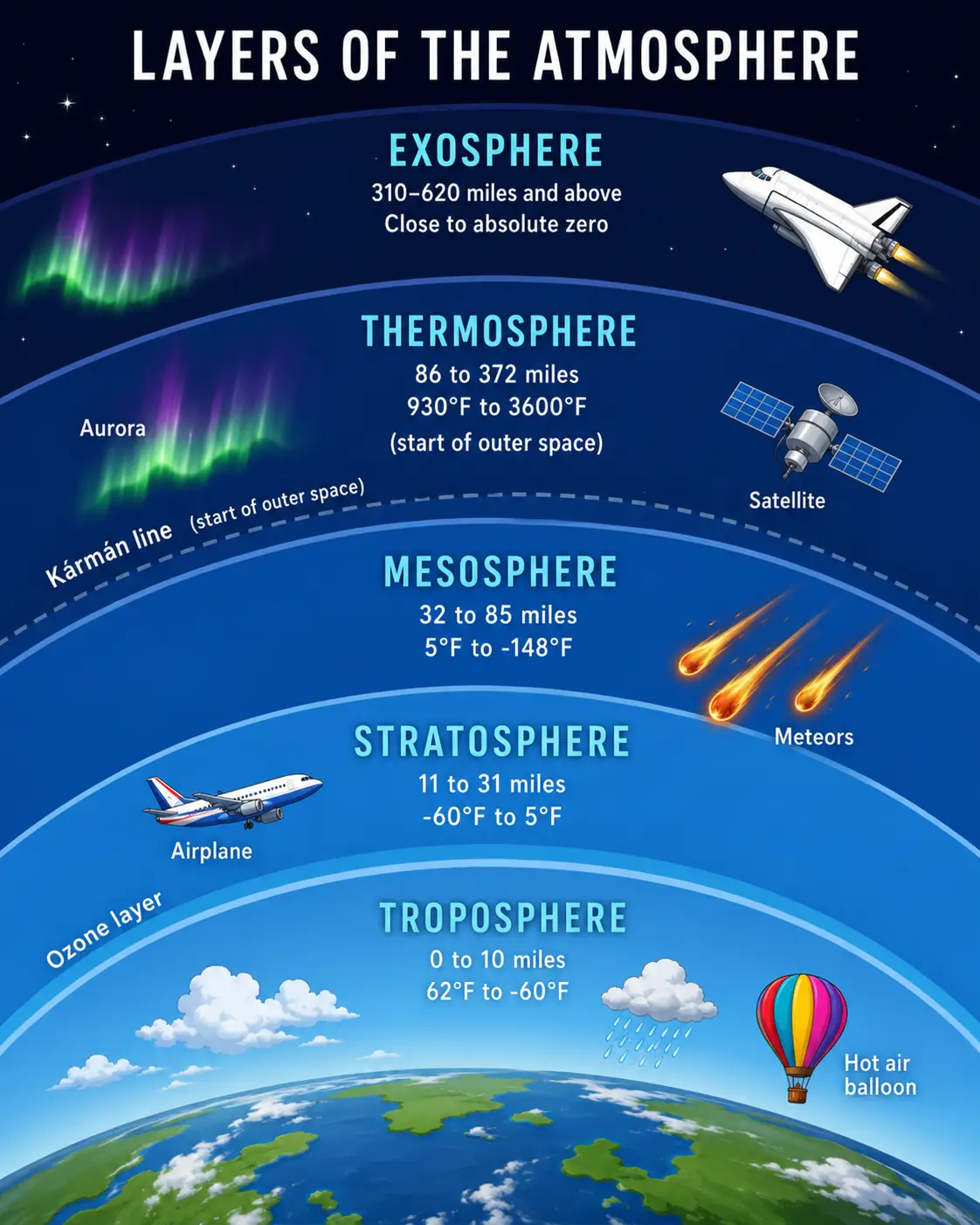
The atmosphere is made up of five main layers, each with their own characteristics.

The main layers of Earth’s atmosphere.
Atmosphere
Achievable

Troposphere: this is the layer closest to Earth’s surface, containing almost all of the atmosphere’s water and about 80% of its total mass. Almost all of Earth’s weather happens here. Temperature drops as you rise in altitude.

Stratosphere: the second layer from Earth’s surface, containing the ozone layer, which absorbs most of the sun’s harmful ultraviolet radiation.

Mesosphere: this is the third layer of atmosphere. Temperature continues to drop with altitude here, making the mesosphere the coldest layer of Earth’s atmosphere. It is also the layer where most meteors burn up upon entry.

Thermosphere: this is the fourth layer of Earth’s atmosphere. The thermosphere is the hottest layer, though it doesn’t feel hot due to its low density. Many low-Earth-orbit satellites orbit in this layer, and natural light displays like the aurora borealis and aurora australis primarily occur here.

Exosphere: this is the fifth layer of Earth’s atmosphere, though some scientists consider it to be part of open space rather than the atmosphere. The air density is so low that molecules can travel hundreds of kilometers before colliding, and some atoms and molecules escape Earth’s gravity into space. Like the thermosphere, many of Earth’s satellites orbit in this layer.

The Universe

  • Universe = all space, time, matter, energy; ~13.8 billion years old
  • Key terms: planet (orbits star), satellite (orbits planet), star (plasma/gas sphere), star system, galaxy
  • Milky Way galaxy contains our Solar System (8 planets, hundreds of moons)

Earth’s Motion

  • Rotates on axis every 24 hours → day/night
  • Orbits sun in ~365 days (elliptical) → calendar year
  • Axial tilt ~23.5° → causes seasons, opposite seasons in N/S hemispheres
  • Equator gets consistent sun exposure year-round → stays warm

Moons and Satellites

  • Moon: natural satellite; orbits and rotates in sync (~27 days each) = “synchronous rotation”/“tidally locked” → only one side visible from Earth
  • Moon phases: caused by changing sun/Earth/moon positions, not moon’s own light; full cycle ~29.5 days
  • Moon distribution uneven: larger planets (stronger gravity) have more moons; Mercury/Venus have none

Weather and Climate

  • Weather = short-term daily atmospheric conditions; Climate = long-term averages (30+ years)
  • Four climate zones by latitude:
    • Polar: least direct sun, frigid, extreme seasonal light variation (24hr sun/dark)
    • Temperate: four distinct seasons, moderate rainfall
    • Subtropical: hot summers, mild winters, little frost
    • Tropical: near equator, warm year-round, least seasonal variation (~12hrs sunlight year-round)

Geosphere (Rock Cycle)

  • Geosphere = Earth’s rocks, minerals, soil, fossils
  • Three rock types interconvert via rock cycle:
    • Igneous: cooled/crystallized molten rock
    • Sedimentary: compacted/cemented weathered fragments
    • Metamorphic: heat/pressure alters existing rock without melting
  • Driven by tectonic plate movement (internal) and weathering/erosion (external)
  • Weathering types: mechanical (physical breakdown) vs. chemical (reaction-based breakdown)

Hydrosphere (Water Cycle)

  • Hydrosphere = all Earth’s water (fresh/salt, all three states)
  • Water cycle steps:
    • Evaporation: liquid → vapor via sun’s heat
    • Condensation: vapor cools → liquid droplets/ice, forms clouds
    • Precipitation: droplets fall as rain, hail, sleet, or snow

Atmosphere

  • Composition: ~78% nitrogen, 21% oxygen, 1% argon, variable water vapor (0–4%)
  • Key roles: supplies O2​/CO2​, blocks UV radiation, regulates temperature (greenhouse effect)
  • Five layers (closest to farthest from Earth):
    • Troposphere: weather occurs here, most mass/water, temp drops with altitude
    • Stratosphere: contains ozone layer (absorbs UV)
    • Mesosphere: coldest layer, meteors burn up here
    • Thermosphere: hottest (low density), houses low-orbit satellites, auroras occur here
    • Exosphere: outermost, extremely low density, merges into space, satellites orbit here

Sign up for free to take 5 quiz questions on this topic

Previous
Next  | 6.1 Forces and Motion
All rights reserved ©2016 - 2026 Achievable, Inc.

Environmental Science

The Universe

Planet: A large, round celestial body that orbits a star

Satellite: An object that orbits a planet, such as a moon. It can be natural or artificial.

Star: A large sphere of plasma and gas that emits light and is held together by its own gravity

Star System: A star and all the planets, asteroids, satellites, comets, and other objects that orbit it

Galaxy: A collection of stars, planets, dust, and other matter held together by gravity

The universe is the totality of existence: all of space, time, matter, and energy. It’s approximately 13.8 billion years old.

Space is the enormous, near-perfect vacuum between celestial objects. It is extremely cold, effectively frictionless, and incredibly vast.

Our home galaxy, the Milky Way, contains our Solar System, which has 8 planets and hundreds of moons orbiting them.

The Earth

The Earth is the third planet from the sun in the Solar System. It spins on its own axis once every 24 hours, creating our day and the appearance of the sun rising and setting.

While rotating on its axis, the Earth also orbits the sun in an elliptical pattern, taking approximately 365 days and creating our calendar year.

The Earth’s rotational axis is tilted about 23.5°, causing different parts of the planet to get more or less sun exposure throughout the year. This creates our changing seasons and is why the Northern and Southern Hemispheres have opposite seasons to one another. This tilt also keeps weather near the equator warm year-round because it has about the same amount of sun exposure all year.

Moons and Satellites

A moon is a natural satellite that orbits a planet.

A moon spins along its own axis while also orbiting its planet. Our moon orbits the Earth in approximately 27 days and also completes one full rotation in the same amount of time. Because both actions take the same amount of time, this means that we only ever see one side of the moon from Earth.

This kind of joint rotation is called “synchronous rotation” or being “tidally locked.”

Moon Phases

The moon doesn’t produce its own light. It appears bright because it reflects the sun’s light, and, depending on the positions of the moon, Earth, and sun, it can appear dark, fully lit, or somewhere in between.

The various stages of the moon’s appearance are called the “phases of the moon,” and they cycle through a pattern that takes approximately 29.5 days to complete.

Other Satellites

Moons aren’t distributed evenly among the planets. Mercury and Venus have none, while larger planets tend to have more because their stronger gravity can capture and hold them.

Weather and Climate

Weather: The day-to-day atmospheric conditions in a particular location

Climate: The long-term averaging of weather conditions in a particular location

Weather describes a location’s temperature, humidity, precipitation (rain, snow, sleet, and hail), cloud cover, wind, and other atmospheric conditions.

Climate describes a location’s long-term weather patterns, usually looking at data of the past 30 years or more.

Climates are grouped in a variety of different ways, but we can roughly divide the Earth by latitude into polar, temperate, subtropical, and tropical zones.

Polar Zones

Polar zones are at the furthest northern and southern parts of the Earth and include the Arctic and Antarctic. These regions get the least amount of direct sunlight due to Earth’s axial tilt so the climate is typically frigid year-round, with extensive ice and snow coverage in many areas. These regions also get the most varied amounts of light over the seasons, with 24 hours of sunlight in parts of the summer and 24 hours of darkness in parts of the winter.

Temperate Zones

Temperate zones are warmer than polar zones, with more seasonal variety and direct sunlight. They typically have four distinct seasons (spring, summer, autumn, and winter) as well as moderate rainfall. Due to the Earth’s tilt, day length in these zones varies more than it does near the equator.

Subtropical Zones

Subtropical zones are characterized by hot summers and mild winters, with little frost or snowfall.

Tropical Zones

Tropical zones are areas around the equator. They get the most direct sunlight throughout the year and so are typically warm to hot year-round. These zones have the least variation in temperature between seasons and the least variation of sunlight over the seasons. They average 12 hours of sunlight in both summer and winter.

Geosphere (Rock cycle)

The geosphere includes all of Earth’s rocks, minerals, soil, and fossils, spanning from deep in the Earth’s interior to its surface.

The rock cycle is the continuous transformation and recycling of rocks within the geosphere, a process that can take millions of years.

There are three main types of rocks, and all of them can transform into one another, depending on the conditions and pressures being placed on them.

Igneous rock: igneous rocks are formed when molten rock, such as lava or underground magma, cools and crystallizes.

Sedimentary rock: sedimentary rocks are formed when existing rocks or minerals become fragmented through weathering and are then deposited, compacted, and cemented together over time.

Metamorphic rock: metamorphic rocks are formed when pressure and heat are applied to existing rocks, changing their structure without fully melting them.

The rock cycle is driven by a combination of Earth’s internal and external processes. Internal systems like tectonic plate movements, heat, and pressure influence volcanic activity and create mountains and valleys. External processes include weathering, which breaks rocks down over time, and erosion, which carries the pieces away and deposits them elsewhere, where they eventually form new rocks.

Tectonic Plates: Tectonic plates are massive, rigid sections of Earth’s crust and upper mantle that fit together to form the planet’s outer shell. They float on the slow-moving mantle beneath them, and over time they collide, pull apart, or slide past one another. This movement drives volcanic activity, earthquakes, and the formation of mountains and valleys.

Mechanical weathering: the physical breakdown of rock caused by forces like wind, water, and ice, which wear down or break apart rock without changing what it’s made of.

Chemical weathering: the breakdown of rock through chemical reactions, such as oxidation or acid rain, which change the rock’s mineral makeup over time.

Hydrosphere (water cycle)

The hydrosphere includes all of Earth’s water in both fresh and salt forms, and in all three states: liquid, solid, and gas.

The water cycle is the constant movement of water between Earth’s surface and the atmosphere, through evaporation, condensation, and precipitation.

Evaporation: the sun’s heat and energy causes water on Earth’s surface to turn from its liquid form into its gaseous form. This water vapor is then carried upward into the atmosphere.

Condensation: as the water vapor travels higher in the atmosphere, the temperature becomes cooler. This cooler temperature transforms some of the water vapor back into its liquid form. The condensed water can collect to form clouds, which are a combination of miniature liquid water droplets and/or ice crystals.

Precipitation: eventually, the liquid water droplets or ice crystals become large enough that they are pulled back to Earth’s surface by gravity. If the water stays in liquid form, it falls to the Earth as rain. If it becomes cool enough to transform into solid form or partly solid form, it falls to the Earth in the form of hail, sleet, or snow.

Atmosphere

The atmosphere is the layer of gases, aerosols, and particulates that surrounds Earth. It is held in place by gravity and separating its surface from outer space. It provides three key functions: supplying the oxygen animals need and the carbon dioxide plants need to survive, reducing harmful solar radiation like ultraviolet light, and helping maintain steady temperatures through the greenhouse effect.

The atmosphere is primarily nitrogen (78%), oxygen (21%), and argon (1%), with trace amounts of other gases and a constantly cycling amount of water vapor (0–4%, depending on location and weather).

The atmosphere is made up of five main layers, each with their own characteristics.

Troposphere: this is the layer closest to Earth’s surface, containing almost all of the atmosphere’s water and about 80% of its total mass. Almost all of Earth’s weather happens here. Temperature drops as you rise in altitude.

Stratosphere: the second layer from Earth’s surface, containing the ozone layer, which absorbs most of the sun’s harmful ultraviolet radiation.

Mesosphere: this is the third layer of atmosphere. Temperature continues to drop with altitude here, making the mesosphere the coldest layer of Earth’s atmosphere. It is also the layer where most meteors burn up upon entry.

Thermosphere: this is the fourth layer of Earth’s atmosphere. The thermosphere is the hottest layer, though it doesn’t feel hot due to its low density. Many low-Earth-orbit satellites orbit in this layer, and natural light displays like the aurora borealis and aurora australis primarily occur here.

Exosphere: this is the fifth layer of Earth’s atmosphere, though some scientists consider it to be part of open space rather than the atmosphere. The air density is so low that molecules can travel hundreds of kilometers before colliding, and some atoms and molecules escape Earth’s gravity into space. Like the thermosphere, many of Earth’s satellites orbit in this layer.

Key points

The Universe

  • Universe = all space, time, matter, energy; ~13.8 billion years old
  • Key terms: planet (orbits star), satellite (orbits planet), star (plasma/gas sphere), star system, galaxy
  • Milky Way galaxy contains our Solar System (8 planets, hundreds of moons)

Earth’s Motion

  • Rotates on axis every 24 hours → day/night
  • Orbits sun in ~365 days (elliptical) → calendar year
  • Axial tilt ~23.5° → causes seasons, opposite seasons in N/S hemispheres
  • Equator gets consistent sun exposure year-round → stays warm

Moons and Satellites

  • Moon: natural satellite; orbits and rotates in sync (~27 days each) = “synchronous rotation”/“tidally locked” → only one side visible from Earth
  • Moon phases: caused by changing sun/Earth/moon positions, not moon’s own light; full cycle ~29.5 days
  • Moon distribution uneven: larger planets (stronger gravity) have more moons; Mercury/Venus have none

Weather and Climate

  • Weather = short-term daily atmospheric conditions; Climate = long-term averages (30+ years)
  • Four climate zones by latitude:
    • Polar: least direct sun, frigid, extreme seasonal light variation (24hr sun/dark)
    • Temperate: four distinct seasons, moderate rainfall
    • Subtropical: hot summers, mild winters, little frost
    • Tropical: near equator, warm year-round, least seasonal variation (~12hrs sunlight year-round)

Geosphere (Rock Cycle)

  • Geosphere = Earth’s rocks, minerals, soil, fossils
  • Three rock types interconvert via rock cycle:
    • Igneous: cooled/crystallized molten rock
    • Sedimentary: compacted/cemented weathered fragments
    • Metamorphic: heat/pressure alters existing rock without melting
  • Driven by tectonic plate movement (internal) and weathering/erosion (external)
  • Weathering types: mechanical (physical breakdown) vs. chemical (reaction-based breakdown)

Hydrosphere (Water Cycle)

  • Hydrosphere = all Earth’s water (fresh/salt, all three states)
  • Water cycle steps:
    • Evaporation: liquid → vapor via sun’s heat
    • Condensation: vapor cools → liquid droplets/ice, forms clouds
    • Precipitation: droplets fall as rain, hail, sleet, or snow

Atmosphere

  • Composition: ~78% nitrogen, 21% oxygen, 1% argon, variable water vapor (0–4%)
  • Key roles: supplies O2​/CO2​, blocks UV radiation, regulates temperature (greenhouse effect)
  • Five layers (closest to farthest from Earth):
    • Troposphere: weather occurs here, most mass/water, temp drops with altitude
    • Stratosphere: contains ozone layer (absorbs UV)
    • Mesosphere: coldest layer, meteors burn up here
    • Thermosphere: hottest (low density), houses low-orbit satellites, auroras occur here
    • Exosphere: outermost, extremely low density, merges into space, satellites orbit here

More from General Science

  • Life Science
  • Chemistry