



Chemistry
Chemistry is the study of matter. This includes the properties, behaviors, and interactions of matter.
Particles
Atoms
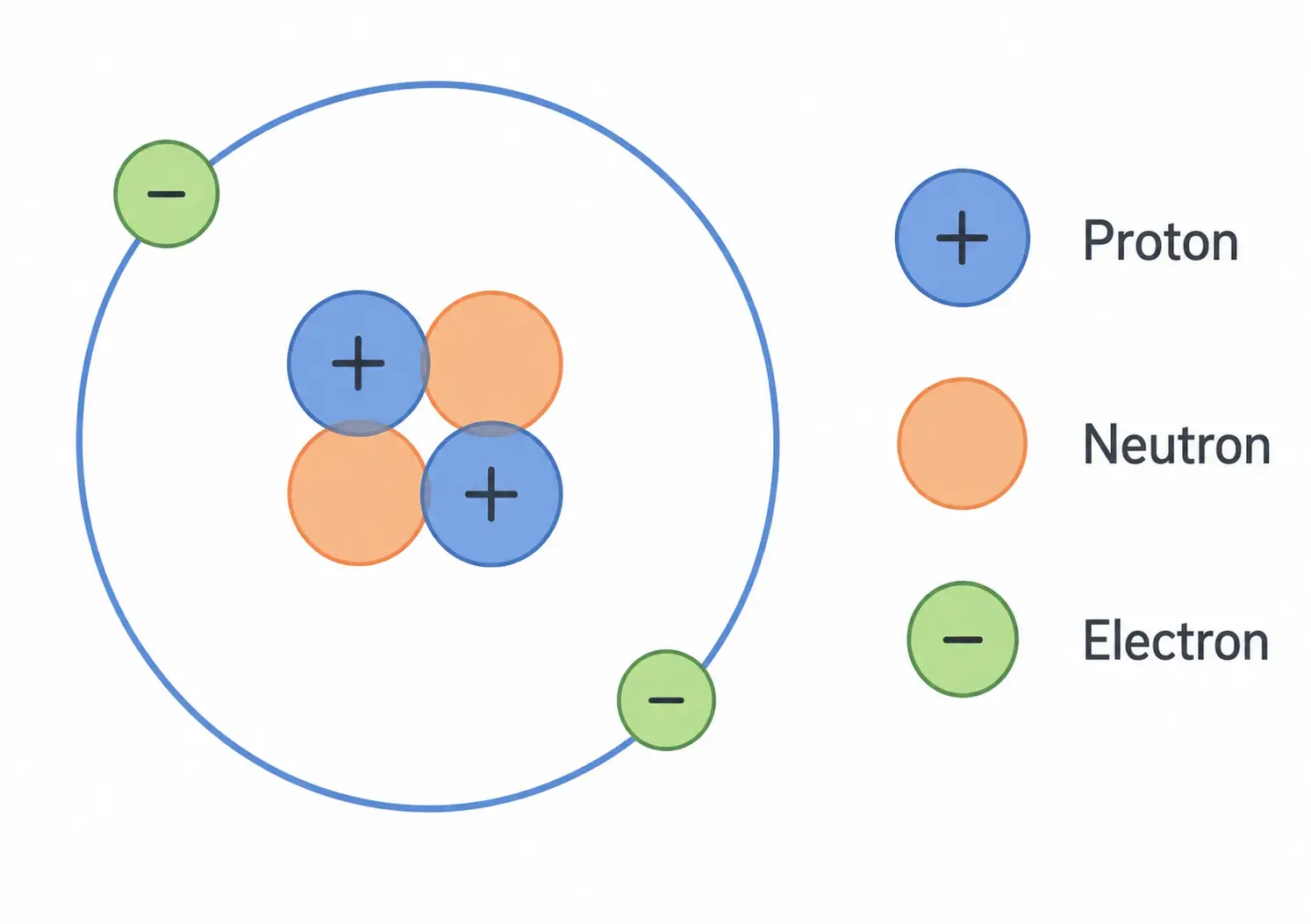
Atoms are extremely small particles and the building blocks of all matter. They are made up of a nucleus of protons and neutrons and are surrounded by a “cloud” of electrons.
More than of the mass of an atom is in the nucleus, as electrons are incredibly small compared to protons and neutrons.
Protons have a positive charge. Neutrons have a neutral charge. Electrons have a negative charge.
The opposing charges of the protons and electrons in an atom bind it together.
An atom’s atomic number is the number of protons in an atom.
For example, an oxygen atom has protons, so its atomic number is .
An atom’s mass number is the number of protons and neutrons combined.
For example, an oxygen atom with protons and neutrons has a mass number of .
Ions
If an atom has the same number of protons and electrons, the atom has a neutral charge. If an atom has an imbalance between protons and electrons, it has a charge and is called an ion.
If an atom has more protons than electrons, it has a positive charge. This is called a positive ion, or cation.
If an atom has more electrons than protons, it has a negative charge. This is called a negative ion, or anion.
Isotopes
Isotopes are atoms of the same element that have the same number of protons but a different number of neutrons.
Isotopes have the same chemical properties as one another, but different mass numbers and physical properties.
Isotopes are often named after their mass number (the number of protons and neutrons combined).
For example, a carbon- atom has protons and neutrons.
A carbon- atom has protons and neutrons.
And a carbon- atom has protons and neutrons.
Unstable Isotopes
If an isotope has too many or too few neutrons, the atom can become unstable and radioactive.
Unstable atoms will break down over time in an attempt to stabilize, releasing harmful particles in a process called radioactive decay.
For example, carbon- and carbon- are stable, but carbon- is radioactive because it has too many neutrons to maintain long-term stability.
States of Matter
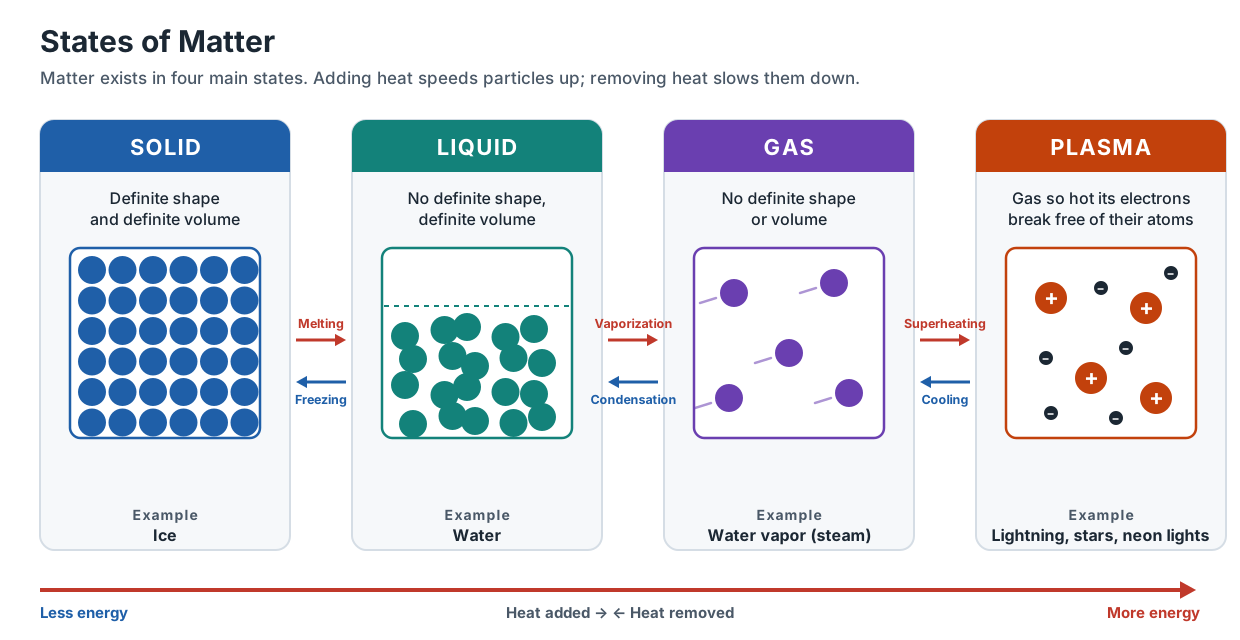
Matter exists in four main states: solid, liquid, gas, and plasma.
Solid Matter
Solids maintain a particular shape and volume unless acted on by an outside force. The molecules within a solid are closely packed and cannot freely move. They can only vibrate in place.
Solids can be melted to form liquids.
Liquid Matter
Liquids do not maintain a particular shape; instead, they conform to the shape of the container they are in. Liquids do, however, maintain a set volume. The molecules within a liquid are relatively closely packed but move freely over one another.
Liquids can be heated to make gases or cooled to make solids.
Gas Matter
Gases do not maintain a particular shape or volume and expand to completely fill the container they are in. The molecules within a gas are spread apart and rapidly moving.
Gases can be cooled to form liquids.
Plasma Matter
Plasma is formed when gas becomes superheated, separating electrons from neutrally charged atoms. This creates positive ions and negative, free-floating electrons. The majority of matter in the universe is plasma, and stars are mostly composed of it. Though plasma is less abundant on Earth, it is generated by lightning, neon lights, and sparks.
Temperature
Temperature measures how fast, on average, the particles in a substance are moving. Adding heat speeds the particles up, which is how a solid melts into a liquid and a liquid boils into a gas.
Temperature is measured in degrees Celsius (°C) or degrees Fahrenheit (°F). Science uses Celsius, where water freezes at and boils at . Everyday temperatures in the United States use Fahrenheit, where water freezes at and boils at .
To convert Celsius to Fahrenheit, multiply by , then add :
To convert Fahrenheit to Celsius, subtract , then multiply by :
For example, what is in Fahrenheit?
The Periodic Table
An element is a substance made up of atoms that all have the same number of protons. Examples of elements are hydrogen, potassium, and sodium.
For instance, hydrogen is an element with one proton. Sodium is an element with protons.
The Periodic Table is the organization of all known elements in the universe, including some that can only be synthesized. They are arranged by their number of protons and chemical properties.
Chemical Bonding
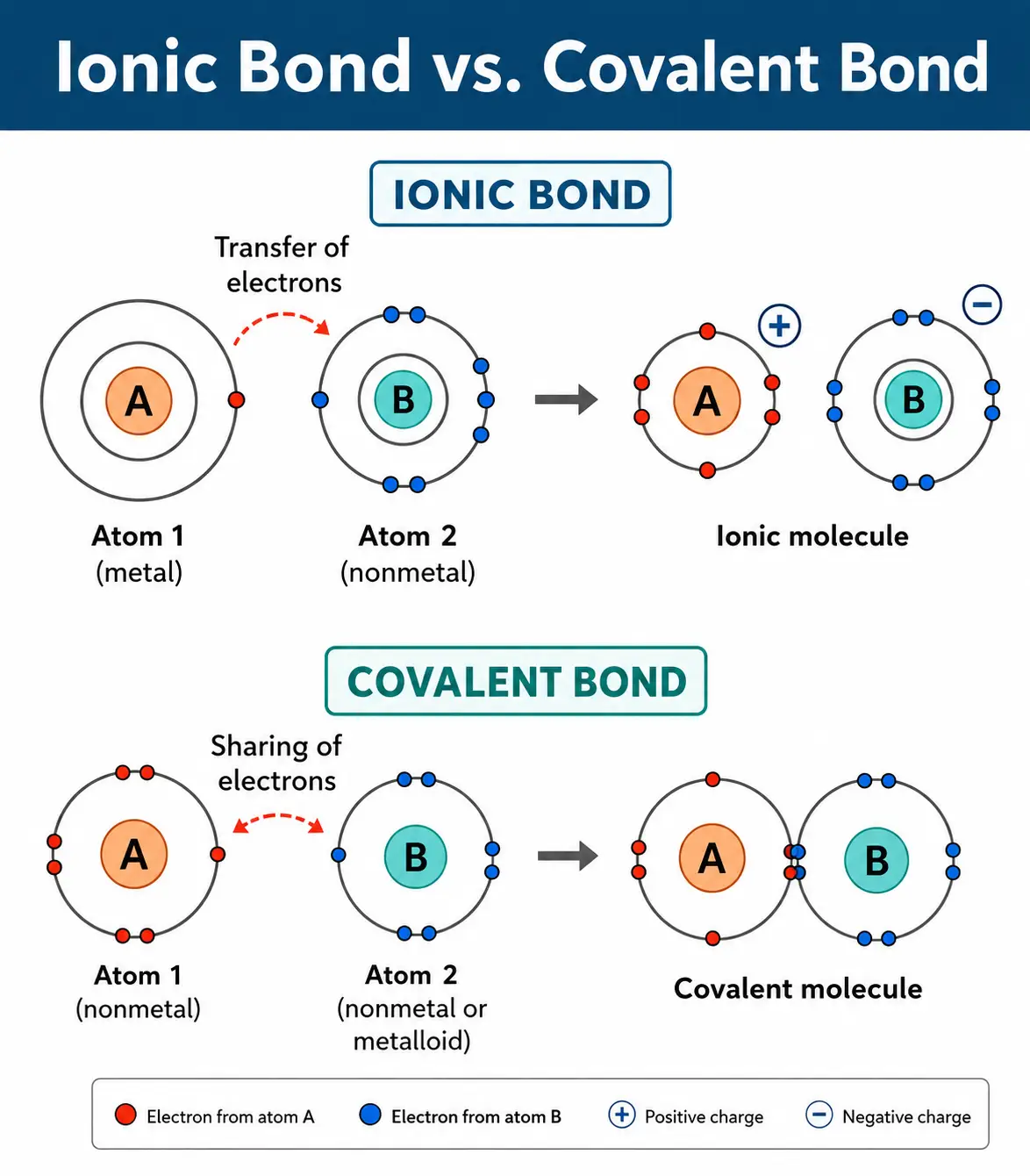
Because bonded atoms are often more stable than free atoms, they often spontaneously bond together. When atoms or ions combine, they form structures such as molecules or crystals.
Ionic Bonds
An ionic bond typically forms when an atom donates one or more electrons to another atom, resulting in positively charged cations and negatively charged anions. The attraction of their opposite charges helps hold the compound together. This typically happens between a nonmetal and a metal.
Covalent Bonds
Covalent bonds are formed when two atoms share one or more pairs of electrons. This typically happens between two nonmetals.
Chemical Reactions
A chemical reaction is when one or more substances convert into another substance. The initial substance(s) are called the reactants, and the result is called the product(s). Examples of chemical reactions include burning wood, baking a cake, or digesting food.
As an example, let’s look at the process of photosynthesis. Carbon dioxide and water undergo a chemical reaction to form glucose and oxygen.
Notice how the number of elements is balanced on each side. There are a total of carbon atoms, oxygen atoms, and hydrogen atoms on each side of the equation. This is because matter cannot be created or destroyed; it can only be transformed.
Solutions
A solution is a mixture of substances so blended together that the individual components cannot be observed separately. Air is an example of a solution, as it is mainly a mixture of nitrogen, oxygen, argon, and carbon dioxide. Saltwater or coffee are also examples of solutions.
The majority component in any solution is called the solvent, while the minority component(s) in the solution are called the solute.
The maximum amount of a substance that can be dissolved in a volume of solvent is called solubility.
Water is the most common solvent.
Acids and Bases
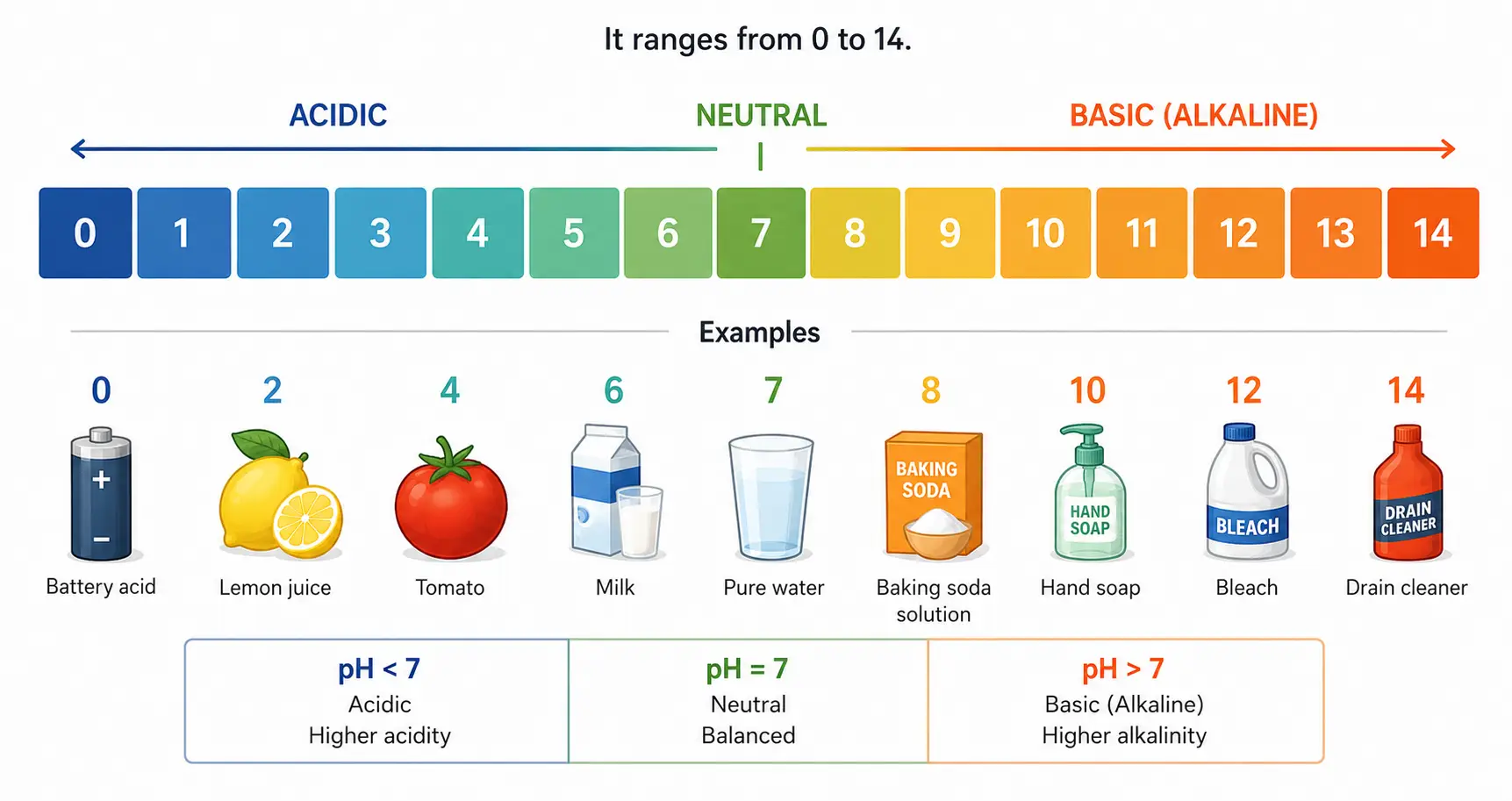
Acids and bases are substances that react in a particular way when dissolved. They are classified both by their position on the pH scale and by the ions they form.
Acids
Acids form hydrogen ions (H+) when dissolved in water. They have a pH less than .
Acids typically taste sour and can be corrosive, especially at lower pH levels. Examples of highly acidic substances include stomach acid and lemon juice.
Bases
Bases form hydroxide ions (OH-) when dissolved in water. They have a pH of more than .
Bases typically taste bitter and have a slippery feel. Like acids, bases can be corrosive, especially at higher pH levels. Examples of highly basic substances are soap and bleach.
A substance with a pH of is considered neutral. Water typically has a neutral pH.