



Finishing Tools
These tools refine a surface (mostly wood, and metal in the case of files) after the main work is done, smoothing or shaping materials for a clean final result.
Handheld finishers
Handheld finishers rely on manual effort and simple mechanical action to remove or refine material without a power source.
| Tool | Used for |
|---|---|
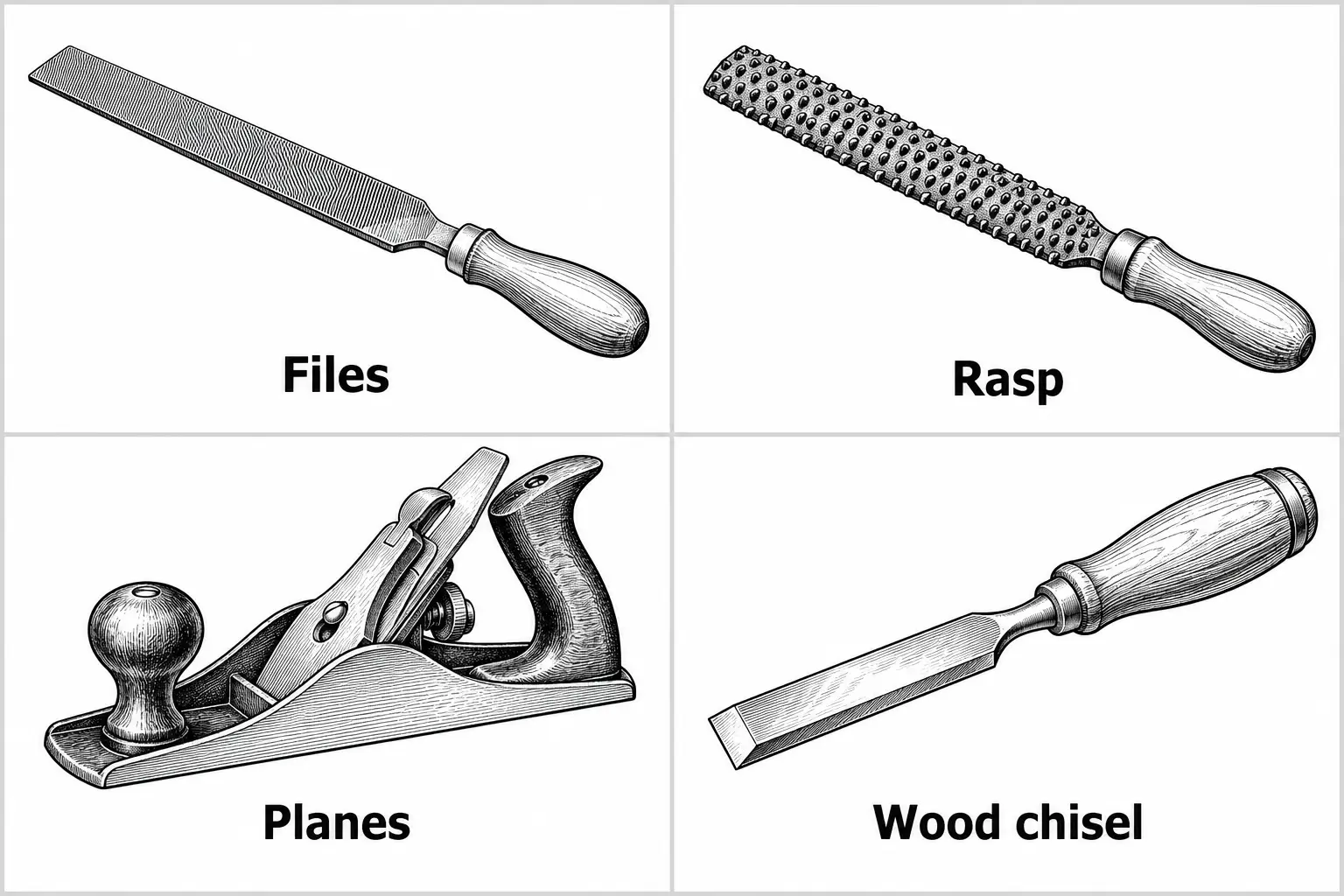
| Files | Removing small amounts of material at a time using fine rows of ridges; used mainly on metal, also on wood. |
| Rasp | Removing larger amounts of material, more aggressively than a file, using coarse, individually raised teeth that leave a rougher surface; used mainly on wood. |
| Planes | Shaving thin layers off wood to flatten, smooth, or size a board. |
| Wood chisel | Cutting and paring wood by hand, such as shaping joints and mortises; often driven with a mallet. |
Electric finishers
Electric finishers use a motor to speed up sanding and material removal compared to handheld tools.
| Tool | Used for |
|---|---|
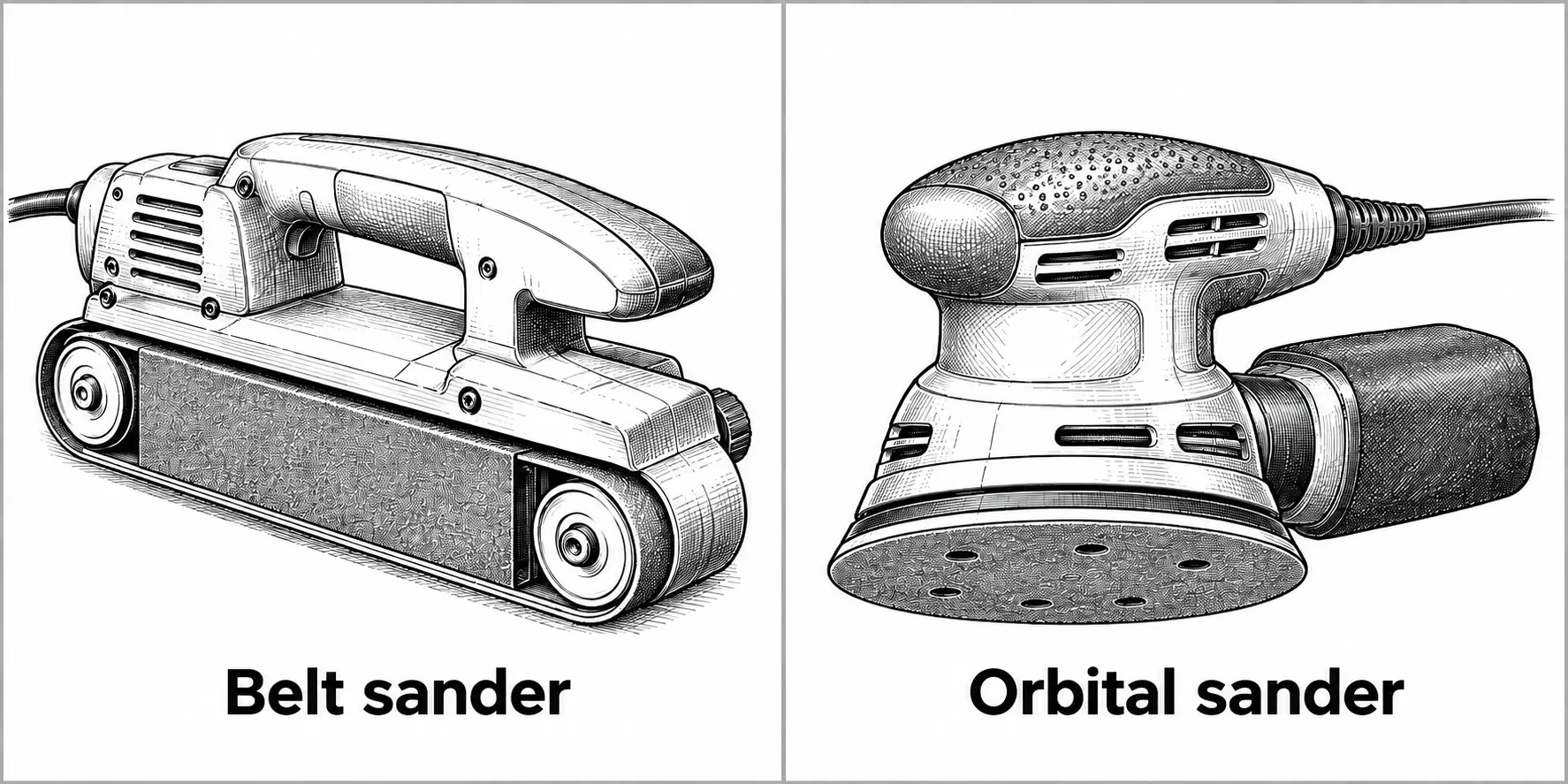
| Belt sander | Removing material quickly on large, flat surfaces. |
| Orbital sander | Smoothing the final surface of the product. |
All sandpaper, whichever tool holds it, is graded by grit number: lower numbers (e.g., 40-60) are coarse, while higher numbers (e.g., 150-220+) are fine. The usual sequence is coarse grit on a belt sander to remove material, then fine grit on an orbital sander for the final finish. On a belt sander, a tension lever holds the belt tight on its rollers, and a tracking knob keeps it running in the center.