


Achievable logoAchievable logo
ASVAB
Sign in
Sign up
Purchase
Textbook
Practice exams
Support
How it works
Exam catalog
Mountain with a flag at the peak
Textbook
Introduction
1. Word Knowledge
2. Math Knowledge
3. Paragraph Comprehension
4. Arithmetic Reasoning
5. Shop Information
5.1 Measuring Tools
5.2 Striking Tools
5.3 Turning Tools
5.4 Cutting Tools
5.5 Finishing Tools
5.6 Other Tools
6. Auto Information
Wrapping up
Achievable logoAchievable logo
5.3 Turning Tools
Achievable ASVAB
5. Shop Information
Our ASVAB course is currently in development and is a work-in-progress.

Turning Tools

12 min read
Font
Discuss
Share
Feedback

Wrench

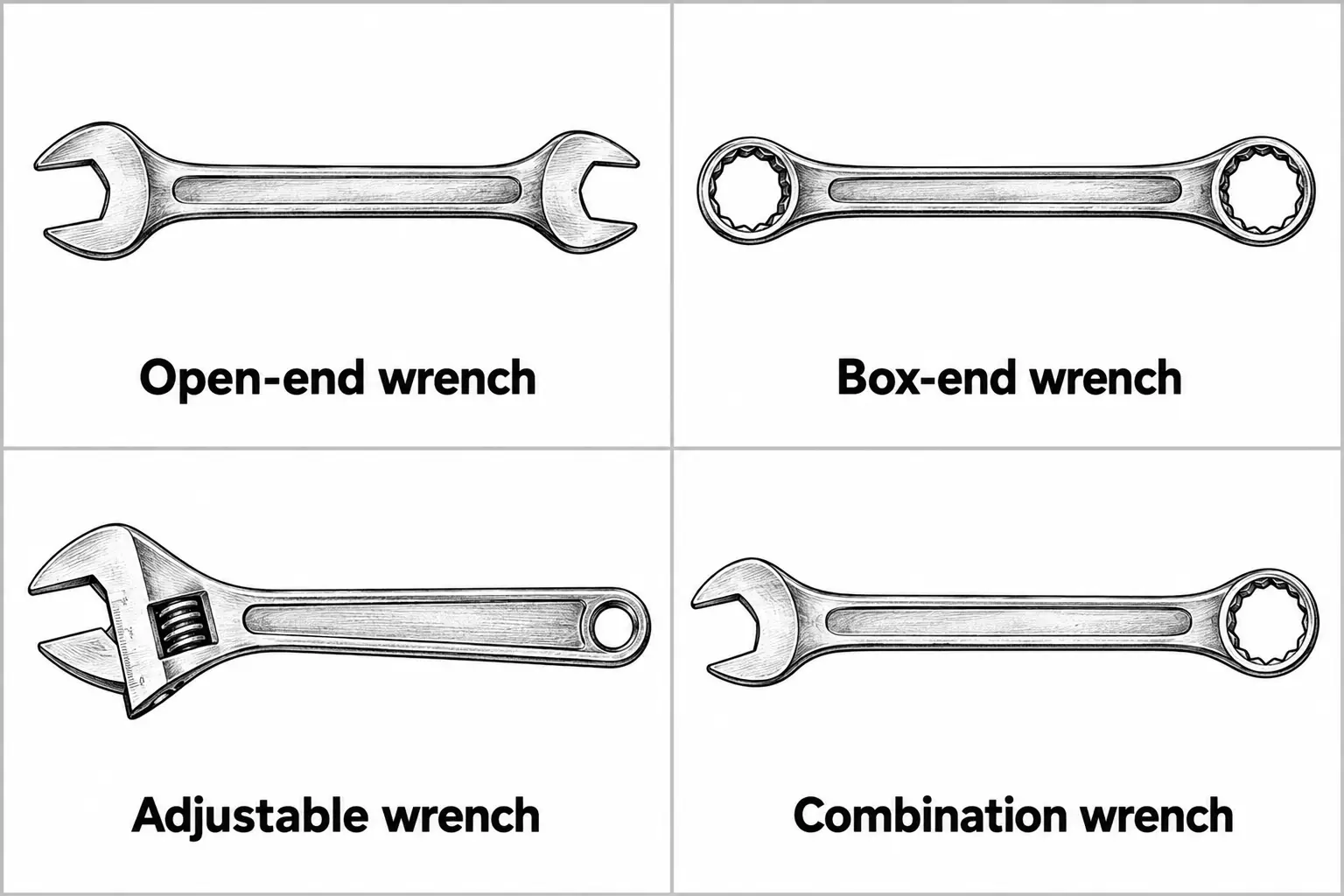
Wrenches grip onto fasteners on two or more sides to apply turning force. Different styles of wrench are specialized for specific kinds of grip, torque, and access.

Open-end wrench

Used for: Tightening and loosening bolts on plumbing fittings, drain pipes, and automotive components. It grips two sides of a fastener, making it ideal for tight spaces where a full rotation is not possible.

Open-end wrench with U-shaped fastener grip.
Open-end wrench

Box-end wrench

Used for: Machine assembly and applications where the entire bolt head is accessible. It fully surrounds the fastener, providing greater grip and torque.

Box-end wrench with enclosed fastener grip.
Box-end wrench

Adjustable wrench

Used for: General-purpose repairs and situations where multiple bolt sizes are encountered. It has an adjustable jaw that fits a variety of fastener sizes, reducing the number of tools needed.

Adjustable wrench with movable jaw.
Adjustable wrench

Combination wrench

Used for: Automotive repair, machinery maintenance, and general mechanical work. It has one open end and a box end, combining versatility with increased torque.

Combination wrench with open and box ends.
Combination wrench

Sockets

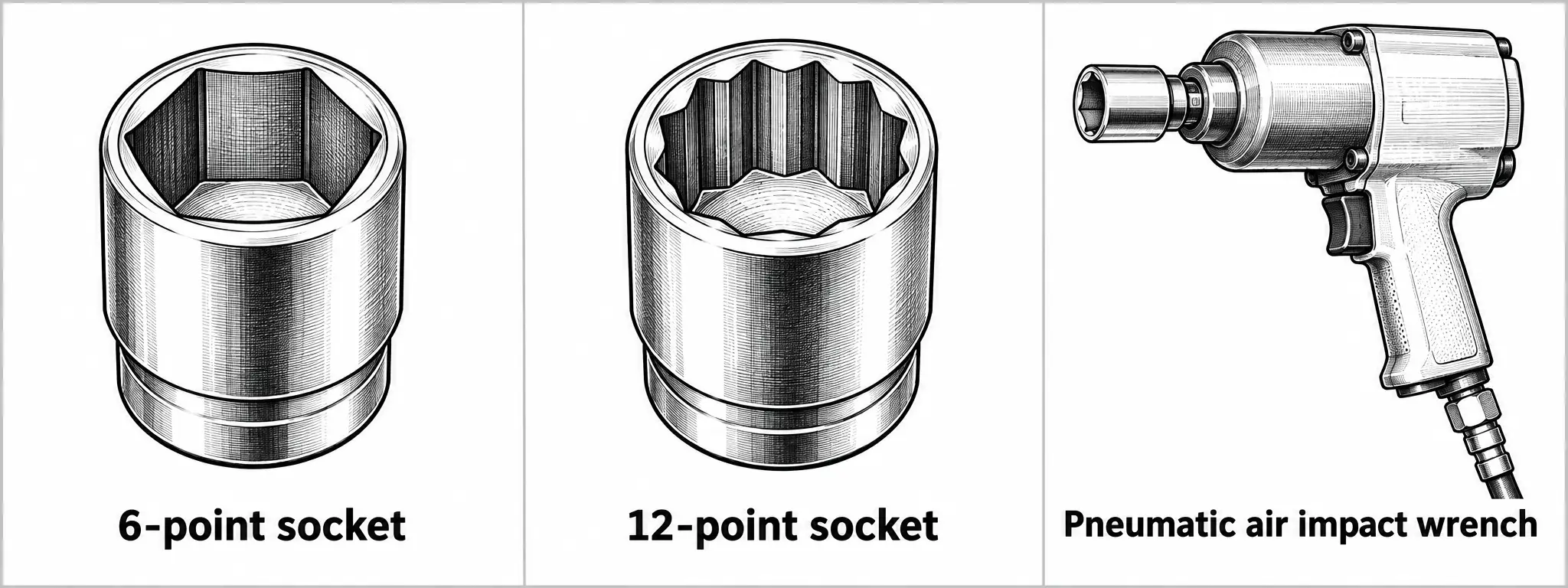
Sockets are used to tighten or loosen bolts on flat or recessed fasteners where a standard wrench cannot easily reach.

6-point socket

Used for: Tightening and loosening stubborn or high-torque bolts while reducing the chance of rounding the fastener. It is a six-sided socket that provides maximum contact with the fastener.

Six-point socket designed for maximum fastener contact.
6-point socket

12-point socket

Used for: Working in tight spaces and speeding up fastener installation or removal where frequent repositioning is needed. It is a twelve-sided socket that allows the tool to engage the fastener from more positions.

Twelve-point socket designed for multiple fastener positions.
12-point socket

Pneumatic air impact wrench

Used for: Removing and installing large bolts on heavy equipment, aircraft, ships, and industrial machinery. It is a power tool that uses compressed air to rapidly tighten or loosen fasteners with high torque.

Pneumatic impact wrench powered by compressed air.
Pneumatic air impact wrench

Screwdrivers

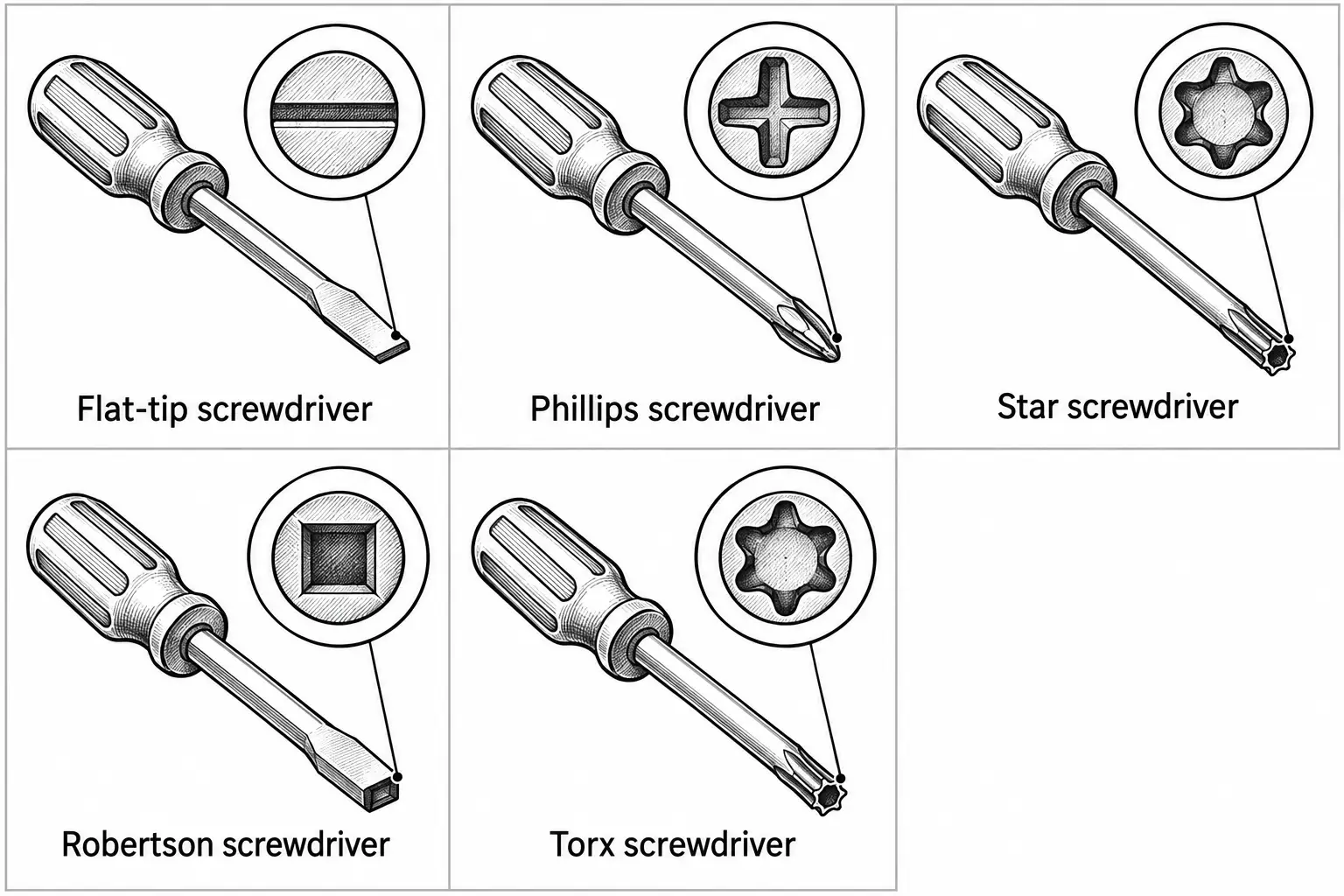
A tool that uses a twisting force to turn a screw. The more points of contact the screwdriver has, the less likely it will slip or strip the screw. You also get more torque with less force.

When a screwdriver slips out of the head of a screw, it is called cam-out.

Illustration showing screwdriver cam-out from a fastener.
Cam-out

Flat-tip screwdriver

Used for: Driving and removing standard flat-head screws in general-purpose applications. The flat blade is designed for slotted screw heads.

Flat-tip screwdriver with straight blade.
Flat-tip screwdriver

Phillips screwdriver

Used for: Driving and removing Phillips-head screws commonly found in electronics, appliances, and construction. The cross-shaped tip provides greater grip and torque than a flat-tip screwdriver.

Phillips screwdriver with cross-shaped tip.
Phillips screwdriver

Star screwdriver

Used for: Driving and removing star-shape screws while reducing the chance of slipping. The star-shaped tip provides increased contact with the screw head for improved torque.

Torx screwdriver with star-shaped tip.
Star screwdriver

Robertson screwdriver

Used for: Driving Robertson screws with reduced cam out and improved control. The square-tip resists slipping and holds screws securely during installation.

Robertson screwdriver with square-tip drive.
Robertson screwdriver

Torx screwdriver

Used for: Driving Torx screws where high torque and minimal cam out are required, such as in automotive and machinery applications. The inverted star-shaped tip provides maximum contact with the screw head.

Torx screwdriver with star-shaped tip.
Torx screwdriver

Nuts & bolts

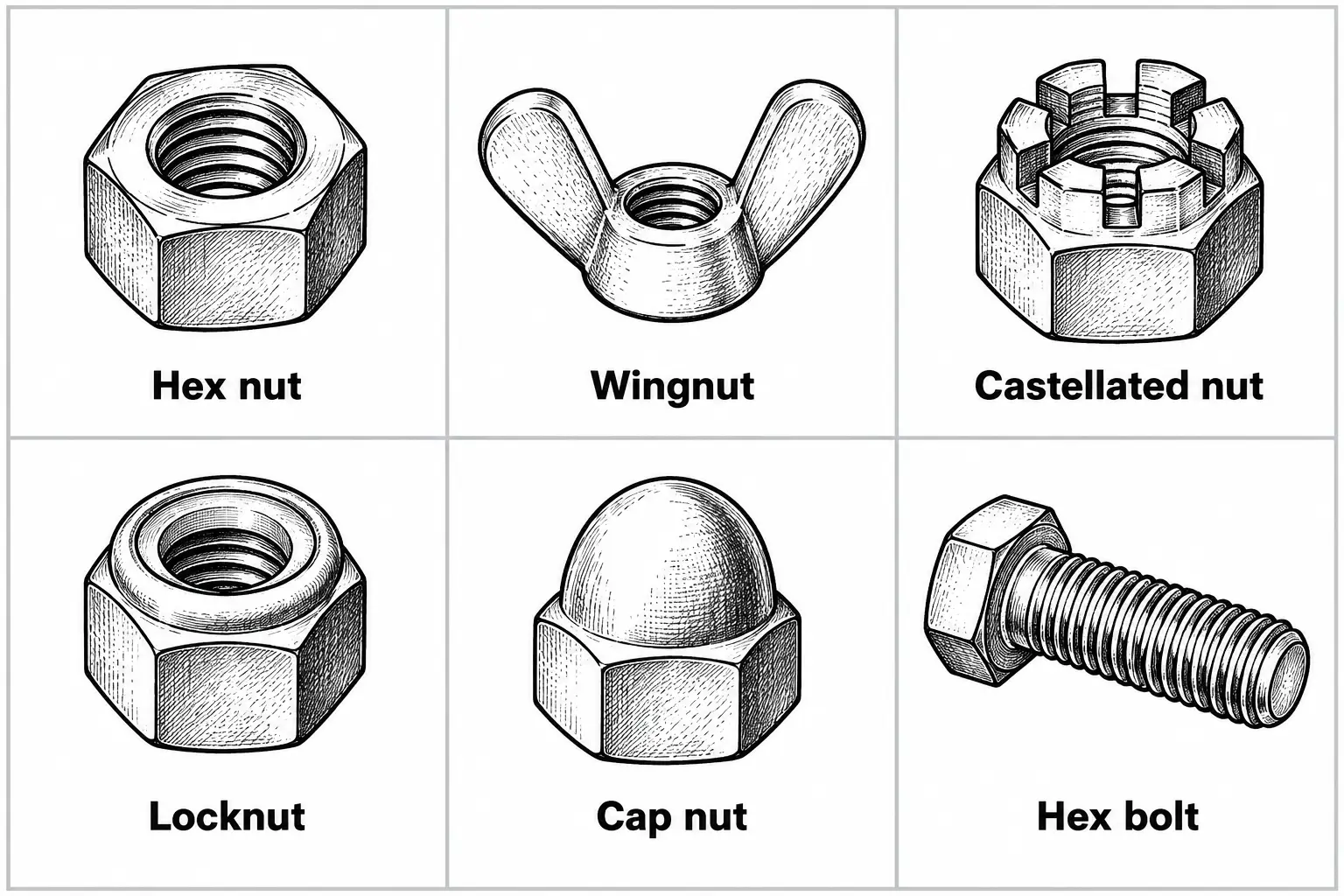
A nut secures a bolt in place. A bolt is externally threaded, while a nut is internally threaded. The dimensions must match so that they lock properly.

Hex nut

Used for: General fastening applications in construction, machinery, and everyday assembly. This is the standard six-sided nut used with threaded bolts and fasteners.

Hexagonal nut used with threaded fasteners.
Hex nut

Wingnut

Used for: Applications that require frequent adjustment or removal without applying excessive force. The two wing-like tabs can be tightened or loosened by hand without tools.

Wingnut with hand-tightened wings.
Wingnut

Castellated nut

Used for: Automotive suspensions, wheel hubs, steering components, and other safety-critical assemblies. The slotted design allows the nut to be secured with a cotter pin, preventing it from loosening under vibration.

Castellated nut with slots for a cotter pin.
Castellated nut

Locknut

Used for: Motors, machinery, and other equipment exposed to constant vibration. It’s nylon insert resists loosening caused by vibration.

Locknut designed to resist loosening from vibration.
Locknut

Cap nut

Used for: Protecting exposed bolt ends, improving appearance, and preventing accidental contact with sharp threads. The closed end covers the exposed threads of a bolt.

Cap nut with closed decorative end.
Cap nut

Bolt

Used for: Holding heavy materials together. They are similar to a screw, but are flat at the end instead of sharp. This is because they pass through pre-drilled holes instead of creating the holes themselves, as screws need to do.

Threaded bolt with a six-sided head.
Hex bolt
Previous
Next  | 5.4 Cutting Tools
All rights reserved ©2016 - 2026 Achievable, Inc.

Turning Tools

Wrench

Wrenches grip onto fasteners on two or more sides to apply turning force. Different styles of wrench are specialized for specific kinds of grip, torque, and access.

Open-end wrench

Used for: Tightening and loosening bolts on plumbing fittings, drain pipes, and automotive components. It grips two sides of a fastener, making it ideal for tight spaces where a full rotation is not possible.

Box-end wrench

Used for: Machine assembly and applications where the entire bolt head is accessible. It fully surrounds the fastener, providing greater grip and torque.

Adjustable wrench

Used for: General-purpose repairs and situations where multiple bolt sizes are encountered. It has an adjustable jaw that fits a variety of fastener sizes, reducing the number of tools needed.

Combination wrench

Used for: Automotive repair, machinery maintenance, and general mechanical work. It has one open end and a box end, combining versatility with increased torque.

Sockets

Sockets are used to tighten or loosen bolts on flat or recessed fasteners where a standard wrench cannot easily reach.

6-point socket

Used for: Tightening and loosening stubborn or high-torque bolts while reducing the chance of rounding the fastener. It is a six-sided socket that provides maximum contact with the fastener.

12-point socket

Used for: Working in tight spaces and speeding up fastener installation or removal where frequent repositioning is needed. It is a twelve-sided socket that allows the tool to engage the fastener from more positions.

Pneumatic air impact wrench

Used for: Removing and installing large bolts on heavy equipment, aircraft, ships, and industrial machinery. It is a power tool that uses compressed air to rapidly tighten or loosen fasteners with high torque.

Screwdrivers

A tool that uses a twisting force to turn a screw. The more points of contact the screwdriver has, the less likely it will slip or strip the screw. You also get more torque with less force.

When a screwdriver slips out of the head of a screw, it is called cam-out.

Flat-tip screwdriver

Used for: Driving and removing standard flat-head screws in general-purpose applications. The flat blade is designed for slotted screw heads.

Phillips screwdriver

Used for: Driving and removing Phillips-head screws commonly found in electronics, appliances, and construction. The cross-shaped tip provides greater grip and torque than a flat-tip screwdriver.

Star screwdriver

Used for: Driving and removing star-shape screws while reducing the chance of slipping. The star-shaped tip provides increased contact with the screw head for improved torque.

Robertson screwdriver

Used for: Driving Robertson screws with reduced cam out and improved control. The square-tip resists slipping and holds screws securely during installation.

Torx screwdriver

Used for: Driving Torx screws where high torque and minimal cam out are required, such as in automotive and machinery applications. The inverted star-shaped tip provides maximum contact with the screw head.

Nuts & bolts

A nut secures a bolt in place. A bolt is externally threaded, while a nut is internally threaded. The dimensions must match so that they lock properly.

Hex nut

Used for: General fastening applications in construction, machinery, and everyday assembly. This is the standard six-sided nut used with threaded bolts and fasteners.

Wingnut

Used for: Applications that require frequent adjustment or removal without applying excessive force. The two wing-like tabs can be tightened or loosened by hand without tools.

Castellated nut

Used for: Automotive suspensions, wheel hubs, steering components, and other safety-critical assemblies. The slotted design allows the nut to be secured with a cotter pin, preventing it from loosening under vibration.

Locknut

Used for: Motors, machinery, and other equipment exposed to constant vibration. It’s nylon insert resists loosening caused by vibration.

Cap nut

Used for: Protecting exposed bolt ends, improving appearance, and preventing accidental contact with sharp threads. The closed end covers the exposed threads of a bolt.

Bolt

Used for: Holding heavy materials together. They are similar to a screw, but are flat at the end instead of sharp. This is because they pass through pre-drilled holes instead of creating the holes themselves, as screws need to do.

More from Shop Information

  • Measuring Tools
  • Striking Tools
  • Cutting Tools
  • Finishing Tools
  • Other Tools