


Achievable logoAchievable logo
AP Macroeconomics
Sign in
Sign up
Purchase
Textbook
Practice exams
Support
How it works
Exam catalog
Mountain with a flag at the peak
Textbook
Example
1. Core economic concepts
2. Measurement of economic performance
3. Modeling of income and prices
4. Financial sector
4.1 Closed economy loanable funds market
4.2 Macroeconomic finance
4.3 Financial assets and markets
4.4 Introduction to money
4.5 Simple money market
4.6 Banking and money supply expansion
4.7 Monetary policy
4.8 Reserves market
4.9 Implementation of monetary policy
5. Long-run consequences of stabilization policy
6. Open economy
Achievable logoAchievable logo
4.7 Monetary policy
Achievable AP Macroeconomics
4. Financial sector
Our AP Macroeconomics course is currently in development and is a work-in-progress.

Monetary policy

10 min read
Font
Discuss
Share
Feedback

In this subchapter we will outline more specifically what monetary policy is, what a central bank is and their role in designing and implementing monetary policy, as well as the tools available to implement monetary policy today. Details of how these tools interact with markets and how exactly they impact the money supply will be discussed in the following subchapters.

Monetary policy

Definitions
Monetary policy
Any action taken by a monetary authority to manage the money supply in order to achieve economic goals.
Central bank
A public institution that manages the money supply of a country or group of countries. For most countries around the world a central bank is the primary monetary authority. They issue currency, regulate financial systems, and often act as a bank to government entities, banks and other large financial institutions.

Central banks often have a primary goal of price stability, and in some countries full employment is either a statutory requirement or a secondary goal. Other goals pursued by central banks include inflation targeting, exchange rate stability, support for economic growth, and stability of domestic financial markets. Many combinations of such goals are contradictory, requiring careful consideration of how they should be balanced.

Due to serving as a bank for other banks, a key function of most central banks is to act as the “lender of last resort” and to provide liquidity to financial institutions in cases when they are unable to obtain it through normal channels such as the interbank lending market / market for reserves or the selling of securities at market prices.

The first central bank, the Sveriges Riksbank, was established in 1668 in Sweden and it is wholly owned by the government. This type of ownership is often the case, but central banks are commonly managed independently, with the freedom to conduct policy outside of direct political influence. The level of central bank independence will be an important consideration when we consider the long run consequences of monetary policy and the impact of monetary policy on exchange rates.

The Federal Reserve System

In the United States the central bank is the Federal Reserve System (often shortened as “the Fed”), which was established by The Federal Reserve Act in 1913. The structure of the Fed is unique among central banks in the world. Legally it is quasi-governmental, organized as a set of independent but interlinked entities. The Fed does not receive federal funding, its operations are financed by interest earned on securities and fees for services provided to the banking system to facilitate transfers. After payment of expenses and maintenance of a reserve fund, any net earnings are transferred to the general fund of the U.S. Treasury,

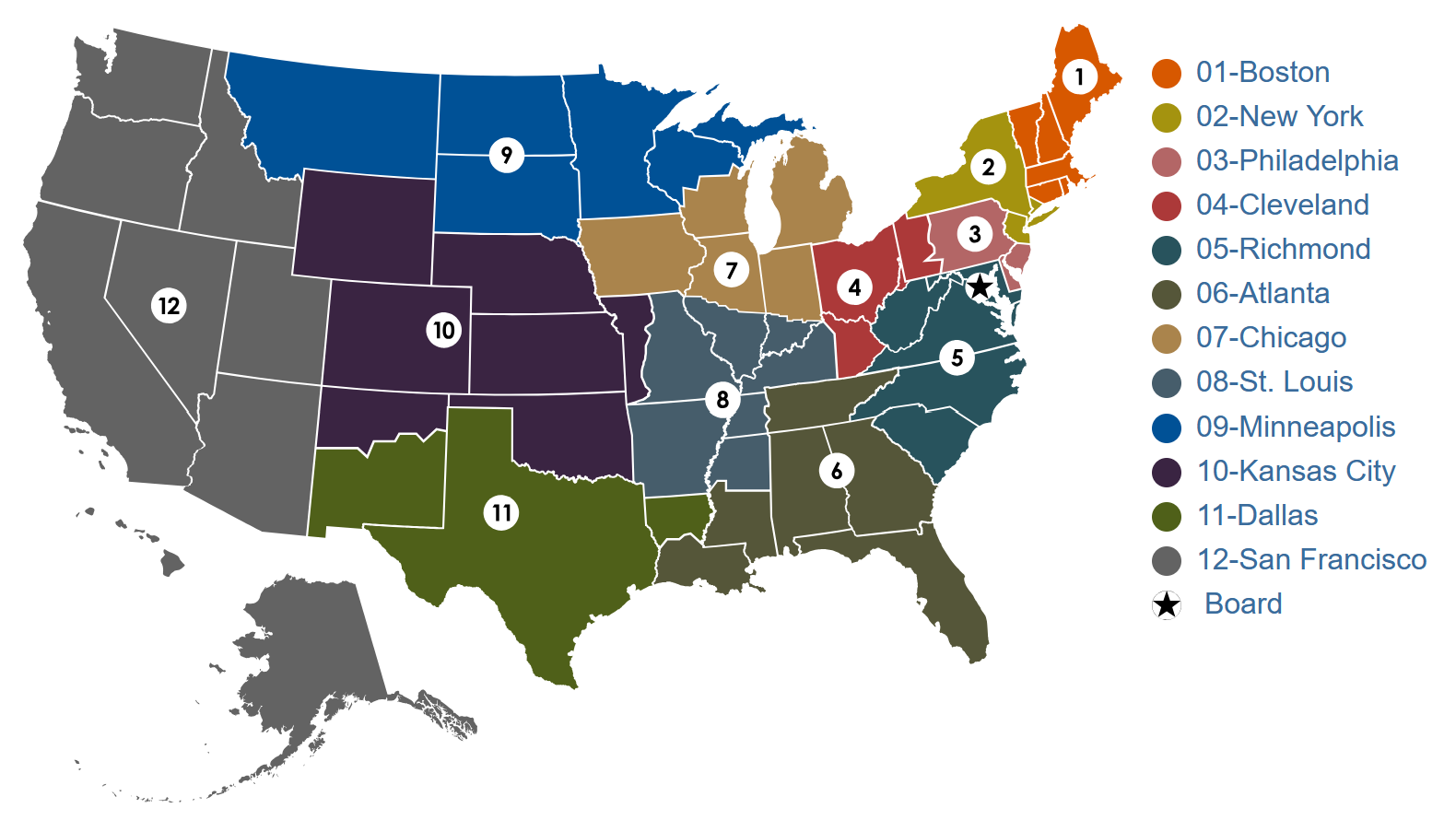
There are three main entities of the Federal Reserve System: 12 regional Reserve Banks, the Board of Governors, and the Federal Open Market Committee (FOMC).

United States map with 12 Federal Reserve Districts
Federal Reserve Districts
Board of Governors of the Federal Reserve System
/
Public domain

The 12 Reserve Banks are the core of most functions of the Federal Reserve. Each Reserve Bank is separately incorporated with its own board of directors and a board President who acts as the chief executive officer. The member banks in each district are shareholders of their Reserve Bank, holding stock that cannot be sold or traded but does grant the power to elect a portion of the board. Unlike private corporations, however, Reserve Banks are operated in the public interest and not in the interest of shareholders.

The operations of each Federal Reserve Bank include supervision of member banks and financial institutions, lending to depository institutions, ensuring financial institutions are compliant with federal consumer protection and fair lending laws, providing financial services to support payment systems such as operation of automated clearinghouse (ACH) transfers and clearing checks, and serving as a bank for the U.S. Treasury.

The Board of Governors is the part of the Fed that is a federal government agency. It has 7 members, who are appointed by the president and approved by the U.S. Senate to 14 year non-renewable terms. One expires every two years, in an effort to maintain independence from political considerations. They report to the U.S. House of Representatives, with primary responsibilities of guiding the operation of the Federal Reserve System and overseeing the 12 Federal Reserve Banks. The Chair of the Board of Governors is the acting executive officer and presides over the Board meetings.

Each member of the Board of Governors is also on the Federal Open Market Committee (FOMC), the chief group that conducts monetary policy. The full board has 12 voting members, adding the President of the Federal Reserve Bank of New York, and 4 other Federal Reserve Bank presidents serving one-year terms in rotation. They meet at a minimum every six weeks, although additional meetings may be called if emergencies arise.

Goals and responsibilities

The Federal Reserve System separates their responsibilities into 5 key functions:

  1. Conducting monetary policy
  2. Promoting stability of the financial system
  3. Supervising and regulating financial institutions
  4. Fostering payment and settlement system safety and efficiency
  5. Promoting consumer protection and community development

The Federal Reserve Act of 1977 outlines the goals of the Fed as pursuing “maximum employment, stable prices, and moderate long-term interest rates.” The last two are in most cases essentially one goal, since stable prices lead to stable inflation expectations. The goals of the Fed are generally described as a dual mandate of maximum employment and price stability.

Since 1996 the Fed has had an inflation target of 2%, although in 2020 this was modified to be a target for average inflation. This signals an increased tolerance of higher inflation, allowing the Fed to be less strict in pursuing price stability. Any use of a specific explicit inflation goal may be referred to as inflation targeting.

As an important side note, the Fed does not use the CPI to measure inflation. They use the Personal Consumption Expenditures (PCE) price index instead. This uses uses the methodology of the GDP deflator, but only for the consumption © portion of GDP. The fundamental difference is that PCE focuses on all recorded spending regardless of where it is produced, while the CPI tracks the prices paid by urban consumers for a basket of goods and services.

Monetary policy tools

The primary interest rate target for monetary policy is the federal funds rate (FFR). This is the rate at which banks lend to each other in the overnight market for reserves and is sometimes referred to as the policy rate. Since 2009 the Fed sets a 0.25% target range for the FFR.

To achieve that target, the Fed may adjust specific interest rates or use open market operations. This is the purchase or sale of short term US government bonds, T-bills. The specifics of how this works will be covered in the next subchapter.

Other tools

Some secondary Fed actions are interest rates for special markets or types of transactions used by banks and financial institutions. Each of these is directly set by the Fed.

The longest standing of these is the discount rate, the interest rate for borrowing from the Fed at the discount window. Such borrowing represents the Fed acting as the lender of last resort.

There is also the Interest Rate on Reserve Balances (IORB). Since 2021 this has been a single rate for all bank reserves held at the Fed. Interest payments on excess reserves have only existed since 2008.

The other non-rate tools are reserve requirements, forward guidance and quantitative easing. We have already discussed reserve requirements in reviewing the money supply creation process. Higher reserve requirements reduce the money multiplier and all else equal will lower the available supply of money. Conversely, lower requirements increase the money multiplier and all else equal will increase the money supply. Since March of 2020 reserve requirements have been 0% for all banks in the US.

Forward guidance refers to the setting of public expectations for future actions by the Fed. This primarily consisted of specific statements in press releases and press conferences following FOMC meetings, in attempts to influence markets towards desired actions. This started to be more consistently used during the Great Recession, but has mostly be discontinued as of June 2026.

Quantitative easing was first used in the U.S. to provide additional stimulus beyond what existing tools could provide during the Great Recession (2007-2009). Broadly speaking QE is when a central bank purchases any assets outside of the scope of their standard monetary policy tools, for the Fed this is any asset other than T-bills. It can be viewed as a special version of open market operations.

Monetary transmission mechanism

As a reminder, expansionary policies are actions designed to increase economic activity and as a consequence usually lower employment. Contractionary policies, are intended to lower economic activity and will usually increase unemployment.

Tool Expansionary action Contractionary action
Federal funds rate (FFR) ↓ ↑
Open market operations (OMO) Purchase Sale
Interest rate on reserve balances (IORB) ↓ ↑
Quantitative easing (QE) Expansion Tightening
Discount rate ↓ ↑
Reserve ratio ↓ ↑

Increases in the money supply are expansionary in the short run. Cuts or reductions of any interest rate mentioned are expansionary as well, because they encourage increases in the money supply. Conversely, any rise or increase in an interest rate is contractionary, and encourages reductions in the money supply.

To understand exactly why, next we will review the monetary transmission mechanism. The policy rate is not directly the rate for loans. Understanding how changes in the policy rate turn into changes in economic activity is a key topic.

Expansionary transmission

  • Expansionary actions increase excess reserves or reduce the opportunity cost of lending. Banks are more willing to make loans.
  • An increased willingness to lend leads to lower rates for businesses and consumers.
  • Consumer spending (C) and investment (I) increase. This increases demand for goods and services (Y).
  • Businesses increase hiring and spending on other inputs.
  • This lowers unemployment and moves the economy towards the natural rate of unemployment (real GDP equal to potential GDP).

Contractionary transmission

  • Contractionary actions lower excess reserves or increase interest rates faced by banks. This increases the opportunity cost of borrowing, so banks raise interest rates offered to consumers and businesses and make fewer loans.
  • Consumer spending (C) and investment (I) decrease. This decreases demand for goods and services (Y).
  • The fall in demand makes businesses hire less or fire some employees and spend less on other inputs.
  • Reductions in spending reduce inflation dropping it back towards the 2 percent target. Unemployment would also likely rise.

Monetary policy and the AD curve

From the description of the transmission mechanism, we can see that monetary policy impacts the AD curve.

With expansionary policy, usually the goal is to reduce unemployment at the cost of inflation.

With contractionary policy the focus is reducing inflation, at the cost of higher unemployment.

Monetary policy

  • Actions by monetary authority to manage money supply for economic goals
  • Central banks: public institutions managing money supply, issuing currency, regulating financial systems
  • Key central bank functions: price stability, full employment, inflation targeting, exchange rate stability, lender of last resort

The Federal Reserve System

  • U.S. central bank, established 1913, quasi-governmental structure
  • Three main entities:
    • 12 regional Reserve Banks (core operations, supervision, payments)
    • Board of Governors (7 members, 14-year terms, federal agency)
    • Federal Open Market Committee (FOMC, 12 voting members, conducts monetary policy)
  • Fed finances operations via interest/fees, not federal funding; net earnings go to U.S. Treasury

Goals and responsibilities

  • Five key functions:
    • Conduct monetary policy
    • Promote financial system stability
    • Supervise/regulate financial institutions
    • Foster payment/settlement system safety and efficiency
    • Promote consumer protection/community development
  • Dual mandate: maximum employment and price stability
  • Explicit average inflation target: 2% (Core PCE inflation, not CPI)

Monetary policy tools

  • Main policy rate: Federal Funds Rate (FFR), target range set by Fed
  • Key tools:
    • Open market operations (buy/sell T-bills)
    • Reserve requirements (affect money multiplier; 0% since March 2020)
    • Forward guidance (public communication of policy outlook)
    • Quantitative easing (QE): purchase of assets beyond T-bills
    • Discount rate: interest for borrowing from Fed (lender of last resort)
    • Interest Rate on Reserve Balances (IORB): paid on reserves at Fed
    • Overnight Reverse Repurchase Agreements (ON RRP): overnight loans with T-bills as collateral

Monetary transmission mechanism

  • Lowering interest rates or reserve ratio: expansionary, increases money supply
    • Reduces banks’ opportunity cost of lending, increases loans, boosts consumer/investment spending, lowers unemployment, raises inflation
  • Raising interest rates or reserve ratio: contractionary, decreases money supply
    • Increases borrowing costs, reduces spending/investment, lowers demand, increases unemployment, reduces inflation
  • Tradeoff: expansionary policy lowers unemployment but may raise inflation; contractionary policy reduces inflation but may raise unemployment
Previous
Next  | 4.8 Reserves market
All rights reserved ©2016 - 2026 Achievable, Inc.

Monetary policy

In this subchapter we will outline more specifically what monetary policy is, what a central bank is and their role in designing and implementing monetary policy, as well as the tools available to implement monetary policy today. Details of how these tools interact with markets and how exactly they impact the money supply will be discussed in the following subchapters.

Monetary policy

Definitions
Monetary policy
Any action taken by a monetary authority to manage the money supply in order to achieve economic goals.
Central bank
A public institution that manages the money supply of a country or group of countries. For most countries around the world a central bank is the primary monetary authority. They issue currency, regulate financial systems, and often act as a bank to government entities, banks and other large financial institutions.

Central banks often have a primary goal of price stability, and in some countries full employment is either a statutory requirement or a secondary goal. Other goals pursued by central banks include inflation targeting, exchange rate stability, support for economic growth, and stability of domestic financial markets. Many combinations of such goals are contradictory, requiring careful consideration of how they should be balanced.

Due to serving as a bank for other banks, a key function of most central banks is to act as the “lender of last resort” and to provide liquidity to financial institutions in cases when they are unable to obtain it through normal channels such as the interbank lending market / market for reserves or the selling of securities at market prices.

The first central bank, the Sveriges Riksbank, was established in 1668 in Sweden and it is wholly owned by the government. This type of ownership is often the case, but central banks are commonly managed independently, with the freedom to conduct policy outside of direct political influence. The level of central bank independence will be an important consideration when we consider the long run consequences of monetary policy and the impact of monetary policy on exchange rates.

The Federal Reserve System

In the United States the central bank is the Federal Reserve System (often shortened as “the Fed”), which was established by The Federal Reserve Act in 1913. The structure of the Fed is unique among central banks in the world. Legally it is quasi-governmental, organized as a set of independent but interlinked entities. The Fed does not receive federal funding, its operations are financed by interest earned on securities and fees for services provided to the banking system to facilitate transfers. After payment of expenses and maintenance of a reserve fund, any net earnings are transferred to the general fund of the U.S. Treasury,

There are three main entities of the Federal Reserve System: 12 regional Reserve Banks, the Board of Governors, and the Federal Open Market Committee (FOMC).

The 12 Reserve Banks are the core of most functions of the Federal Reserve. Each Reserve Bank is separately incorporated with its own board of directors and a board President who acts as the chief executive officer. The member banks in each district are shareholders of their Reserve Bank, holding stock that cannot be sold or traded but does grant the power to elect a portion of the board. Unlike private corporations, however, Reserve Banks are operated in the public interest and not in the interest of shareholders.

The operations of each Federal Reserve Bank include supervision of member banks and financial institutions, lending to depository institutions, ensuring financial institutions are compliant with federal consumer protection and fair lending laws, providing financial services to support payment systems such as operation of automated clearinghouse (ACH) transfers and clearing checks, and serving as a bank for the U.S. Treasury.

The Board of Governors is the part of the Fed that is a federal government agency. It has 7 members, who are appointed by the president and approved by the U.S. Senate to 14 year non-renewable terms. One expires every two years, in an effort to maintain independence from political considerations. They report to the U.S. House of Representatives, with primary responsibilities of guiding the operation of the Federal Reserve System and overseeing the 12 Federal Reserve Banks. The Chair of the Board of Governors is the acting executive officer and presides over the Board meetings.

Each member of the Board of Governors is also on the Federal Open Market Committee (FOMC), the chief group that conducts monetary policy. The full board has 12 voting members, adding the President of the Federal Reserve Bank of New York, and 4 other Federal Reserve Bank presidents serving one-year terms in rotation. They meet at a minimum every six weeks, although additional meetings may be called if emergencies arise.

Goals and responsibilities

The Federal Reserve System separates their responsibilities into 5 key functions:

  1. Conducting monetary policy
  2. Promoting stability of the financial system
  3. Supervising and regulating financial institutions
  4. Fostering payment and settlement system safety and efficiency
  5. Promoting consumer protection and community development

The Federal Reserve Act of 1977 outlines the goals of the Fed as pursuing “maximum employment, stable prices, and moderate long-term interest rates.” The last two are in most cases essentially one goal, since stable prices lead to stable inflation expectations. The goals of the Fed are generally described as a dual mandate of maximum employment and price stability.

Since 1996 the Fed has had an inflation target of 2%, although in 2020 this was modified to be a target for average inflation. This signals an increased tolerance of higher inflation, allowing the Fed to be less strict in pursuing price stability. Any use of a specific explicit inflation goal may be referred to as inflation targeting.

As an important side note, the Fed does not use the CPI to measure inflation. They use the Personal Consumption Expenditures (PCE) price index instead. This uses uses the methodology of the GDP deflator, but only for the consumption © portion of GDP. The fundamental difference is that PCE focuses on all recorded spending regardless of where it is produced, while the CPI tracks the prices paid by urban consumers for a basket of goods and services.

Monetary policy tools

The primary interest rate target for monetary policy is the federal funds rate (FFR). This is the rate at which banks lend to each other in the overnight market for reserves and is sometimes referred to as the policy rate. Since 2009 the Fed sets a 0.25% target range for the FFR.

To achieve that target, the Fed may adjust specific interest rates or use open market operations. This is the purchase or sale of short term US government bonds, T-bills. The specifics of how this works will be covered in the next subchapter.

Other tools

Some secondary Fed actions are interest rates for special markets or types of transactions used by banks and financial institutions. Each of these is directly set by the Fed.

The longest standing of these is the discount rate, the interest rate for borrowing from the Fed at the discount window. Such borrowing represents the Fed acting as the lender of last resort.

There is also the Interest Rate on Reserve Balances (IORB). Since 2021 this has been a single rate for all bank reserves held at the Fed. Interest payments on excess reserves have only existed since 2008.

The other non-rate tools are reserve requirements, forward guidance and quantitative easing. We have already discussed reserve requirements in reviewing the money supply creation process. Higher reserve requirements reduce the money multiplier and all else equal will lower the available supply of money. Conversely, lower requirements increase the money multiplier and all else equal will increase the money supply. Since March of 2020 reserve requirements have been 0% for all banks in the US.

Forward guidance refers to the setting of public expectations for future actions by the Fed. This primarily consisted of specific statements in press releases and press conferences following FOMC meetings, in attempts to influence markets towards desired actions. This started to be more consistently used during the Great Recession, but has mostly be discontinued as of June 2026.

Quantitative easing was first used in the U.S. to provide additional stimulus beyond what existing tools could provide during the Great Recession (2007-2009). Broadly speaking QE is when a central bank purchases any assets outside of the scope of their standard monetary policy tools, for the Fed this is any asset other than T-bills. It can be viewed as a special version of open market operations.

Monetary transmission mechanism

As a reminder, expansionary policies are actions designed to increase economic activity and as a consequence usually lower employment. Contractionary policies, are intended to lower economic activity and will usually increase unemployment.

Tool Expansionary action Contractionary action
Federal funds rate (FFR) ↓ ↑
Open market operations (OMO) Purchase Sale
Interest rate on reserve balances (IORB) ↓ ↑
Quantitative easing (QE) Expansion Tightening
Discount rate ↓ ↑
Reserve ratio ↓ ↑

Increases in the money supply are expansionary in the short run. Cuts or reductions of any interest rate mentioned are expansionary as well, because they encourage increases in the money supply. Conversely, any rise or increase in an interest rate is contractionary, and encourages reductions in the money supply.

To understand exactly why, next we will review the monetary transmission mechanism. The policy rate is not directly the rate for loans. Understanding how changes in the policy rate turn into changes in economic activity is a key topic.

Expansionary transmission

  • Expansionary actions increase excess reserves or reduce the opportunity cost of lending. Banks are more willing to make loans.
  • An increased willingness to lend leads to lower rates for businesses and consumers.
  • Consumer spending (C) and investment (I) increase. This increases demand for goods and services (Y).
  • Businesses increase hiring and spending on other inputs.
  • This lowers unemployment and moves the economy towards the natural rate of unemployment (real GDP equal to potential GDP).

Contractionary transmission

  • Contractionary actions lower excess reserves or increase interest rates faced by banks. This increases the opportunity cost of borrowing, so banks raise interest rates offered to consumers and businesses and make fewer loans.
  • Consumer spending (C) and investment (I) decrease. This decreases demand for goods and services (Y).
  • The fall in demand makes businesses hire less or fire some employees and spend less on other inputs.
  • Reductions in spending reduce inflation dropping it back towards the 2 percent target. Unemployment would also likely rise.

Monetary policy and the AD curve

From the description of the transmission mechanism, we can see that monetary policy impacts the AD curve.

With expansionary policy, usually the goal is to reduce unemployment at the cost of inflation.

With contractionary policy the focus is reducing inflation, at the cost of higher unemployment.

Key points

Monetary policy

  • Actions by monetary authority to manage money supply for economic goals
  • Central banks: public institutions managing money supply, issuing currency, regulating financial systems
  • Key central bank functions: price stability, full employment, inflation targeting, exchange rate stability, lender of last resort

The Federal Reserve System

  • U.S. central bank, established 1913, quasi-governmental structure
  • Three main entities:
    • 12 regional Reserve Banks (core operations, supervision, payments)
    • Board of Governors (7 members, 14-year terms, federal agency)
    • Federal Open Market Committee (FOMC, 12 voting members, conducts monetary policy)
  • Fed finances operations via interest/fees, not federal funding; net earnings go to U.S. Treasury

Goals and responsibilities

  • Five key functions:
    • Conduct monetary policy
    • Promote financial system stability
    • Supervise/regulate financial institutions
    • Foster payment/settlement system safety and efficiency
    • Promote consumer protection/community development
  • Dual mandate: maximum employment and price stability
  • Explicit average inflation target: 2% (Core PCE inflation, not CPI)

Monetary policy tools

  • Main policy rate: Federal Funds Rate (FFR), target range set by Fed
  • Key tools:
    • Open market operations (buy/sell T-bills)
    • Reserve requirements (affect money multiplier; 0% since March 2020)
    • Forward guidance (public communication of policy outlook)
    • Quantitative easing (QE): purchase of assets beyond T-bills
    • Discount rate: interest for borrowing from Fed (lender of last resort)
    • Interest Rate on Reserve Balances (IORB): paid on reserves at Fed
    • Overnight Reverse Repurchase Agreements (ON RRP): overnight loans with T-bills as collateral

Monetary transmission mechanism

  • Lowering interest rates or reserve ratio: expansionary, increases money supply
    • Reduces banks’ opportunity cost of lending, increases loans, boosts consumer/investment spending, lowers unemployment, raises inflation
  • Raising interest rates or reserve ratio: contractionary, decreases money supply
    • Increases borrowing costs, reduces spending/investment, lowers demand, increases unemployment, reduces inflation
  • Tradeoff: expansionary policy lowers unemployment but may raise inflation; contractionary policy reduces inflation but may raise unemployment

More from Financial sector

  • Closed economy loanable funds market
  • Macroeconomic finance
  • Financial assets and markets
  • Introduction to money
  • Simple money market