


Achievable logoAchievable logo
AP Macroeconomics
Sign in
Sign up
Purchase
Textbook
Practice exams
Support
How it works
Exam catalog
Mountain with a flag at the peak
Textbook
Example
1. Core economic concepts
2. Measurement of economic performance
3. Modeling of income and prices
4. Financial sector
4.1 Closed economy loanable funds market
4.2 Macroeconomic finance
4.3 Financial assets and markets
4.4 Introduction to money
4.5 Simple money market
4.6 Banking and money supply expansion
4.7 Monetary policy
4.8 Reserves market
4.9 Implementation of monetary policy
5. Long-run consequences of stabilization policy
6. Open economy
Achievable logoAchievable logo
4.4 Introduction to money
Achievable AP Macroeconomics
4. Financial sector
Our AP Macroeconomics course is currently in development and is a work-in-progress.

Introduction to money

9 min read
Font
Discuss
Share
Feedback

In our discussion thus far we have spoken about income, spending, production with a focus on these things in real terms. In other words relating to physical units of production rather than the monetary value, as with using real GDP instead of nominal GDP. In the real world money is a critical component of transactions. We need to build up some terminology and concepts in preparation for understanding how money and monetary policy impact the economy.

Before our main discussion it is good to highlight a subtle distinction in terminology, between money and currency. Money refers to the actual unit of measurement, say U.S. Dollars, while currency refers to paper notes and physical coins. The terms are often used interchangeably when discussing broader topics such foreign exchange. In such cases currency is used to mean money supply in a specific country or area, like U.S. Dollars for the United States or Euros for the Eurozone.

What makes something money?

Money has four functions it serves.

Definitions
Medium of exchange
Commonly acceptable for the purchase of goods and services
Unit of account
Used to display and measure prices, and the value of assets
Standard of deferred payment
Usable today and in the future, and thus accepted as a unit of measurement for loans, debts and other agreements for future payments
Store of value
Reliably holds value over time

A medium of exchange enables not just trade between two people, but also further exchanges with others. A single trade may not be complicated, as our loose barter examples above suggest, but not every trade will result in a good that you can trade with someone else for something you want. Anything with wide acceptance for trading can serve as a medium of exchange.

The function of acting as a unit of account has a deep connection to one of our earliest concepts, the need to evaluate trade-offs. Market transactions will offer direct comparisons, perhaps sometimes requiring minor adjustments. Comparing prices of goods, for example, may require a conversion to price per weight or per unit, due to differences in package sizes. Comparisons across countries require adjustments using exchange rates, and fairly comparing across time requires use of a measure of inflation to get things in real terms.

Closely connected to this is the function of serving as a standard of deferred payment, expanding the role of money to include payments in the future as well as payments today. So items such as loans, bonds and other debt instruments are denominated in money. Physical paper money in the United States uses the term “legal tender” which means that it is legally recognized by the government for tax payments.

Finally, money must be a store of value. That does not require that it has the same value, just that it will safely still be worth a somewhat predictable amount. Lots of things may be a store of value, such as collectible items like any variety of tradable cards or historical coins, but these items cannot be commonly used for purchases, other goods are not valued in terms of them and except for rare cases future payments are not based on them.

All four functions are required for something to be considered money. There are things that may be used for transactions such as cryptocurrencies, but then usually fail to meet the store of value requirement. There is an argument that countries with currencies that are not managed well can also suffer from this problem, but when it comes to the official currency of a country we can set that issue aside as long as the other functions are met.

Money and trade

Money enables the exchange of goods and services. A hypothetical world without any money at all needs some other way to enable trading. One possibility is barter, the direct trade of one good for another. This would be highly inefficient because of “the double coincidence of wants.” To make a barter trade with your neighbor, they must have something that you wand and you need to have something that they want.

As an example, if a farmer with chickens wants a new fence, they need to not only find someone with lumber who can build a fence, but also one that wants the eggs that they have. Even assuming you can find the right items to trade, both parties still need to agree on an amount to trade. The trade ratio represents a real price, exactly like the Ricardian trade examples discussed earlier with individuals instead of countries.

This is a common story told by economists as a motivator for monetary development. There is not strong evidence of any early society completely organized around barter. What is more likely are systems of informal credit. This includes things such as transferable IOUs instead formal measures such as legal contracts or intermediaries such as banks.

The time and resources lost in making trades in informal systems are transaction costs. These are especially problematic when trading multiple goods or producing complex goods. Think of goods with many small pieces that are made by different companies, such as a car, a computer or a house.

Money cuts down on transaction costs and makes frequent trades and complex goods easier to accomplish. It also enables the building blocks of our financial system, the ability to save, borrow, invest and develop more complex financial contracts and structures.

Commodity and fiat money

Although we are used to paper money, which we will talk about shortly, historically money has taken many forms. Early examples are primarily commodity money, where the items traded have intrinsic value, value from some alternative use. Most commonly this was precious metals, such as gold and silver, but examples in other countries included copper and shells. At first glance shells may not seem to have intrinsic value, but in societies that used them they had significant social and cultural purposes beyond their use as currency.

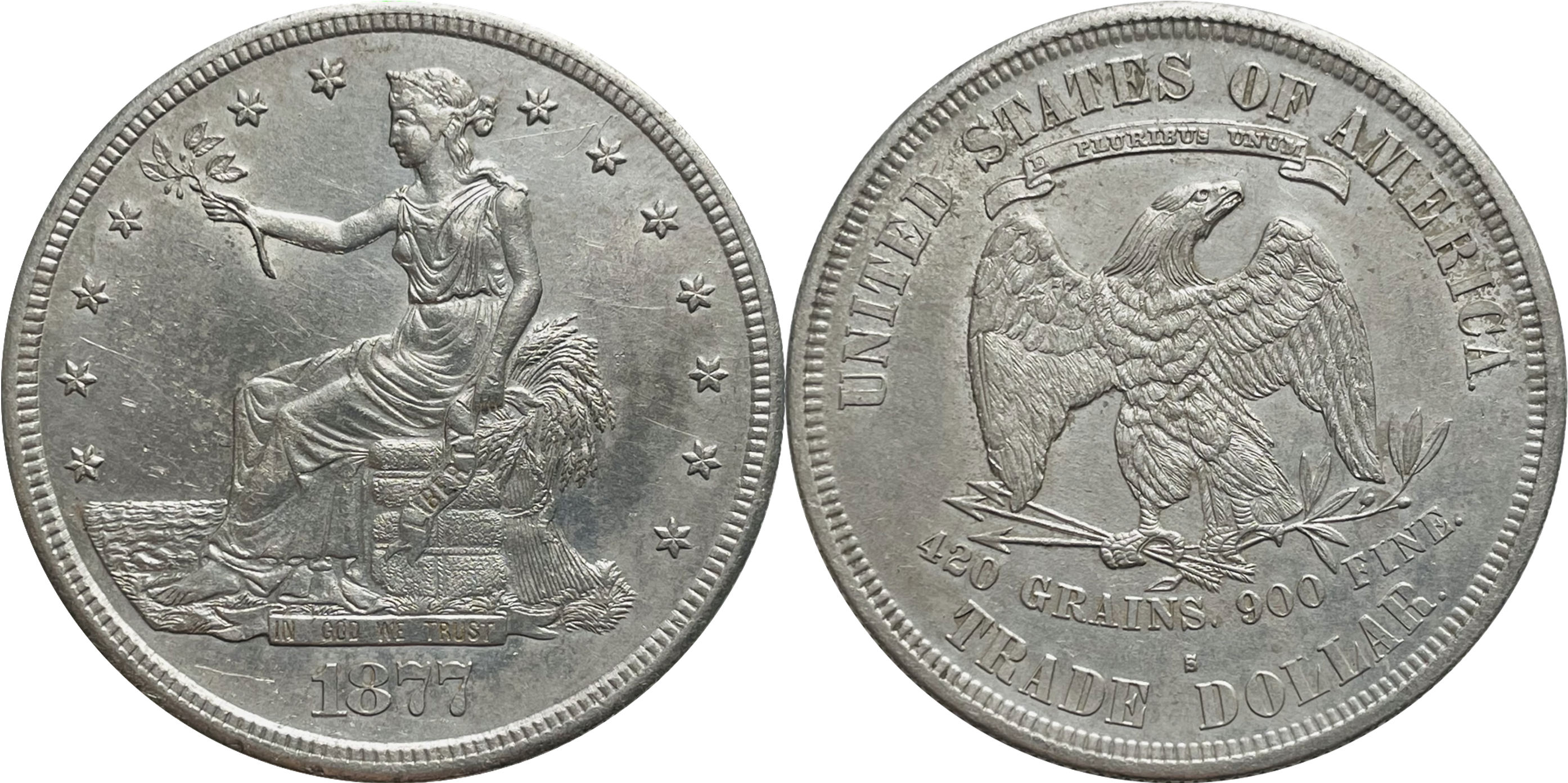
By the late 19th century the gold was the primary basis for the international monetary system, with silver having a secondary role. Many countries minted gold and silver coins, providing standardization and reducing the need to weigh out precious metals for transactions. This sometimes included tokens, coins not made from precious metals but exchangeable for them. This would eventually expand to include banknotes, paper money that was initially backed by precious metals and could be exchanged for them at banks.

A major drawback of these developments is that the use of non-precious metals and paper money does encourage counterfeiting, the criminal production of non-official copies for financial gain.

US Silver Trade Dollar from 1877
Silver Trade Dollar
Wikimedia
/
CC0 1.0

After World War Two, the Bretton Woods system removed the need for the backing by precious metals with the sole exception of U.S. Dollars. In 1971 that was suspended as well, and we moved completely to the modern system where paper notes themselves are all that matters. This is called fiat money, money that has value because everyone else thinks it does and not because you can actually do anything with the notes themselves. A key factor behind the confidence in paper bank notes is that the government must accept these as payment for taxes and other debts owed. A related idea is that a key source of inflation can be a loss of confidence in the government’s willingness and ability to collect tax revenue.

** Modern definitions of money Liquidity has already been discussed as the ease at which a thing can be turned into the medium of exchange, both in terms of time and real transaction costs. This concept is at the heart of how we label different types of money.

As we move forward the most important items are all labelled with capital letters. $C=currency $, $R=reserves $, and D=demanddeposits. These abbreviations will be particularly useful when we discuss the money multiplier in the next subchapter.

Definitions
Monetary base (MB)
Physical currency + bank reserves (C+R)
M1 money supply
Physical currency + checking accounts + savings accounts + other highly liquid deposits (C+D)
M2 money supply
M1 + small short term deposits + retail money market mutual funds

Everything beyond currency in M1 is currently referred to as “transaction deposits” by the Federal Reserve. An important change related to this occurred in 2020, when Regulation D was amended to reduce the limits on savings account withdrawals. That shifted the categorization of savings accounts from M2 to M1. They now count as transaction deposits, since reduced liquidity is no longer a legal requirement. This is an important difference, so be cautious if using older AP resources for review.

In M2, “small” refers to deposits less than $100,000. This may not seem small, but it is for financial actors such as banks and the Fed. As we move forward, when we talk about the money supply you should think of it as M2, the broadest measure of readily available funds.

Importantly, notice what is not counted as money here. There has been no mention of credit cards, or debt of any kind. Also missing are modern creations such as cryptocurrencies. These could be considered speculative assets, at a minimum failing to meet the function of a store of value due to their wild price swings. There is the possibility for this to change over time, and some countries such as El Salvador have attempted to make Bitcoin legal tender. As of mid-2026, even in those countries acceptance and regular use is still not common.

Money vs. Currency

  • Money: unit of measurement (e.g., U.S. Dollars)
  • Currency: physical notes and coins
  • Terms often used interchangeably in broader contexts

Role of Money in Transactions

  • Eliminates inefficiency of barter (double coincidence of wants)
  • Facilitates complex production and trade
  • Enables saving, borrowing, investing, and financial contracts

Four Functions of Money

  • Medium of exchange: widely accepted for purchases
  • Unit of account: measures and displays prices/values
  • Standard of deferred payment: basis for future payments (loans, debts)
  • Store of value: retains value over time

Requirements for Money

  • Must fulfill all four functions
  • Cryptocurrencies and poorly managed currencies may fail as store of value

Commodity and Fiat Money

  • Commodity money: has intrinsic value (e.g., gold, silver, shells)
  • Gold standard: money backed by precious metals
  • Fiat money: value based on trust and government acceptance, not intrinsic value
  • Modern fiat money: not redeemable for commodities, accepted for taxes/debts

Liquidity and Money Supply Definitions

  • Liquidity: ease of converting to medium of exchange
  • Currency ©: physical notes and coins
  • Reserves ®: bank reserves
  • Deposits (D): checking, savings, and other liquid accounts

Measures of Money Supply

  • Monetary base (MB): C + R (currency + reserves)
  • M1: C + D (currency + deposits, including checking and savings)
  • M2: M1 + small time deposits (<$100,000) + retail money market funds

Modern Money Supply Considerations

  • Savings accounts now included in M1 (since 2020)
  • Credit cards, debt, and cryptocurrencies not counted as money
  • M2 is the broadest commonly used measure of money supply
Previous
Next  | 4.5 Simple money market
All rights reserved ©2016 - 2026 Achievable, Inc.

Introduction to money

In our discussion thus far we have spoken about income, spending, production with a focus on these things in real terms. In other words relating to physical units of production rather than the monetary value, as with using real GDP instead of nominal GDP. In the real world money is a critical component of transactions. We need to build up some terminology and concepts in preparation for understanding how money and monetary policy impact the economy.

Before our main discussion it is good to highlight a subtle distinction in terminology, between money and currency. Money refers to the actual unit of measurement, say U.S. Dollars, while currency refers to paper notes and physical coins. The terms are often used interchangeably when discussing broader topics such foreign exchange. In such cases currency is used to mean money supply in a specific country or area, like U.S. Dollars for the United States or Euros for the Eurozone.

What makes something money?

Money has four functions it serves.

Definitions
Medium of exchange
Commonly acceptable for the purchase of goods and services
Unit of account
Used to display and measure prices, and the value of assets
Standard of deferred payment
Usable today and in the future, and thus accepted as a unit of measurement for loans, debts and other agreements for future payments
Store of value
Reliably holds value over time

A medium of exchange enables not just trade between two people, but also further exchanges with others. A single trade may not be complicated, as our loose barter examples above suggest, but not every trade will result in a good that you can trade with someone else for something you want. Anything with wide acceptance for trading can serve as a medium of exchange.

The function of acting as a unit of account has a deep connection to one of our earliest concepts, the need to evaluate trade-offs. Market transactions will offer direct comparisons, perhaps sometimes requiring minor adjustments. Comparing prices of goods, for example, may require a conversion to price per weight or per unit, due to differences in package sizes. Comparisons across countries require adjustments using exchange rates, and fairly comparing across time requires use of a measure of inflation to get things in real terms.

Closely connected to this is the function of serving as a standard of deferred payment, expanding the role of money to include payments in the future as well as payments today. So items such as loans, bonds and other debt instruments are denominated in money. Physical paper money in the United States uses the term “legal tender” which means that it is legally recognized by the government for tax payments.

Finally, money must be a store of value. That does not require that it has the same value, just that it will safely still be worth a somewhat predictable amount. Lots of things may be a store of value, such as collectible items like any variety of tradable cards or historical coins, but these items cannot be commonly used for purchases, other goods are not valued in terms of them and except for rare cases future payments are not based on them.

All four functions are required for something to be considered money. There are things that may be used for transactions such as cryptocurrencies, but then usually fail to meet the store of value requirement. There is an argument that countries with currencies that are not managed well can also suffer from this problem, but when it comes to the official currency of a country we can set that issue aside as long as the other functions are met.

Money and trade

Money enables the exchange of goods and services. A hypothetical world without any money at all needs some other way to enable trading. One possibility is barter, the direct trade of one good for another. This would be highly inefficient because of “the double coincidence of wants.” To make a barter trade with your neighbor, they must have something that you wand and you need to have something that they want.

As an example, if a farmer with chickens wants a new fence, they need to not only find someone with lumber who can build a fence, but also one that wants the eggs that they have. Even assuming you can find the right items to trade, both parties still need to agree on an amount to trade. The trade ratio represents a real price, exactly like the Ricardian trade examples discussed earlier with individuals instead of countries.

This is a common story told by economists as a motivator for monetary development. There is not strong evidence of any early society completely organized around barter. What is more likely are systems of informal credit. This includes things such as transferable IOUs instead formal measures such as legal contracts or intermediaries such as banks.

The time and resources lost in making trades in informal systems are transaction costs. These are especially problematic when trading multiple goods or producing complex goods. Think of goods with many small pieces that are made by different companies, such as a car, a computer or a house.

Money cuts down on transaction costs and makes frequent trades and complex goods easier to accomplish. It also enables the building blocks of our financial system, the ability to save, borrow, invest and develop more complex financial contracts and structures.

Commodity and fiat money

Although we are used to paper money, which we will talk about shortly, historically money has taken many forms. Early examples are primarily commodity money, where the items traded have intrinsic value, value from some alternative use. Most commonly this was precious metals, such as gold and silver, but examples in other countries included copper and shells. At first glance shells may not seem to have intrinsic value, but in societies that used them they had significant social and cultural purposes beyond their use as currency.

By the late 19th century the gold was the primary basis for the international monetary system, with silver having a secondary role. Many countries minted gold and silver coins, providing standardization and reducing the need to weigh out precious metals for transactions. This sometimes included tokens, coins not made from precious metals but exchangeable for them. This would eventually expand to include banknotes, paper money that was initially backed by precious metals and could be exchanged for them at banks.

A major drawback of these developments is that the use of non-precious metals and paper money does encourage counterfeiting, the criminal production of non-official copies for financial gain.

After World War Two, the Bretton Woods system removed the need for the backing by precious metals with the sole exception of U.S. Dollars. In 1971 that was suspended as well, and we moved completely to the modern system where paper notes themselves are all that matters. This is called fiat money, money that has value because everyone else thinks it does and not because you can actually do anything with the notes themselves. A key factor behind the confidence in paper bank notes is that the government must accept these as payment for taxes and other debts owed. A related idea is that a key source of inflation can be a loss of confidence in the government’s willingness and ability to collect tax revenue.

** Modern definitions of money Liquidity has already been discussed as the ease at which a thing can be turned into the medium of exchange, both in terms of time and real transaction costs. This concept is at the heart of how we label different types of money.

As we move forward the most important items are all labelled with capital letters. $C=currency $, $R=reserves $, and D=demanddeposits. These abbreviations will be particularly useful when we discuss the money multiplier in the next subchapter.

Definitions
Monetary base (MB)
Physical currency + bank reserves (C+R)
M1 money supply
Physical currency + checking accounts + savings accounts + other highly liquid deposits (C+D)
M2 money supply
M1 + small short term deposits + retail money market mutual funds

Everything beyond currency in M1 is currently referred to as “transaction deposits” by the Federal Reserve. An important change related to this occurred in 2020, when Regulation D was amended to reduce the limits on savings account withdrawals. That shifted the categorization of savings accounts from M2 to M1. They now count as transaction deposits, since reduced liquidity is no longer a legal requirement. This is an important difference, so be cautious if using older AP resources for review.

In M2, “small” refers to deposits less than $100,000. This may not seem small, but it is for financial actors such as banks and the Fed. As we move forward, when we talk about the money supply you should think of it as M2, the broadest measure of readily available funds.

Importantly, notice what is not counted as money here. There has been no mention of credit cards, or debt of any kind. Also missing are modern creations such as cryptocurrencies. These could be considered speculative assets, at a minimum failing to meet the function of a store of value due to their wild price swings. There is the possibility for this to change over time, and some countries such as El Salvador have attempted to make Bitcoin legal tender. As of mid-2026, even in those countries acceptance and regular use is still not common.

Key points

Money vs. Currency

  • Money: unit of measurement (e.g., U.S. Dollars)
  • Currency: physical notes and coins
  • Terms often used interchangeably in broader contexts

Role of Money in Transactions

  • Eliminates inefficiency of barter (double coincidence of wants)
  • Facilitates complex production and trade
  • Enables saving, borrowing, investing, and financial contracts

Four Functions of Money

  • Medium of exchange: widely accepted for purchases
  • Unit of account: measures and displays prices/values
  • Standard of deferred payment: basis for future payments (loans, debts)
  • Store of value: retains value over time

Requirements for Money

  • Must fulfill all four functions
  • Cryptocurrencies and poorly managed currencies may fail as store of value

Commodity and Fiat Money

  • Commodity money: has intrinsic value (e.g., gold, silver, shells)
  • Gold standard: money backed by precious metals
  • Fiat money: value based on trust and government acceptance, not intrinsic value
  • Modern fiat money: not redeemable for commodities, accepted for taxes/debts

Liquidity and Money Supply Definitions

  • Liquidity: ease of converting to medium of exchange
  • Currency ©: physical notes and coins
  • Reserves ®: bank reserves
  • Deposits (D): checking, savings, and other liquid accounts

Measures of Money Supply

  • Monetary base (MB): C + R (currency + reserves)
  • M1: C + D (currency + deposits, including checking and savings)
  • M2: M1 + small time deposits (<$100,000) + retail money market funds

Modern Money Supply Considerations

  • Savings accounts now included in M1 (since 2020)
  • Credit cards, debt, and cryptocurrencies not counted as money
  • M2 is the broadest commonly used measure of money supply

More from Financial sector

  • Closed economy loanable funds market
  • Macroeconomic finance
  • Financial assets and markets
  • Simple money market
  • Banking and money supply expansion