



Banking and money supply expansion
Of all of the financial intermediaries in the modern economy, banks are the most important. They link savers and borrowers through the process of taking deposits and using those funds to make loans. This process has an essential role in determining the money supply, but before discussing that we must lay out the basics of what banks are and how they operate.
Recall that the money supply can be viewed as currency plus demand deposits, . If banks did not exist, there are no deposits or reserves and the only money is currency, and .
When we add banks we have to consider reserves, deposits received that are kept completely liquid. Some of this is physical cash in a vault, ready to be withdrawn by customers. The rest are held in accounts at the Federal Reserve.
Our main tool to look at banking activity will be a simplified version of their balance sheet, often referred to as a T-account. The left side shows the bank’s assets, what is owed to them. All reserves will be here, as will be any loans made or securities owned by the bank. The right side shows liabilities, or what the bank owes to others, plus any equity (also called bank capital). This includes deposits and any financial instruments issued.
The T-account reflects double-entry bookkeeping, so the totals of each side must always be equal and any change that occurs on one side must somehow be matched by a change on the other side. It is only necessary to understand how this works for a few simple transactions and that is what will be covered now.
Full-reserve bank
The simplest form of banking is full-reserve banking, where the bank has to hold all money deposited as reserves. In which case the T account for our bank looks like this:
| Assets | Liabilities |
|---|---|
| Reserves $1000 | Deposits $1000 |
This bank cannot have any impact on the money supply, they merely act as a place to store money temporarily. The banking system adds nothing to the economy in this case.
Fractional-reserve bank
More realistically we have the case of fractional reserve banking, where the bank is required by the Federal Reserve to hold a percentage of every deposit as reserves, . The remaining percentage is initially held as excess reserves, but they may be lent out or used for other financial transactions.
Assuming or a reserve ratio and no desire to hold excess reserves, the bank T account looks like this:
| Assets | Liabilities |
|---|---|
| Reserves $100 | Deposits $1000 |
| Loans $900 |
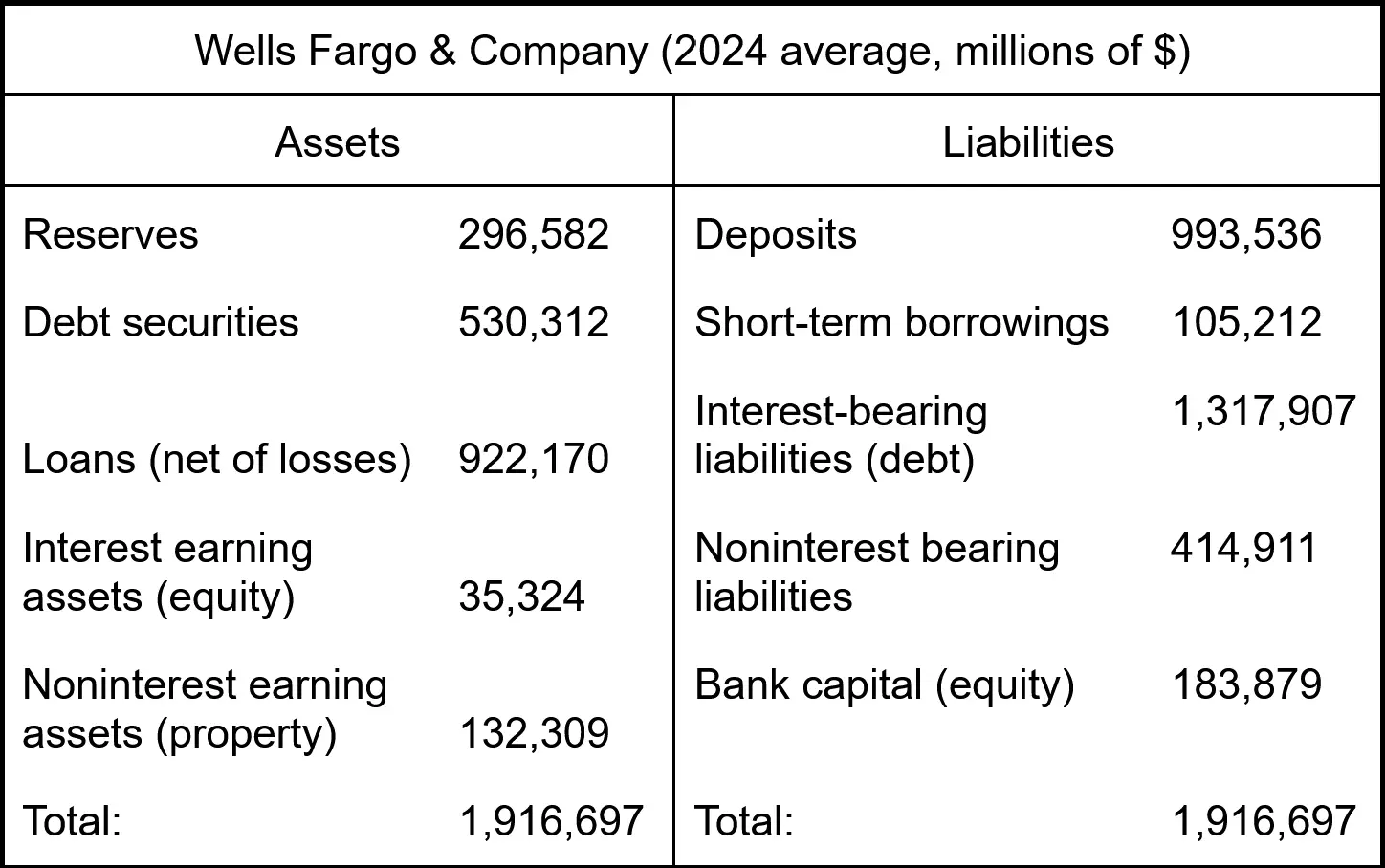
More realistically, many banks have more involvement in financial markets than simply taking deposits and making loans. Taking Wells Fargo as an example, here is an example constructed from their average 2024 balance sheet sourced from their 2024 Annual Report, rearranged with simplified categories to focus on our key ideas.
Note there are multiple types of investments, represented in the Asset rows below Reserves, and multiple types of Liabilities, everything other than Deposits and Equity on the Liability side. Bank capital represents the value to owners, in this case the shareholders… Wells Fargo is a public company and their shares are traded in the stock market.
Treating everything other than equity as requiring reserves, we can calculate their actual reserve ratio as
Money supply expansion
With the basics of banking and the T-account outlined, we can discuss the process of money supply expansion. This is the story that best explains how things work in the limited reserves case of the market for reserves, which will be presented later in the chapter.
Recall the definitions for the money supply and the monetary base, and . Our goal is to be able to connect the two, so to find a value where . This value is called the money multiplier.
To start we take a simple bank balance sheet, with $1000 in deposits and no bank capital. Thus liabilities in the form of deposits will be exactly equal to reserves plus loans. Let represent the reserve ratio or percentage of deposits that are required to be held as reserves. Finally, we will assume that our bank has no desire to hold excess reserves and thus lends all reserves it is able to.
For our example let . So for the $1000 in deposits, that leads to held as reserves. The remainder is used for loans, so .
From this starting point, let us look at how a new deposit of $100 changes the bank’s balance sheet and what . Initially all of this amount is held in reserves. So our T-account looks like this:
| Assets | Liabilities |
|---|---|
| Reserves $100 + 100 | Deposits $1000 + 100 |
| Loans $900 |
Banks will set aside required reserves. For $100 deposit, that means that the required addition to reserves is . The remaining $90, so , is initially excess reserves.
| Assets | Liabilities |
|---|---|
| Reserves$110 | Deposits $1100 |
| Excess reserves $90 | |
| Loans$900 |
The bank wishes to earn a return on those funds, so they loan them out. This leaves us with this T-account showing where the bank ends up after the deposit of $100.
| Assets | Liabilities |
|---|---|
| Reserves$110 | Deposits $1100 |
| Loans$990 |
However, just as spending becomes income for someone else, the loans become deposits at another bank. Regardless if that deposit is made at the same bank or a different bank, the same percentage, is held as reserves and the rest is loaned out. Which is deposited, again split into required reserves and loans. This process repeats until the amounts are too small to measure. This is a similar logic as we saw with the spending and tax multipliers.
The largest possible change in the money supply is
If banks always loan excess reserves and all funds given as loans are deposited in a bank, then the total change in the money supply for an additional dollar of deposits is exactly .
Realistic limitations
The issues are that zero currency holdings is not realistic, businesses may hold loaned funds outside of banks and that banks will not wish to lend every dollar that they can. To step around these issues without needing to make additional assumptions, we can turn to banking data.
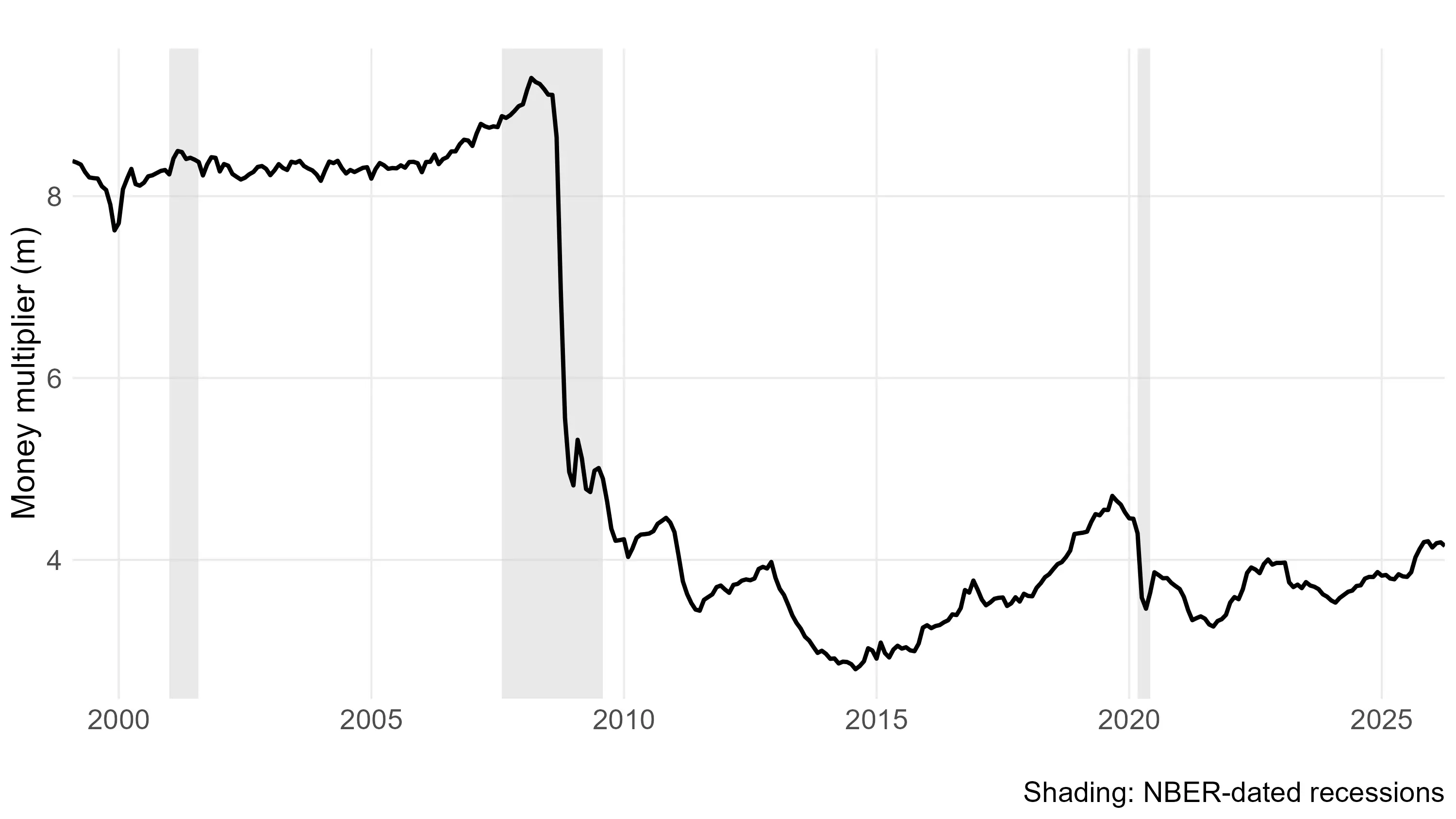
The money multiplier can be calculated as the ratio of the money supply to the monetary base . This happens to be a case where combining real life data with the theoretical equation avoids having to deal with realistic complications.
Looking at the last 25 years, we can see that the money multiplier is not constant. In March of 2020 the required reserve ratio was dropped to zero, replacing a required reserve policy of 3% for lower balance banks and 10% for larger balance banks. That change should make the multiplier higher, because it enables banks to make more loans.
The drops during both the Great Recession and at the start of 2020, signal a lower willingness of banks to make additional loans when deposits are made. This is an interruption of the process to reach the largest possible change in the money multiplier story.