



Special limits
Dominant term analysis can be extended to exponential and logarithmic functions by comparing their growth rates to algebraic functions (such as polynomials or roots).
As , the growth rates of these functions can be ranked in the following order:
This comparison is specifically for large positive values of . In expressions containing a mix of these functions, the faster-growing function dominates the end behavior.
Example 1:
Evaluate:
a)
b)
c)
Solutions
a)
Direct substitution gives the indeterminate form .
Even with the massive power of , the exponential function in the denominator eventually dominates the polynomial in the numerator for large values of .
This behavior fits case 1 from the horizontal asymptotes section, and the limit is .
b)
Direct substitution gives .
Since , an algebraic function, grows faster than the natural logarithm , the numerator eventually dominates.
This behavior fits case 3 and the limit is .
c)
Both are exponential functions, but the denominator dominates because it has a larger base. Since this fits case 1, the limit is .
Alternatively, we can use exponent rules to rewrite the expression as a single function
Because , repeated multiplication by makes the expression shrink toward . Therefore, the limit is .
Example 2:
As approaches , basic exponential functions such as approach instead, which leads to different end behavior.
Evaluate:
As , the pieces behave like this:
-
Numerator:
-
Denominator: (a very small positive number)
When a very large negative number is divided by a very small positive number, the expression becomes unbounded in the negative direction. You can observe this by calculating with concrete values such as .
Therefore,
This fits case 3: the numerator dominates because the denominator shrinks toward .
Let
Evaluate:
a)
b)
Answers
a)
b)
Solutions
a)
As :
- In the numerator, dominates and the constant .
- In the denominator, dominates the constant .
So for large , the expression can be reduced to
This fits case 3. You may also consider that because the base () is greater than , repeated multiplication causes the expression to grow without bound, and the limit is .
b)
As , the exponential functions and all approach . Substituting those end behaviors into the expression gives
Squeeze theorem
Also called the sandwich theorem, the Squeeze theorem helps you evaluate limits by trapping a function between two others whose limits are already known.
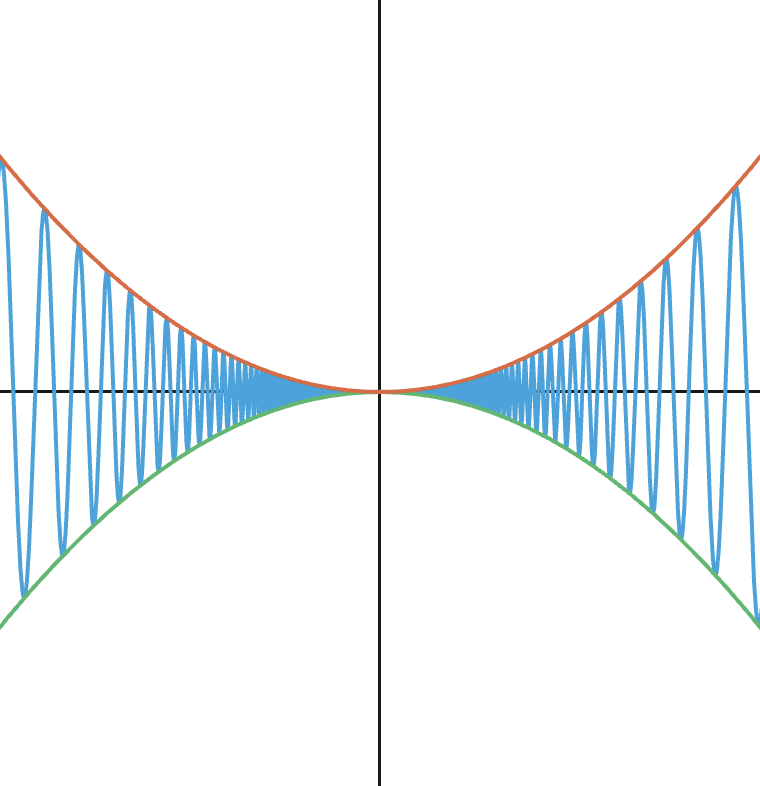
As shown in the graph, if the lower bounding function (in green) and the upper bounding function (in red) converge to the same limit at a point, the middle function (in blue) is forced to that limit.
Example
Let and be the functions defined by and .
If is a function such that for all , find .
Since is squeezed between the bounding functions and as , evaluate the limits of the bounds:
and
Because the two limits are equal, by the Squeeze theorem.
Bounded functions at infinity
Consider the limit
Trigonometric functions like and oscillate indefinitely between and , so the numerator does not approach a single value. As such, direct substitution is not applicable.
But since the denominator grows without bound while the numerator remains bounded, dominant term analysis suggests that the fraction approaches .
This can be proven using the Squeeze theorem. Since is bounded for all ,
Dividing each part of the inequality by gives:
The limits of both bounding functions equal as approaches . Therefore, by the Squeeze theorem,
Special trigonometric limits
If approaches instead of , the previous approach no longer applies. Although the following limits can be proven using the Squeeze theorem, you are only expected to memorize them:
Their reciprocals are the same:
Examples
A common variant changes the argument of the sine function.
- Evaluate
In order to use the special trig limit, the denominator must match the argument of sine, or . The trick is to multiply by in the form of :
- Evaluate
Here, there is no outside the sine functions, so we create the special limit forms by multiplying by and .
Start by rewriting the expression as a product:
Now create the special limit form:
Rearrange the expression to form the special limits:
Challenge problem
Direct substitution gives the indeterminate form .
First, rewrite the expression as
Next, make a substitution by letting . Then .
As approaches approaches , and the limit rewritten in terms of is
Note that substitution doesn’t change the function. We’ve only changed the form it’s written in so that the special limit can be applied.