


Achievable logoAchievable logo
AP Calculus AB
Sign in
Sign up
Purchase
Textbook
Practice exams
Support
How it works
Exam catalog
Mountain with a flag at the peak
Textbook
Introduction
1. Limits
1.1 Tables and graphs
1.2 Analytical limits
1.3 Advanced algebraic limits
1.4 Limits and infinity
1.5 Special limits
1.6 Continuity
2. Derivative basics
3. Advanced differentiation
4. Contextual uses
5. Analytical uses
6. Integration
7. Differential equations
8. Applications of integrals
9. Testing details tag
10. test
Wrapping up
Achievable logoAchievable logo
1.6 Continuity
Achievable AP Calculus AB
1. Limits
Our AP Calculus AB course is currently in development and is a work-in-progress.

Continuity

12 min read
Font
Discuss
Share
Feedback

What you’ll learn:

  • The 3 conditions that define continuity at a point
  • How to classify discontinuities as removable, jump, or infinite
  • Intermediate value theorem (IVT)

Defining continuity with limits

In section 1.1, we looked at one-sided limits to determine if a limit exists overall. This idea can be extended to continuity - a function is defined to be continuous at a point a if the limits from either side are the same and match the function’s value at that point. More formally, there are three conditions that must be met for a function to be continuous:

Definition of continuity at point a:

  1. f(a) is defined

  2. x→alim​f(x) exists, meaning

x→a−lim​f(x)=x→a+lim​f(x)

  1. x→alim​f(x)=f(a)

If any of these conditions are not satisfied, the function is discontinuous at x=a.

Example

This type of question often shows up on the AP exam:

What value of k will make the piecewise function f(x) continuous everywhere?

f(x)=⎩⎨⎧​x−1x2−4x+3​k​if x=1if x=1​

Solution

For f(x) to be continuous, x→alim​f(x) and f(a) must both exist and agree with each other.

Since f(x) is a piecewise function, the breakpoint x=1 is a potential “problem area” for the limit. This will be the a we test for continuity at.

Condition 1: f(a) is defined.

f(1)=k as defined by the piecewise function.

Condition 2: x→1lim​f(x) must exist.

f(x) behaves like the rational function everywhere but x=1. So we must find

x→1lim​x−1x2−4x+3​

=x→1lim​(x−1)​(x−1)​(x−3)​

=x→1lim​(x−3)

=−2

Condition 3: x→1lim​f(x) must match f(1) for f(x) to be continuous at x=1. So

k=−2​

This value for k plugs in the hole created by the rational function.

Classifying discontinuities

The three main types of discontinuities are:

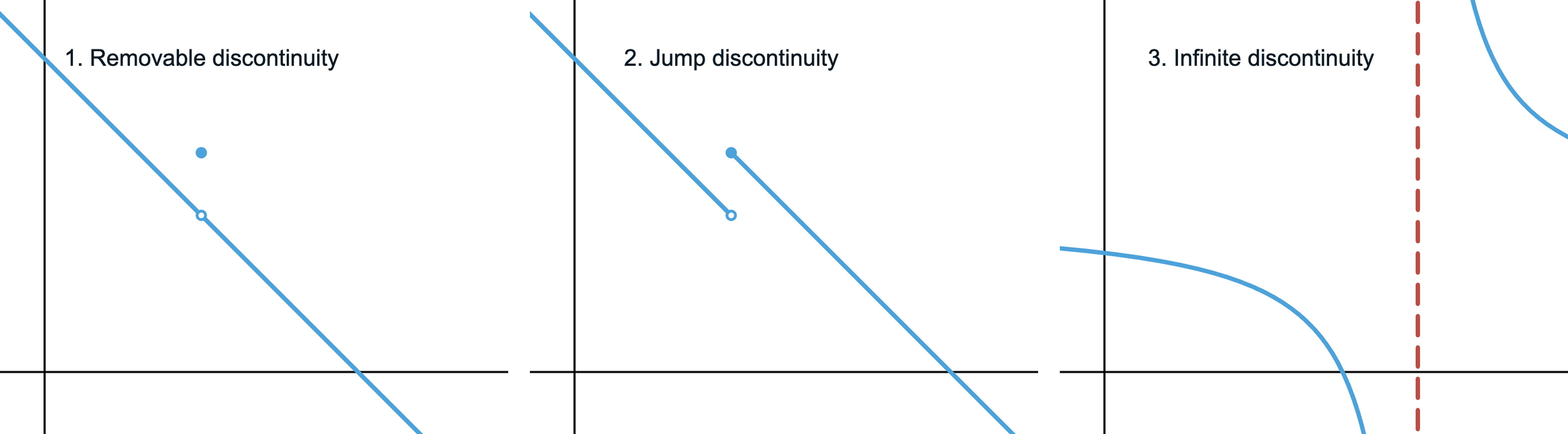
1. Removable discontinuity (hole)

  • When f(x) passes condition 2 but fails condition 3.
    i.e. x→alim​f(x) exists but is =f(a).
    • Removable discontinuities are often referred to as “holes.”

2. Jump discontinuity

  • When f(x) fails condition 2
    i.e. x→a−lim​f(x)=x→a+lim​f(x) as f(x) “jumps” from one value to another at x=a.
    • Usually seen in piecewise functions at the breakpoint(s).

3. Infinite (asymptotic) discontinuity

  • When x→alim​f(x)=±∞ (does not exist). This means f(x) approaches a vertical asymptote at x=a.
    • Often seen in rational functions where factoring and canceling still leaves a constant over a variable denominator i.e. f(x)=x−41​

Shown below is a visual of each:

Types of discontinuities

If a question asks you to assess the continuity of a function and classify any discontinuities, follow these steps:

Check condition 1: Find potential discontinuities

Typically, discontinuities occur in:

  • Rational functions (when the denominator =0)
  • Logarithmic functions (since the argument must be >0)
  • Piecewise functions

If f(a) is undefined, then f(x) is discontinuous there. We just have to classify the discontinuity.

Even if f(a) is defined (e.g. in a piecewise function) continuity is not guaranteed. Proceed to step 2.

Check condition 2: Classify discontinuity

Find the one-sided limits as x→a to classify the discontinuity.

  • If either one-sided limit is ±∞, it’s an infinite discontinuity.
  • If the one-sided limits are finite but don’t match, it’s a jump discontinuity.
  • If they match and the limit exists, proceed to step 3.

Check condition 3: Limit = f(a)

Match the results from conditions 1 and 2. If f(a) from step 1 does not equal the limit from step 2, it’s a removable discontinuity.

If the values match, congrats! The function is continuous there.

Examples

1. Classify the discontinuities on f(x)=x2−x−6x2−4x+3​, if any.

Solution

Answer: Infinite discontinuity at x=2, removable discontinuity at x=3.

Condition 1: Potential discontinuities

This rational function is undefined when the denominator equals 0:

x2−x−6=0(x+2)(x−3)=0x=−2,3

These are the points of discontinuity.

Condition 2: Classify

Check each point individually with conditions 2 and 3.

  • For a=−2:

Evaluate

x→−2lim​x2−x−6x2−4x+3​

Direct substitution results in the indeterminate form 00​. Let’s try factoring both the numerator and the denominator and canceling:

=x→−2lim​(x+2)(x−3)​(x−1)(x−3)​​

=x→−2lim​(x+2)(x−1)​

Direct substitution yields 0−3​, which suggests a vertical asymptote is involved. Checking the one-sided limits:

Left: x→−2−lim​(x+2)(x−1)​=∞

Right: x→−2+lim​(x+2)(x−1)​=−∞

Since the limits are infinite and the limit does not exist, there’s an infinite discontinuity at x=2.

  • For a=3:

Evaluate

x→3lim​x2−x−6x2−4x+3​

Using the same factoring technique, the limit becomes:

x→3lim​(x+2)(x−1)​

=52​

The limit exists which passes condition 2.

Condition 3: Matching

Unfortunately f(3) is still undefined so x→3lim​f(x)=f(3) and the point fails condition 3.

Therefore there is a removable discontinuity at x=3 - a hole that, if filled in, would be at y=52​.

Let’s explore another example - a piecewise function:

2. Classify any discontinuities on f(x), the piecewise function defined by:

f(x)=⎩⎨⎧​x+21−x+4​if x<1if x=1if x>1​

Solution

(spoiler)

Answer: Removable discontinuity at x=1

Condition 1: f(1)=1 as defined by the second piece. But since x is approaching the breakpoint of the piecewise function in this limit, there is a potential discontinuity there.

Condition 2: Does x→1−lim​f(x)=x→1+lim​f(x)?

Left-hand limit:

As x→1−, f(x) is defined by (x+2) for all x<1.

x→1−lim​(x+2)=3

Right-hand limit:

As x→1+, f(x) is defined by (−x+4) for all x>1.

x→1+lim​(−x+4)=3

Since the one-sided limits are the same finite number, x→1lim​f(x)=3 and condition 2 has been satisfied.

Condition 3: Does x→1lim​f(x)=f(1)?

No, x→1lim​f(x)=3 while f(1)=1 . Therefore the discontinuity at x=1 is removable.

Intermediate value theorem

One important property that results from continuity is the Intermediate Value Theorem (IVT).

Intermediate value theorem:

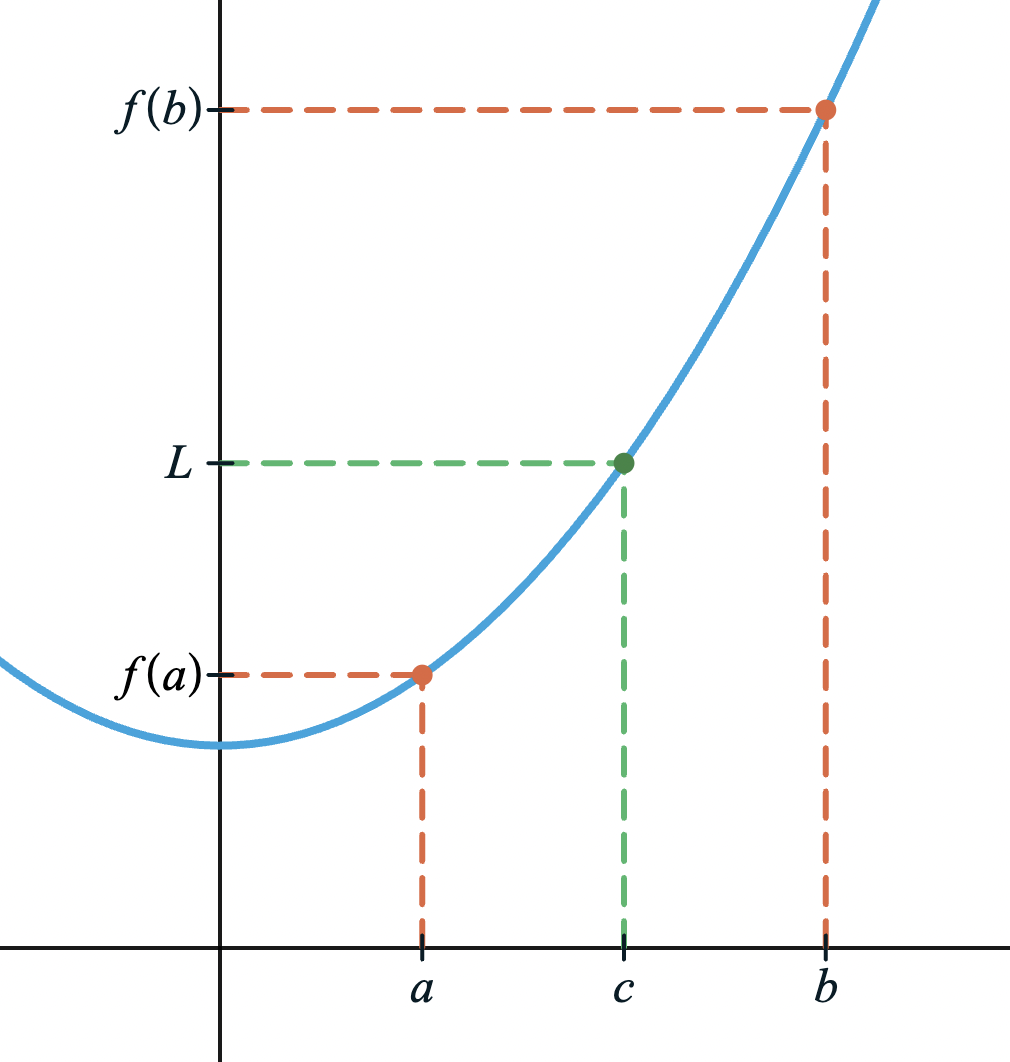
If f(x) is continuous on the interval [a,b], and L is any number between f(a) and f(b), then there exists at least one number c in [a,b] such that f(c)=L.

In simpler terms, a continuous function will hit every value between f(a) and f(b) in the interval [a,b], including some y-value L at some x-value c.

Intermediate value theorem

Examples

1. Let f(x)=x2−4 on the interval [1,3]. Use the IVT to show that there is a root in the interval and find the value of c guaranteed by the IVT.

Solution

f(x) is a polynomial so continuous everywhere.

A root, or solution, means that f(x) crosses the x-axis (where L=0).

Check the values at the endpoints:

  • f(1)=12−4=−3
  • f(3)=32−4=5

Because −3<L<5, the IVT guarantees some c in [1,3] where f(c)=0, which means c is a root.

To find c:

f(c)=0 means that

c2−4=0c=±2

Only c=2​ lies in the given interval [1,3].

AP tip:

If a free-response question requires the use of the IVT, make sure to explicitly state the conditions met - that f(x) is continuous and the target value L is between f(a) and f(b) - to conclude the existence of c in [a,b] where f(c)=L.

2. Let f(x) be a continuous function defined on the interval [1,4]. The values of f(x) at various points are given in the table:

x f(x)
1 2
2 5
3 3
4 7

What is the minimum number of times f(x)=4 on the interval [1,4]?

Solution

(spoiler)

Answer: 3times​

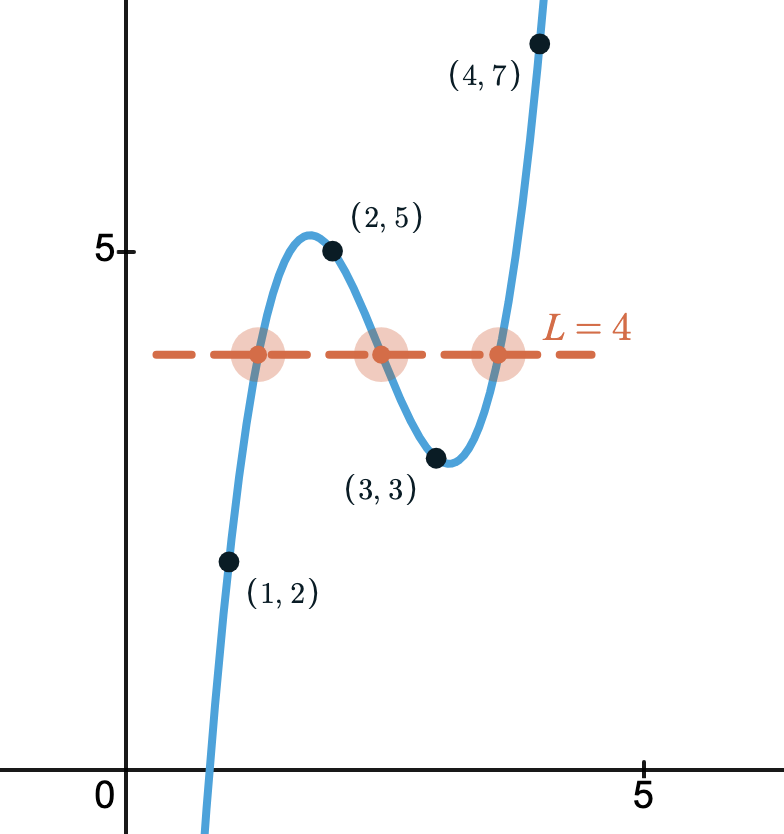
While we could apply the IVT on each interval [1,2], [2,3], and [3,4], it would be easier to just draw a graph for a general idea of the situation:

Figure 1.6.3 IVT problem
The four points are what’s important - the function can look much crazier and quickly bounce back and forth between multiple values. However, f(x) has to pass the horizontal line L=4 at the very least 3 times, in order to go from a point below the line to a point above it and vice versa.

Challenge problem

1. For what values of m and b will f(x) be continuous over all real numbers?

f(x)=⎩⎨⎧​mx2+b3x−mx3−b​if x≤−2if −2≤x<2if x≥2​

Solution

(spoiler)

Answer: m=−34​ and b=32​​

All 3 pieces are polynomials and continuous over their individual intervals. The potential discontinuities are at the breakpoints.

Breakpoint x=−2:

For f(x) to be continuous at x=−2,

f(−2)=x→−2−lim​f(x)=x→−2+lim​f(x)

First,

f(−2)​=m(−2)2+b=4m+b​

Next, the one-sided limits:

  • Left: x→−2−lim​f(x)

​=m(−2)2+b=4m+b​

  • Right: x→−2+lim​f(x)

​=3(−2)−m=−6−m​

The one-sided limits must match, so setting them equal to each other and rearranging,

5m+b=−6

However there are two unknown variables, so we need another equation that relates m and b.

Breakpoint x=2:

This time, we need

f(2)=x→2−lim​f(x)=x→2+lim​f(x)

for f(x) to be continuous at x=2.

First,

f(2)​=(2)3−b=8−b​

Next, the one-sided limits:

x→2−lim​f(x)=3(2)−m=6−m

x→2+lim​f(x)=(2)3−b=8−b

They must match, so setting them equal and rearranging,

m−b=−2

Solving the system of equations

5m+b=−6m−b=−2​​

results in m=−34​ and b=32​.

Key points
  • A function is continuous at x=a if, in short:
    f(a)=x→alim​f(x) (both exist and match).
  • If not, there are 3 main types of discontinuities:
Type of discontinuity Occurs when f(x)…
Removable (hole) Passes cond. 2 but fails cond. 3: Limit =f(a)
Jump Fails cond. 2: Limit DNE
Infinite/asymptotic Fails cond. 2: Limit =±∞
  • The Intermediate value theorem is a guarantee that a continuous function will take all intermediate values between f(a) and f(b), making it useful for proving the existence of a root or some specified value, even if the solution can’t be found easily.

Sign up for free to take 10 quiz questions on this topic

All rights reserved ©2016 - 2026 Achievable, Inc.