



Factorization of quadratics and cubics
In this chapter, you’ll factor both quadratic and cubic functions. Cubic functions are less common, but you still need to know how to factor them in a few special cases.
Factoring quadratic functions
A quadratic function has a highest exponent of . To factor a quadratic, you rewrite it as the product of two binomials (two sets of parentheses) that multiply back to the original expression.
Format
This is an example of a quadratic after it has been factored.
To multiply two binomials, you use FOIL. If you need a refresher, review the chapter Simplifying Expressions.
FOILing gives:
This simplifies to:
So factoring a quadratic is the reverse of FOILing. A typical factorization looks like , where the plus signs may instead be minus signs.
Method
To factor a “classic” quadratic of the form , you’ll use two main steps:
- Look at the third term (the constant term, the number with no ). List its factor pairs.
- Find the factor pair whose sum equals the coefficient of the middle term (the number attached to ).
Once you find the correct pair, those two numbers go into the parentheses.
Example:
What are the factors of the third number?
The factors of are and
Which of these factor sets adds up to the second number?
This does not add up to .
This does add up to the second number.
So the correct factors are and .
Now set up the parentheses.
- Put an on the left side of each set of parentheses.
- Put the two factors on the right side.
- Use a plus sign for a positive number and a minus sign for a negative number.
Place an on the left-hand side of each set of parentheses:
Now fill in the right-hand side with the factors and :
That is the final answer.
Note that is also a valid answer.
Try an example with a negative in the equation.
Factor the following equation.
Factors of the third number: , , ,
Find the factors that sum up to the second number:
These are the correct factors.
Set up parentheses:
Place numbers, being mindful of the negative sign on , to get the final answer:
Remember, you can always check your factorization by FOILing and confirming that you get the original quadratic expression.
Factoring cubic equations
A cubic function has a highest exponent of . To factor a cubic equation, you must be given one factor to start with.
When you divide the cubic by that given factor, you reduce the cubic to a quadratic. Then you can factor the quadratic using the steps from the previous section.
Many cubic factorizations require synthetic division. If you’re comfortable with synthetic division, you can skip the next section and go straight to the method. You can also use long division, but it takes longer.
Synthetic division
For this explanation, we’ll use the equation and the given factor .
First, list the coefficients of the original equation (use s as placeholders if there is no term for a given exponent).
Next, drop the first coefficient down below the line:
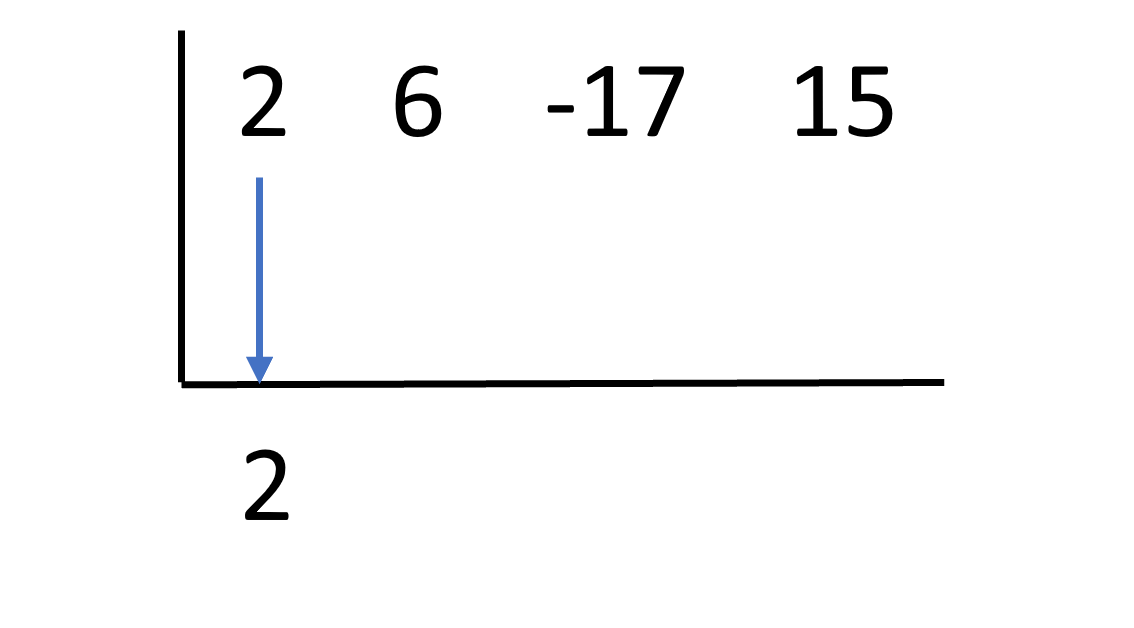
Now, take the root from the factor you are given and place it to the left of the vertical line. In this case, the number is . This was obtained by setting and solving for . If this step is unclear, revisit the chapter “Solving quadratic equations.”
Then, multiply the root number () by the first number under the line (). This equals .
Next, put this number underneath the second coefficient.
Add this number () to the coefficient above it and place the sum () under the line.
Now, repeat this pattern for the rest of the coefficients.
Multiply that sum () by and place it () under the third coefficient.
Add the number () and the number above it and place the sum under the line.
Multiply that sum () by the root number () and place it () under the fourth coefficient.
Lastly, place the sum of that number () and the number above it under the line.
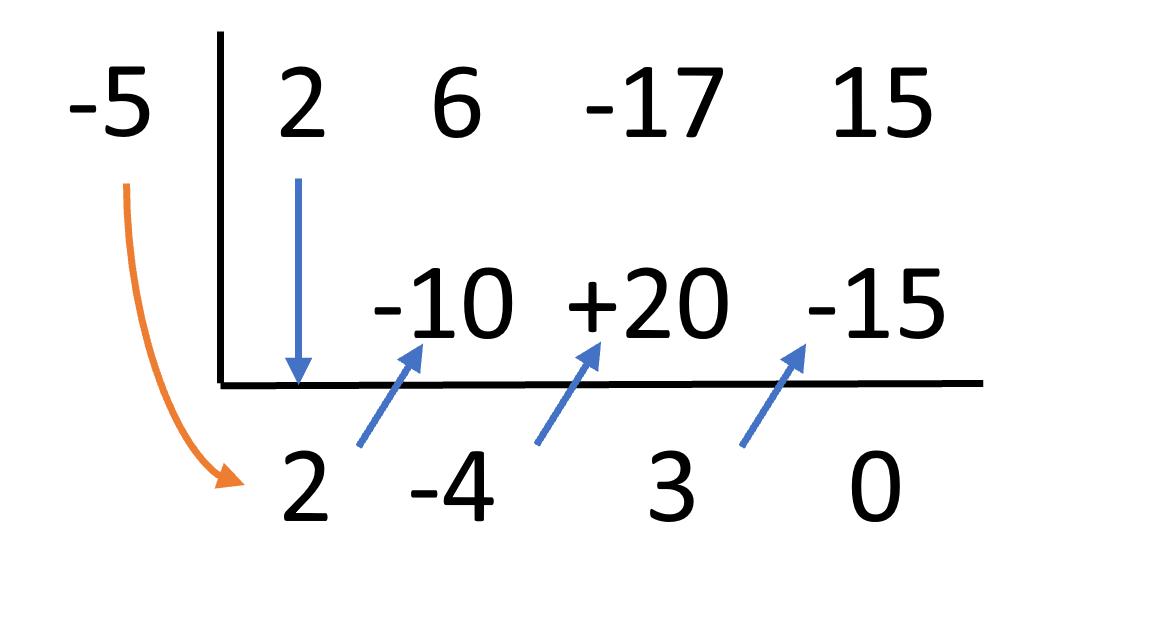
After you complete the pattern, you’ll have a new number beneath the line under each coefficient.
- The last number is the remainder, and it should be .
- If it isn’t , redo the synthetic division to check your work.
- If your work is correct and the remainder still isn’t , then the root you used is not a factor of the cubic, and you can’t continue factoring using that factor.
The numbers below the line (except the remainder) are the coefficients of the reduced equation. Since you started with a cubic, the reduced equation is quadratic (the degree drops by 1). So the final result is:
Method
To factor a cubic function:
- Divide the cubic equation by the factor you are given (usually using synthetic division).
- Factor the resulting quadratic.
An example question could look like the following.
Factor the cubic equation given that is one of the factors.
You would perform synthetic division to reduce the cubic function to a quadratic function, as shown above. Then factor the quadratic you get. Your final answer will include the given factor and the two factors from the quadratic, for a total of three factors.
Sum or difference of two cubes
You can quickly factor a cubic function of the form by memorizing:
This is called the sum of two cubes.
Similarly, you can quickly factor a cubic function of the form by memorizing:
This is called the difference of two cubes.