



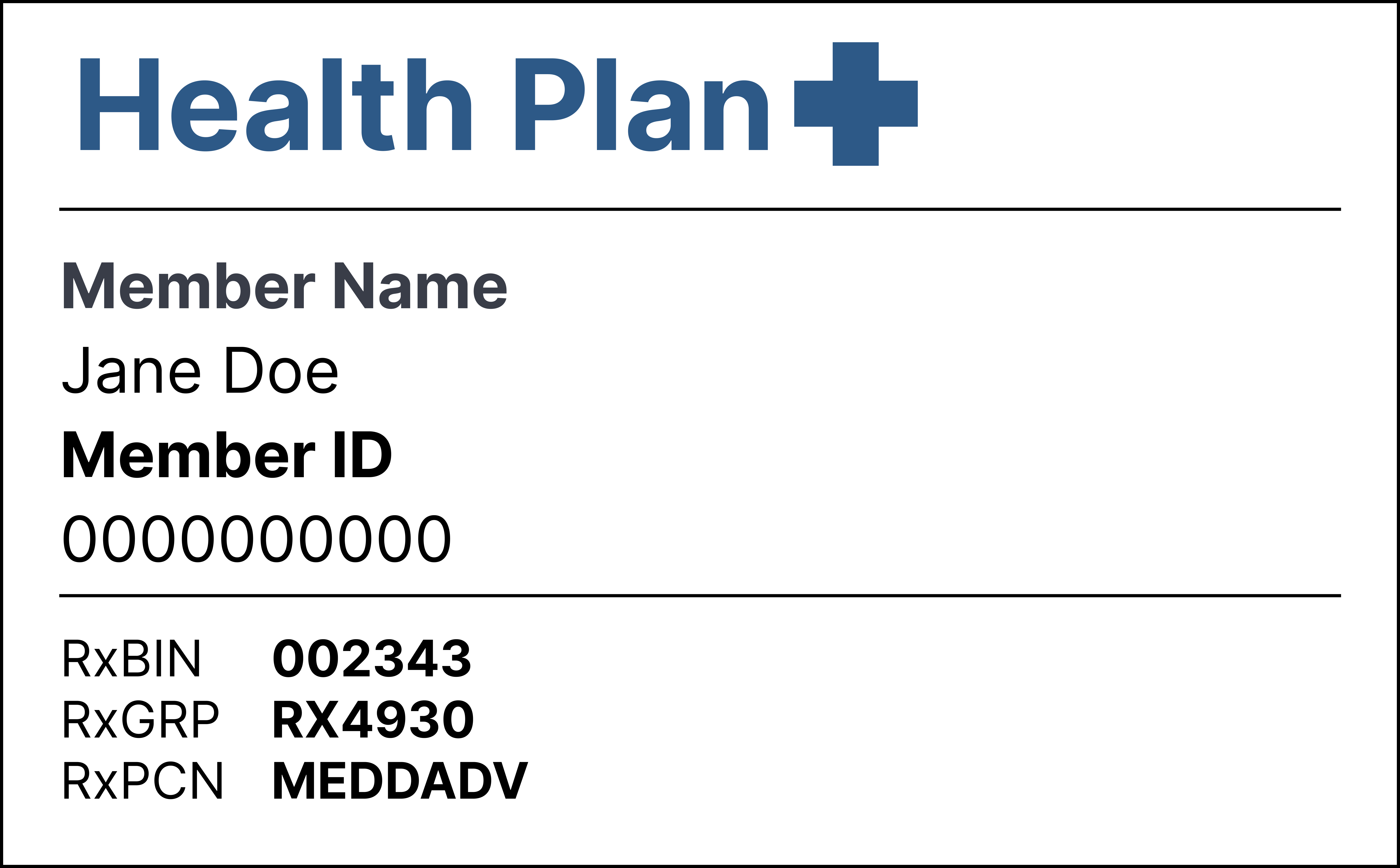
Health insurance plans and common terms
Most health plans include prescription benefits as long as the medication is listed on the plan’s formulary (the plan’s approved list of covered medications). If a medication isn’t on the formulary, it may not be covered at all, or the patient may have to pay more for it.
Common terms associated with health insurance
Co-payment: A fixed, predetermined amount paid for a covered health care service. For example, if a specialist visit copay is $50, the insured pays $50 for each approved specialist visit. A copay is a flat dollar amount, while coinsurance is a percentage of the cost.
Co-insurance: The insured’s share of the cost, expressed as a fixed percentage. For example, 20% coinsurance means that for every $100 in covered costs, the insured pays $20.
Deductible: The amount the insured pays out of pocket before the insurance plan starts paying for covered services. For example, if the deductible is $5000, the plan doesn’t pay until $5000 in costs has been met.
Example: Deductible, then coinsurance
A plan has a $500 deductible and 20% coinsurance. The patient has paid $400 toward the deductible. A covered drug costs $300.
Step 1: The remaining deductible is $500 − $400 = $100, and the patient pays all of it.
Step 2: The remaining cost is $300 − $100 = $200. The patient pays 20% × $200 = $40.
Answer: $100 + $40 = $140. The premium is not part of the counter price.
Premium: The amount paid regularly (such as monthly or quarterly) to keep health insurance coverage active.
Network: The providers, facilities, and pharmacies included in a health insurance plan.
Preauthorization or prior authorization: Also called precertification, this is the process of getting approval from the insurance company before using certain services (such as surgery, specialist visits, brand-name drugs, or certain procedures). The insurance company determines whether the requested service is medically necessary and may suggest alternatives that typically cost less (for example, a generic version instead of a brand-name drug).
RxBIN or BIN number: The bank identification number (BIN) is a unique six-digit number that identifies the insurance provider and plan. It’s printed on the prescription insurance card, and the pharmacy’s software uses it (with the PCN where needed) to route the claim to the right processor, such as a pharmacy benefit manager.
RxPCN number: The Rx processor control number (PCN) is another identifier that further specifies the insurance provider and plan. It helps the pharmacy route a claim to the correct processor.
Member ID, group number, and Rx group: The member ID is a unique number assigned to a specific plan member. The group number identifies the specific plan selected and is commonly used in employer-provided health plans; the Rx group number works alongside it to process prescription benefits. Plans can differ in their provider networks, fees, charges, and other coverage details.
Person code: The person code identifies the primary member and any dependents on the plan. On many plans, the primary member is listed as 00 or 01. Dependents (such as a spouse or children) have different person codes, which vary by insurance provider.
Coordination of benefits (COB): Coordination of benefits (COB) applies when a patient has more than one insurance plan. COB determines which plan pays first (primary payer) and how much the other plan pays (secondary payer). Typically, the primary payer pays first and the secondary payer may cover some or all of the remaining balance. Together, the two plans never pay more than the pharmacy’s total charge - the secondary plan pays at most the balance left after the primary pays, even if it would have paid more when billed alone.
Adjudication: Pharmacy claim adjudication is the process of evaluating a pharmacy claim, commonly performed by pharmacy benefit managers (PBMs). During adjudication, the system checks whether:
- The prescription is covered
- Cost-saving options are available
- Drug safety issues exist
- Prior authorization is required
After these checks, the claim is approved, held for more information, or rejected.
NCPDP or National Council for Prescription Drug Programs: NCPDP is a nonprofit organization that develops and promotes standards for the electronic exchange of healthcare information related to pharmacy services. Its standards include SCRIPT, which facilitates e-prescribing, and reject codes, standardized codes used by insurers and processors to explain why a claim was rejected.
Table showing common NCPDP reject codes (M/I means missing/invalid)
| Code number | Reason for rejection |
|---|---|
| 01 | M/I BIN |
| 62 | Patient/Cardholder ID name mismatch |
| 65 | Patient is not covered |
| 67 | Filled before coverage effective |
| 69 | Filled after coverage terminated |
| 70 | Product/service not covered |
| 75 | Prior authorization needed |
| 76 | Plan limitations exceeded |
| 79 | Refill too soon |
| 88 | DUR reject error |
Types of health and prescription insurance: Health insurance may be provided through an employer, purchased privately (including self-employed coverage), or purchased as an individual or family plan. Government-provided health insurance includes Medicare and Medicaid.
Plans also differ by structure, such as:
- Health maintenance organizations (HMOs): Typically the least flexible. The provider network is limited, referrals are needed to see specialists, care (including pharmacies) outside the network is generally not covered, and premiums and out-of-pocket costs are usually lower.
- Preferred provider organizations (PPOs): Typically the most flexible. Referrals aren’t required, out-of-network providers are covered at a higher out-of-pocket cost, and premiums are usually higher.
- Exclusive provider organizations (EPOs): In-network only, like an HMO, but usually no referral is needed to see a specialist. Generally costs more than an HMO.
- Point of service (POS) plans: Needs a primary care referral, like an HMO, but allows out-of-network care at a higher cost, like a PPO. Generally costs more than an HMO.
TRICARE is health insurance for current and retired uniformed service members and their families. It covers prescription drugs as well as doctor and hospital visits. Care is available through military hospitals and clinics and through TRICARE-authorized civilian providers.
Medicare: Medicare is federal health insurance for people age 65 and older. It also covers some people under 65 with certain disabilities or health conditions, such as end-stage renal disease. Original Medicare includes Part A and Part B.
Part A (hospital insurance) covers inpatient care in hospitals, skilled nursing facilities, hospice, and some home health care.
Part B (medical insurance) covers outpatient care and services provided by physicians and other health care providers (such as nurse practitioners and physician assistants). It also covers home health care, durable medical equipment (such as blood sugar meters and test strips, wheelchairs, nebulizers, and walkers), and preventive services (such as screenings, vaccines, and wellness checkups).
For prescription drug coverage, the patient needs either:
- A Medicare Advantage plan that includes drug coverage, or
- An additional Medicare drug plan
Part D covers prescription drugs, including recommended vaccines. Medicare Advantage is also known as Part C. It’s a Medicare-approved private plan that can be used instead of Original Medicare. Medicare Advantage plans can differ from Original Medicare in provider networks, out-of-pocket costs, premiums, and benefits.
Medicaid: Medicaid is a joint federal and state program that covers medical costs for eligible people with limited income and resources. Medicaid may help pay health expenses such as Medicare Part B monthly premiums, Part A premiums, deductibles, coinsurance, and copays. Some people qualify for both Medicaid and Medicare (dual eligibility). In that situation, Medicare pays first and Medicaid pays last. Drugs covered by a Part D plan work differently. Medicaid pays neither the drug nor its cost-sharing, such as the copay. Instead, dual-eligible patients get Extra Help, a Medicare program that lowers their Part D premiums and copays.
Workers’ compensation: Workers’ compensation provides disability compensation and health insurance to workers who are injured at work or develop occupational diseases. Each state has a Workers’ Compensation Board that processes claims. Federal employees receive workers’ compensation through the Department of Labor.