


Achievable logoAchievable logo
NCLEX
Sign in
Sign up
Purchase
Textbook
Practice exams
Support
How it works
Resources
Exam catalog
Mountain with a flag at the peak
Textbook
Introduction
1. Safe and effective care environment
2. Health promotion and maintenance
3. Psychosocial Integrity
4. Physiological Integrity
4.1 Basic care and comfort
4.2 Pharmacological and parenteral therapies
4.2.1 Intravenous therapy
4.2.2 Medication administration principles
4.2.3 Blood and blood product administration
4.2.4 Pharmacodynamics and side effects
4.2.5 High-risk medications
4.2.6 Adverse effects, contraindications, and interactions
4.2.7 Dosage calculations and safe administration
4.3 Reduction of risk potential
4.4 Physiological adaptation
Wrapping up
Achievable logoAchievable logo
4.2.2 Medication administration principles
Achievable NCLEX
4. Physiological Integrity
4.2. Pharmacological and parenteral therapies
Our NCLEX course is currently in development and is a work-in-progress.

Medication administration principles

7 min read
Font
Discuss
Share
Feedback

Introduction

Administering medications is one of nursing’s most routine, and riskiest, responsibilities. A single error can lead to life-threatening consequences, so safe practice demands attention to detail, critical thinking, and unwavering vigilance.

On the NCLEX, you’ll be tested not only on drug knowledge but also on your ability to verify prescriptions, advocate for safety, and use clinical judgment to prevent harm. Throughout this chapter, Next Generation NCLEX (NGN) insight callouts highlight how these skills show up in exam items.

NGN insight: It’s not just about giving a pill. It’s about knowing why, how, to whom, and what to do if something goes wrong.

Learning objectives

By the end of this section, you should be able to:

  • apply the six rights of medication administration to every encounter
  • understand common medication routes, their uses, and risks
  • identify safety protocols for high-alert medications
  • respond appropriately to errors, near misses, or unclear prescriptions
  • educate clients about their medications and assess understanding

The six rights of medication administration

This foundational safety checklist must be verified before every dose, regardless of experience level or setting:

  1. Right client: Use two identifiers (e.g., name and date of birth); scan ID bands; never rely on room number. The NCLEX uses client to mean the individual, family, group, or population receiving care.
  2. Right medication: Compare MAR to medication label three times; watch for look-alike/sound-alike (LASA) drugs.
  3. Right dose: Double-check calculations, pay attention to decimals (0.1 mg vs. 1 mg).
  4. Right route: Ensure medication form matches ordered route (e.g., PO vs. IV).
  5. Right time: Administer within agency policy window; confirm PRN indications.
  6. Right documentation: Record immediately after administration, not before.
Definitions
MAR (Medication administration record)
Legal document listing all client medications, doses, times, and routes.
Look-alike/sound-alike (LASA) medications
Medications with similar names that increase risk of error (e.g., hydroxyzine vs. hydralazine).
PRN
Medication given “as needed” based on the client’s assessment and prescribed clinical parameters (e.g., pain score ≥6).
Prescription
A direction for treatment, including medications, formulated by a primary health care provider; the NCLEX uses this term for what’s often informally called a “medication order” in clinical practice.

NGN tip: The NCLEX often tests what NOT to do, like documenting before giving the medication or skipping ID verification.

Routes of medication administration

Each route has benefits and risks. Nurses must assess suitability, understand pharmacokinetics, and monitor for complications.

Route Description NCLEX tip
Oral (PO) Most common, convenient Assess swallowing ability; don’t crush enteric-coated
Sublingual (SL) Under the tongue; rapid absorption Don’t swallow; avoid food/water until dissolved
Topical Applied to skin/mucosa Rotate sites; wear gloves for hormone patches
Rectal/vaginal Suppositories or creams Ensure privacy; use lubrication; monitor retention
Inhalation MDI or nebulizers for respiratory delivery Use spacer if needed; rinse mouth after steroids
Subcutaneous (SubQ) Into fatty tissue (e.g., insulin, heparin) Rotate sites; 45-90° angle; monitor for bleeding
Intramuscular (IM) Into muscle tissue Use the Z-track technique for selected IM medications as indicated. Aspiration is generally not recommended for vaccines and most routine IM injections; follow medication-specific guidance and institutional policy
Intravenous (IV) Direct into bloodstream Rapid action; monitor site for infiltration, phlebitis
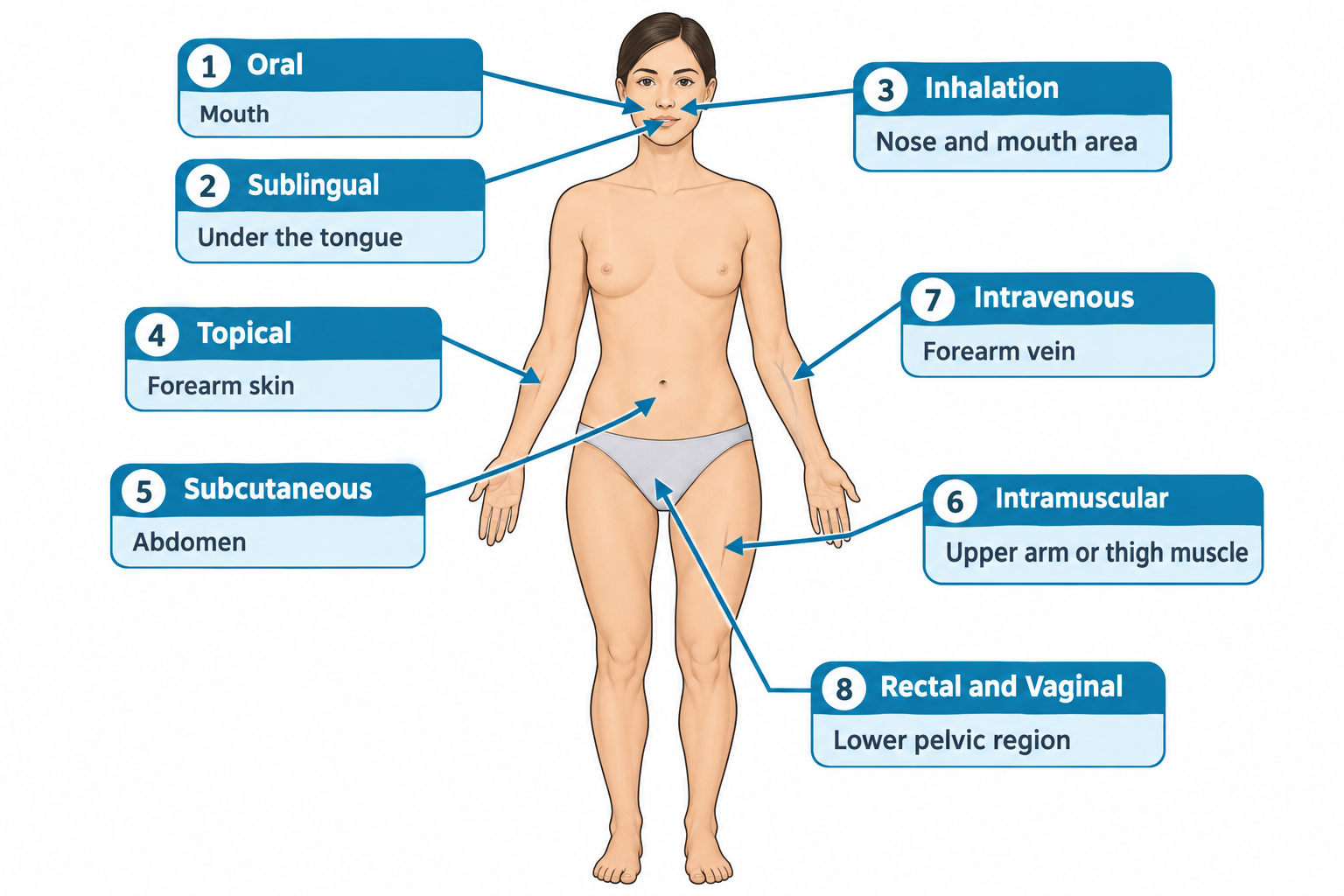
A frontal outline of a woman's body with numbered arrows pointing to sites for each medication route: 1 Oral to the mouth, 2 Sublingual under the tongue, 3 Inhalation to the nose and mouth area, 4 Topical to the forearm skin, 5 Subcutaneous to the abdomen, 6 Intramuscular to the upper arm or thigh muscle, 7 Intravenous to a forearm vein, and 8 Rectal and Vaginal to the lower pelvic region.
Common medication administration routes
Achievable

High-alert medication safety

The Institute for Safe Medication Practices (ISMP) lists high-alert meds that require extra caution due to the risk of serious harm.

Examples Nursing safeguards
Insulin Verify the dose and insulin type independently (e.g., rapid-acting vs. long-acting)
Heparin Monitor for bleeding; monitor aPTT for UFH; independently double-check the dose
Opioids Assess RR and sedation level; have naloxone ready
Chemotherapy Wear PPE; use special disposal
Anticoagulants Monitor for signs of bleeding and appropriate laboratory values as indicated

NGN tip: Always use independent double-checks for high-alert medication according to facility protocol.

Clinical vignette: A nurse is preparing to give morphine IV to a post-op client. She confirms the client’s name and DOB, checks allergies, scans the barcode, and compares the MAR and label. Before giving the dose, she checks the client’s respiratory rate (10/min). Concerned, she holds the medication, contacts the provider, and documents the hold.

Rationale: A respiratory rate of 10/min increases the risk of opioid-induced respiratory depression. The nurse followed the six rights of medication administration, used clinical judgment, and appropriately withheld the medication to prioritize client safety. Exactly what NCLEX wants you to do.

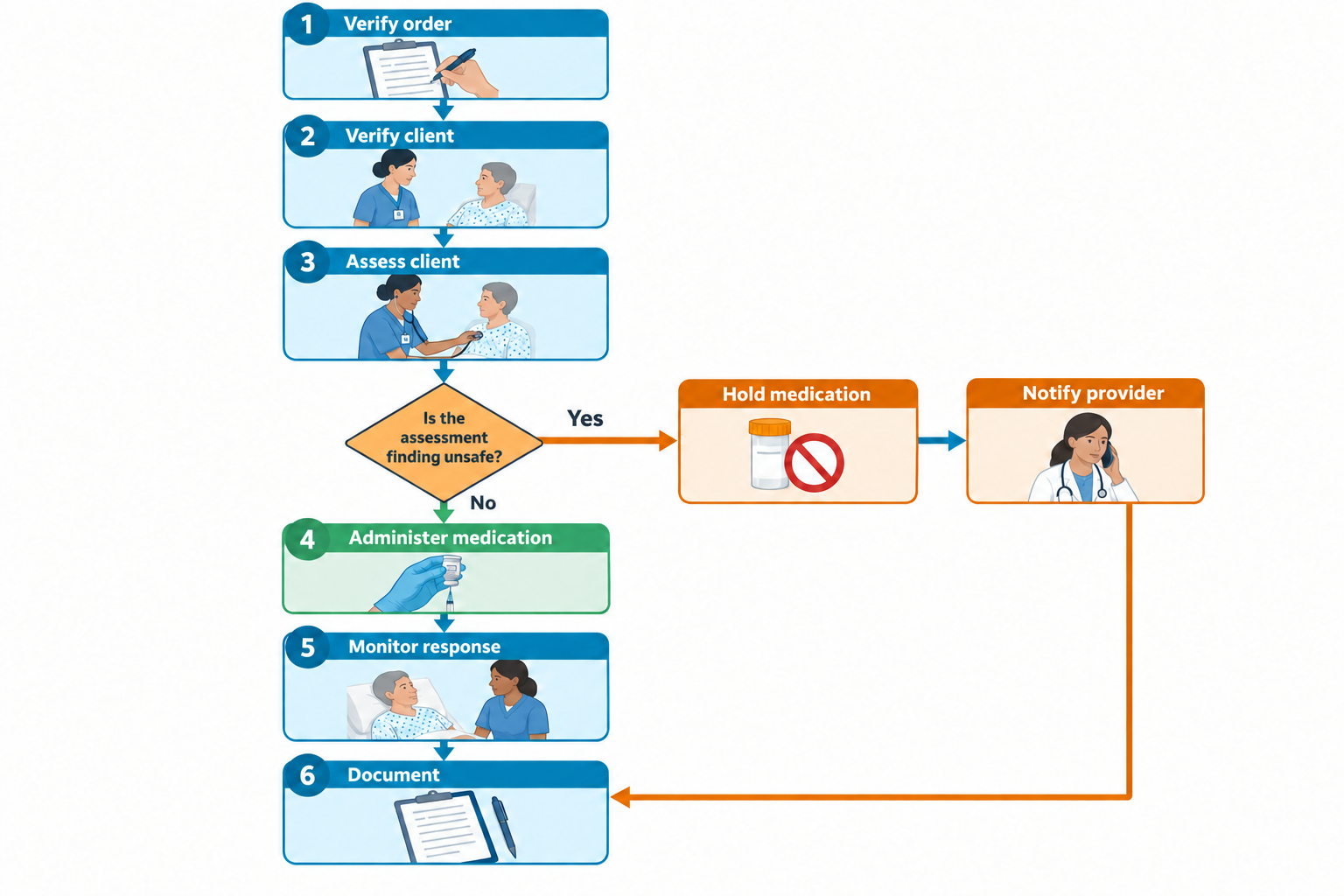
A vertical flowchart of six numbered steps for safe medication administration: (1) Verify order with a clipboard, (2) Verify client with a nurse confirming patient identity, (3) Assess client with a nurse checking blood pressure, then a decision diamond asking 'Is the assessment finding unsafe?' If yes, the path moves right to 'Hold medication' (a pill bottle with a no-entry symbol) and then 'Notify provider' (a nurse on the phone in a white coat). If no, the flow continues down to (4) Administer medication (a gloved hand holding a syringe), (5) Monitor response (a nurse checking on a bedridden patient), and (6) Document (a clipboard and pen).
Safe medication administration workflow
Achievable

Documentation and client education

  • Always document after administering (time, dose, route, site, effect).
  • For PRNs, include reason given and response.
  • Do not stop prescribed medications without consulting the healthcare provider unless instructed to do so.
  • Reconcile medications at each transition of care (admission, transfer, discharge) to catch duplications, omissions, or interactions.
  • Teach clients:
    • medication name, purpose, and side effects.
    • when and how to take it.
    • importance of adherence (especially with antibiotics or antihypertensives).
    • when to call provider (e.g., bleeding, rash, swelling).

Exam tip: on the NCLEX, a medication direction is a prescription - an order specific to a medication, formulated by an authorized primary health care provider. Never administer a medication from a verbal or informal order without first verifying it against the client’s prescription in the MAR.

  • Always confirm right patient, right drug, right dose, right route, right time, right documentation.
  • Use two identifiers—not room number
  • Be alert for look-alike/sound-alike meds
  • Never crush extended-release or enteric-coated tablets
  • High-alert meds require extra checks and monitoring.

Sign up for free to take 5 quiz questions on this topic

Previous
Next  | 4.2.3 Blood and blood product administration
All rights reserved ©2016 - 2026 Achievable, Inc.

Medication administration principles

Introduction

Administering medications is one of nursing’s most routine, and riskiest, responsibilities. A single error can lead to life-threatening consequences, so safe practice demands attention to detail, critical thinking, and unwavering vigilance.

On the NCLEX, you’ll be tested not only on drug knowledge but also on your ability to verify prescriptions, advocate for safety, and use clinical judgment to prevent harm. Throughout this chapter, Next Generation NCLEX (NGN) insight callouts highlight how these skills show up in exam items.

NGN insight: It’s not just about giving a pill. It’s about knowing why, how, to whom, and what to do if something goes wrong.

Learning objectives

By the end of this section, you should be able to:

  • apply the six rights of medication administration to every encounter
  • understand common medication routes, their uses, and risks
  • identify safety protocols for high-alert medications
  • respond appropriately to errors, near misses, or unclear prescriptions
  • educate clients about their medications and assess understanding

The six rights of medication administration

This foundational safety checklist must be verified before every dose, regardless of experience level or setting:

  1. Right client: Use two identifiers (e.g., name and date of birth); scan ID bands; never rely on room number. The NCLEX uses client to mean the individual, family, group, or population receiving care.
  2. Right medication: Compare MAR to medication label three times; watch for look-alike/sound-alike (LASA) drugs.
  3. Right dose: Double-check calculations, pay attention to decimals (0.1 mg vs. 1 mg).
  4. Right route: Ensure medication form matches ordered route (e.g., PO vs. IV).
  5. Right time: Administer within agency policy window; confirm PRN indications.
  6. Right documentation: Record immediately after administration, not before.
Definitions
MAR (Medication administration record)
Legal document listing all client medications, doses, times, and routes.
Look-alike/sound-alike (LASA) medications
Medications with similar names that increase risk of error (e.g., hydroxyzine vs. hydralazine).
PRN
Medication given “as needed” based on the client’s assessment and prescribed clinical parameters (e.g., pain score ≥6).
Prescription
A direction for treatment, including medications, formulated by a primary health care provider; the NCLEX uses this term for what’s often informally called a “medication order” in clinical practice.

NGN tip: The NCLEX often tests what NOT to do, like documenting before giving the medication or skipping ID verification.

Routes of medication administration

Each route has benefits and risks. Nurses must assess suitability, understand pharmacokinetics, and monitor for complications.

Route Description NCLEX tip
Oral (PO) Most common, convenient Assess swallowing ability; don’t crush enteric-coated
Sublingual (SL) Under the tongue; rapid absorption Don’t swallow; avoid food/water until dissolved
Topical Applied to skin/mucosa Rotate sites; wear gloves for hormone patches
Rectal/vaginal Suppositories or creams Ensure privacy; use lubrication; monitor retention
Inhalation MDI or nebulizers for respiratory delivery Use spacer if needed; rinse mouth after steroids
Subcutaneous (SubQ) Into fatty tissue (e.g., insulin, heparin) Rotate sites; 45-90° angle; monitor for bleeding
Intramuscular (IM) Into muscle tissue Use the Z-track technique for selected IM medications as indicated. Aspiration is generally not recommended for vaccines and most routine IM injections; follow medication-specific guidance and institutional policy
Intravenous (IV) Direct into bloodstream Rapid action; monitor site for infiltration, phlebitis

High-alert medication safety

The Institute for Safe Medication Practices (ISMP) lists high-alert meds that require extra caution due to the risk of serious harm.

Examples Nursing safeguards
Insulin Verify the dose and insulin type independently (e.g., rapid-acting vs. long-acting)
Heparin Monitor for bleeding; monitor aPTT for UFH; independently double-check the dose
Opioids Assess RR and sedation level; have naloxone ready
Chemotherapy Wear PPE; use special disposal
Anticoagulants Monitor for signs of bleeding and appropriate laboratory values as indicated

NGN tip: Always use independent double-checks for high-alert medication according to facility protocol.

Clinical vignette: A nurse is preparing to give morphine IV to a post-op client. She confirms the client’s name and DOB, checks allergies, scans the barcode, and compares the MAR and label. Before giving the dose, she checks the client’s respiratory rate (10/min). Concerned, she holds the medication, contacts the provider, and documents the hold.

Rationale: A respiratory rate of 10/min increases the risk of opioid-induced respiratory depression. The nurse followed the six rights of medication administration, used clinical judgment, and appropriately withheld the medication to prioritize client safety. Exactly what NCLEX wants you to do.

Documentation and client education

  • Always document after administering (time, dose, route, site, effect).
  • For PRNs, include reason given and response.
  • Do not stop prescribed medications without consulting the healthcare provider unless instructed to do so.
  • Reconcile medications at each transition of care (admission, transfer, discharge) to catch duplications, omissions, or interactions.
  • Teach clients:
    • medication name, purpose, and side effects.
    • when and how to take it.
    • importance of adherence (especially with antibiotics or antihypertensives).
    • when to call provider (e.g., bleeding, rash, swelling).

Exam tip: on the NCLEX, a medication direction is a prescription - an order specific to a medication, formulated by an authorized primary health care provider. Never administer a medication from a verbal or informal order without first verifying it against the client’s prescription in the MAR.

Key points
  • Always confirm right patient, right drug, right dose, right route, right time, right documentation.
  • Use two identifiers—not room number
  • Be alert for look-alike/sound-alike meds
  • Never crush extended-release or enteric-coated tablets
  • High-alert meds require extra checks and monitoring.

More from Pharmacological and parenteral therapies

  • Intravenous therapy
  • Blood and blood product administration
  • Pharmacodynamics and side effects
  • High-risk medications
  • Adverse effects, contraindications, and interactions