



Coping mechanisms and stress management
Introduction
Coping is the set of thoughts, emotions, and behaviors people use to manage stress. It can protect mental health or undermine it. Sometimes it does both at once. For nurses, understanding coping styles is essential for interpreting client behavior, preventing crises, and guiding clients toward healthier strategies.
NCLEX tests these concepts often, especially in scenarios where a client’s behavior may look “difficult” but is actually a coping response to anxiety, trauma, guilt, or fear. Recognizing the difference between adaptive and maladaptive coping helps nurses intervene safely, therapeutically, and non-judgmentally.
Learning objectives
By the end of this section, you should be able to:
- Differentiate between adaptive and maladaptive coping mechanisms
- Recognize common defense mechanisms seen in clinical settings
- Apply nursing interventions that improve coping and reduce distress
- Guide clients through stress reduction techniques
- Use therapeutic communication to address ineffective coping
- Interpret NCLEX-style scenarios involving coping and behavior changes
Understanding stress and coping
Stress is a natural response to perceived threats, loss, or change. It activates:
- Emotional responses (fear, sadness, anger)
- Cognitive changes (worry, impaired concentration)
- Physical symptoms (tachycardia, tension, nausea)
- Behavioral shifts (withdrawal, irritability, avoidance)
Coping mechanisms are the strategies clients use, consciously or unconsciously, to restore emotional balance.
Adaptive coping mechanisms
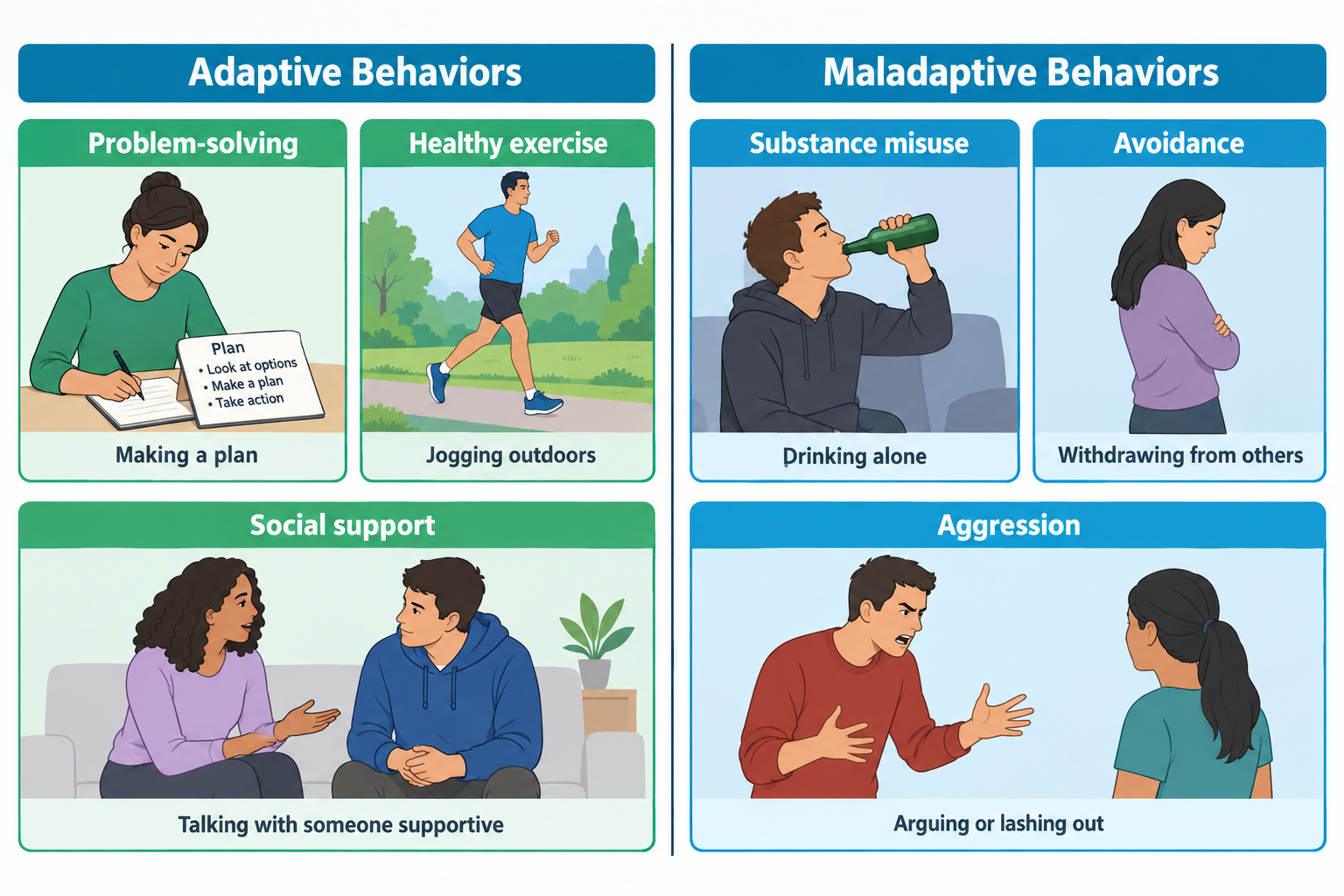
Adaptive coping promotes growth, safety, and stability. These behaviors help clients manage stress without harming themselves or others.
Examples of adaptive coping
- Problem-solving: identifying solutions, asking for help.
- Seeking social support: reaching out to friends, family, community.
- Assertive communication: expressing needs respectfully.
- Humor: reducing tension appropriately.
- Time management: reducing overwhelm through organization.
Exercise, journaling, and relaxation techniques are also adaptive - these are covered in more detail under stress management interventions below.
Nursing interventions
- Reinforce and praise effective coping strategies
- Provide teaching on relaxation and mindfulness
- Help clients identify strengths and protective factors
- Encourage open expression of feelings using therapeutic communication
Maladaptive coping mechanisms
Maladaptive coping may temporarily relieve stress but leads to long-term harm. These patterns often appear in NCLEX questions because they signal risk.
Examples of maladaptive coping
- Avoidance or withdrawal
- Substance misuse (alcohol, drugs, smoking, vaping)
- Aggression, hostility, or blaming others
- Denial of illness or safety risks
- Impulsive behaviors (gambling, spending, risky sex)
- Overeating or undereating
- Compulsive behaviors
- Self-harm
Nursing interventions
- Assess for safety risks (self-harm, substance withdrawal)
- Use therapeutic communication to explore underlying emotions
- Provide referrals to mental health or substance use support services
- Avoid confrontation or shaming; meet the client where they are
Defense mechanisms
Defense mechanisms are unconscious strategies that protect individuals from anxiety or internal conflict. NCLEX often tests whether you can identify which defense mechanism a client is using and whether it is adaptive or maladaptive.
Common defense mechanisms
- Compensation
- Emphasizing strengths to make up for weaknesses.
- Denial
- Refusing to acknowledge painful reality.
- Displacement
- Shifting emotions to a safer target.
- Projection
- Attributing one’s feelings to others.
- Rationalization
- Justifying behavior with logical explanations.
- Regression
- Reverting to childlike behaviors during stress.
- Reaction formation
- Behaving opposite to one’s true feelings.
- Suppression
- Consciously choosing to delay emotional expression.
- Repression
- Unconsciously blocking distressing thoughts.
- Sublimation
- Channeling unacceptable impulses into constructive behavior.
- Intellectualization
- Focusing on facts to avoid emotional discomfort.
Example: Identifying a defense mechanism
A client with a new colostomy tells the nurse, “I don’t need to learn how to change this bag. I’ll be back to normal in a week and won’t need it anymore.” Which defense mechanism is this client using?
The client is using denial - refusing to acknowledge the permanence of the colostomy. The nurse should gently explore the client’s feelings rather than confront the denial directly, and continue offering teaching in small, non-threatening steps.
Supporting altered body image and role changes
Sudden changes in appearance or function - such as alopecia from chemotherapy, limb amputation, or burns - can be as distressing as the underlying illness itself. Clients may also need to adapt to new or lost roles, such as a parent who becomes a care recipient or a provider who can no longer work.
- Encourage the client to verbalize feelings about the change before offering solutions.
- Gently correct misperceptions rather than dismissing them.
- Reinforce use of adaptive aids (wigs, prostheses, adaptive equipment) as tools for coping, not signs of vanity.
- Refer to support groups or rehabilitation specialists as appropriate.
- Assess how well the client is adapting to temporary versus permanent role changes, and involve family in the adjustment.
Stress management interventions
Nurses frequently teach or model stress-management strategies.
Relaxation techniques
- Guided imagery
- Deep-breathing exercises
- Progressive muscle relaxation
- Grounding techniques (“name 5 things you can see…”)
- Meditation and mindfulness
Behavioral strategies
- Limit stimulants (caffeine, nicotine)
- Regular exercise
- Structured daily routine
- Adequate sleep hygiene
Emotional strategies
- Journaling
- Talking with supportive individuals
- Identifying triggers
- Scheduling enjoyable activities
Cognitive strategies
- Reframing negative thoughts
- Problem-solving steps
- Challenging unrealistic beliefs
Environmental strategies
- Reduce noise and other physical irritants in the care environment.
- Orient clients to reduce uncertainty (introduce staff, explain routines and procedures).
- Provide clear information to address gaps in knowledge before procedures.
- Minimize abrupt or unnecessary changes to routines, and prepare clients in advance for changes that can’t be avoided.
Assessment of coping
During assessment, the nurse evaluates:
- The client’s perception of the stressor.
- Current coping strategies and their effectiveness.
- Emotional and behavioral responses
- Available support systems.
- Cultural or spiritual coping resources.
- Safety concerns (self-harm, aggression, substance withdrawal).
Clinical vignette: A 34-year-old woman recently diagnosed with breast cancer begins missing appointments and avoids phone calls. When the nurse gently explores this, the client admits she feels overwhelmed and terrified. The nurse identifies avoidance as a maladaptive coping mechanism and helps her express fears, connect with oncology support services, and choose more adaptive strategies.