


Achievable logoAchievable logo
CMA Part 1
Sign in
Sign up
Purchase
Textbook
Practice exams
Support
How it works
Exam catalog
Mountain with a flag at the peak
Textbook
1. External financial reporting decisions
2. Planning, budgeting, and forecasting
3. Performance management
4. Cost management
4.1 Measurement concepts
4.1.1 Cost behavior, cost objects, and cost pools
4.1.2 Product and period costs, cost drivers, and cost measurement methods
4.1.3 Inventory cost flow: trading vs. manufacturing
4.1.4 Absorption vs. variable costing: impact on inventory and income
4.1.5 Absorption vs. variable costing: illustrative problem
4.1.6 Joint and by-product costing: key concepts
4.1.7 Joint and by-product costing: cost allocation methods and by-product costing
4.2 Costing systems
4.3 Overhead costs
4.4 Supply chain management
4.5 Business process improvement
5. Internal control
6. Technology and analytics
Achievable logoAchievable logo
4.1.1 Cost behavior, cost objects, and cost pools
Achievable CMA Part 1
4. Cost management
4.1. Measurement concepts
Our CMA Part 1 course is currently in development and is a work-in-progress.

Cost behavior, cost objects, and cost pools

7 min read
Font
Discuss
Share
Feedback

Learning outcome statements

The learning outcome statements relevant for this section are:

  1. calculate fixed, variable, and mixed costs, and demonstrate an understanding of the behavior of each in the long and short term and how a change in assumptions regarding cost type or relevant range affects these costs
  2. identify cost objects and cost pools, and assign costs to appropriate activities
  3. demonstrate an understanding of the nature and types of cost drivers and the causal relationship that exists between cost drivers and costs incurred
  4. demonstrate an understanding of the various methods for measuring costs and accumulating work-in-process and finished goods inventories
  5. identify and define cost measurement techniques, such as actual costing, normal costing, and standard costing; calculate costs using each of these techniques; identify the appropriate use of each technique; and describe the benefits and limitations of each technique

Cost classification and behavior

Cost behavior refers to how a cost changes in response to variations in activity levels. Understanding cost behavior is essential for managers to predict future costs and make informed decisions. Costs can be classified based on behavior, traceability, and function. The behavioral classification is especially useful for planning, budgeting, and decision-making.

When analyzing cost behavior, it is important to distinguish between how costs behave in total versus how they behave on a per-unit basis.

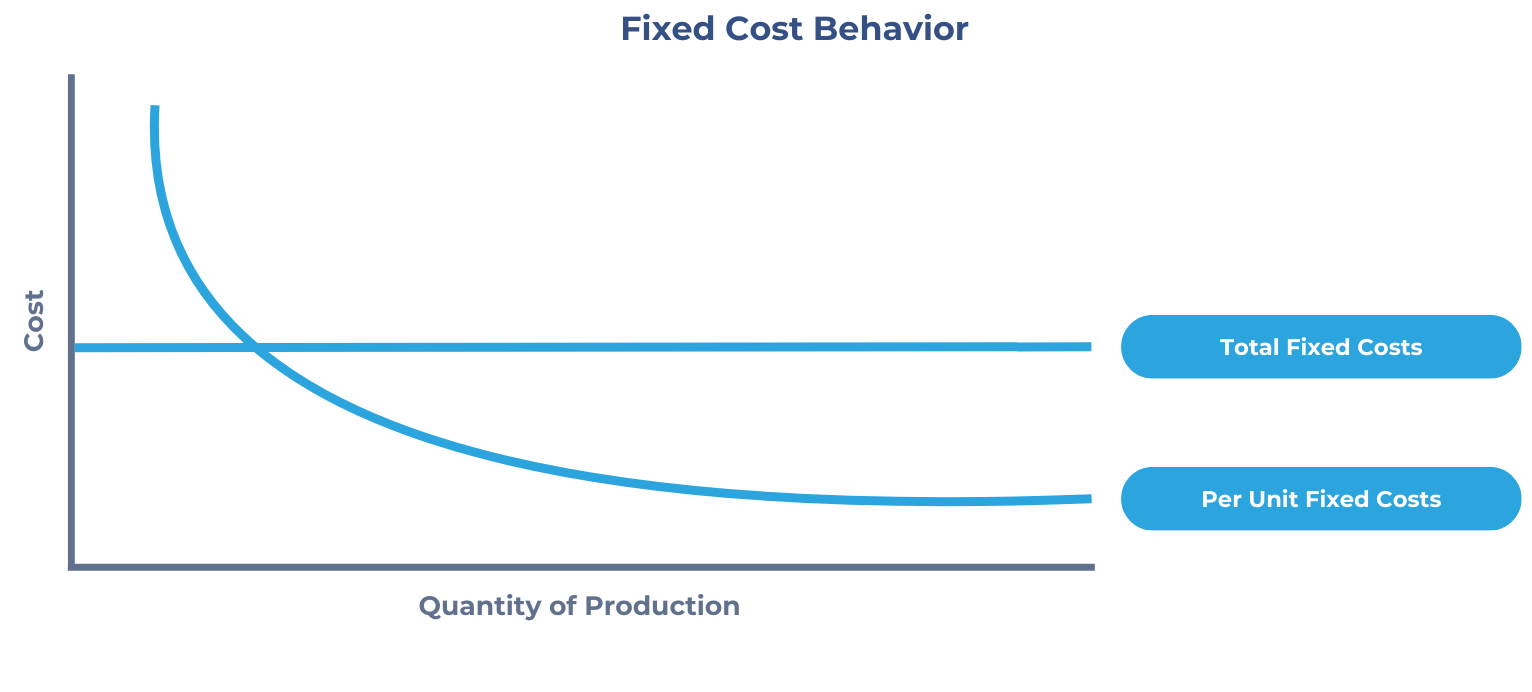
  • Fixed Costs remain unchanged in total regardless of the level of activity, within the relevant range. However, on a per-unit basis, fixed costs decrease as activity increases because the total fixed cost is spread over more units.
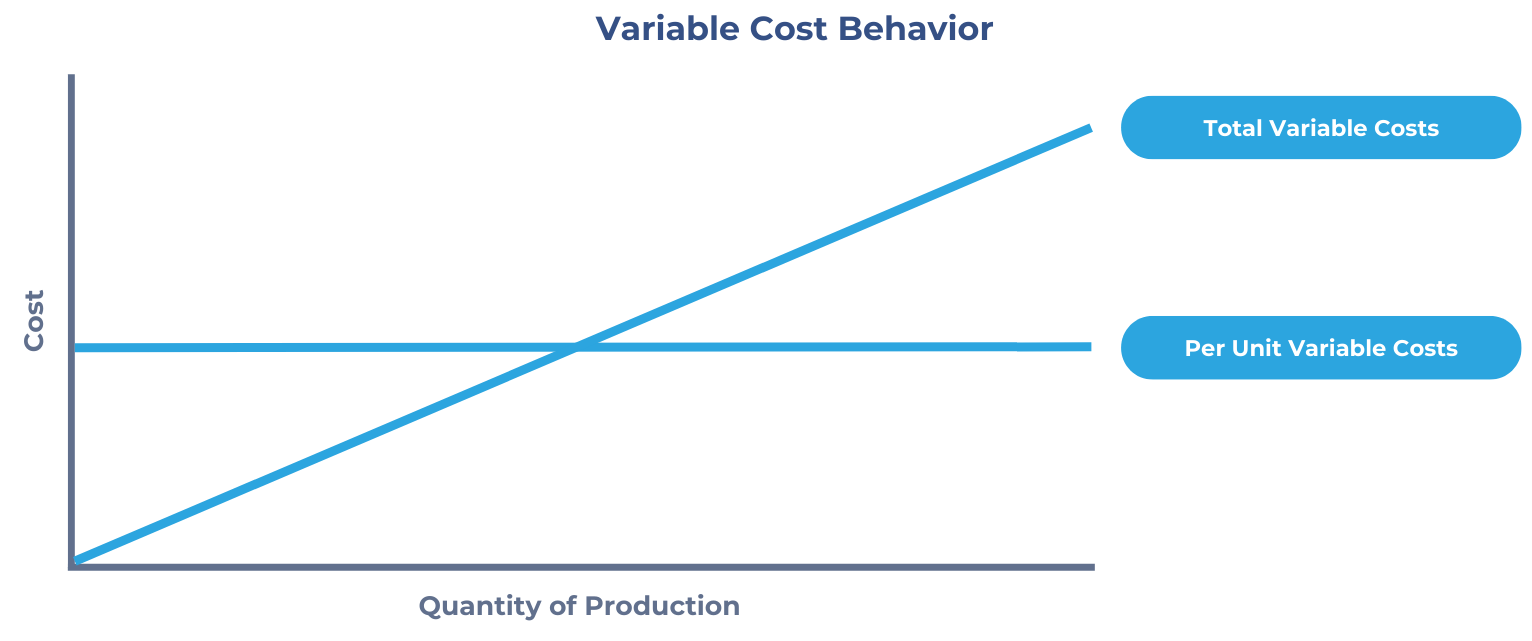
  • Variable Costs vary directly and proportionately with activity level. The total variable cost increases as more units are produced, while the variable cost per unit remains constant.
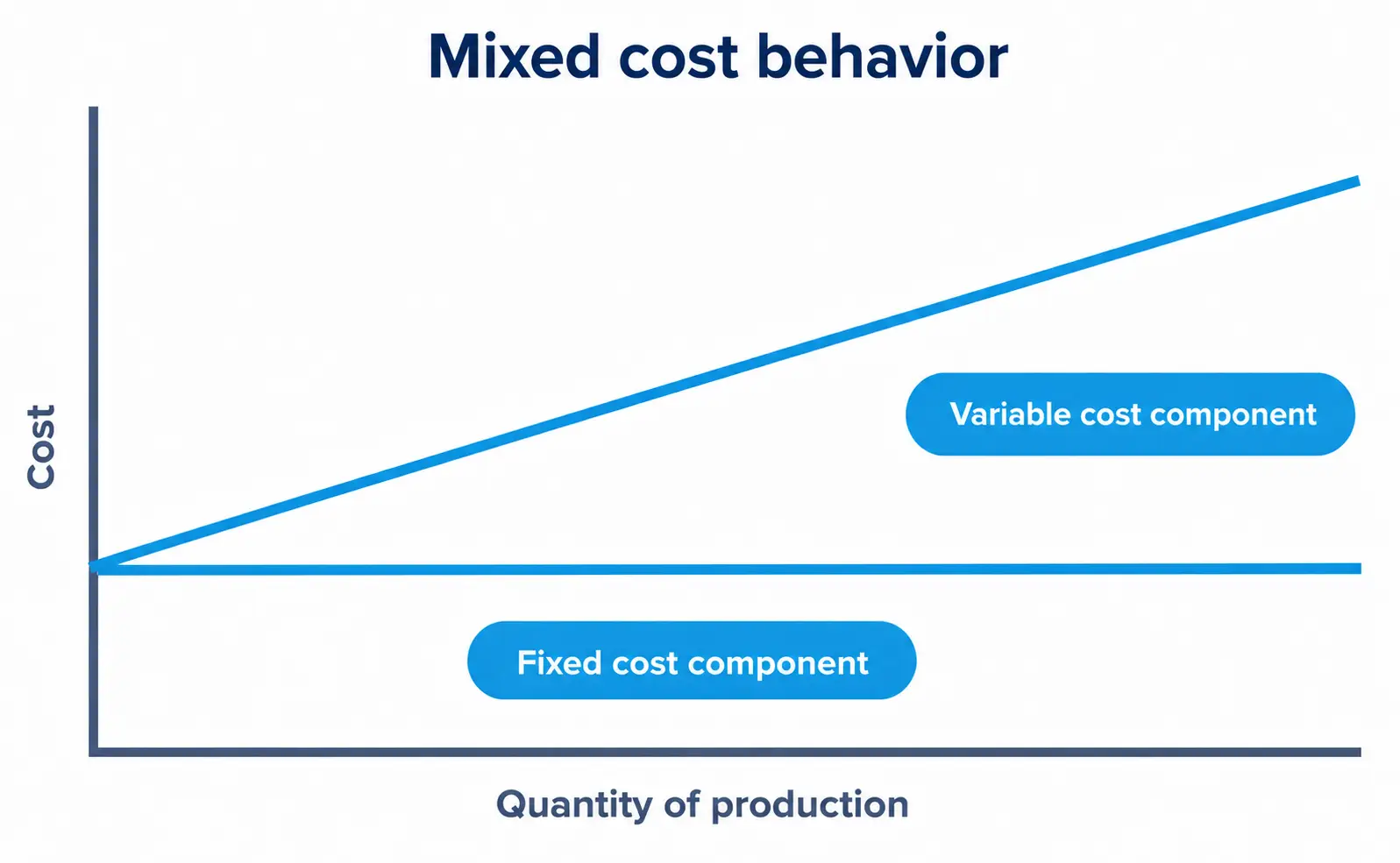
  • Mixed Costs contain both fixed and variable components. These costs do not change in a strictly linear fashion with activity levels. For instance, they may increase with production but not proportionally.

A classic example is a utility bill: there is a base service fee (fixed) that must be paid regardless of usage, and a variable component that increases based on actual electricity or water consumption.

Another example of mixed cost is sales staff compensation that includes a fixed base salary plus a commission per sale. Regardless of whether any sales are made, the base salary is paid, but total compensation rises as more sales are completed.

Mixed costs are also known as semi-variable or semi-fixed costs. To analyze them effectively, companies often separate the fixed and variable components using techniques such as the high-low method or regression analysis.

Fixed cost behavior illustration
Variable cost behavior illustration
Showing mixed cost as a rising variable component on top of a flat fixed cost component.
Mixed Cost Behavior

Cost behavior can vary between the short term and long term, which significantly impacts decision-making. In the short term, some costs are often fixed due to contractual obligations or capacity limitations. For example, rental payments or salaried labor may not change even if production increases or decreases within a short period.

In the long term, however, most costs become more variable. Contracts may be renegotiated, operations can be scaled, and labor structures can be altered. This flexibility allows managers to adjust costs in response to strategic goals or changes in market demand.

For example, A factory lease is considered fixed over a one-year period because the terms are locked in, but in the long term, the lease can be renegotiated, terminated, or replaced by a different facility, making the cost variable from a strategic perspective.

Another example is permanent employees who are salaried in the short term. Over several years, staffing levels can be adjusted through hiring freezes, attrition, or restructuring, making labor more variable in the long term.

Definitions
Relevant range
The level of activity within which cost assumptions remain valid. Outside this range, cost behavior may shift, leading to step costs or changes in fixed or variable classifications.

An example of relevant range is when a factory may operate efficiently between 10,000 to 20,000 units of production. Within this range, fixed costs like rent remain unchanged, and variable costs per unit stay constant. However, if production exceeds 20,000 units, the company might need to rent additional space or hire another supervisor, increasing fixed costs. Alternatively, if production drops below 10,000 units, equipment may be underutilized, leading to inefficiencies and altered cost behavior.

Cost objects and cost pools

Understanding the distinction between cost objects and cost pools is foundational to effective cost allocation and managerial decision-making. In any organization, it is important to know where costs are incurred and how they should be assigned. This allows managers to better control costs, assess departmental performance, price products appropriately, and allocate overhead costs fairly across different segments of the business.

Definitions
Cost object
Any item for which a separate cost measurement is desired. Common examples include a product, department, service line, customer, or project. For example, in a furniture company, each type of furniture (chairs, tables or desks) may be treated as a separate cost object.
Cost pool
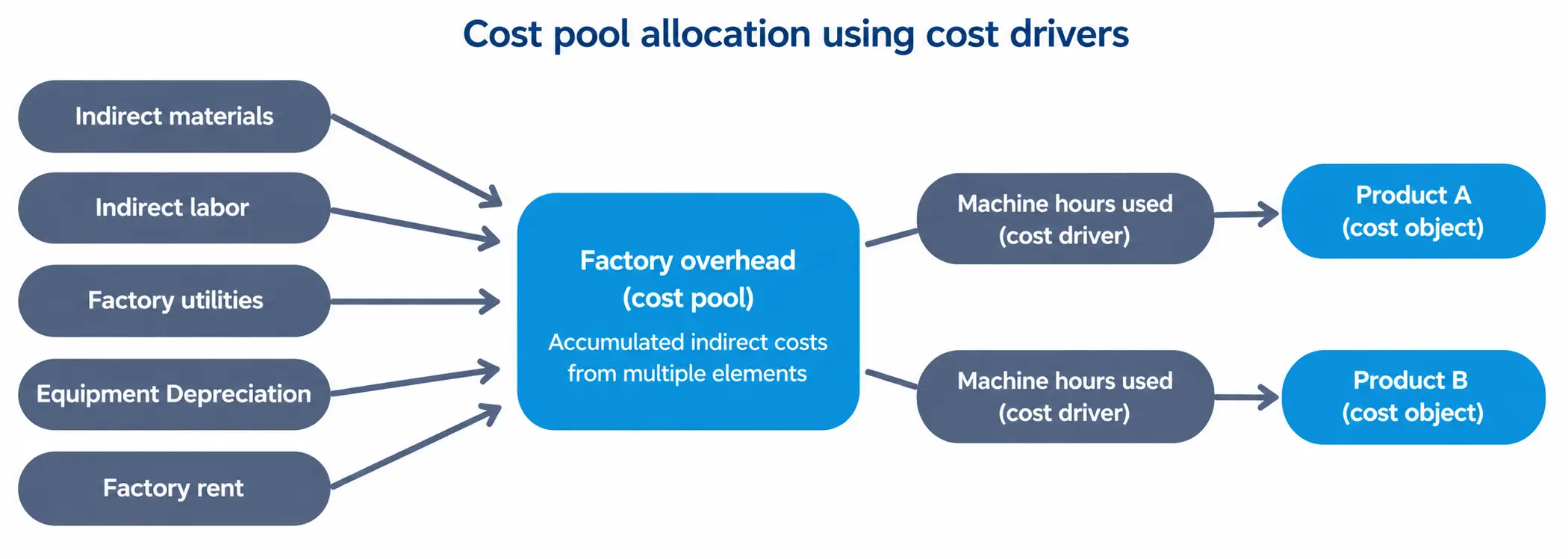
A collection or grouping of individual cost elements that relate to a specific activity, department, or function. For example, all electricity, maintenance, and depreciation costs of a manufacturing facility might be grouped into a single “factory overhead” cost pool.
Showing indirect costs flowing into a factory overhead cost pool then allocated to two products by machine hours.
Cost Pool Allocation

Accurate assignment of costs to cost objects via cost pools supports effective costing systems and internal control. This process enables better budgeting, pricing decisions, and profitability analysis. For instance, utility and supervisory labor costs from the factory cost pool might be allocated to individual products based on machine hours or labor hours used.

This process enables better budgeting, pricing decisions, and profitability analysis. For instance, utility and supervisory labor costs from the factory cost pool might be allocated to individual products based on machine hours or labor hours used.

This concept becomes especially relevant when dealing with indirect costs, such as overhead, that cannot be traced directly to a single item. While direct materials and direct labor can be directly traced to a product or job, overhead costs must be distributed using cost pools and allocated to cost objects based on appropriate drivers. This is why identifying cost objects and establishing cost pools is critical for accurate product costing, especially in complex or multi-product environments.

Cost classification and behavior

  • Fixed costs: unchanged in total within relevant range; per-unit decreases as activity rises
  • Variable costs: total varies directly with activity; per-unit remains constant
  • Mixed costs: contain both fixed and variable elements; analyzed using high-low method or regression

Short-term vs. long-term cost behavior

  • Short term: many costs fixed due to contracts/capacity limits
  • Long term: most costs become variable; contracts renegotiated, operations scaled
  • Relevant range: activity level where cost assumptions hold; outside this, cost behavior may change

Cost objects and cost pools

  • Cost object: item needing separate cost measurement (e.g., product, department, project)
  • Cost pool: group of related costs for allocation (e.g., factory overhead)
  • Indirect costs/overhead: assigned to cost objects via cost pools and appropriate allocation bases

Sign up for free to take 10 quiz questions on this topic

Previous
Next  | 4.1.2 Product and period costs, cost drivers, and cost measurement methods
All rights reserved ©2016 - 2026 Achievable, Inc.

Cost behavior, cost objects, and cost pools

Learning outcome statements

The learning outcome statements relevant for this section are:

  1. calculate fixed, variable, and mixed costs, and demonstrate an understanding of the behavior of each in the long and short term and how a change in assumptions regarding cost type or relevant range affects these costs
  2. identify cost objects and cost pools, and assign costs to appropriate activities
  3. demonstrate an understanding of the nature and types of cost drivers and the causal relationship that exists between cost drivers and costs incurred
  4. demonstrate an understanding of the various methods for measuring costs and accumulating work-in-process and finished goods inventories
  5. identify and define cost measurement techniques, such as actual costing, normal costing, and standard costing; calculate costs using each of these techniques; identify the appropriate use of each technique; and describe the benefits and limitations of each technique

Cost classification and behavior

Cost behavior refers to how a cost changes in response to variations in activity levels. Understanding cost behavior is essential for managers to predict future costs and make informed decisions. Costs can be classified based on behavior, traceability, and function. The behavioral classification is especially useful for planning, budgeting, and decision-making.

When analyzing cost behavior, it is important to distinguish between how costs behave in total versus how they behave on a per-unit basis.

  • Fixed Costs remain unchanged in total regardless of the level of activity, within the relevant range. However, on a per-unit basis, fixed costs decrease as activity increases because the total fixed cost is spread over more units.
  • Variable Costs vary directly and proportionately with activity level. The total variable cost increases as more units are produced, while the variable cost per unit remains constant.
  • Mixed Costs contain both fixed and variable components. These costs do not change in a strictly linear fashion with activity levels. For instance, they may increase with production but not proportionally.

A classic example is a utility bill: there is a base service fee (fixed) that must be paid regardless of usage, and a variable component that increases based on actual electricity or water consumption.

Another example of mixed cost is sales staff compensation that includes a fixed base salary plus a commission per sale. Regardless of whether any sales are made, the base salary is paid, but total compensation rises as more sales are completed.

Mixed costs are also known as semi-variable or semi-fixed costs. To analyze them effectively, companies often separate the fixed and variable components using techniques such as the high-low method or regression analysis.

Cost behavior can vary between the short term and long term, which significantly impacts decision-making. In the short term, some costs are often fixed due to contractual obligations or capacity limitations. For example, rental payments or salaried labor may not change even if production increases or decreases within a short period.

In the long term, however, most costs become more variable. Contracts may be renegotiated, operations can be scaled, and labor structures can be altered. This flexibility allows managers to adjust costs in response to strategic goals or changes in market demand.

For example, A factory lease is considered fixed over a one-year period because the terms are locked in, but in the long term, the lease can be renegotiated, terminated, or replaced by a different facility, making the cost variable from a strategic perspective.

Another example is permanent employees who are salaried in the short term. Over several years, staffing levels can be adjusted through hiring freezes, attrition, or restructuring, making labor more variable in the long term.

Definitions
Relevant range
The level of activity within which cost assumptions remain valid. Outside this range, cost behavior may shift, leading to step costs or changes in fixed or variable classifications.

An example of relevant range is when a factory may operate efficiently between 10,000 to 20,000 units of production. Within this range, fixed costs like rent remain unchanged, and variable costs per unit stay constant. However, if production exceeds 20,000 units, the company might need to rent additional space or hire another supervisor, increasing fixed costs. Alternatively, if production drops below 10,000 units, equipment may be underutilized, leading to inefficiencies and altered cost behavior.

Cost objects and cost pools

Understanding the distinction between cost objects and cost pools is foundational to effective cost allocation and managerial decision-making. In any organization, it is important to know where costs are incurred and how they should be assigned. This allows managers to better control costs, assess departmental performance, price products appropriately, and allocate overhead costs fairly across different segments of the business.

Definitions
Cost object
Any item for which a separate cost measurement is desired. Common examples include a product, department, service line, customer, or project. For example, in a furniture company, each type of furniture (chairs, tables or desks) may be treated as a separate cost object.
Cost pool
A collection or grouping of individual cost elements that relate to a specific activity, department, or function. For example, all electricity, maintenance, and depreciation costs of a manufacturing facility might be grouped into a single “factory overhead” cost pool.

Accurate assignment of costs to cost objects via cost pools supports effective costing systems and internal control. This process enables better budgeting, pricing decisions, and profitability analysis. For instance, utility and supervisory labor costs from the factory cost pool might be allocated to individual products based on machine hours or labor hours used.

This process enables better budgeting, pricing decisions, and profitability analysis. For instance, utility and supervisory labor costs from the factory cost pool might be allocated to individual products based on machine hours or labor hours used.

This concept becomes especially relevant when dealing with indirect costs, such as overhead, that cannot be traced directly to a single item. While direct materials and direct labor can be directly traced to a product or job, overhead costs must be distributed using cost pools and allocated to cost objects based on appropriate drivers. This is why identifying cost objects and establishing cost pools is critical for accurate product costing, especially in complex or multi-product environments.

Key points

Cost classification and behavior

  • Fixed costs: unchanged in total within relevant range; per-unit decreases as activity rises
  • Variable costs: total varies directly with activity; per-unit remains constant
  • Mixed costs: contain both fixed and variable elements; analyzed using high-low method or regression

Short-term vs. long-term cost behavior

  • Short term: many costs fixed due to contracts/capacity limits
  • Long term: most costs become variable; contracts renegotiated, operations scaled
  • Relevant range: activity level where cost assumptions hold; outside this, cost behavior may change

Cost objects and cost pools

  • Cost object: item needing separate cost measurement (e.g., product, department, project)
  • Cost pool: group of related costs for allocation (e.g., factory overhead)
  • Indirect costs/overhead: assigned to cost objects via cost pools and appropriate allocation bases

More from Measurement concepts

  • Product and period costs, cost drivers, and cost measurement methods
  • Inventory cost flow: trading vs. manufacturing
  • Absorption vs. variable costing: impact on inventory and income
  • Absorption vs. variable costing: illustrative problem
  • Joint and by-product costing: key concepts