



Joint and by-product costing: key concepts
Learning outcome statements
The learning outcome statements relevant for this section are:
- determine the appropriate use of joint product and by-product costing
- demonstrate an understanding of concepts such as split-off point and separable costs
- determine the allocation of joint product and by-product costs using the physical measure method, the sales value at split-off method, constant gross profit (gross margin) method, and the net realizable value method, and describe the benefits and limitations of each method
Introduction
Many manufacturing processes produce multiple outputs simultaneously from a common input and shared processing effort. These outputs, known as joint products and by-products, emerge from a single production process and remain indistinguishable until a specific point in the process, referred to as the split-off point. At this stage, each product becomes separately identifiable and may be further processed or sold.
The challenge for accountants lies in determining how to allocate joint costs (the costs incurred up to the split-off point) among the resulting products. This allocation is crucial not only for inventory valuation and cost of goods sold, but also for profitability analysis, pricing decisions, and financial reporting.
Joint and by-product costing systems are commonly used in industries where multiple outputs naturally arise from a single process. Examples include:
- Petroleum refining (e.g., gasoline, diesel, kerosene)
- Meat processing (e.g., various cuts of meat and animal by-products)
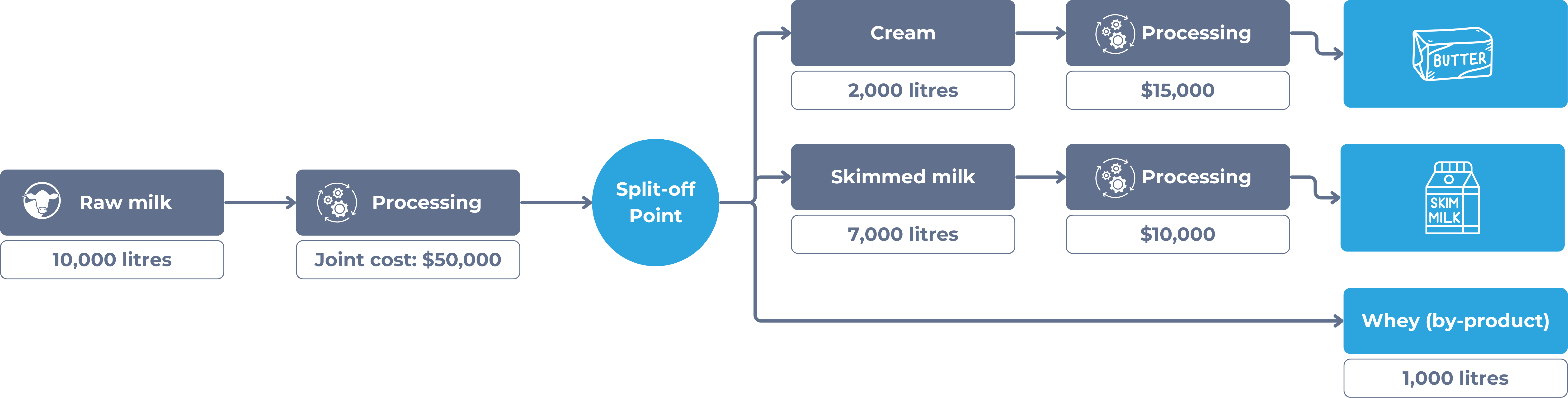
- Dairy production (e.g., milk, cream, whey)
- Chemical manufacturing (e.g., acids, solvents, and derivatives)
Because joint products often represent significant revenue streams, and by-products can either be sold or reused, organizations must carefully consider how to account for these outputs in a way that reflects economic reality and supports effective decision-making.
Key concepts
Understanding joint and by-product costing begins with a clear grasp of three foundational ideas: joint products, by-products, and the split-off point. These concepts frame how costs are traced, allocated, and reported in multi-output production environments.
Joint products
Joint products are two or more products of significant value that are simultaneously produced from a common input and manufacturing process. They share the same production path until a certain stage, after which they are physically distinguishable and may undergo further processing. For example, in crude oil refining, gasoline, diesel, and jet fuel are joint products.
Joint products are not distinguishable until the split-off point, which necessitates the allocation of joint costs, the total cost incurred up to that point, across the products.
By-products
By-products are secondary outputs of relatively minor value that are also generated incidentally during the joint production process. Although by-products can be sold or reused, they are not the primary focus of the production activity.
For example, in meat processing, bones and hides may be considered by-products when the main focus is on meat cuts. Unlike joint products, by-products are not typically allocated joint costs in the same way. Instead, they may be recorded as:
- Other income, or
- A reduction in the cost of the main products
The choice of treatment depends on materiality and the organization’s accounting policy.
Split-off point
The split-off point is the stage in the production process where joint products (and by-products) become separately identifiable. Costs incurred up to this point are called joint costs, while any costs incurred after this point (e.g., further refining or packaging) are known as separable costs.
Joint costs must be allocated to the main products using a systematic and rational method.
Separable costs, in contrast, are directly traceable to individual products and are not subject to allocation.
Separable costs
Separable costs are any costs that arise after the split-off point and can be attributed directly to a specific product. These may include:
- Additional materials or packaging
- Direct labor specific to a product
- Transportation or finishing costs
These costs are not part of joint cost allocation and are included in the total cost of the product after allocation.