


Achievable logoAchievable logo
CMA Part 1
Sign in
Sign up
Purchase
Textbook
Practice exams
Support
How it works
Exam catalog
Mountain with a flag at the peak
Textbook
1. External financial reporting decisions
2. Planning, budgeting, and forecasting
3. Performance management
4. Cost management
4.1 Measurement concepts
4.1.1 Cost behavior, cost objects, and cost pools
4.1.2 Product and period costs, cost drivers, and cost measurement methods
4.1.3 Inventory cost flow: trading vs. manufacturing
4.1.4 Absorption vs. variable costing: impact on inventory and income
4.1.5 Absorption vs. variable costing: illustrative problem
4.1.6 Joint and by-product costing: key concepts
4.1.7 Joint and by-product costing: cost allocation methods and by-product costing
4.2 Costing systems
4.3 Overhead costs
4.4 Supply chain management
4.5 Business process improvement
5. Internal control
6. Technology and analytics
Achievable logoAchievable logo
4.1.2 Product and period costs, cost drivers, and cost measurement methods
Achievable CMA Part 1
4. Cost management
4.1. Measurement concepts
Our CMA Part 1 course is currently in development and is a work-in-progress.

Product and period costs, cost drivers, and cost measurement methods

8 min read
Font
Discuss
Share
Feedback

Product costs vs. period costs

In understanding cost classification, it’s important to distinguish between product costs and period costs, especially in the context of cost accumulation and inventory valuation.

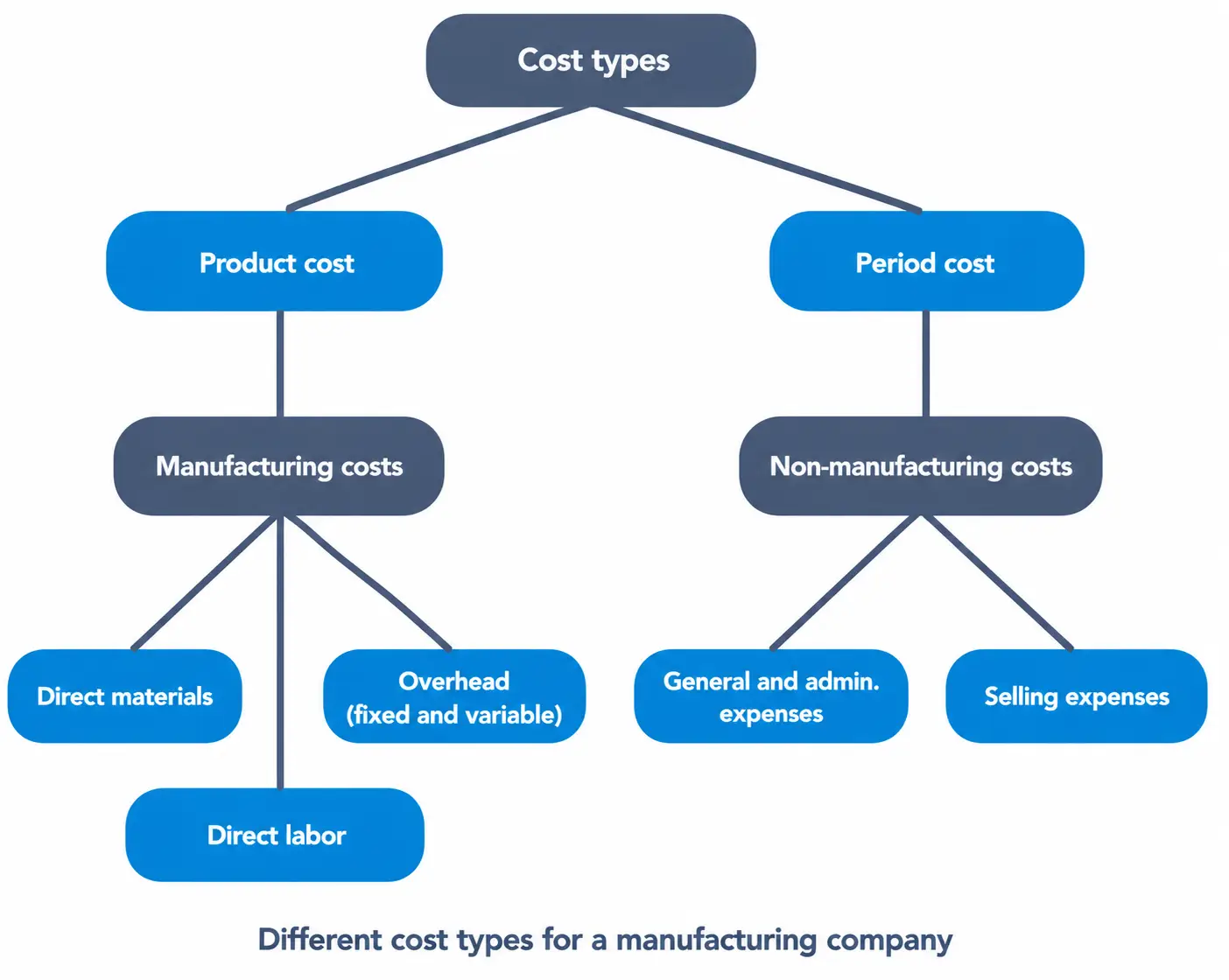
Splitting cost types into product costs and period costs with further subcategories.
Manufacturing Cost Types

Product costs

These are costs that are incurred to create a product and are capitalized as inventory on the balance sheet until the product is sold. Once the product is sold, these costs move from inventory to cost of goods sold (COGS) on the income statement. Product costs include:

1. Direct materials

Direct materials are raw materials that can be directly and physically traced to the production of finished goods. They form a fundamental part of the product’s composition and can be measured and assigned to specific cost objects (such as jobs or units) without allocation. steel in car manufacturing, fabric in clothing production, or flour in bread making.

2. Direct labor

Direct labor refers to the wages, salaries, and related benefits of employees who are directly involved in the manufacturing or production of goods. These are the hands-on workers, such as machine operators, assembly line staff, and bakers, whose efforts can be physically and directly traced to specific units or batches of output.

Because direct labor is directly traceable to individual cost objects, it is considered a direct cost and a component of product costs. Unlike overhead, it does not require allocation via cost pools. Instead, it is assigned straight to the cost object it helped produce.

3. Manufacturing overhead

Manufacturing overhead refers to indirect costs that are incurred in the production process but cannot be directly traced to a specific product, job, or service. These are essential costs that support manufacturing activities but do not become a physical part of the finished product and are not directly involved in the transformation of inputs to outputs. Manufacturing overhead is typically classified into two categories:

  • 3.1. Variable Overhead: These costs fluctuate with production volume. Examples include indirect materials (e.g., lubricants, cleaning supplies) and utilities used in the factory. The more you produce, the more variable overhead is incurred.

  • 3.2. Fixed Overhead: These costs remain constant within the relevant range of activity, regardless of production levels. Examples include factory rent, depreciation on manufacturing equipment, and salaries of production supervisors.

Overhead often includes:

  • Indirect Materials: Materials used in the production process that are not easily traceable to specific units of output, such as glue or nails.

  • Indirect Labor: Wages paid to workers who support the production process but do not directly work on manufacturing the product, such as maintenance staff, quality control personnel, or supervisors.

Since overhead cannot be traced directly to cost objects, it must be assigned using cost pools and cost drivers, making it a central focus in cost allocation systems. This distinguishes it from direct materials and direct labor, which are directly assigned without the need for allocation.

Period costs

Period costs are non-manufacturing costs that are expensed in the period incurred. These include:

  • Selling expenses (e.g., sales commissions)
  • Administrative expenses (e.g., office salaries, rent)

These costs are not tied to production and are reported directly in the income statement. Since period costs are expensed as incurred and not associated with production activities, the concepts of cost pools and cost allocation are generally not applied to them. Cost allocation and cost pooling are relevant only for indirect manufacturing costs (i.e., overhead) that need to be distributed to products or cost objects. In contrast, period costs are treated as operating expenses and do not require tracing or allocation to inventory or jobs.

Cost drivers and causality

A cost driver is a factor that causes or relates to a change in cost. Examples include machine hours, labor hours, and number of setups. Cost drivers are essential in linking cost pools (groups of accumulated indirect costs) with cost objects, which are the final targets of cost assignment (such as a product or department). They serve as the allocation basis, ensuring that costs are assigned in proportion to actual resource consumption. For example, if machine hours are the driver, products using more machine time will absorb a higher share of the overhead pool allocated via that driver.

Volume-based drivers

This works well in traditional settings. These are typically used when a company’s overhead costs are largely driven by production volume.

For example, in a factory where overhead is driven primarily by machine time or the number of units produced, such as in food processing or bottling, using units produced or machine hours as the cost driver is appropriate and cost-effective.

Activity-based drivers

These are more accurate in complex environments. In service-oriented or multi-product manufacturing settings where costs are incurred by multiple activities that do not scale linearly with volume, activity-based drivers offer a more precise allocation. This concept will be discussed in greater depth in the subsection on Activity-Based Costing. Understanding the causal relationship between activities and costs allows for better cost management, particularly in activity-based costing systems where indirect costs are significant.

For example, in a custom furniture company where some products require design consultations, special tooling, and longer setup times, overhead should be allocated based on activities like number of design hours, setups, or inspections rather than just number of units produced.

Cost measurement techniques

The method an organization chooses to measure and assign costs can significantly impact how inventory is valued, how performance is assessed, and how strategic decisions are made. Each technique has implications for timeliness, accuracy, and the degree of variance analysis that management can perform. Understanding these methods equips accountants and decision-makers to choose the most appropriate system based on the size, complexity, and operational goals of the organization.

There are three types of cost measurement techniques covered in the CMA Exam:

Technique Material and Labor Overhead Application
Actual Costing Actual Actual
Normal Costing Actual Predetermined Rate
Standard Costing Standard Standard

Actual costing

Actual costing assigns actual direct materials, direct labor, and actual overhead to products. It is precise but not timely due to reporting delays. Actual costing is most appropriate in environments where accuracy is critical and actual cost data is readily available, such as in industries with low production variability, high-value customized goods, or regulated environments where detailed cost tracking is mandated. It is also suitable for smaller organizations with limited product complexity where overhead application can be tracked in real time.

Benefits:

  • Provides the most accurate reflection of actual resource consumption
  • Aligns closely with financial accounting standards
  • Useful for post-period analysis and historical costing

Limitations:

  • Requires waiting for actual cost data, which delays reporting
  • Makes budgeting and performance evaluation difficult due to lack of timeliness
  • Inefficient for real-time decision-making or operational control

Normal costing

Normal costing uses actual direct materials and labor but applies overhead using a predetermined rate. This balances accuracy with timeliness. Normal costing is best suited for companies that need timely cost data for internal decision-making but still want to reflect actual usage of direct inputs. It is widely used in manufacturing settings where overhead costs are relatively stable and production processes are ongoing, such as automotive assembly, consumer goods manufacturing, or electronics production. This method is also ideal for firms seeking a practical compromise between the precision of actual costing and the speed of standard costing. CMA problems are typically presented to compute using normal costing techniques, unless otherwise stated.

Benefits:

  • Offers a timely view of production costs, enabling faster internal decision-making
  • Simplifies overhead application through the use of a consistent rate
  • Reduces volatility in reported product costs compared to actual costing

Limitations:

  • May result in under- or overapplied overhead, requiring end-of-period adjustments
  • Less precise than actual costing for performance measurement
  • Relies on accurate budgeting and forecasting of overhead and activity bases

Standard costing

Standard costing uses predetermined amounts for all cost elements. Variances between standard and actual costs are analyzed for performance evaluation. Standard costing is best suited for organizations with repetitive production processes and stable cost structures, such as manufacturing firms with assembly lines or mass production environments. It is highly effective in businesses where consistency, budgeting, and performance control are priorities. This method is especially useful when management seeks to track efficiency through variance analysis and needs a quick turnaround for cost reporting.

Benefits:

  • Facilitates budgeting and planning through consistent cost benchmarks
  • Enables performance evaluation via variance analysis
  • Supports timely cost reporting and control

Limitations:

  • Requires regular updates to remain relevant and reflective of actual operations
  • May cause misleading decisions if variances are not properly interpreted
  • Less flexible in environments with frequent process or cost structure changes

Product costs vs. period costs

  • Product costs: direct materials, direct labor, manufacturing overhead
    • Capitalized as inventory until sold, then expensed as COGS
  • Period costs: selling and administrative expenses
    • Expensed in period incurred, not tied to production

Product costs

  • Direct materials: raw materials traceable to finished goods
  • Direct labor: wages/benefits for hands-on production workers
  • Manufacturing overhead: indirect costs (variable and fixed)
    • Variable: indirect materials, utilities
    • Fixed: factory rent, equipment depreciation, supervisor salaries
    • Includes indirect materials/labor, allocated via cost pools and drivers

Period costs

  • Selling expenses: sales commissions, marketing
  • Administrative expenses: office salaries, office rent
  • Expensed as incurred, not allocated to products

Cost drivers and causality

  • Cost driver: factor causing cost changes (e.g., machine hours, labor hours)
  • Links cost pools (indirect costs) to cost objects (products/departments)
  • Volume-based drivers: used when overhead varies with production volume
  • Activity-based drivers: used in complex settings, allocate based on activities (e.g., setups, inspections)

Cost measurement techniques

  • Actual costing: actual materials, labor, and overhead
    • Most accurate, least timely
  • Normal costing: actual materials/labor, overhead at predetermined rate
    • Balances accuracy and timeliness, common in practice
  • Standard costing: all costs at predetermined (standard) amounts
    • Enables variance analysis, best for stable, repetitive processes

Sign up for free to take 10 quiz questions on this topic

Previous
Next  | 4.1.3 Inventory cost flow: trading vs. manufacturing
All rights reserved ©2016 - 2026 Achievable, Inc.

Product and period costs, cost drivers, and cost measurement methods

Product costs vs. period costs

In understanding cost classification, it’s important to distinguish between product costs and period costs, especially in the context of cost accumulation and inventory valuation.

Product costs

These are costs that are incurred to create a product and are capitalized as inventory on the balance sheet until the product is sold. Once the product is sold, these costs move from inventory to cost of goods sold (COGS) on the income statement. Product costs include:

1. Direct materials

Direct materials are raw materials that can be directly and physically traced to the production of finished goods. They form a fundamental part of the product’s composition and can be measured and assigned to specific cost objects (such as jobs or units) without allocation. steel in car manufacturing, fabric in clothing production, or flour in bread making.

2. Direct labor

Direct labor refers to the wages, salaries, and related benefits of employees who are directly involved in the manufacturing or production of goods. These are the hands-on workers, such as machine operators, assembly line staff, and bakers, whose efforts can be physically and directly traced to specific units or batches of output.

Because direct labor is directly traceable to individual cost objects, it is considered a direct cost and a component of product costs. Unlike overhead, it does not require allocation via cost pools. Instead, it is assigned straight to the cost object it helped produce.

3. Manufacturing overhead

Manufacturing overhead refers to indirect costs that are incurred in the production process but cannot be directly traced to a specific product, job, or service. These are essential costs that support manufacturing activities but do not become a physical part of the finished product and are not directly involved in the transformation of inputs to outputs. Manufacturing overhead is typically classified into two categories:

  • 3.1. Variable Overhead: These costs fluctuate with production volume. Examples include indirect materials (e.g., lubricants, cleaning supplies) and utilities used in the factory. The more you produce, the more variable overhead is incurred.

  • 3.2. Fixed Overhead: These costs remain constant within the relevant range of activity, regardless of production levels. Examples include factory rent, depreciation on manufacturing equipment, and salaries of production supervisors.

Overhead often includes:

  • Indirect Materials: Materials used in the production process that are not easily traceable to specific units of output, such as glue or nails.

  • Indirect Labor: Wages paid to workers who support the production process but do not directly work on manufacturing the product, such as maintenance staff, quality control personnel, or supervisors.

Since overhead cannot be traced directly to cost objects, it must be assigned using cost pools and cost drivers, making it a central focus in cost allocation systems. This distinguishes it from direct materials and direct labor, which are directly assigned without the need for allocation.

Period costs

Period costs are non-manufacturing costs that are expensed in the period incurred. These include:

  • Selling expenses (e.g., sales commissions)
  • Administrative expenses (e.g., office salaries, rent)

These costs are not tied to production and are reported directly in the income statement. Since period costs are expensed as incurred and not associated with production activities, the concepts of cost pools and cost allocation are generally not applied to them. Cost allocation and cost pooling are relevant only for indirect manufacturing costs (i.e., overhead) that need to be distributed to products or cost objects. In contrast, period costs are treated as operating expenses and do not require tracing or allocation to inventory or jobs.

Cost drivers and causality

A cost driver is a factor that causes or relates to a change in cost. Examples include machine hours, labor hours, and number of setups. Cost drivers are essential in linking cost pools (groups of accumulated indirect costs) with cost objects, which are the final targets of cost assignment (such as a product or department). They serve as the allocation basis, ensuring that costs are assigned in proportion to actual resource consumption. For example, if machine hours are the driver, products using more machine time will absorb a higher share of the overhead pool allocated via that driver.

Volume-based drivers

This works well in traditional settings. These are typically used when a company’s overhead costs are largely driven by production volume.

For example, in a factory where overhead is driven primarily by machine time or the number of units produced, such as in food processing or bottling, using units produced or machine hours as the cost driver is appropriate and cost-effective.

Activity-based drivers

These are more accurate in complex environments. In service-oriented or multi-product manufacturing settings where costs are incurred by multiple activities that do not scale linearly with volume, activity-based drivers offer a more precise allocation. This concept will be discussed in greater depth in the subsection on Activity-Based Costing. Understanding the causal relationship between activities and costs allows for better cost management, particularly in activity-based costing systems where indirect costs are significant.

For example, in a custom furniture company where some products require design consultations, special tooling, and longer setup times, overhead should be allocated based on activities like number of design hours, setups, or inspections rather than just number of units produced.

Cost measurement techniques

The method an organization chooses to measure and assign costs can significantly impact how inventory is valued, how performance is assessed, and how strategic decisions are made. Each technique has implications for timeliness, accuracy, and the degree of variance analysis that management can perform. Understanding these methods equips accountants and decision-makers to choose the most appropriate system based on the size, complexity, and operational goals of the organization.

There are three types of cost measurement techniques covered in the CMA Exam:

Technique Material and Labor Overhead Application
Actual Costing Actual Actual
Normal Costing Actual Predetermined Rate
Standard Costing Standard Standard

Actual costing

Actual costing assigns actual direct materials, direct labor, and actual overhead to products. It is precise but not timely due to reporting delays. Actual costing is most appropriate in environments where accuracy is critical and actual cost data is readily available, such as in industries with low production variability, high-value customized goods, or regulated environments where detailed cost tracking is mandated. It is also suitable for smaller organizations with limited product complexity where overhead application can be tracked in real time.

Benefits:

  • Provides the most accurate reflection of actual resource consumption
  • Aligns closely with financial accounting standards
  • Useful for post-period analysis and historical costing

Limitations:

  • Requires waiting for actual cost data, which delays reporting
  • Makes budgeting and performance evaluation difficult due to lack of timeliness
  • Inefficient for real-time decision-making or operational control

Normal costing

Normal costing uses actual direct materials and labor but applies overhead using a predetermined rate. This balances accuracy with timeliness. Normal costing is best suited for companies that need timely cost data for internal decision-making but still want to reflect actual usage of direct inputs. It is widely used in manufacturing settings where overhead costs are relatively stable and production processes are ongoing, such as automotive assembly, consumer goods manufacturing, or electronics production. This method is also ideal for firms seeking a practical compromise between the precision of actual costing and the speed of standard costing. CMA problems are typically presented to compute using normal costing techniques, unless otherwise stated.

Benefits:

  • Offers a timely view of production costs, enabling faster internal decision-making
  • Simplifies overhead application through the use of a consistent rate
  • Reduces volatility in reported product costs compared to actual costing

Limitations:

  • May result in under- or overapplied overhead, requiring end-of-period adjustments
  • Less precise than actual costing for performance measurement
  • Relies on accurate budgeting and forecasting of overhead and activity bases

Standard costing

Standard costing uses predetermined amounts for all cost elements. Variances between standard and actual costs are analyzed for performance evaluation. Standard costing is best suited for organizations with repetitive production processes and stable cost structures, such as manufacturing firms with assembly lines or mass production environments. It is highly effective in businesses where consistency, budgeting, and performance control are priorities. This method is especially useful when management seeks to track efficiency through variance analysis and needs a quick turnaround for cost reporting.

Benefits:

  • Facilitates budgeting and planning through consistent cost benchmarks
  • Enables performance evaluation via variance analysis
  • Supports timely cost reporting and control

Limitations:

  • Requires regular updates to remain relevant and reflective of actual operations
  • May cause misleading decisions if variances are not properly interpreted
  • Less flexible in environments with frequent process or cost structure changes
Key points

Product costs vs. period costs

  • Product costs: direct materials, direct labor, manufacturing overhead
    • Capitalized as inventory until sold, then expensed as COGS
  • Period costs: selling and administrative expenses
    • Expensed in period incurred, not tied to production

Product costs

  • Direct materials: raw materials traceable to finished goods
  • Direct labor: wages/benefits for hands-on production workers
  • Manufacturing overhead: indirect costs (variable and fixed)
    • Variable: indirect materials, utilities
    • Fixed: factory rent, equipment depreciation, supervisor salaries
    • Includes indirect materials/labor, allocated via cost pools and drivers

Period costs

  • Selling expenses: sales commissions, marketing
  • Administrative expenses: office salaries, office rent
  • Expensed as incurred, not allocated to products

Cost drivers and causality

  • Cost driver: factor causing cost changes (e.g., machine hours, labor hours)
  • Links cost pools (indirect costs) to cost objects (products/departments)
  • Volume-based drivers: used when overhead varies with production volume
  • Activity-based drivers: used in complex settings, allocate based on activities (e.g., setups, inspections)

Cost measurement techniques

  • Actual costing: actual materials, labor, and overhead
    • Most accurate, least timely
  • Normal costing: actual materials/labor, overhead at predetermined rate
    • Balances accuracy and timeliness, common in practice
  • Standard costing: all costs at predetermined (standard) amounts
    • Enables variance analysis, best for stable, repetitive processes

More from Measurement concepts

  • Cost behavior, cost objects, and cost pools
  • Inventory cost flow: trading vs. manufacturing
  • Absorption vs. variable costing: impact on inventory and income
  • Absorption vs. variable costing: illustrative problem
  • Joint and by-product costing: key concepts