


Achievable logoAchievable logo
CMA Part 1
Sign in
Sign up
Purchase
Textbook
Practice exams
Support
How it works
Exam catalog
Mountain with a flag at the peak
Textbook
1. External financial reporting decisions
2. Planning, budgeting, and forecasting
3. Performance management
3.1 Cost and variance measures
3.2 Responsibility centers and reporting segments
3.3 Performance measures
3.3.1 Profitability analysis
3.3.2 Calculating and evaluating profitability
3.3.3 Return on investment (ROI) and Residual Income (RI)
3.3.4 Investment base and calculation issues for ROI and RI
3.3.5 Key Performance Indicators (KPIs) and the Balanced Scorecard
4. Cost management
5. Internal control
6. Technology and analytics
Achievable logoAchievable logo
3.3.5 Key Performance Indicators (KPIs) and the Balanced Scorecard
Achievable CMA Part 1
3. Performance management
3.3. Performance measures
Our CMA Part 1 course is currently in development and is a work-in-progress.

Key Performance Indicators (KPIs) and the Balanced Scorecard

8 min read
Font
Discuss
Share
Feedback

The learning outcome statements relevant for this section are:

  1. define critical success factors (CSFs) and KPIs and discuss the importance of these measures in evaluating an organization
  2. define the concept of a balanced scorecard and identify its components
  3. identify and describe the perspectives of a balanced scorecard, including financial, customer, internal process, and learning and growth
  4. identify and describe the characteristics of an effective balanced scorecard
  5. demonstrate an understanding of a strategy map and the role it plays
  6. analyze and interpret a balanced scorecard and evaluate performance based on the analysis
  7. recommend performance measures and a periodic reporting methodology given operational goals and actual results

Critical Success Factors (CSFs) and Key Performance Indicators (KPIs)

Definitions
Critical Success Factors (CSFs)
These represent the essential elements or activities that an organization must achieve to meet its strategic objectives. These factors are specific to an organization’s mission, vision, and goals, and they provide the foundation for achieving competitive advantage. For instance, a CSF for a manufacturing company might be maintaining high product quality, while a CSF for a retail organization might be exceptional customer service.
Key Performance Indicators (KPIs)
These are measurable values that track progress toward achieving CSFs. They are quantifiable metrics used to evaluate success in meeting specific objectives. For example, a KPI for product quality could be the defect rate, and a KPI for customer service might be the average response time to customer inquiries. Together, CSFs and KPIs provide a structured way to monitor and evaluate organizational performance.

CSFs and KPIs are essential for evaluating an organization because they bridge the gap between strategic goals and operational performance. By focusing on CSFs, organizations can prioritize the activities that directly impact their success. KPIs, in turn, provide the tools to measure progress and identify areas for improvement. These measures help organizations ensure alignment between day-to-day operations and long-term strategic objectives, enabling timely decision-making and resource allocation.

Moreover, using CSFs and KPIs allows organizations to monitor performance across various levels, from individual departments to the entire enterprise. This comprehensive perspective ensures that efforts are coordinated and directed toward achieving key outcomes. By identifying and tracking these metrics, organizations can maintain a clear focus on what matters most for their success.

The Balanced Scorecard

Definitions
Balanced Scorecard (BSC)
A strategic management tool that provides a comprehensive framework for evaluating organizational performance. Unlike traditional performance measures that focus solely on financial outcomes, the BSC integrates both financial and non-financial metrics to provide a holistic view of an organization’s performance.

The Balanced Scorecard is typically organized into four key components or perspectives:

  1. Financial perspective: Focuses on financial outcomes such as revenue growth, cost management, and profitability, ensuring that the organization’s strategic goals translate into financial success.
  2. Customer perspective: Evaluates customer satisfaction, retention, and acquisition metrics to ensure that the organization is meeting customer needs and expectations.
  3. Internal process perspective: Measures the efficiency and effectiveness of internal operations that drive value creation, such as production processes, innovation, and quality control.
  4. Learning and growth perspective: Focuses on the organization’s capacity for long-term improvement through employee development, knowledge management, and fostering innovation.

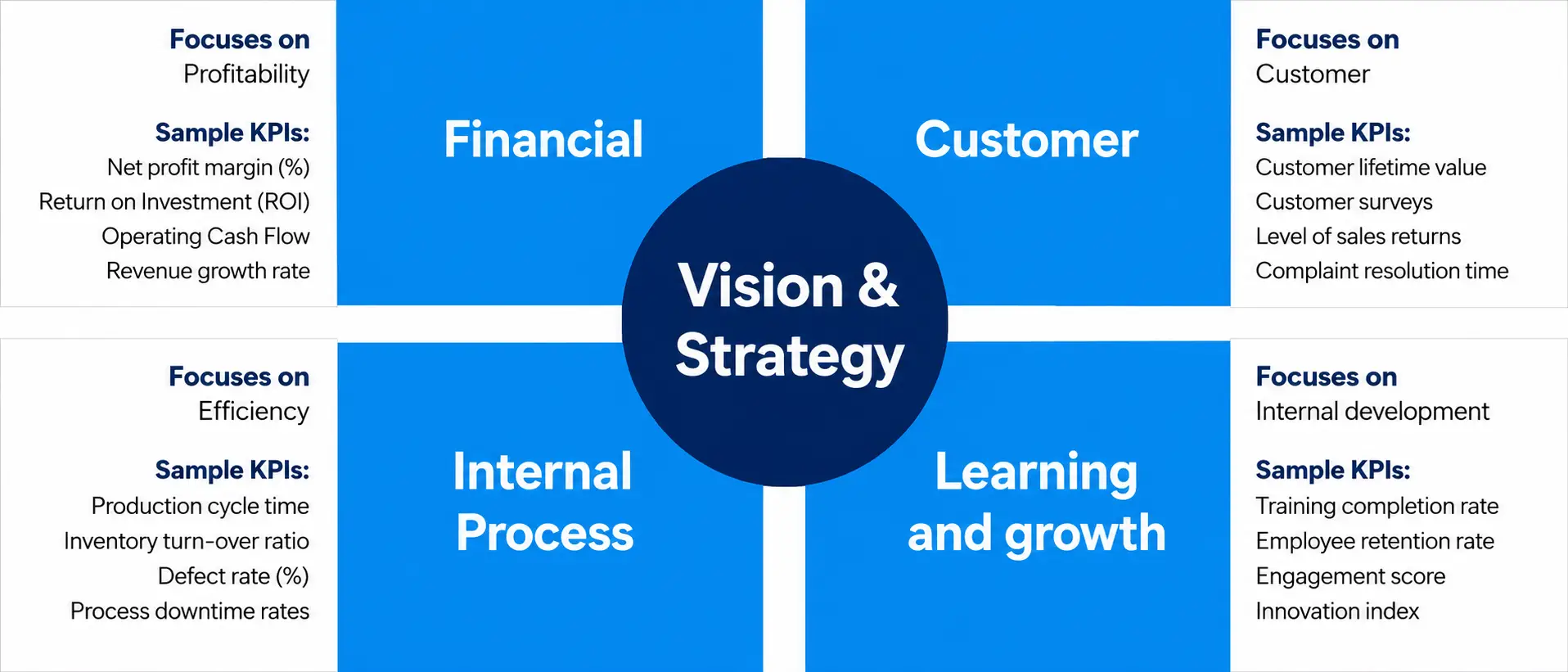
The illustration below highlights the various dimensions of the balanced scorecard, each accompanied by specific goals and KPIs. It emphasizes that the company’s strategy and objectives serve as the central focus, guiding all performance measures.

Four-quadrant diagram of balanced scorecard perspectives around vision and strategy with sample KPIs.
Balanced Scorecard Perspectives

By linking these perspectives, the Balanced Scorecard enables organizations to align their performance metrics with their strategic objectives, ensuring that every aspect of the business contributes to overall success.

Characteristics of an effective Balanced Scorecard

An effective Balanced Scorecard (BSC) is more than just a collection of metrics; it is a strategic tool designed to drive organizational success. For a BSC to be effective, it must exhibit several key characteristics that ensure alignment, clarity, and actionable insights:

  • Alignment with strategic objectives: Each metric within the BSC should directly support the company’s mission and goals, ensuring that all activities contribute to achieving desired outcomes. Misaligned metrics can lead to wasted resources and conflicting priorities.
  • Balanced representation: The BSC must provide a balanced representation of performance across its four perspectives: financial, customer, internal process, and learning and growth. This balance ensures that no single aspect of the organization is emphasized at the expense of others, promoting holistic improvement and sustainability.
  • Measurable and actionable metrics: Metrics within the BSC must be clear and quantifiable, allowing for consistent tracking and comparison over time. Actionable metrics enable managers to make informed decisions and implement changes that drive improvements.
  • Timely and accurate data: An effective BSC incorporates timely and accurate data. Regular updates ensure that the organization can respond quickly to changes and maintain a dynamic approach to performance management. Without accurate and current data, the BSC loses its relevance and effectiveness.

By incorporating these characteristics, organizations can leverage the Balanced Scorecard as a powerful tool to align operations with strategy, monitor progress, and drive continuous improvement.

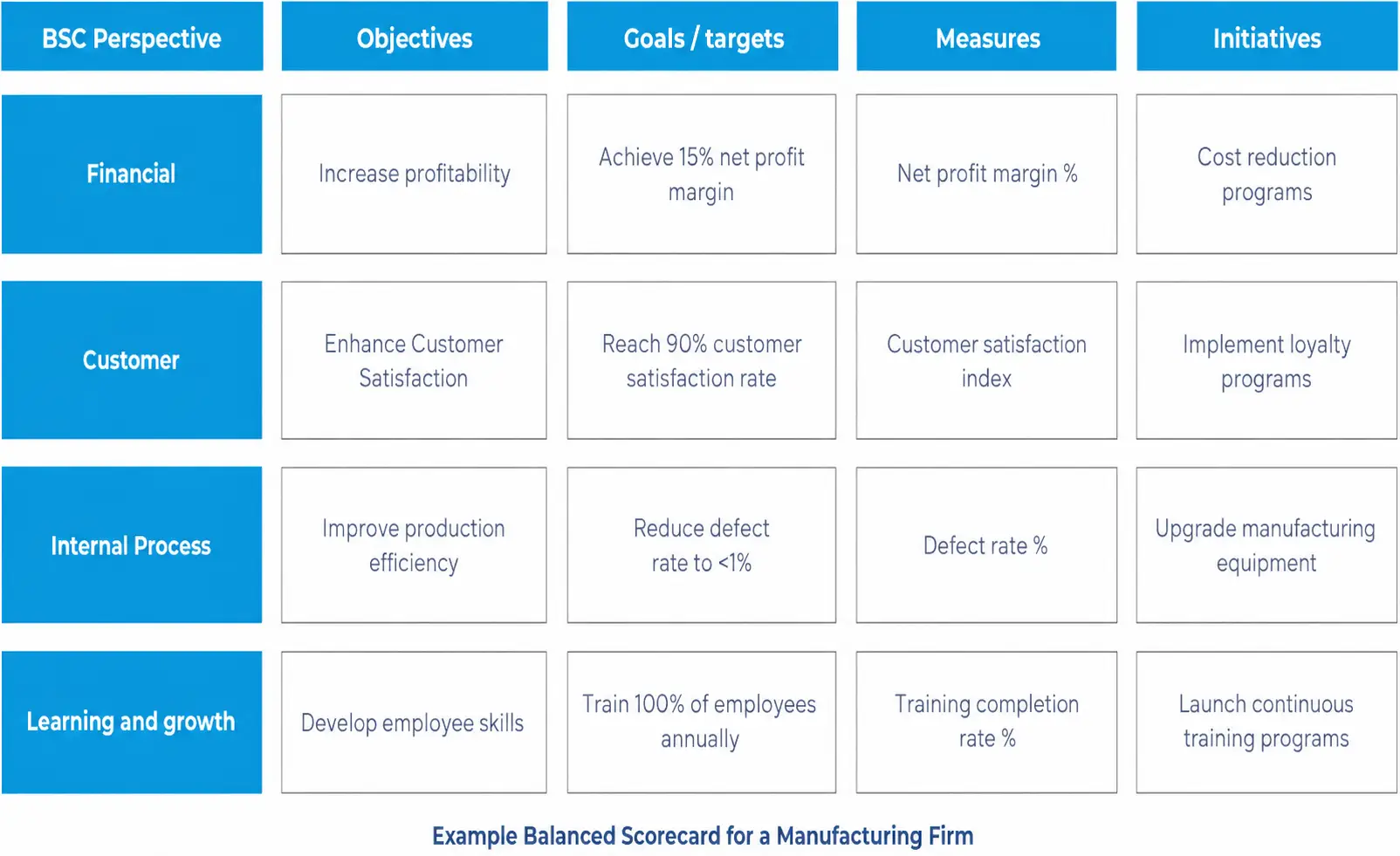
Below is an example of a Balanced Scorecard (BSC) for a manufacturing firm, typically organized in a table format to show the integration of strategy and metrics across perspectives:

Example of a balanced scorecard for a manufacturing firm listing objectives, goals, measures, and initiatives.
Manufacturing Balanced Scorecard
This table aligns the organization’s strategy with actionable goals, measurable metrics, and specific initiatives, ensuring every perspective contributes to the overall success of the manufacturing firm. Note that actual Balanced Scorecards are typically more detailed and comprehensive, encompassing a broader range of metrics and initiatives to fully capture organizational performance.

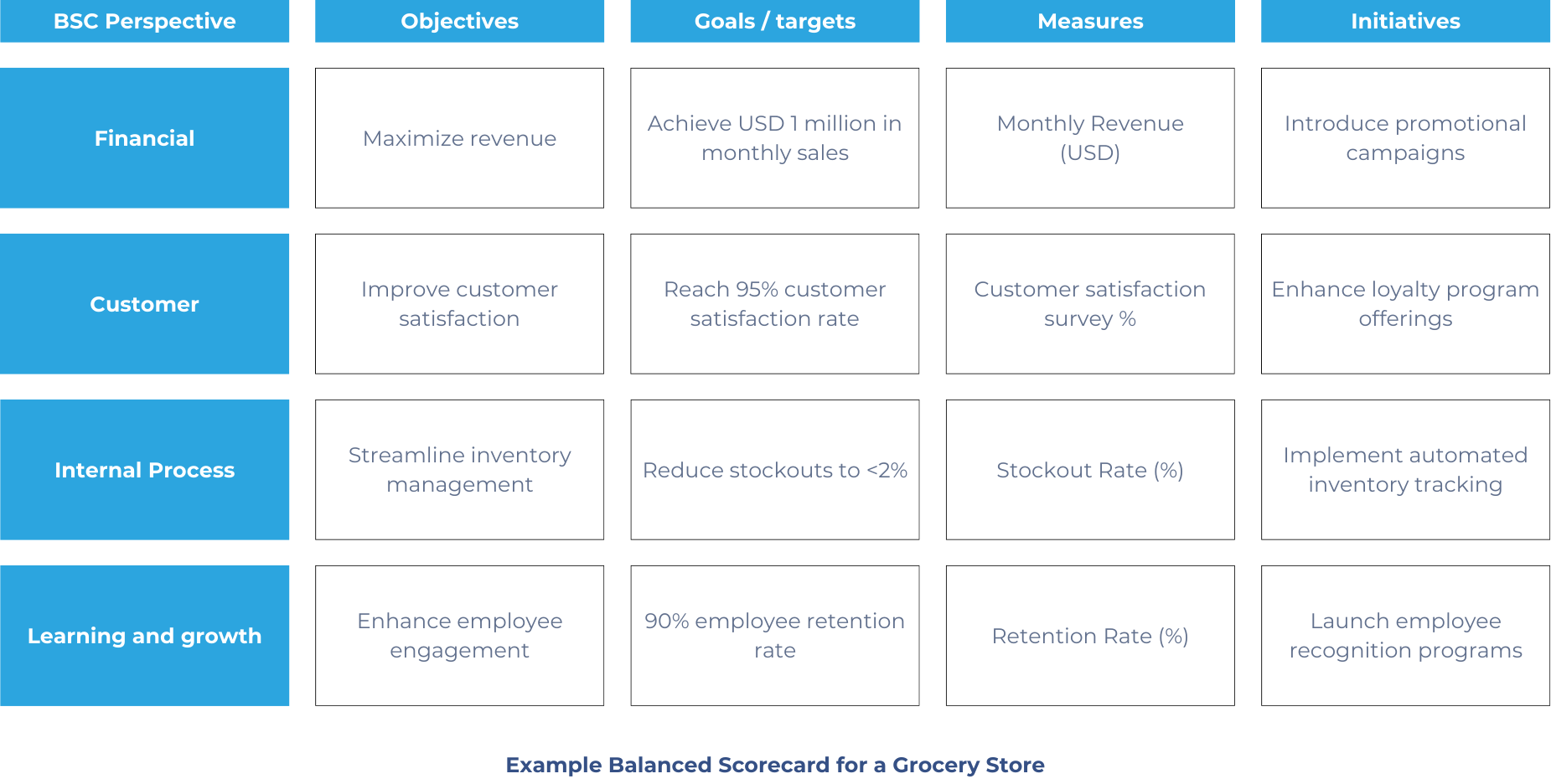
Below is another example of a Balanced Scorecard (BSC) for a grocery store, structured to reflect its unique operational focus:

Balanced Scorecard for Grocery Store

This example demonstrates how a grocery store can align its strategic objectives with actionable goals and measures, ensuring all operations contribute to customer satisfaction, operational efficiency, and financial success. As with all Balanced Scorecards, actual implementations are often more detailed and tailored to specific organizational needs.

Strategy map

Definitions
Strategy map
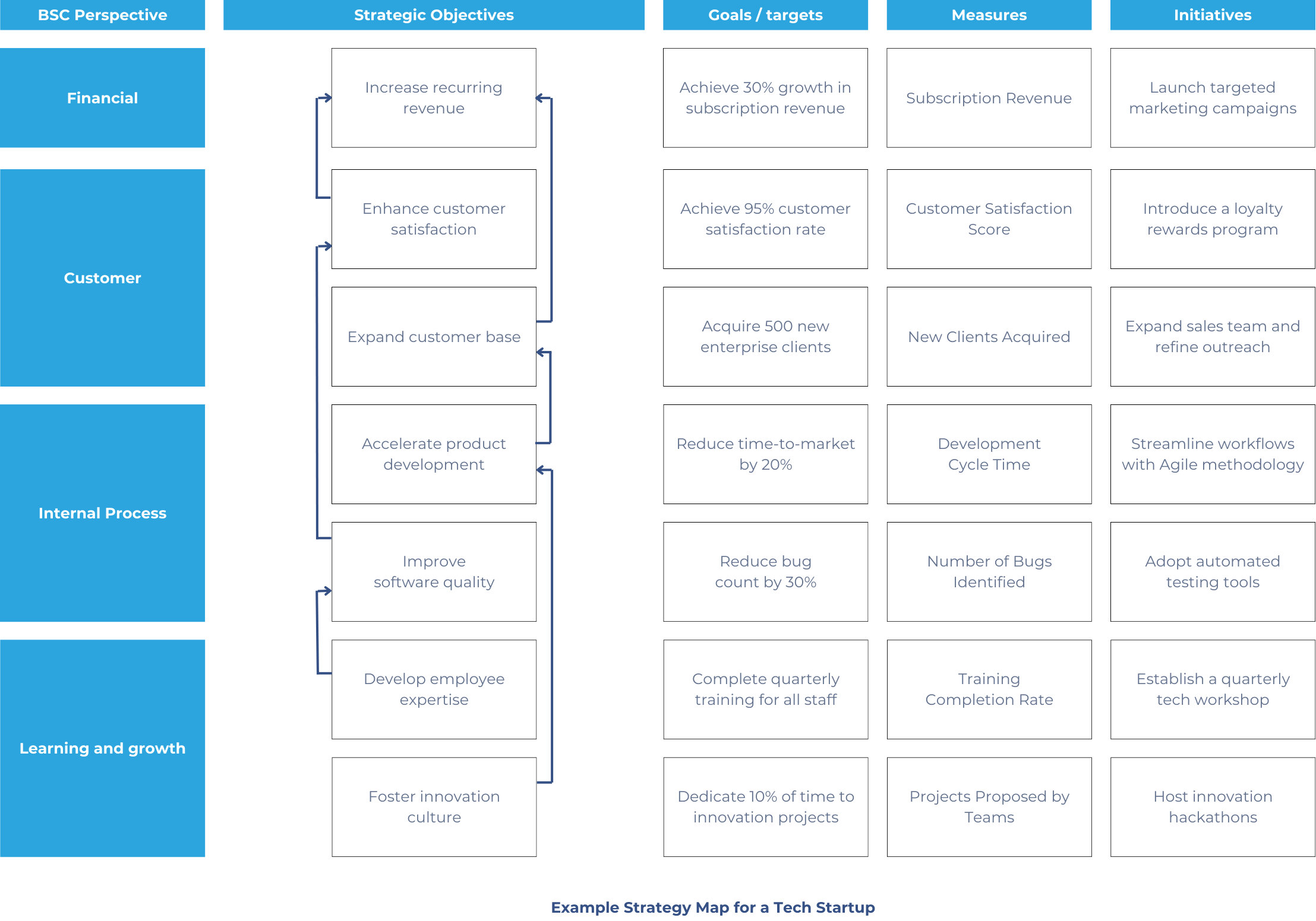
A visual representation of the strategic objectives and relationships within a Balanced Scorecard framework. It connects the four perspectives of the Balanced Scorecard by illustrating how specific goals interlink to achieve the organization’s overall strategy.

A strategy map provides a cause-and-effect view of how objectives in one perspective influence outcomes in another. For example, investments in employee training and development (learning and growth perspective) can lead to improved operational efficiency (internal process perspective), resulting in higher customer satisfaction (customer perspective) and ultimately better financial performance (financial perspective). This interconnected structure ensures that every objective supports the organization’s strategic vision.

Benefits of using a strategy map

  • Alignment: Ensures that all goals and activities align with the organization’s strategic priorities, reducing misaligned efforts.
  • Clarity: Offers a clear and concise visualization of how different objectives and activities contribute to overall success.
  • Focus: Helps managers prioritize initiatives and allocate resources effectively by understanding the key drivers of success.
  • Communication: Enhances communication across the organization by providing a shared framework for understanding and implementing strategy.

Example application

Consider an organization that prioritizes innovation. Its strategy map might show how investments in research and development (learning and growth perspective) lead to process improvements (internal process perspective), which enable the creation of cutting-edge products (customer perspective) and drive revenue growth (financial perspective). By linking these goals visually, the strategy map provides a roadmap for achieving the organization’s objectives.

Strategy Map Example

Critical Success Factors (CSFs) and Key Performance Indicators (KPIs)

  • CSFs: essential elements for achieving strategic objectives
  • KPIs: quantifiable metrics tracking progress toward CSFs
  • Enable alignment of operations with strategy and support timely decision-making

Balanced Scorecard (BSC)

  • Strategic management tool integrating financial and non-financial metrics
  • Four perspectives:
    • Financial: revenue, cost, profitability
    • Customer: satisfaction, retention, acquisition
    • Internal process: operational efficiency, quality control
    • Learning and growth: employee development, innovation
  • Aligns performance metrics with strategic objectives

Characteristics of an Effective Balanced Scorecard

  • Metrics aligned with strategic objectives
  • Balanced representation across all four perspectives
  • Measurable, actionable, timely, and accurate data

Strategy Map

  • Visual representation linking BSC objectives across perspectives
  • Shows cause-and-effect relationships between goals
  • Benefits:
    • Aligns activities with strategy
    • Clarifies and communicates strategic priorities
    • Helps prioritize initiatives and resource allocation

Sign up for free to take 11 quiz questions on this topic

Previous
Next  | 4.1.1 Cost behavior, cost objects, and cost pools
All rights reserved ©2016 - 2026 Achievable, Inc.

Key Performance Indicators (KPIs) and the Balanced Scorecard

The learning outcome statements relevant for this section are:

  1. define critical success factors (CSFs) and KPIs and discuss the importance of these measures in evaluating an organization
  2. define the concept of a balanced scorecard and identify its components
  3. identify and describe the perspectives of a balanced scorecard, including financial, customer, internal process, and learning and growth
  4. identify and describe the characteristics of an effective balanced scorecard
  5. demonstrate an understanding of a strategy map and the role it plays
  6. analyze and interpret a balanced scorecard and evaluate performance based on the analysis
  7. recommend performance measures and a periodic reporting methodology given operational goals and actual results

Critical Success Factors (CSFs) and Key Performance Indicators (KPIs)

Definitions
Critical Success Factors (CSFs)
These represent the essential elements or activities that an organization must achieve to meet its strategic objectives. These factors are specific to an organization’s mission, vision, and goals, and they provide the foundation for achieving competitive advantage. For instance, a CSF for a manufacturing company might be maintaining high product quality, while a CSF for a retail organization might be exceptional customer service.
Key Performance Indicators (KPIs)
These are measurable values that track progress toward achieving CSFs. They are quantifiable metrics used to evaluate success in meeting specific objectives. For example, a KPI for product quality could be the defect rate, and a KPI for customer service might be the average response time to customer inquiries. Together, CSFs and KPIs provide a structured way to monitor and evaluate organizational performance.

CSFs and KPIs are essential for evaluating an organization because they bridge the gap between strategic goals and operational performance. By focusing on CSFs, organizations can prioritize the activities that directly impact their success. KPIs, in turn, provide the tools to measure progress and identify areas for improvement. These measures help organizations ensure alignment between day-to-day operations and long-term strategic objectives, enabling timely decision-making and resource allocation.

Moreover, using CSFs and KPIs allows organizations to monitor performance across various levels, from individual departments to the entire enterprise. This comprehensive perspective ensures that efforts are coordinated and directed toward achieving key outcomes. By identifying and tracking these metrics, organizations can maintain a clear focus on what matters most for their success.

The Balanced Scorecard

Definitions
Balanced Scorecard (BSC)
A strategic management tool that provides a comprehensive framework for evaluating organizational performance. Unlike traditional performance measures that focus solely on financial outcomes, the BSC integrates both financial and non-financial metrics to provide a holistic view of an organization’s performance.

The Balanced Scorecard is typically organized into four key components or perspectives:

  1. Financial perspective: Focuses on financial outcomes such as revenue growth, cost management, and profitability, ensuring that the organization’s strategic goals translate into financial success.
  2. Customer perspective: Evaluates customer satisfaction, retention, and acquisition metrics to ensure that the organization is meeting customer needs and expectations.
  3. Internal process perspective: Measures the efficiency and effectiveness of internal operations that drive value creation, such as production processes, innovation, and quality control.
  4. Learning and growth perspective: Focuses on the organization’s capacity for long-term improvement through employee development, knowledge management, and fostering innovation.

The illustration below highlights the various dimensions of the balanced scorecard, each accompanied by specific goals and KPIs. It emphasizes that the company’s strategy and objectives serve as the central focus, guiding all performance measures.

By linking these perspectives, the Balanced Scorecard enables organizations to align their performance metrics with their strategic objectives, ensuring that every aspect of the business contributes to overall success.

Characteristics of an effective Balanced Scorecard

An effective Balanced Scorecard (BSC) is more than just a collection of metrics; it is a strategic tool designed to drive organizational success. For a BSC to be effective, it must exhibit several key characteristics that ensure alignment, clarity, and actionable insights:

  • Alignment with strategic objectives: Each metric within the BSC should directly support the company’s mission and goals, ensuring that all activities contribute to achieving desired outcomes. Misaligned metrics can lead to wasted resources and conflicting priorities.
  • Balanced representation: The BSC must provide a balanced representation of performance across its four perspectives: financial, customer, internal process, and learning and growth. This balance ensures that no single aspect of the organization is emphasized at the expense of others, promoting holistic improvement and sustainability.
  • Measurable and actionable metrics: Metrics within the BSC must be clear and quantifiable, allowing for consistent tracking and comparison over time. Actionable metrics enable managers to make informed decisions and implement changes that drive improvements.
  • Timely and accurate data: An effective BSC incorporates timely and accurate data. Regular updates ensure that the organization can respond quickly to changes and maintain a dynamic approach to performance management. Without accurate and current data, the BSC loses its relevance and effectiveness.

By incorporating these characteristics, organizations can leverage the Balanced Scorecard as a powerful tool to align operations with strategy, monitor progress, and drive continuous improvement.

Below is an example of a Balanced Scorecard (BSC) for a manufacturing firm, typically organized in a table format to show the integration of strategy and metrics across perspectives:

This table aligns the organization’s strategy with actionable goals, measurable metrics, and specific initiatives, ensuring every perspective contributes to the overall success of the manufacturing firm. Note that actual Balanced Scorecards are typically more detailed and comprehensive, encompassing a broader range of metrics and initiatives to fully capture organizational performance.

Below is another example of a Balanced Scorecard (BSC) for a grocery store, structured to reflect its unique operational focus:

This example demonstrates how a grocery store can align its strategic objectives with actionable goals and measures, ensuring all operations contribute to customer satisfaction, operational efficiency, and financial success. As with all Balanced Scorecards, actual implementations are often more detailed and tailored to specific organizational needs.

Strategy map

Definitions
Strategy map
A visual representation of the strategic objectives and relationships within a Balanced Scorecard framework. It connects the four perspectives of the Balanced Scorecard by illustrating how specific goals interlink to achieve the organization’s overall strategy.

A strategy map provides a cause-and-effect view of how objectives in one perspective influence outcomes in another. For example, investments in employee training and development (learning and growth perspective) can lead to improved operational efficiency (internal process perspective), resulting in higher customer satisfaction (customer perspective) and ultimately better financial performance (financial perspective). This interconnected structure ensures that every objective supports the organization’s strategic vision.

Benefits of using a strategy map

  • Alignment: Ensures that all goals and activities align with the organization’s strategic priorities, reducing misaligned efforts.
  • Clarity: Offers a clear and concise visualization of how different objectives and activities contribute to overall success.
  • Focus: Helps managers prioritize initiatives and allocate resources effectively by understanding the key drivers of success.
  • Communication: Enhances communication across the organization by providing a shared framework for understanding and implementing strategy.

Example application

Consider an organization that prioritizes innovation. Its strategy map might show how investments in research and development (learning and growth perspective) lead to process improvements (internal process perspective), which enable the creation of cutting-edge products (customer perspective) and drive revenue growth (financial perspective). By linking these goals visually, the strategy map provides a roadmap for achieving the organization’s objectives.

Key points

Critical Success Factors (CSFs) and Key Performance Indicators (KPIs)

  • CSFs: essential elements for achieving strategic objectives
  • KPIs: quantifiable metrics tracking progress toward CSFs
  • Enable alignment of operations with strategy and support timely decision-making

Balanced Scorecard (BSC)

  • Strategic management tool integrating financial and non-financial metrics
  • Four perspectives:
    • Financial: revenue, cost, profitability
    • Customer: satisfaction, retention, acquisition
    • Internal process: operational efficiency, quality control
    • Learning and growth: employee development, innovation
  • Aligns performance metrics with strategic objectives

Characteristics of an Effective Balanced Scorecard

  • Metrics aligned with strategic objectives
  • Balanced representation across all four perspectives
  • Measurable, actionable, timely, and accurate data

Strategy Map

  • Visual representation linking BSC objectives across perspectives
  • Shows cause-and-effect relationships between goals
  • Benefits:
    • Aligns activities with strategy
    • Clarifies and communicates strategic priorities
    • Helps prioritize initiatives and resource allocation

More from Performance measures

  • Profitability analysis
  • Calculating and evaluating profitability
  • Return on investment (ROI) and Residual Income (RI)
  • Investment base and calculation issues for ROI and RI