


Achievable logoAchievable logo
CMA Part 1
Sign in
Sign up
Purchase
Textbook
Practice exams
Support
How it works
Exam catalog
Mountain with a flag at the peak
Textbook
1. External financial reporting decisions
2. Planning, budgeting, and forecasting
3. Performance management
3.1 Cost and variance measures
3.2 Responsibility centers and reporting segments
3.3 Performance measures
3.3.1 Profitability analysis
3.3.2 Calculating and evaluating profitability
3.3.3 Return on investment (ROI) and Residual Income (RI)
3.3.4 Investment base and calculation issues for ROI and RI
3.3.5 Key Performance Indicators (KPIs) and the Balanced Scorecard
4. Cost management
5. Internal control
6. Technology and analytics
Achievable logoAchievable logo
3.3.1 Profitability analysis
Achievable CMA Part 1
3. Performance management
3.3. Performance measures
Our CMA Part 1 course is currently in development and is a work-in-progress.

Profitability analysis

9 min read
Font
Discuss
Share
Feedback

Learning outcome statements

The learning outcome statements relevant for this section are:

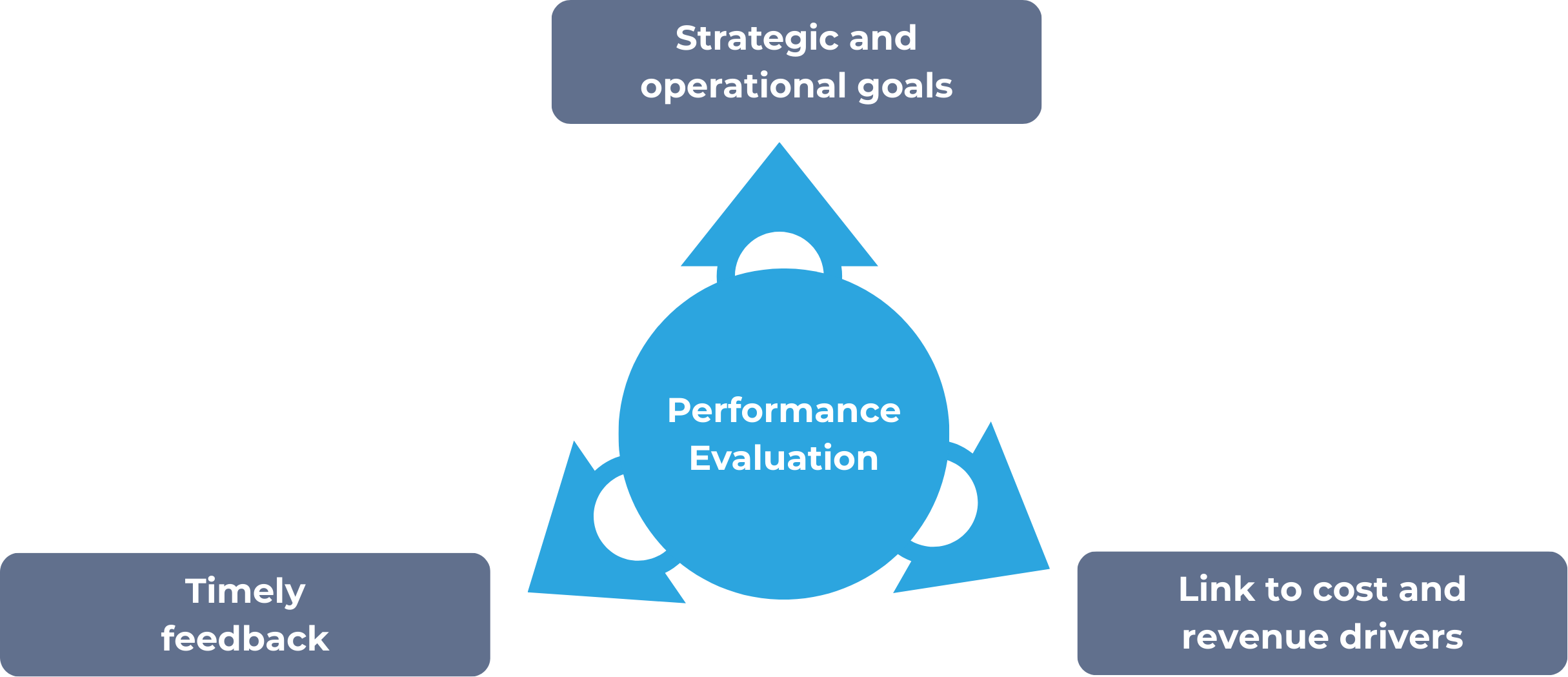
  1. explain why performance evaluation measures should be directly related to strategic and operational goals and objectives, why timely feedback is critical, and why performance measures should be related to the factors that drive the element being measured (e.g., cost drivers and revenue drivers)
  2. explain the issues involved in determining product profitability, business unit profitability, and customer profitability, including cost measurement, cost allocation, investment measurement, and valuation
  3. calculate product-line profitability, business unit profitability, and customer profitability
  4. evaluate customers and products on the basis of controllable margin and recommend ways to improve profitability and/or drop unprofitable customers and products

Performance evaluation

Performance evaluation considerations

Performance evaluation measures are most effective when they are directly aligned with an organization’s strategic and operational goals and objectives. This alignment ensures that performance metrics reflect the broader purpose and direction of the organization. For instance, if a company’s strategic goal is to expand market share, evaluation measures should focus on metrics like customer acquisition, revenue growth, and market penetration. Misaligned measures, such as focusing solely on cost reduction, could conflict with growth objectives and lead to counterproductive behaviors. When performance metrics mirror organizational goals, employees and managers are better equipped to make decisions that contribute to long-term success.

Timely feedback is essential for effective performance evaluation because it enables quick responses to deviations from expected outcomes. Delayed feedback can result in prolonged inefficiencies, missed opportunities, or compounding errors. For example, in a manufacturing setting, immediate reporting on production variances allows managers to address issues before they escalate, ensuring smooth operations. Timely feedback also fosters accountability and encourages employees to adjust their efforts promptly, improving overall performance. By shortening the feedback loop, organizations can remain agile and responsive to changes in their operating environment.

Performance measures must also be linked to the factors that drive the element being measured, such as cost drivers and revenue drivers. This linkage ensures that metrics are meaningful and actionable. For instance, measuring customer profitability requires analyzing factors like sales volume, pricing, and customer service costs. Similarly, assessing production efficiency involves understanding direct labor hours, material usage, and overhead allocation. By focusing on these underlying drivers, organizations can identify the root causes of performance variances and implement targeted improvements. Without such connections, performance measures risk being superficial and failing to provide actionable insights.

Areas of profitability analysis

Performance measurement is often conducted through profitability analysis, which evaluates the financial outcomes of various segments of an organization to determine how effectively resources are being utilized to generate profit. By linking performance evaluation to profitability, organizations can assess the contribution of specific products, customers, or business units to overall financial performance and make informed decisions to optimize resource allocation and strategic initiatives.

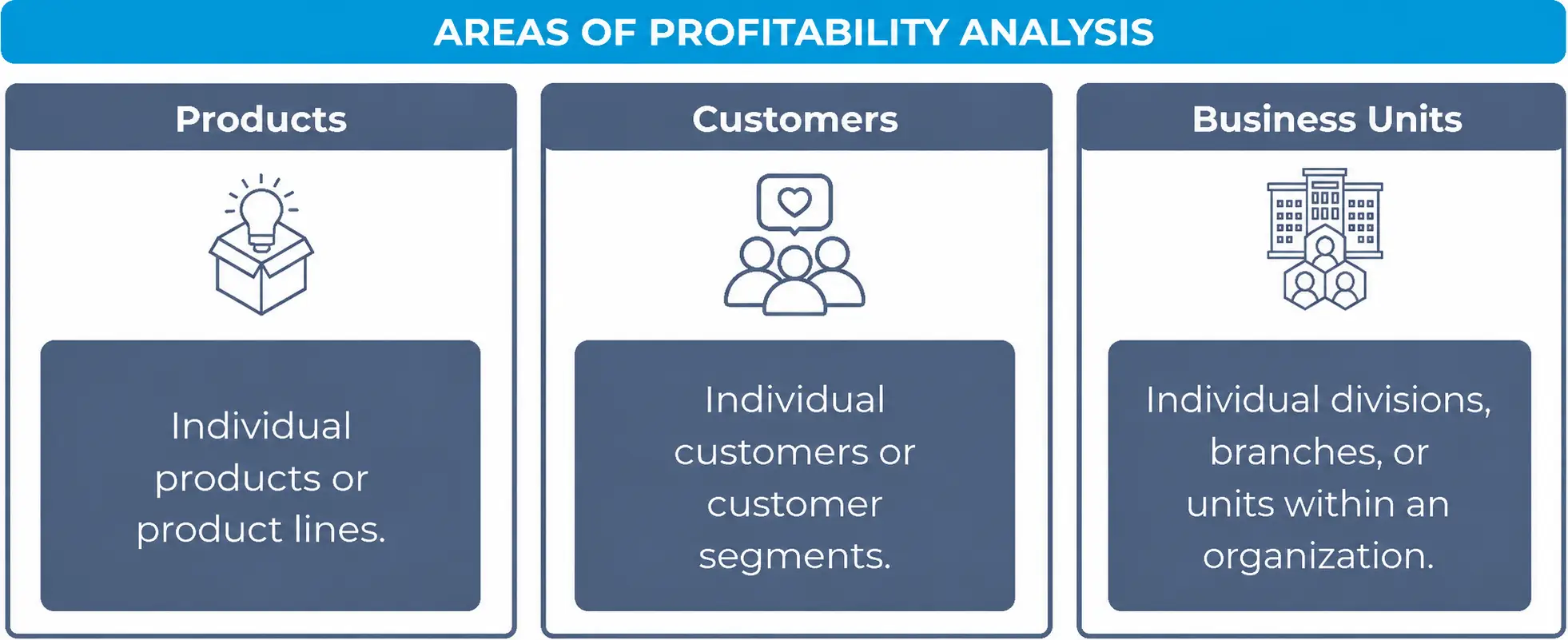
Profitability analysis involves examining revenues, costs, and margins to identify the most and least profitable aspects of an organization’s operations. It provides insights into where the company is generating value and where inefficiencies or underperformance may exist. This analysis helps organizations prioritize efforts, eliminate or improve unprofitable areas, and capitalize on strengths to drive sustainable growth. It can be measured across three general areas:

  1. Products
  2. Customers; and
  3. Business units
Of profitability analysis areas covering products, customers, and business units.
Profitability Analysis Areas

Product profitability analysis

Definitions
Product profitability analysis
Evaluates the financial contribution of individual products or product lines to an organization’s overall profitability.

By analyzing the revenues, costs, and margins associated with each product, companies can identify high-performing products, those that require cost or pricing adjustments, and unprofitable offerings. This analysis helps businesses prioritize resources, refine pricing strategies, and make informed decisions about product development, marketing, and discontinuation.

Accurately determining product profitability involves addressing several key challenges:

1. Cost Measurement

Accurate cost measurement is fundamental to profitability analysis, as it ensures that the costs associated with producing, marketing, and delivering a product are captured correctly. Direct costs, such as materials and labor, are relatively straightforward to measure, but indirect costs, like overhead, require careful allocation. Inaccuracies in cost measurement can lead to distorted profitability insights and misguided strategic decisions.

2. Cost Allocation

Cost allocation refers to the process of distributing indirect costs, such as manufacturing overhead or shared administrative expenses, across products. Determining a fair allocation basis, such as labor hours, machine hours, or sales volume, is critical to avoid over- or underestimating the costs associated with individual products. Poorly allocated costs can misrepresent product profitability, potentially leading to incorrect pricing or resource allocation decisions.

3. Investment Measurement

Investment measurement involves evaluating the capital and resources dedicated to a product, including initial development costs, ongoing production investments, and marketing expenditures. For example, a product may require significant upfront investment in research and development but generate long-term returns. Measuring these investments accurately is crucial for assessing the true profitability and return on investment (ROI) of a product.

4. Valuation

Valuation challenges arise when determining the financial value of a product, particularly for intangible aspects such as brand equity or customer loyalty. For instance, a product with high market recognition may have indirect value that is not immediately reflected in its profitability analysis. Proper valuation requires considering both quantitative metrics (e.g., revenues and costs) and qualitative factors (e.g., brand strength and market position).

Customer profitability analysis

Definitions
Customer profitability analysis
Evaluates the financial contribution of individual customers or customer segments to an organization’s overall profitability.

By comparing the revenues generated by a customer with the costs incurred to serve them, businesses can identify their most and least profitable customers. This analysis helps organizations tailor their marketing strategies, adjust service levels, and make informed decisions about resource allocation and customer relationships.

Accurately assessing customer profitability requires addressing several challenges:

1. Cost Measurement

Measuring costs accurately is critical to understanding customer profitability. While direct costs such as product costs or delivery expenses are straightforward to trace to customers, indirect costs, such as shared marketing efforts or customer service, require careful tracking. Misestimating these costs can lead to an incorrect understanding of customer value.

2. Cost Allocation

Cost allocation involves distributing indirect costs, such as administrative overhead or shared sales resources, among customers. Determining an appropriate allocation basis, such as sales volume, transaction frequency, or service hours, is essential to avoid over- or underestimating the costs associated with specific customers. Inaccurate allocations can skew profitability insights, potentially leading to poor strategic decisions.

3. Investment Measurement

Customer investment measurement evaluates the resources dedicated to acquiring, retaining, and serving customers. These investments may include marketing expenditures, loyalty programs, or account management costs. Understanding the long-term impact of these investments is crucial, as some customers may require significant upfront investment but yield substantial profitability over time. Properly measuring these investments ensures accurate profitability assessments.

4. Valuation

Valuing customer relationships involves assessing both tangible and intangible factors. Tangible elements include direct revenues and costs, while intangible elements may include customer loyalty, referral potential, or strategic importance. For example, a customer who consistently generates repeat business or brings in new clients through referrals may hold greater long-term value than their immediate financial contribution suggests. Including these qualitative aspects enhances the accuracy of customer profitability analysis.

Business unit profitability analysis

Definitions
Business unit profitability analysis
Evaluates the financial performance of individual divisions, branches, or units within an organization.

This involves comparing the revenue generated by a business unit with the associated costs to determine its contribution to the organization’s overall profitability. By assessing the performance of individual units, organizations can identify their strongest and weakest performers, allocate resources effectively, and make informed decisions about strategic investments or restructuring.

Accurately analyzing business unit profitability requires addressing several key challenges:

1. Cost Measurement

Proper cost measurement is fundamental to understanding a business unit’s profitability. Direct costs, such as those related to specific projects or products, are easier to assign to a unit, while indirect costs, like shared administrative expenses, can be more difficult to trace. Failing to measure these costs accurately can lead to distorted profitability insights, misrepresenting a unit’s true performance.

2. Cost Allocation

Cost allocation refers to the process of distributing shared costs, such as corporate overhead, IT infrastructure, or marketing expenses, across different business units. An appropriate allocation basis, such as revenue, headcount, or floor space, must be selected to ensure fairness and accuracy. Inaccurate cost allocation can overburden some units while underestimating the costs borne by others, leading to skewed profitability evaluations.

3. Investment Measurement

Investment measurement evaluates the capital and resources dedicated to each business unit. This includes fixed assets like facilities and equipment, as well as ongoing operational investments. For instance, a new branch may require significant upfront investment, but its profitability may improve over time. Accurately measuring these investments ensures that profitability assessments account for both short-term and long-term financial contributions.

4. Valuation

Valuing a business unit involves both quantitative and qualitative assessments. Quantitative factors include revenue, costs, and profitability, while qualitative aspects, such as strategic importance, market position, and growth potential, also play a role. For example, a business unit operating in a high-growth market may have lower current profitability but offer significant long-term potential. Proper valuation helps organizations balance short-term financial performance with long-term strategic objectives.

Performance evaluation

  • Measures must align with strategic and operational goals
  • Timely feedback enables quick corrective actions
  • Metrics should link to key drivers (cost/revenue drivers)

Profitability analysis

  • Evaluates financial outcomes by product, customer, and business unit
  • Identifies most/least profitable segments for resource allocation
  • Informs decisions to improve or discontinue unprofitable areas

Product profitability analysis

  • Focus: revenues, costs, and margins per product or line
  • Key challenges:
    • Cost measurement: accurate capture of direct/indirect costs
    • Cost allocation: fair distribution of overhead/shared costs
    • Investment measurement: assess capital/resources invested
    • Valuation: consider both quantitative and qualitative product value

Customer profitability analysis

  • Compares customer revenues to costs of serving them
  • Key challenges:
    • Cost measurement: trace direct/indirect service costs
    • Cost allocation: distribute shared costs appropriately
    • Investment measurement: evaluate acquisition/retention costs
    • Valuation: include tangible and intangible customer value

Business unit profitability analysis

  • Assesses financial performance of divisions or branches
  • Key challenges:
    • Cost measurement: assign direct and shared costs accurately
    • Cost allocation: fair basis for distributing overhead
    • Investment measurement: account for capital and operational investments
    • Valuation: combine quantitative results with strategic/qualitative factors

Sign up for free to take 8 quiz questions on this topic

Previous
Next  | 3.3.2 Calculating and evaluating profitability
All rights reserved ©2016 - 2026 Achievable, Inc.

Profitability analysis

Learning outcome statements

The learning outcome statements relevant for this section are:

  1. explain why performance evaluation measures should be directly related to strategic and operational goals and objectives, why timely feedback is critical, and why performance measures should be related to the factors that drive the element being measured (e.g., cost drivers and revenue drivers)
  2. explain the issues involved in determining product profitability, business unit profitability, and customer profitability, including cost measurement, cost allocation, investment measurement, and valuation
  3. calculate product-line profitability, business unit profitability, and customer profitability
  4. evaluate customers and products on the basis of controllable margin and recommend ways to improve profitability and/or drop unprofitable customers and products

Performance evaluation

Performance evaluation measures are most effective when they are directly aligned with an organization’s strategic and operational goals and objectives. This alignment ensures that performance metrics reflect the broader purpose and direction of the organization. For instance, if a company’s strategic goal is to expand market share, evaluation measures should focus on metrics like customer acquisition, revenue growth, and market penetration. Misaligned measures, such as focusing solely on cost reduction, could conflict with growth objectives and lead to counterproductive behaviors. When performance metrics mirror organizational goals, employees and managers are better equipped to make decisions that contribute to long-term success.

Timely feedback is essential for effective performance evaluation because it enables quick responses to deviations from expected outcomes. Delayed feedback can result in prolonged inefficiencies, missed opportunities, or compounding errors. For example, in a manufacturing setting, immediate reporting on production variances allows managers to address issues before they escalate, ensuring smooth operations. Timely feedback also fosters accountability and encourages employees to adjust their efforts promptly, improving overall performance. By shortening the feedback loop, organizations can remain agile and responsive to changes in their operating environment.

Performance measures must also be linked to the factors that drive the element being measured, such as cost drivers and revenue drivers. This linkage ensures that metrics are meaningful and actionable. For instance, measuring customer profitability requires analyzing factors like sales volume, pricing, and customer service costs. Similarly, assessing production efficiency involves understanding direct labor hours, material usage, and overhead allocation. By focusing on these underlying drivers, organizations can identify the root causes of performance variances and implement targeted improvements. Without such connections, performance measures risk being superficial and failing to provide actionable insights.

Areas of profitability analysis

Performance measurement is often conducted through profitability analysis, which evaluates the financial outcomes of various segments of an organization to determine how effectively resources are being utilized to generate profit. By linking performance evaluation to profitability, organizations can assess the contribution of specific products, customers, or business units to overall financial performance and make informed decisions to optimize resource allocation and strategic initiatives.

Profitability analysis involves examining revenues, costs, and margins to identify the most and least profitable aspects of an organization’s operations. It provides insights into where the company is generating value and where inefficiencies or underperformance may exist. This analysis helps organizations prioritize efforts, eliminate or improve unprofitable areas, and capitalize on strengths to drive sustainable growth. It can be measured across three general areas:

  1. Products
  2. Customers; and
  3. Business units

Product profitability analysis

Definitions
Product profitability analysis
Evaluates the financial contribution of individual products or product lines to an organization’s overall profitability.

By analyzing the revenues, costs, and margins associated with each product, companies can identify high-performing products, those that require cost or pricing adjustments, and unprofitable offerings. This analysis helps businesses prioritize resources, refine pricing strategies, and make informed decisions about product development, marketing, and discontinuation.

Accurately determining product profitability involves addressing several key challenges:

1. Cost Measurement

Accurate cost measurement is fundamental to profitability analysis, as it ensures that the costs associated with producing, marketing, and delivering a product are captured correctly. Direct costs, such as materials and labor, are relatively straightforward to measure, but indirect costs, like overhead, require careful allocation. Inaccuracies in cost measurement can lead to distorted profitability insights and misguided strategic decisions.

2. Cost Allocation

Cost allocation refers to the process of distributing indirect costs, such as manufacturing overhead or shared administrative expenses, across products. Determining a fair allocation basis, such as labor hours, machine hours, or sales volume, is critical to avoid over- or underestimating the costs associated with individual products. Poorly allocated costs can misrepresent product profitability, potentially leading to incorrect pricing or resource allocation decisions.

3. Investment Measurement

Investment measurement involves evaluating the capital and resources dedicated to a product, including initial development costs, ongoing production investments, and marketing expenditures. For example, a product may require significant upfront investment in research and development but generate long-term returns. Measuring these investments accurately is crucial for assessing the true profitability and return on investment (ROI) of a product.

4. Valuation

Valuation challenges arise when determining the financial value of a product, particularly for intangible aspects such as brand equity or customer loyalty. For instance, a product with high market recognition may have indirect value that is not immediately reflected in its profitability analysis. Proper valuation requires considering both quantitative metrics (e.g., revenues and costs) and qualitative factors (e.g., brand strength and market position).

Customer profitability analysis

Definitions
Customer profitability analysis
Evaluates the financial contribution of individual customers or customer segments to an organization’s overall profitability.

By comparing the revenues generated by a customer with the costs incurred to serve them, businesses can identify their most and least profitable customers. This analysis helps organizations tailor their marketing strategies, adjust service levels, and make informed decisions about resource allocation and customer relationships.

Accurately assessing customer profitability requires addressing several challenges:

1. Cost Measurement

Measuring costs accurately is critical to understanding customer profitability. While direct costs such as product costs or delivery expenses are straightforward to trace to customers, indirect costs, such as shared marketing efforts or customer service, require careful tracking. Misestimating these costs can lead to an incorrect understanding of customer value.

2. Cost Allocation

Cost allocation involves distributing indirect costs, such as administrative overhead or shared sales resources, among customers. Determining an appropriate allocation basis, such as sales volume, transaction frequency, or service hours, is essential to avoid over- or underestimating the costs associated with specific customers. Inaccurate allocations can skew profitability insights, potentially leading to poor strategic decisions.

3. Investment Measurement

Customer investment measurement evaluates the resources dedicated to acquiring, retaining, and serving customers. These investments may include marketing expenditures, loyalty programs, or account management costs. Understanding the long-term impact of these investments is crucial, as some customers may require significant upfront investment but yield substantial profitability over time. Properly measuring these investments ensures accurate profitability assessments.

4. Valuation

Valuing customer relationships involves assessing both tangible and intangible factors. Tangible elements include direct revenues and costs, while intangible elements may include customer loyalty, referral potential, or strategic importance. For example, a customer who consistently generates repeat business or brings in new clients through referrals may hold greater long-term value than their immediate financial contribution suggests. Including these qualitative aspects enhances the accuracy of customer profitability analysis.

Business unit profitability analysis

Definitions
Business unit profitability analysis
Evaluates the financial performance of individual divisions, branches, or units within an organization.

This involves comparing the revenue generated by a business unit with the associated costs to determine its contribution to the organization’s overall profitability. By assessing the performance of individual units, organizations can identify their strongest and weakest performers, allocate resources effectively, and make informed decisions about strategic investments or restructuring.

Accurately analyzing business unit profitability requires addressing several key challenges:

1. Cost Measurement

Proper cost measurement is fundamental to understanding a business unit’s profitability. Direct costs, such as those related to specific projects or products, are easier to assign to a unit, while indirect costs, like shared administrative expenses, can be more difficult to trace. Failing to measure these costs accurately can lead to distorted profitability insights, misrepresenting a unit’s true performance.

2. Cost Allocation

Cost allocation refers to the process of distributing shared costs, such as corporate overhead, IT infrastructure, or marketing expenses, across different business units. An appropriate allocation basis, such as revenue, headcount, or floor space, must be selected to ensure fairness and accuracy. Inaccurate cost allocation can overburden some units while underestimating the costs borne by others, leading to skewed profitability evaluations.

3. Investment Measurement

Investment measurement evaluates the capital and resources dedicated to each business unit. This includes fixed assets like facilities and equipment, as well as ongoing operational investments. For instance, a new branch may require significant upfront investment, but its profitability may improve over time. Accurately measuring these investments ensures that profitability assessments account for both short-term and long-term financial contributions.

4. Valuation

Valuing a business unit involves both quantitative and qualitative assessments. Quantitative factors include revenue, costs, and profitability, while qualitative aspects, such as strategic importance, market position, and growth potential, also play a role. For example, a business unit operating in a high-growth market may have lower current profitability but offer significant long-term potential. Proper valuation helps organizations balance short-term financial performance with long-term strategic objectives.

Key points

Performance evaluation

  • Measures must align with strategic and operational goals
  • Timely feedback enables quick corrective actions
  • Metrics should link to key drivers (cost/revenue drivers)

Profitability analysis

  • Evaluates financial outcomes by product, customer, and business unit
  • Identifies most/least profitable segments for resource allocation
  • Informs decisions to improve or discontinue unprofitable areas

Product profitability analysis

  • Focus: revenues, costs, and margins per product or line
  • Key challenges:
    • Cost measurement: accurate capture of direct/indirect costs
    • Cost allocation: fair distribution of overhead/shared costs
    • Investment measurement: assess capital/resources invested
    • Valuation: consider both quantitative and qualitative product value

Customer profitability analysis

  • Compares customer revenues to costs of serving them
  • Key challenges:
    • Cost measurement: trace direct/indirect service costs
    • Cost allocation: distribute shared costs appropriately
    • Investment measurement: evaluate acquisition/retention costs
    • Valuation: include tangible and intangible customer value

Business unit profitability analysis

  • Assesses financial performance of divisions or branches
  • Key challenges:
    • Cost measurement: assign direct and shared costs accurately
    • Cost allocation: fair basis for distributing overhead
    • Investment measurement: account for capital and operational investments
    • Valuation: combine quantitative results with strategic/qualitative factors

More from Performance measures

  • Calculating and evaluating profitability
  • Return on investment (ROI) and Residual Income (RI)
  • Investment base and calculation issues for ROI and RI
  • Key Performance Indicators (KPIs) and the Balanced Scorecard