


This browser is too old to run Achievable.

Update it, or open this page in a current version of Chrome, Safari, Firefox or Edge. On an iPhone or iPad, update iOS: every browser there runs on the version of Safari that comes with it.

Achievable logoAchievable logo
ASVAB
Sign in
Sign up
Purchase
Textbook
Practice exams
Support
How it works
Resources
Exam catalog
Mountain with a flag at the peak
Textbook
Introduction
1. Word Knowledge
2. Mathematics Knowledge
2.1 Foundational math
2.2 Pre-algebra
2.3 Algebra I
2.4 Geometry basics
2.4.1 Lines and slopes
2.4.2 Angles and transversals
2.4.3 Basic shapes and area
2.4.4 Circles, polygons, and coordinate geometry
2.5 Algebra II
2.6 Advanced geometry
2.7 Math strategies
3. Paragraph Comprehension
4. Arithmetic Reasoning
5. General Science
6. Mechanical Comprehension
7. Electronics Information
8. Shop Information
9. Auto Information
10. Assembling Objects
Wrapping up
Achievable logoAchievable logo
2.4.4 Circles, polygons, and coordinate geometry
Achievable ASVAB
2. Mathematics Knowledge
2.4. Geometry basics
Our ASVAB course is currently in development and is a work-in-progress.

Circles, polygons, and coordinate geometry

9 min read
Font
Discuss
Share
Feedback

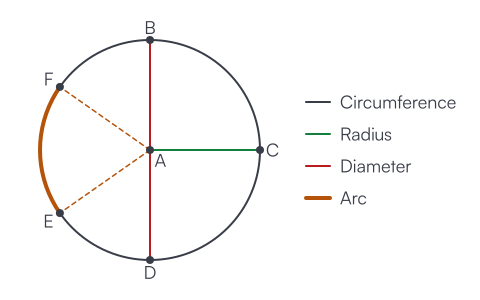
Circles

Definitions
Circumference
The outer edge of the circle
Radius
The distance from the center to the edge of the circle
Diameter
The distance from one edge of the circle to the other while passing through the center of the circle
Chord
A line drawn from one edge of the circle to the other
Arcs
A segment of the circumference

A circle is a perfectly round shape where every point on the edge is the same distance from the center.

Understanding the parts of a circle will help you solve problems involving distance, area, and measurements around the circle.

Sidenote
Two important relationships to remember:
  • The radius goes from the center to the edge.
  • The diameter goes all the way across the circle and is twice the radius.

diameter=2×radius

The circumference is the distance around the circle, similar to perimeter in other shapes.

A circle with center A, showing its circumference, a radius AC, a diameter BD, and an arc FE.
Parts of a circle
Achievable
Sidenote
More on circles

We’ll explore the circle more in Advanced Geometry!

Polygons

Definitions
Polygon
A multisided closed shape made up of straight lines, with a minimum of 3 sides
Regular polygon
A polygon with all equal sides and all equal angles

A polygon is a flat, closed shape made up entirely of straight line segments. Each side connects end-to-end, forming a complete shape with no gaps.

Polygons can have many different numbers of sides. The simplest polygon is a triangle (3 sides), but polygons can also have 4 sides (quadrilaterals), 5 sides (pentagons), 6 sides (hexagons), and more.

Polygon types

Some polygons are regular, meaning all sides and angles are equal. Others are irregular, meaning their sides or angles are different.

One useful idea is that any polygon can be broken into triangles. This helps you understand angle relationships and solve problems involving the total interior angle measure.

Sum of angles of a polygon

We know the interior angles in a rectangle add up to 360∘ and the interior angles in a triangle add up to 180∘.

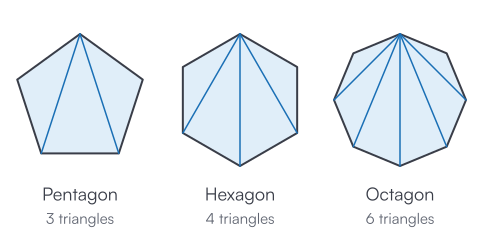
For larger polygons, we can break the shape into triangles by drawing lines from a single vertex to all other non-adjacent vertices.

Each triangle contributes 180∘, so the total interior angle sum depends on how many triangles are formed.

For a polygon with n sides, you can always form (n−2) triangles.

A regular pentagon, hexagon and octagon, each divided into triangles by diagonals from one vertex: 3, 4 and 6 triangles, n − 2 for a polygon of n sides.
Common polygons
Achievable

Officially, the formula for finding the sum of a polygon’s interior angles is:

(n−2)×180

where n = the number of sides of the polygon.

Let’s look at a problem together.

Example:

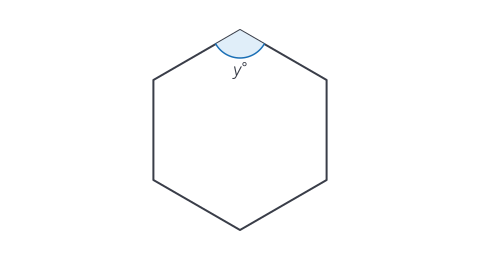
What is the value of ∠y in this regular polygon?

A regular hexagon with the interior angle at its top vertex marked y°.
Hexagon Example
Achievable

This is asking: what is the measure of one interior angle?

To find the total degree value of any polygon, you can either:

  • Use the formula (n−2)×180, or
  • Break the polygon into triangles (each triangle has 180∘).

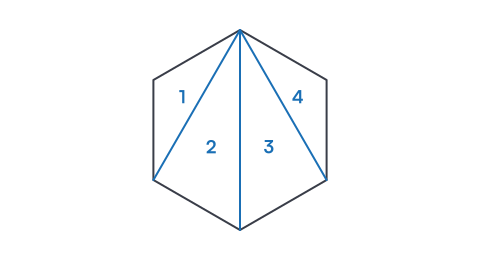
Let’s break this one into triangles to show that we create 4 triangles.

A regular hexagon with three diagonals drawn from its top vertex, dividing it into 4 triangles, numbered 1 to 4.
Hexagon example
Achievable

180×4=720∘

Because the polygon is regular, all interior angles are equal.

So to find one angle, divide the total by the number of sides:

6720​=120∘

∠y=120∘

Steps taken:

  • Find total angle sum
  • Divide by the number of sides
  • Write the answer

Knowledge check: What is the measure of each interior angle in a regular pentagon?

(spoiler)

First, find the total interior angle sum:

(5−2)×180=3×180=540∘

Because the polygon is regular, divide by the number of sides:

5540​=108∘

Each interior angle is 108∘.

Coordinate plane

Definitions
Coordinate plane
A flat plane defined by two perpendicular axes — the horizontal x-axis and the vertical y-axis
Origin
The point (0,0) where the x-axis and y-axis intersect

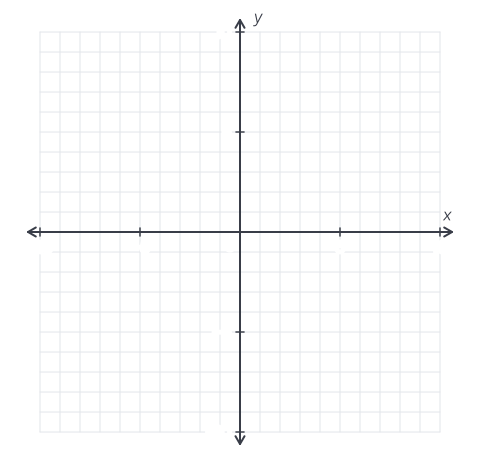
The coordinate plane is a flat surface used to locate points using two numbers.

A coordinate plane with a horizontal x-axis and a vertical y-axis, each numbered from −10 to 10, crossing at the origin, 0.
Coordinate Plane
Achievable

The point where the two axes meet is called the origin, written as (0,0).

Plotting points

To plot a point on the coordinate plane:

  • Move horizontally along the x-axis first, then
  • Move vertically along the y-axis

Write the point as (x-value,y-value).

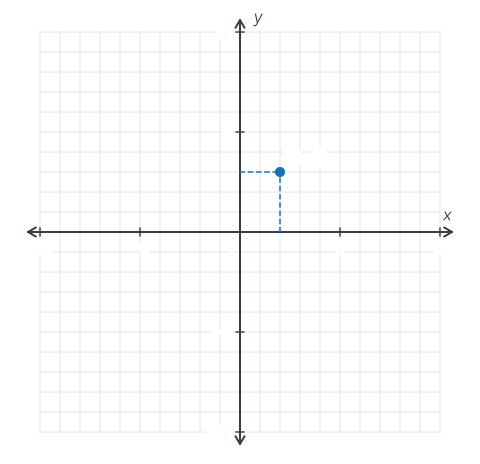
For example,

The point (2, 3) plotted on a coordinate plane, 2 units to the right of the origin and 3 units up.
Coordinate point
Achievable

Start at the origin. This point is 2 units in the x direction and 3 units in the y direction, so it’s written (2,3).

Understanding direction

  • The x-value tells you how far left or right to move

  • The y-value tells you how far up or down to move

  • x is positive to the right and negative to the left

  • y is positive above and negative below

Quadrants

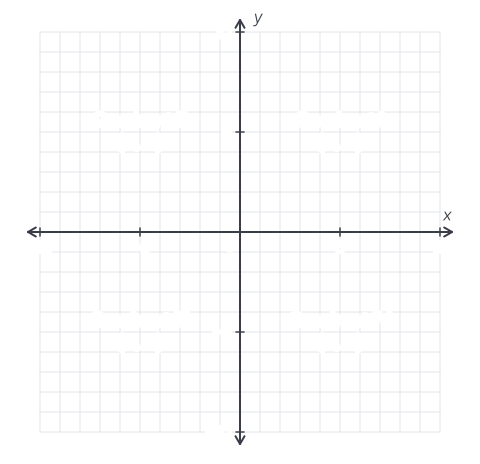
The coordinate plane is divided into four sections called quadrants.

A coordinate plane with the four quadrants labeled: Quadrant I (+, +) upper right, Quadrant II (−, +) upper left, Quadrant III (−, −) lower left, and Quadrant IV (+, −) lower right.
Quadrants of the coordinate plane
Achievable

Each quadrant has a pattern of positive and negative values:

  • Quadrant I: (+,+)
  • Quadrant II: (−,+)
  • Quadrant III: (−,−)
  • Quadrant IV: (+,−)

Midpoint

Definitions
Midpoint
The point exactly halfway between two points, found by averaging their x-values and y-values

The midpoint is the point exactly halfway between two points on a coordinate plane.

To find it, average the x-values and average the y-values separately.

(2x1​+x2​​,2y1​+y2​​)

Example:

What is the midpoint of (−3,8) and (5,−2)?

This is asking: what point is exactly halfway between the two given points?

Substitute the values into the formula:

===​(2x1​+x2​​,2y1​+y2​​)(2−3+5​,28+(−2)​)(22​,26​)(1,3)​

The midpoint is (1,3).

Steps taken:

  • Add the x-values and divide by 2
  • Add the y-values and divide by 2
  • Write the coordinate

Knowledge check: What is the midpoint of (2,4) and (6,8)?

(spoiler)

The midpoint is (4,6).

Circles

  • Key parts: circumference (outer edge), radius (center to edge), diameter (edge to edge through center), chord, arc
  • diameter=2×radius
  • Circumference = distance around circle (like perimeter)

Polygons

  • Polygon: closed shape of straight sides, minimum 3; regular polygon has all equal sides/angles
  • Any polygon can be split into triangles from one vertex: (n−2) triangles for n sides
  • Sum of interior angles: (n−2)×180
  • For regular polygons, each interior angle = total sum ÷ number of sides

Coordinate plane

  • Formed by perpendicular x-axis (horizontal) and y-axis (vertical); origin = (0,0)
  • Points written as (x,y): move horizontally first, then vertically
  • Four quadrants with sign patterns:
    • Quadrant I: (+,+)
    • Quadrant II: (−,+)
    • Quadrant III: (−,−)
    • Quadrant IV: (+,−)

Midpoint

  • Midpoint = average of x-values and average of y-values: (2x1​+x2​​,2y1​+y2​​)
  • Represents point exactly halfway between two coordinates

Sign up for free to take 5 quiz questions on this topic

Previous
Next  | 2.5.1 FOIL and multiplying polynomials
All rights reserved ©2016 - 2026 Achievable, Inc.

Circles, polygons, and coordinate geometry

Circles

Definitions
Circumference
The outer edge of the circle
Radius
The distance from the center to the edge of the circle
Diameter
The distance from one edge of the circle to the other while passing through the center of the circle
Chord
A line drawn from one edge of the circle to the other
Arcs
A segment of the circumference

A circle is a perfectly round shape where every point on the edge is the same distance from the center.

Understanding the parts of a circle will help you solve problems involving distance, area, and measurements around the circle.

Sidenote
Two important relationships to remember:
  • The radius goes from the center to the edge.
  • The diameter goes all the way across the circle and is twice the radius.

diameter=2×radius

The circumference is the distance around the circle, similar to perimeter in other shapes.

Sidenote
More on circles

We’ll explore the circle more in Advanced Geometry!

Polygons

Definitions
Polygon
A multisided closed shape made up of straight lines, with a minimum of 3 sides
Regular polygon
A polygon with all equal sides and all equal angles

A polygon is a flat, closed shape made up entirely of straight line segments. Each side connects end-to-end, forming a complete shape with no gaps.

Polygons can have many different numbers of sides. The simplest polygon is a triangle (3 sides), but polygons can also have 4 sides (quadrilaterals), 5 sides (pentagons), 6 sides (hexagons), and more.

Polygon types

Some polygons are regular, meaning all sides and angles are equal. Others are irregular, meaning their sides or angles are different.

One useful idea is that any polygon can be broken into triangles. This helps you understand angle relationships and solve problems involving the total interior angle measure.

Sum of angles of a polygon

We know the interior angles in a rectangle add up to 360∘ and the interior angles in a triangle add up to 180∘.

For larger polygons, we can break the shape into triangles by drawing lines from a single vertex to all other non-adjacent vertices.

Each triangle contributes 180∘, so the total interior angle sum depends on how many triangles are formed.

For a polygon with n sides, you can always form (n−2) triangles.

Officially, the formula for finding the sum of a polygon’s interior angles is:

(n−2)×180

where n = the number of sides of the polygon.

Let’s look at a problem together.

Example:

What is the value of ∠y in this regular polygon?

This is asking: what is the measure of one interior angle?

To find the total degree value of any polygon, you can either:

  • Use the formula (n−2)×180, or
  • Break the polygon into triangles (each triangle has 180∘).

Let’s break this one into triangles to show that we create 4 triangles.

180×4=720∘

Because the polygon is regular, all interior angles are equal.

So to find one angle, divide the total by the number of sides:

6720​=120∘

∠y=120∘

Steps taken:

  • Find total angle sum
  • Divide by the number of sides
  • Write the answer

Knowledge check: What is the measure of each interior angle in a regular pentagon?

(spoiler)

First, find the total interior angle sum:

(5−2)×180=3×180=540∘

Because the polygon is regular, divide by the number of sides:

5540​=108∘

Each interior angle is 108∘.

Coordinate plane

Definitions
Coordinate plane
A flat plane defined by two perpendicular axes — the horizontal x-axis and the vertical y-axis
Origin
The point (0,0) where the x-axis and y-axis intersect

The coordinate plane is a flat surface used to locate points using two numbers.

The point where the two axes meet is called the origin, written as (0,0).

Plotting points

To plot a point on the coordinate plane:

  • Move horizontally along the x-axis first, then
  • Move vertically along the y-axis

Write the point as (x-value,y-value).

For example,

Start at the origin. This point is 2 units in the x direction and 3 units in the y direction, so it’s written (2,3).

Understanding direction

  • The x-value tells you how far left or right to move

  • The y-value tells you how far up or down to move

  • x is positive to the right and negative to the left

  • y is positive above and negative below

Quadrants

The coordinate plane is divided into four sections called quadrants.

Each quadrant has a pattern of positive and negative values:

  • Quadrant I: (+,+)
  • Quadrant II: (−,+)
  • Quadrant III: (−,−)
  • Quadrant IV: (+,−)

Midpoint

Definitions
Midpoint
The point exactly halfway between two points, found by averaging their x-values and y-values

The midpoint is the point exactly halfway between two points on a coordinate plane.

To find it, average the x-values and average the y-values separately.

(2x1​+x2​​,2y1​+y2​​)

Example:

What is the midpoint of (−3,8) and (5,−2)?

This is asking: what point is exactly halfway between the two given points?

Substitute the values into the formula:

===​(2x1​+x2​​,2y1​+y2​​)(2−3+5​,28+(−2)​)(22​,26​)(1,3)​

The midpoint is (1,3).

Steps taken:

  • Add the x-values and divide by 2
  • Add the y-values and divide by 2
  • Write the coordinate

Knowledge check: What is the midpoint of (2,4) and (6,8)?

(spoiler)

The midpoint is (4,6).

Key points

Circles

  • Key parts: circumference (outer edge), radius (center to edge), diameter (edge to edge through center), chord, arc
  • diameter=2×radius
  • Circumference = distance around circle (like perimeter)

Polygons

  • Polygon: closed shape of straight sides, minimum 3; regular polygon has all equal sides/angles
  • Any polygon can be split into triangles from one vertex: (n−2) triangles for n sides
  • Sum of interior angles: (n−2)×180
  • For regular polygons, each interior angle = total sum ÷ number of sides

Coordinate plane

  • Formed by perpendicular x-axis (horizontal) and y-axis (vertical); origin = (0,0)
  • Points written as (x,y): move horizontally first, then vertically
  • Four quadrants with sign patterns:
    • Quadrant I: (+,+)
    • Quadrant II: (−,+)
    • Quadrant III: (−,−)
    • Quadrant IV: (+,−)

Midpoint

  • Midpoint = average of x-values and average of y-values: (2x1​+x2​​,2y1​+y2​​)
  • Represents point exactly halfway between two coordinates

More from Geometry basics

  • Lines and slopes
  • Angles and transversals
  • Basic shapes and area