


This browser is too old to run Achievable.

Update it, or open this page in a current version of Chrome, Safari, Firefox or Edge. On an iPhone or iPad, update iOS: every browser there runs on the version of Safari that comes with it.

Achievable logoAchievable logo
ASVAB
Sign in
Sign up
Purchase
Textbook
Practice exams
Support
How it works
Resources
Exam catalog
Mountain with a flag at the peak
Textbook
Introduction
1. Word Knowledge
2. Mathematics Knowledge
2.1 Foundational math
2.2 Pre-algebra
2.3 Algebra I
2.4 Geometry basics
2.5 Algebra II
2.5.1 FOIL and multiplying polynomials
2.5.2 Systems of equations
2.5.3 Functions, complex numbers, and consecutive integers
2.5.4 Mean, median, mode, range, and factorials
2.6 Advanced geometry
2.7 Math strategies
3. Paragraph Comprehension
4. Arithmetic Reasoning
5. General Science
6. Mechanical Comprehension
7. Electronics Information
8. Shop Information
9. Auto Information
10. Assembling Objects
Wrapping up
Achievable logoAchievable logo
2.5.1 FOIL and multiplying polynomials
Achievable ASVAB
2. Mathematics Knowledge
2.5. Algebra II
Our ASVAB course is currently in development and is a work-in-progress.

FOIL and multiplying polynomials

6 min read
Font
Discuss
Share
Feedback

FOIL-ing or each by each

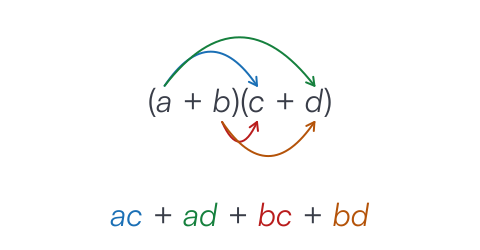
When you multiply polynomials, you can use the FOIL method or the each-by-each method. They’re the same idea: multiply every term in one polynomial by every term in the other polynomial, then combine like terms.

FOIL is a memory aid specifically for multiplying two binomials.

F - First (multiply the first terms within each parentheses)
O - Outside (multiply the two terms on the farthest edge of the parentheses)
I - Inside (multiply the two terms closest to the inside)
L - Last (multiply the last terms within each parentheses)

The FOIL method on (a + b)(c + d): arrows join the First terms a and c, the Outside terms a and d, the Inside terms b and c, and the Last terms b and d, giving ac + ad + bc + bd.
FOIL method graphic
Achievable

Example 1:

Distribute (b+2)(b+3).

Use FOIL:

(b+2)(b+3)​=b2+3b+2b+6=b2+5b+6​

Example 2:

Multiply (y+7)(y2+2y+3).

Here you’re multiplying a binomial by a trinomial, so use the same each-by-each idea: multiply each term in (y+7) by each term in (y2+2y+3), then combine like terms.

(y+7)(y2+2y+3)​=y(y2+2y+3)+7(y2+2y+3)=y3+2y2+3y+7y2+14y+21=y3+9y2+17y+21​

Steps taken:

  • Multiply each term in one expression by each term in the other
  • Combine like terms

Knowledge check: Expand

(x+4)(x+5)

(spoiler)

x2+9x+20

Greatest common factor

Definitions
Greatest common factor
The largest shared factor between a set of terms
Factor
A value that divides evenly into another value.

Factors are values that can evenly go into a larger term. The Greatest Common Factor (GCF) is the largest factor that multiple terms share. We can use factors to reduce a more complex expression, such as one with variables or multiple terms.

Let’s say we have the polynomial 12x3+8x2 and we want to find the common factors between the two terms. We’ll want to look at values that go into both the terms 12 and 8 and both of the variables x3 and x2. If we’re looking specifically for the Greatest Common Factor, we’ll want to find the largest values that go into each term.

  • The factors of 12 are 1,2,3,4,6, and 12
  • The factors of 8 are 1,2,4, and 8
  • They share factors of 1,2, and 4, with 4 being the greatest common factor.

Now look at the variables. What is the highest power they have in common?
Both 12x3 and 8x2 include x and x2, but x2 is the largest shared factor.

So the greatest common factor between 12x3 and 8x2 is 4x2.

We can now rewrite the expression by factoring out 4x2 (divide each term by 4x2):

12x3+8x2=4x2(3x+2)

Steps taken:

  • Find the GCF of the coefficients
  • Find the GCF of the variables
  • Multiply to get the overall GCF
  • Factor it out of each term

Factoring

Definitions
Factoring
Rewriting an expression as a product of simpler factors. It is the reverse of expanding (FOIL-ing).

Factoring is often called reverse FOIL-ing.

When we FOIL, we start with two sets of parentheses and multiply them together to create one larger expression.

For example:

(x+3)(x−5)​=x2−5x+3x−15=x2−2x−15​

Notice what happened:

  • We started with parentheses
  • We multiplied everything together
  • We ended with one simplified expression

Factoring goes in the opposite direction.

Instead of starting with parentheses, we start with the expanded expression:

x2−2x−15

Then we ask:

“What two parentheses could multiply together to create this expression?”

That means we are trying to work backward and “undo” the FOIL process.

So:

x2−2x−15

can be rewritten as:

(x+3)(x−5)

You can think of factoring like solving a puzzle:

  • The expanded expression is the finished puzzle
  • Factoring breaks it back into the smaller pieces that created it

How do we factor?

We will work with expressions in the form:

ax2+bx+c

For:

x2−2x−15

The values are:

  • a=1
  • b=−2
  • c=−15

To factor, we look for two numbers that:

  • Multiply to give c
  • Add to give b

So our factors will look like:

(x±_)(x±_)

At first, we do not know which numbers belong in the parentheses, so we list the factor pairs of −15:

(−1,15)

(1,−15)

(−3,5)

(3,−5)

Since c is negative, one number must be positive and one must be negative.

Now check which pair adds to −2:

−1+151+(−15)−3+53+(−5)​=14=−14=2=−2​

The pair that works is:

3 and −5

So the correct factors are:

(x+3)(x−5)

Check your answer:

We can verify by FOIL-ing:

(x+3)(x−5)​=x2−5x+3x−15=x2−2x−15​

If the expression we get after FOIL-ing matches the original problem, the factoring is correct.

Solving by factoring

If we can factor a quadratic equation, we can solve for x by setting each factor equal to zero.

This works because when two expressions multiply to equal 0, at least one of them must equal 0.

Example:

x2−2x−15(x+3)(x−5)​=0=0​

Now set each factor equal to 0:

x+3x​=0=−3​x−5x​=0=5​

So the solutions are:

x=−3 and x=5

Steps taken:

  • Factor the quadratic expression
  • Set each factor equal to zero
  • Solve each resulting equation
  • State the solutions

Knowledge check: Solve

x2+5x+6=0

(spoiler)

x=−2 and x=−3

Multiplying Polynomials (FOIL / Each-by-Each)

  • FOIL = First, Outside, Inside, Last; used for multiplying two binomials
  • Each-by-each: multiply every term in one polynomial by every term in the other, then combine like terms (works for binomial × trinomial, etc.)
  • Example: (b+2)(b+3)=b2+5b+6

Greatest Common Factor (GCF)

  • Factor: a value that divides evenly into another value
  • GCF: largest factor shared by all terms, found separately for coefficients and variables (lowest shared exponent), then combined
  • Steps: find GCF of coefficients → find GCF of variables → multiply → factor out of each term
  • Example: 12x3+8x2=4x2(3x+2)

Factoring Quadratics (Reverse FOIL)

  • Factoring = rewriting expression as product of simpler factors; opposite of FOIL-ing
  • For ax2+bx+c, find two numbers that multiply to c and add to b
  • Result expressed as (x±_)(x±_); check by FOIL-ing back to confirm
  • Example: x2−2x−15=(x+3)(x−5) since 3×(−5)=−15 and 3+(−5)=−2

Solving Quadratics by Factoring

  • Zero product rule: if two factors multiply to 0, at least one must equal 0
  • Steps: factor the quadratic → set each factor =0 → solve each equation → state both solutions
  • Example: x2−2x−15=0⇒(x+3)(x−5)=0⇒x=−3 or x=5

Sign up for free to take 5 quiz questions on this topic

Previous
Next  | 2.5.2 Systems of equations
All rights reserved ©2016 - 2026 Achievable, Inc.

FOIL and multiplying polynomials

FOIL-ing or each by each

When you multiply polynomials, you can use the FOIL method or the each-by-each method. They’re the same idea: multiply every term in one polynomial by every term in the other polynomial, then combine like terms.

FOIL is a memory aid specifically for multiplying two binomials.

F - First (multiply the first terms within each parentheses)
O - Outside (multiply the two terms on the farthest edge of the parentheses)
I - Inside (multiply the two terms closest to the inside)
L - Last (multiply the last terms within each parentheses)

Example 1:

Distribute (b+2)(b+3).

Use FOIL:

(b+2)(b+3)​=b2+3b+2b+6=b2+5b+6​

Example 2:

Multiply (y+7)(y2+2y+3).

Here you’re multiplying a binomial by a trinomial, so use the same each-by-each idea: multiply each term in (y+7) by each term in (y2+2y+3), then combine like terms.

(y+7)(y2+2y+3)​=y(y2+2y+3)+7(y2+2y+3)=y3+2y2+3y+7y2+14y+21=y3+9y2+17y+21​

Steps taken:

  • Multiply each term in one expression by each term in the other
  • Combine like terms

Knowledge check: Expand

(x+4)(x+5)

(spoiler)

x2+9x+20

Greatest common factor

Definitions
Greatest common factor
The largest shared factor between a set of terms
Factor
A value that divides evenly into another value.

Factors are values that can evenly go into a larger term. The Greatest Common Factor (GCF) is the largest factor that multiple terms share. We can use factors to reduce a more complex expression, such as one with variables or multiple terms.

Let’s say we have the polynomial 12x3+8x2 and we want to find the common factors between the two terms. We’ll want to look at values that go into both the terms 12 and 8 and both of the variables x3 and x2. If we’re looking specifically for the Greatest Common Factor, we’ll want to find the largest values that go into each term.

  • The factors of 12 are 1,2,3,4,6, and 12
  • The factors of 8 are 1,2,4, and 8
  • They share factors of 1,2, and 4, with 4 being the greatest common factor.

Now look at the variables. What is the highest power they have in common?
Both 12x3 and 8x2 include x and x2, but x2 is the largest shared factor.

So the greatest common factor between 12x3 and 8x2 is 4x2.

We can now rewrite the expression by factoring out 4x2 (divide each term by 4x2):

12x3+8x2=4x2(3x+2)

Steps taken:

  • Find the GCF of the coefficients
  • Find the GCF of the variables
  • Multiply to get the overall GCF
  • Factor it out of each term

Factoring

Definitions
Factoring
Rewriting an expression as a product of simpler factors. It is the reverse of expanding (FOIL-ing).

Factoring is often called reverse FOIL-ing.

When we FOIL, we start with two sets of parentheses and multiply them together to create one larger expression.

For example:

(x+3)(x−5)​=x2−5x+3x−15=x2−2x−15​

Notice what happened:

  • We started with parentheses
  • We multiplied everything together
  • We ended with one simplified expression

Factoring goes in the opposite direction.

Instead of starting with parentheses, we start with the expanded expression:

x2−2x−15

Then we ask:

“What two parentheses could multiply together to create this expression?”

That means we are trying to work backward and “undo” the FOIL process.

So:

x2−2x−15

can be rewritten as:

(x+3)(x−5)

You can think of factoring like solving a puzzle:

  • The expanded expression is the finished puzzle
  • Factoring breaks it back into the smaller pieces that created it

How do we factor?

We will work with expressions in the form:

ax2+bx+c

For:

x2−2x−15

The values are:

  • a=1
  • b=−2
  • c=−15

To factor, we look for two numbers that:

  • Multiply to give c
  • Add to give b

So our factors will look like:

(x±_)(x±_)

At first, we do not know which numbers belong in the parentheses, so we list the factor pairs of −15:

(−1,15)

(1,−15)

(−3,5)

(3,−5)

Since c is negative, one number must be positive and one must be negative.

Now check which pair adds to −2:

−1+151+(−15)−3+53+(−5)​=14=−14=2=−2​

The pair that works is:

3 and −5

So the correct factors are:

(x+3)(x−5)

Check your answer:

We can verify by FOIL-ing:

(x+3)(x−5)​=x2−5x+3x−15=x2−2x−15​

If the expression we get after FOIL-ing matches the original problem, the factoring is correct.

Solving by factoring

If we can factor a quadratic equation, we can solve for x by setting each factor equal to zero.

This works because when two expressions multiply to equal 0, at least one of them must equal 0.

Example:

x2−2x−15(x+3)(x−5)​=0=0​

Now set each factor equal to 0:

x+3x​=0=−3​x−5x​=0=5​

So the solutions are:

x=−3 and x=5

Steps taken:

  • Factor the quadratic expression
  • Set each factor equal to zero
  • Solve each resulting equation
  • State the solutions

Knowledge check: Solve

x2+5x+6=0

(spoiler)

x=−2 and x=−3

Key points

Multiplying Polynomials (FOIL / Each-by-Each)

  • FOIL = First, Outside, Inside, Last; used for multiplying two binomials
  • Each-by-each: multiply every term in one polynomial by every term in the other, then combine like terms (works for binomial × trinomial, etc.)
  • Example: (b+2)(b+3)=b2+5b+6

Greatest Common Factor (GCF)

  • Factor: a value that divides evenly into another value
  • GCF: largest factor shared by all terms, found separately for coefficients and variables (lowest shared exponent), then combined
  • Steps: find GCF of coefficients → find GCF of variables → multiply → factor out of each term
  • Example: 12x3+8x2=4x2(3x+2)

Factoring Quadratics (Reverse FOIL)

  • Factoring = rewriting expression as product of simpler factors; opposite of FOIL-ing
  • For ax2+bx+c, find two numbers that multiply to c and add to b
  • Result expressed as (x±_)(x±_); check by FOIL-ing back to confirm
  • Example: x2−2x−15=(x+3)(x−5) since 3×(−5)=−15 and 3+(−5)=−2

Solving Quadratics by Factoring

  • Zero product rule: if two factors multiply to 0, at least one must equal 0
  • Steps: factor the quadratic → set each factor =0 → solve each equation → state both solutions
  • Example: x2−2x−15=0⇒(x+3)(x−5)=0⇒x=−3 or x=5

More from Algebra II

  • Systems of equations
  • Functions, complex numbers, and consecutive integers
  • Mean, median, mode, range, and factorials