



Distance and circles
Distance
Now that you’ve learned about the Pythagorean theorem, you can use it to find the distance between two points.
You can either memorize the distance formula or build a right triangle and use the Pythagorean theorem (recommended).
Since each point is written , label the first point and the second point .
Let’s find the distance using both methods.
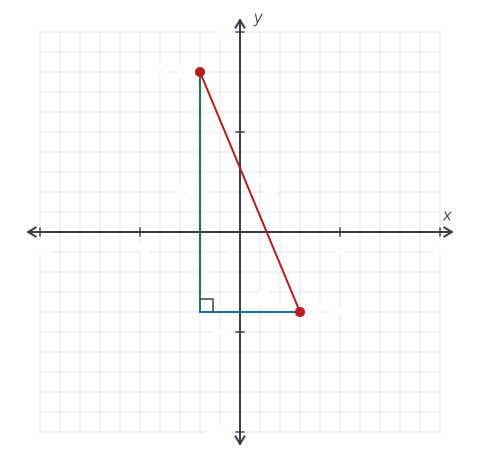
For example, with points and :
Formula method:
Distance
Triangle method:
Alternatively, plot the points and imagine a right triangle. The horizontal and vertical changes between the points are the legs of the triangle, and the distance between the points is the hypotenuse. Then use the Pythagorean theorem.
The horizontal leg runs from to , a length of . The vertical leg runs from to , a length of .
Distance
In distance problems, look for common right triangles (--, --, --), so the square root comes out to a whole number.
Circles - advanced
Circles have a few key measurements that show up often on the exam. The two most important are area and circumference. Each has a formula to use, and both formulas use the radius, .
If a problem gives you the diameter instead of the radius, divide it by first. For example, a circle with diameter has a radius of , so its area is .
Degrees
A full circle goes all the way around and measures .
One way to think about this is to break the circle into parts:
- A straight line is (half of a full turn)
- A circle is made of two of those halves
- So
If a circle is split into sections, all the angle measures must add up to .
You can use this idea to find a missing angle by adding the known angles and subtracting from .
Let’s try a couple of examples to practice working with circles.
Example:
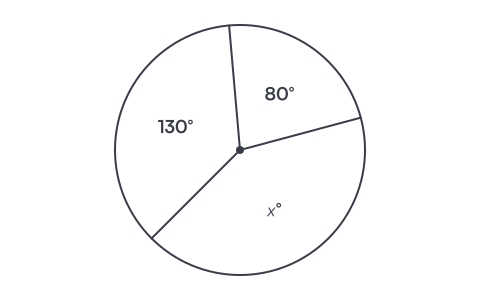
What is the value of in degrees?
All the angles in a circle add up to . Add the two known angles, then subtract from :
So .
Arcs
Segments of the circumference are called arcs, which just means parts of the circle’s edge. An arc’s measure is given in degrees and equals its central angle, while an arc’s length is the actual distance along that piece of the circle - a fraction of the whole circumference.
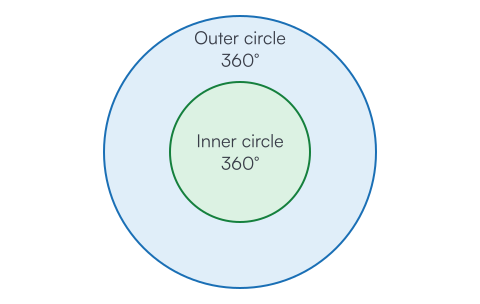
A circle of any size measures around, so an arc’s degree measure depends only on its central angle, not on the radius.
Example:
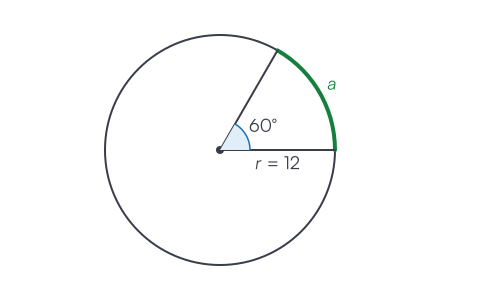
In the circle below, what is the length of arc ?
A.
B.
C.
D.An arc is a fraction of the circumference, so start by finding the circumference.
Now use the fact that the arc is the same fraction of the circumference as its central angle is of °. Here, arc corresponds to a ° central angle, so set up a proportion:
B is the correct answer