



Radians and measurement applications
Radians
Another way to measure angles in a circle is in radians. Radians measure a circle as fractions of .
So a full circle () corresponds to radians.
That means:
- Half a circle () is
- One fourth of a circle () is
This works for any circle, no matter the size.
These relationships let us convert between degrees and radians. Since , we can use this to switch between the two units.
Converting degrees to radians
Think of it like a unit swap: the degrees cancel out, and you’re left with radians. Always multiply the degree value by , then simplify your fraction if possible.
Example 1:
What is in radians?
Start with the key idea:
To convert degrees → radians, multiply by .
Now apply it:
Simplify the fraction by dividing top and bottom by :
So, radians.
Example 2:
What is radians in degrees?
Start with the same idea:
To convert radians → degrees, multiply by .
Now apply it:
The cancels out:
Simplify:
So, radians = .
Steps taken:
- Multiply by the correct conversion factor
- for degrees → radians
- for radians → degrees
- Cancel out units (degrees or )
- Simplify the fraction
Volume
The volume of an object tells you how much space it takes up. You can think of it like how much something can hold (like water in a box or container).
For the ASVAB, it helps to think of volume as: Area of a flat face × height
Rectangular prisms
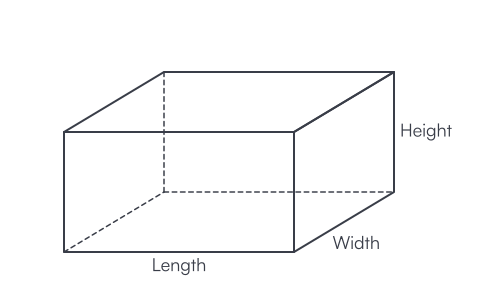
A box (rectangular prism) has a flat, rectangular base.
To find the volume, we first find the area of the base using length × width, then multiply by the height. This works because you are finding the area of the base, then stacking that area upward to fill the shape.
The base is the bottom face of the shape. The height is how tall the shape is from bottom to top.
Cylinders
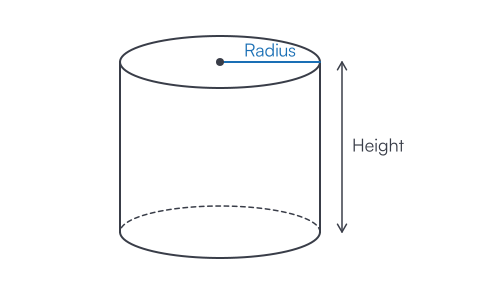
A cylinder follows the same idea as a box, but instead of a rectangular base, it has a circular base.
So instead of length × width, we use the area of a circle for the base, then multiply by the height.
In the example cylinder below, is the area of the circular base, and is the height of the cylinder.
Example:
Find the volume of a cylinder with radius and height .
Use the formula:
Start by identifying the values:
First, square the radius. Then multiply by the height. Finally, multiply by .
The volume is .
Surface area
Surface area is the total area covering only the outside of an object. Think of it as the area you can touch.
Different shapes have different formulas, but the idea is always the same: add up the area of every face.
- A cube has 6 equal square faces
- A rectangular prism has 6 rectangular faces
- Other shapes follow the same idea: find each face, then add them together
Example:
What is the surface area of a cube with side length cm?
A. cm²
B. cm²
C. cm²
D. cm²Each face is a square, so use the formula for area: side × side.
The surface area is cm².
Density
Density describes how much mass is packed into a given amount of space.
You can think of it like this:
- More mass in the same space = higher density
- Less mass in the same space = lower density
The formula for density is:
Example:
A rectangular prism with a width of centimeters, a length of centimeters, and a height of centimeters has a mass of grams. What is its density?
A.
B.
C.
D.Start by finding the volume of the rectangular prism.
Now divide mass by volume.
The density is .
Area of irregular shapes
To find the area of an irregular shape, break it into familiar shapes (like rectangles, squares, or triangles). Find the area of each smaller piece, then add them together.
This works because the total area is just the sum of all the smaller parts.
Example:
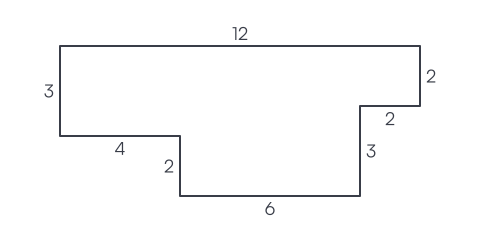
What is the area of the figure?
A.
B.
C.
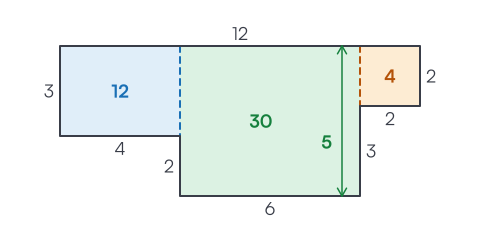
D.Split the figure into smaller rectangles.
Find the area of each piece:
- Rectangle 1:
- Rectangle 2:
- Large rectangle:
Add the areas:
The total area is , so the answer is C.