


This browser is too old to run Achievable.

Update it, or open this page in a current version of Chrome, Safari, Firefox or Edge. On an iPhone or iPad, update iOS: every browser there runs on the version of Safari that comes with it.

Achievable logoAchievable logo
ASVAB
Sign in
Sign up
Purchase
Textbook
Practice exams
Support
How it works
Resources
Exam catalog
Mountain with a flag at the peak
Textbook
Introduction
1. Word Knowledge
2. Mathematics Knowledge
2.1 Foundational math
2.2 Pre-algebra
2.3 Algebra I
2.4 Geometry basics
2.5 Algebra II
2.6 Advanced geometry
2.6.1 Equations of lines and slope
2.6.2 Right triangles and similar triangles
2.6.3 Distance and circles
2.6.4 Radians and measurement applications
2.7 Math strategies
3. Paragraph Comprehension
4. Arithmetic Reasoning
5. General Science
6. Mechanical Comprehension
7. Electronics Information
8. Shop Information
9. Auto Information
10. Assembling Objects
Wrapping up
Achievable logoAchievable logo
2.6.3 Distance and circles
Achievable ASVAB
2. Mathematics Knowledge
2.6. Advanced geometry
Our ASVAB course is currently in development and is a work-in-progress.

Distance and circles

6 min read
Font
Discuss
Share
Feedback

Distance

Now that you’ve learned about the Pythagorean theorem, you can use it to find the distance between two points.

You can either memorize the distance formula or build a right triangle and use the Pythagorean theorem (recommended).

Distance formula:

(y2​−y1​)2+(x2​−x1​)2​

Since each point is written (x,y), label the first point (x1​,y1​) and the second point (x2​,y2​).

Let’s find the distance using both methods.

For example, with points (3,−4) and (−2,8):

  • x1​=3,y1​=−4
  • x2​=−2,y2​=8

Formula method:

Distance=(y2​−y1​)2+(x2​−x1​)2​

(8−(−4))2+(−2−3)2​

(12)2+(−5)2​

144+25​

169​

13

Distance =13

Triangle method:

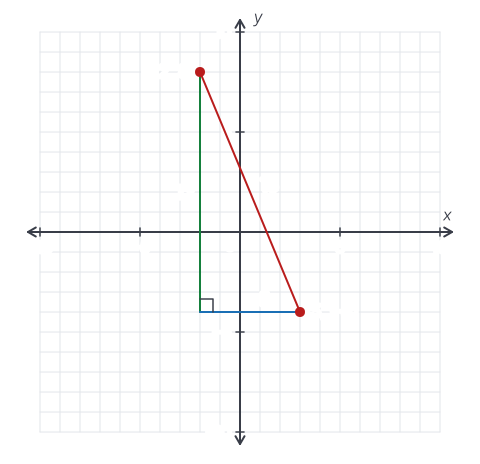
Alternatively, plot the points and imagine a right triangle. The horizontal and vertical changes between the points are the legs of the triangle, and the distance between the points is the hypotenuse. Then use the Pythagorean theorem.

The points (−2, 8) and (3, −4) on a coordinate plane, joined by a segment. A right triangle drawn under it has a vertical leg of 12, a horizontal leg of 5, and the segment, 13, as its hypotenuse.
Distance Example
Achievable

Circles - Advanced

Definitions
Area
The space inside a circle
Circumference
The distance around a circle

Circles have a few key measurements that show up often on the exam. The two most important are area and circumference. Each has a formula to use.

Area is the space inside the circle:

A=πr2

Circumference is the perimeter (distance around the circle):

C=2πr

Degrees

A full circle goes all the way around and measures 360∘.

One way to think about this is to break the circle into parts:

  • A straight line is 180∘ (half of a full turn)
  • A circle is made of two of those halves
  • So 180∘+180∘=360∘

If a circle is split into sections, all the angle measures must add up to 360∘.

You can use this idea to find a missing angle by adding the known angles and subtracting from 360∘.

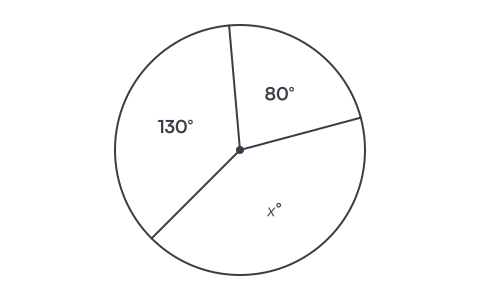
A circle divided by three radii into angles of 130°, 80° and an unknown angle x°.
Solving unknown parts of a circle
Achievable

Let’s try a couple of examples to practice working with circles.

Example:

What is the value of x in degrees?

Start with the key idea: A full circle adds up to 360∘.

This means all the angle pieces in the circle must add up to 360∘.

We are given two angles: 130∘ and 80∘, and one unknown angle x.

First, add the known angles:

130+80=210

Now we know:

210+x=360

To find x, subtract 210 from both sides:

360360−210150​=210+x=x=x​

So x=150∘.

Knowledge check:

A circle is split into angles of 100∘, 120∘, and x. What is x?

(spoiler)

140∘

Arcs

Definitions
Arcs
A part of the edge of a circle

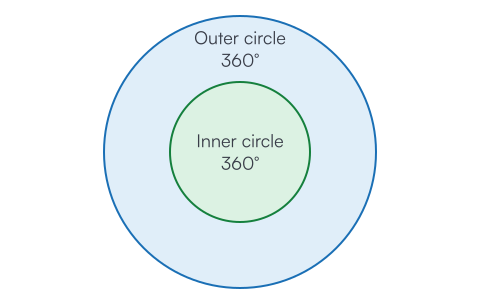
Segments of the circumference are called arcs, which just means parts of the circle’s edge. We measure arcs in degrees. A full circle is 360∘, so the entire edge of the circle also represents 360∘. Any arc is just a portion of that total.

Sidenote
Important to know!

A central angle has the same degree measure as the arc it points to. For example, if the angle is 60∘, the arc is also 60∘.

Two circles with the same center, one inside the other. The outer circle and the inner circle are both labeled 360°.
Circle circumference
Achievable

Example:

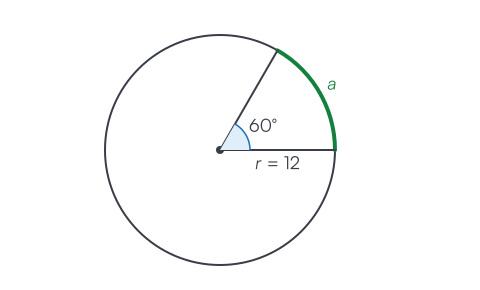
In the circle below, what is the measure of arc length a?

A circle with radius r = 12. Two radii form a 60° central angle, and the arc between them is labeled a.
Arc example problem
Achievable

A. 2π
B. 4π
C. 6π
D. 8π

An arc is a fraction of the circumference, so start by finding the circumference.

CCC​=2πr=2π(12)=24π​

Now use the fact that the arc is the same fraction of the circumference as its central angle is of 360°. Here, arc a corresponds to a 60° central angle, so set up a proportion:

60360​66aaa​=a24π​=a24π​=24π=624π​=4π​

B is the correct answer

Knowledge check: A circle has a radius of 6. What is the length of an arc with a central angle of 90∘?

(spoiler)

3π

Distance Between Points

  • Distance formula: (y2​−y1​)2+(x2​−x1​)2​, using labeled points (x1​,y1​) and (x2​,y2​)
  • Alternative: build a right triangle from horizontal/vertical changes between points, then apply Pythagorean theorem (legs = coordinate differences, hypotenuse = distance)
  • Both methods yield the same result (e.g., distance = 13 for points (3,-4) and (-2,8))

Circle Area & Circumference

  • Area (space inside circle): A=πr2
  • Circumference (distance around circle): C=2πr

Circle Degrees

  • Full circle = 360∘ (two straight lines of 180∘ each)
  • All angle sections within a circle must sum to 360∘
  • Find missing angle: subtract sum of known angles from 360∘

Arcs

  • Arc = a portion of the circle’s edge (circumference), measured in degrees
  • Central angle measure equals its corresponding arc’s degree measure (e.g., 60∘ angle → 60∘ arc)
  • Arc length is found via proportion: central angle360​=arc lengthcircumference​
  • Steps: calculate circumference first (C=2πr), then solve proportion for arc length

Sign up for free to take 5 quiz questions on this topic

Previous
Next  | 2.6.4 Radians and measurement applications
All rights reserved ©2016 - 2026 Achievable, Inc.

Distance and circles

Distance

Now that you’ve learned about the Pythagorean theorem, you can use it to find the distance between two points.

You can either memorize the distance formula or build a right triangle and use the Pythagorean theorem (recommended).

Distance formula:

(y2​−y1​)2+(x2​−x1​)2​

Since each point is written (x,y), label the first point (x1​,y1​) and the second point (x2​,y2​).

Let’s find the distance using both methods.

For example, with points (3,−4) and (−2,8):

  • x1​=3,y1​=−4
  • x2​=−2,y2​=8

Formula method:

Distance=(y2​−y1​)2+(x2​−x1​)2​

(8−(−4))2+(−2−3)2​

(12)2+(−5)2​

144+25​

169​

13

Distance =13

Triangle method:

Alternatively, plot the points and imagine a right triangle. The horizontal and vertical changes between the points are the legs of the triangle, and the distance between the points is the hypotenuse. Then use the Pythagorean theorem.

Circles - Advanced

Definitions
Area
The space inside a circle
Circumference
The distance around a circle

Circles have a few key measurements that show up often on the exam. The two most important are area and circumference. Each has a formula to use.

Area is the space inside the circle:

A=πr2

Circumference is the perimeter (distance around the circle):

C=2πr

Degrees

A full circle goes all the way around and measures 360∘.

One way to think about this is to break the circle into parts:

  • A straight line is 180∘ (half of a full turn)
  • A circle is made of two of those halves
  • So 180∘+180∘=360∘

If a circle is split into sections, all the angle measures must add up to 360∘.

You can use this idea to find a missing angle by adding the known angles and subtracting from 360∘.

Let’s try a couple of examples to practice working with circles.

Example:

What is the value of x in degrees?

Start with the key idea: A full circle adds up to 360∘.

This means all the angle pieces in the circle must add up to 360∘.

We are given two angles: 130∘ and 80∘, and one unknown angle x.

First, add the known angles:

130+80=210

Now we know:

210+x=360

To find x, subtract 210 from both sides:

360360−210150​=210+x=x=x​

So x=150∘.

Knowledge check:

A circle is split into angles of 100∘, 120∘, and x. What is x?

(spoiler)

140∘

Arcs

Definitions
Arcs
A part of the edge of a circle

Segments of the circumference are called arcs, which just means parts of the circle’s edge. We measure arcs in degrees. A full circle is 360∘, so the entire edge of the circle also represents 360∘. Any arc is just a portion of that total.

Sidenote
Important to know!

A central angle has the same degree measure as the arc it points to. For example, if the angle is 60∘, the arc is also 60∘.

Example:

In the circle below, what is the measure of arc length a?

A. 2π
B. 4π
C. 6π
D. 8π

An arc is a fraction of the circumference, so start by finding the circumference.

CCC​=2πr=2π(12)=24π​

Now use the fact that the arc is the same fraction of the circumference as its central angle is of 360°. Here, arc a corresponds to a 60° central angle, so set up a proportion:

60360​66aaa​=a24π​=a24π​=24π=624π​=4π​

B is the correct answer

Knowledge check: A circle has a radius of 6. What is the length of an arc with a central angle of 90∘?

(spoiler)

3π

Key points

Distance Between Points

  • Distance formula: (y2​−y1​)2+(x2​−x1​)2​, using labeled points (x1​,y1​) and (x2​,y2​)
  • Alternative: build a right triangle from horizontal/vertical changes between points, then apply Pythagorean theorem (legs = coordinate differences, hypotenuse = distance)
  • Both methods yield the same result (e.g., distance = 13 for points (3,-4) and (-2,8))

Circle Area & Circumference

  • Area (space inside circle): A=πr2
  • Circumference (distance around circle): C=2πr

Circle Degrees

  • Full circle = 360∘ (two straight lines of 180∘ each)
  • All angle sections within a circle must sum to 360∘
  • Find missing angle: subtract sum of known angles from 360∘

Arcs

  • Arc = a portion of the circle’s edge (circumference), measured in degrees
  • Central angle measure equals its corresponding arc’s degree measure (e.g., 60∘ angle → 60∘ arc)
  • Arc length is found via proportion: central angle360​=arc lengthcircumference​
  • Steps: calculate circumference first (C=2πr), then solve proportion for arc length

More from Advanced geometry

  • Equations of lines and slope
  • Right triangles and similar triangles
  • Radians and measurement applications