



Right triangles and similar triangles
Triangles — Advanced
In this section, we build on basic triangle concepts to solve more complex problems involving side lengths and proportions.
You will use tools like the Pythagorean theorem, similar triangles, and special right triangle relationships to find missing values and analyze triangle properties.
Pythagorean theorem
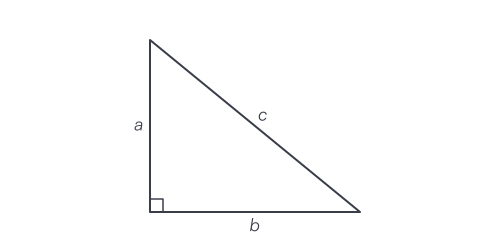
In a right triangle:
- The shorter sides are called the legs and are labeled and . It doesn’t matter which leg is or which is — they’re interchangeable.
- The hypotenuse (the side opposite the angle) is the longest side and is always labeled .
Example:
What is the hypotenuse of a right triangle with leg lengths of and ?
First, remember what each part means:
- The legs are the two shorter sides → and
- The hypotenuse is the longest side (the side across from the right angle) → this is what we are solving for
We use the Pythagorean theorem:
Here:
- and are the legs
- is the hypotenuse
Now plug in the values:
Square each number:
Add them:
Now we need to undo the square. To do that, take the square root of both sides:
The hypotenuse is .
Try one on your own!
Similar triangles
When triangles have three congruent corresponding angles, they are called similar triangles. Their corresponding side lengths are proportional.
One way to think about it: every triangle’s angles add up to ° If two triangles have the same three angle measures, then they have the same shape. One is just a scaled-up or scaled-down version of the other. Let’s look at how to solve a problem using similar triangles.
Example:
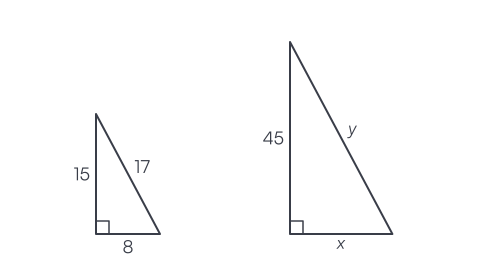
These two triangles are similar. What is the length of ?
Images are not to scale Because the triangles are similar, you can set up a proportion using corresponding sides. The sides labeled and correspond, and the sides labeled and correspond.
Set up the proportion:
The length of is .
Steps taken:
- Identify corresponding sides
- Set up a proportion
- Simplify the ratio
- Solve for the unknown variable
- Write the final answer
Special right triangles
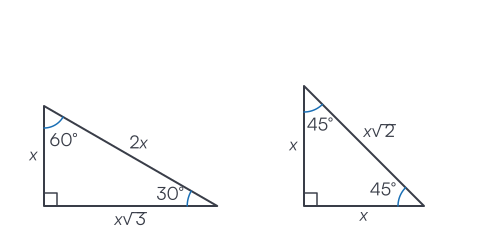
These triangles have specific proportional relationships between their angles and side lengths that are useful to memorize.
Example:
What is the hypotenuse of an isosceles right triangle with a leg length of ?
A.
B.
C.
D.First, identify the type of triangle.
An isosceles right triangle has:
- Two equal sides (the legs)
- Two angles
This means it is a -- triangle.
These triangles always follow the same pattern:
This means:
- Each leg =
- Hypotenuse =
Now plug in what you know.
The leg is , so:
Now find the hypotenuse:
So the hypotenuse is .
B is the correct answer.
Try one on your own!