



Basic shapes and area
Shapes
When working with shapes, there are two main measurements you’ll see often: area and perimeter.
- Area tells you how much space is inside a shape.
- Perimeter tells you how far it is around the outside.
We’ll start with two of the most common shapes: rectangles and squares.
Rectangles and squares
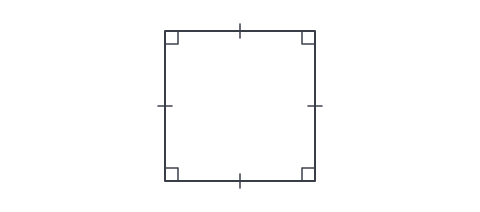
A rectangle has four sides and four right angles (). We call the side lengths the length and the width.
The interior angles of a rectangle always add to because:
A square is a special type of rectangle where all four sides are the same length.
Finding area and perimeter
Example:
A rectangle has a perimeter of inches. If the rectangle has a length of inches, what is the width of the rectangle?
This is asking: what value makes the perimeter formula equal to ?
Use the perimeter formula:
Substitute the known values:
Now solve:
The width of the rectangle is inches.
Steps taken:
- Use the perimeter formula
- Substitute known values
- Solve for the unknown
- Write the final answer
Triangles
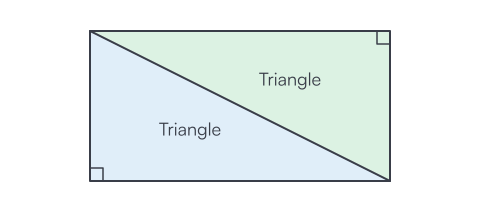
The interior angles of a triangle always add up to . This is important because if you know two angles, you can always find the third. One way to remember this is to picture a triangle as half of a rectangle. Since a rectangle’s interior angles sum to , half of that is:
Types of triangles
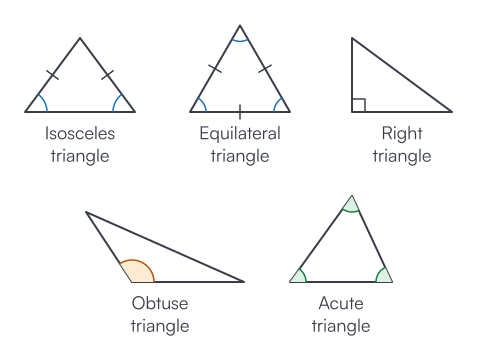
There are many different types of triangles! Triangles can be grouped based on their side lengths or their angle sizes. Knowing the type of triangle helps you quickly understand its properties and solve problems more easily.
- Some triangles are classified by their sides (like isosceles and equilateral).
- Others are classified by their angles (like right, obtuse, and acute).
For example, a right triangle will always have one angle, while an equilateral triangle will always have all sides and angles equal.
Area of triangles
To find the area of a triangle, you need two things:
- The base (a side of the triangle), and
- The height (how tall the triangle is).
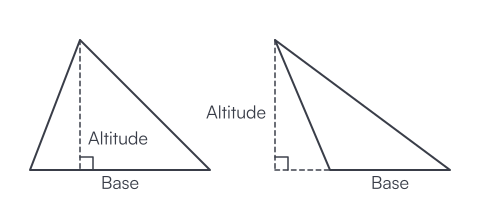
The height is not always one of the triangle’s sides. Instead, it is the perpendicular distance from the base to the opposite vertex.
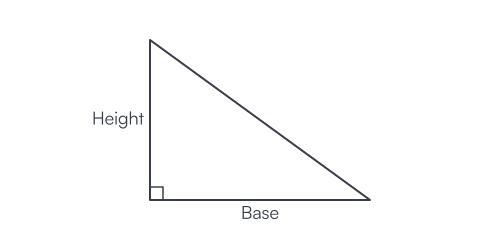
For right triangles, the base and height are already given by the sides that form the right angle, so they are easy to identify.
For many other triangles, you’ll need to draw the height down to the base. This height line is also called an altitude.
The altitude of a triangle is a perpendicular line drawn from a vertex to the opposite side. Sometimes you may need to extend the base to draw the altitude.
Once you have the altitude, use it as the height in the area formula.
Now let’s apply what we’ve learned about base and height to find the area of a triangle.
Example:
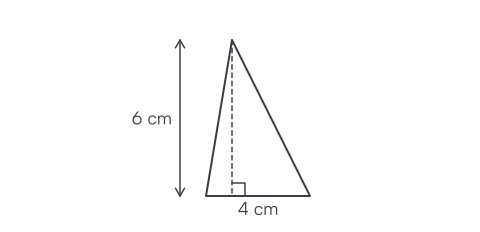
What is the area of the triangle?
This is asking: what is the space inside the triangle?
Use the altitude as the height. From the figure:
- The height is cm
- The base is cm
Now substitute into the formula:
The area of the triangle is .
Steps taken:
- Identify the base and height
- Use the altitude as the height when needed
- Substitute into the area formula
- Multiply to find the area