



Lines and slopes
Lines
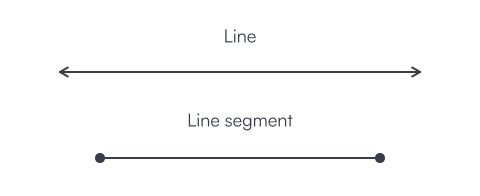
This model shows the difference between a line and a line segment. A line continues forever in both directions, while a line segment has fixed endpoints. This visual helps you see how one extends infinitely and the other does not.
Slopes
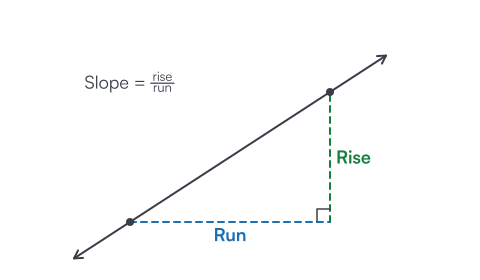
Slope tells you how a line moves as you go from left to right. It shows both how steep the line is and which direction it goes.
This model shows how slope works:
- A line with a positive slope goes up to the right.
- A line with a negative slope goes down to the right.
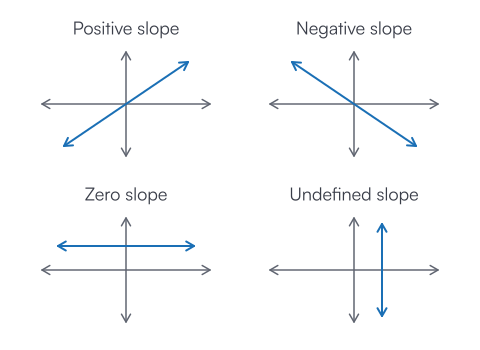
Types of slope
Lines can have different types of slope depending on how they move from left to right.
Interactions of lines
When comparing two lines, it’s helpful to look at their slopes. The slope tells you whether lines will meet, stay apart, or overlap.
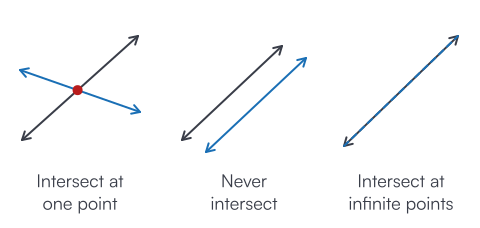
Two lines can interact in one of three ways:
- They can intersect at exactly one point
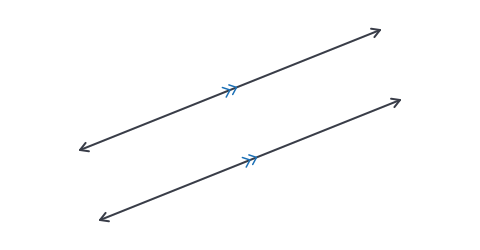
- They can never intersect
- They can overlap and intersect at infinite points.
- Lines intersect when they have different slope values. Since they rise or fall at different rates, they will meet at some point.
- Lines never intersect when they have the same slope value but different starting points. Since they travel at the same rate but start in different locations, they stay a constant distance apart. These are also called parallel lines.
- Lines intersect infinitely when they have the same slope and the same starting point. Because they begin at the same location and travel at the exact same rate, they are the same line.
Perpendicular lines
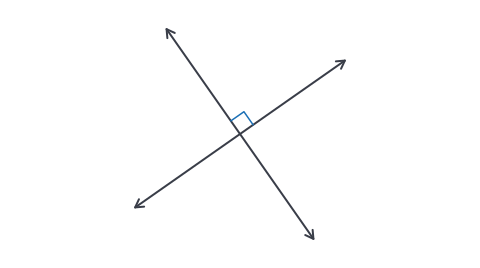
One important type of intersecting lines is perpendicular lines. They meet at exactly one point and form four angles (right angles).
You can also recognize perpendicular lines by looking at their slopes. The slopes of perpendicular lines are opposite reciprocals.
That means:
- The signs are opposite, and
- The fractions are flipped (reciprocal).
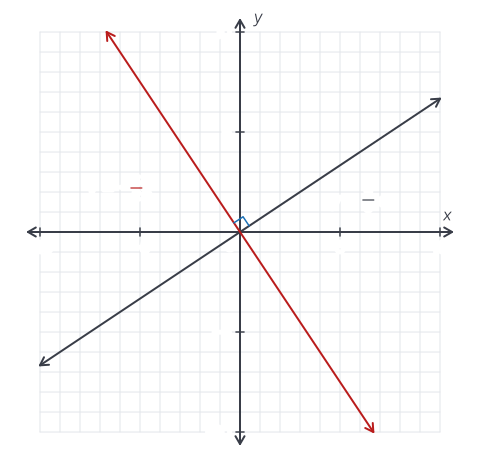
So if one line has a slope of , the line perpendicular to it has a slope of .
In the graph above, the two lines are perpendicular because their slopes are opposite reciprocals.
Practice problem
Example:
If one line has a slope of , what is the slope of a perpendicular line?
To solve, flip the fraction and change the sign: