



Achievable logoAchievable logo
ASVAB
Sign in
Sign up
Purchase
Textbook
Practice exams
Support
How it works
Exam catalog
Mountain with a flag at the peak
Textbook
Introduction
1. Word Knowledge
2. Math Knowledge
2.1 Algebra I
2.1.1 Rules and operations
2.2 Algebra II
2.3 Math strategies
3. Paragraph Comprehension
4. Arithmetic Reasoning
5. Shop Information
6. Auto Information
Wrapping up
Achievable logoAchievable logo
2.1.1 Rules and operations
Achievable ASVAB
2. Math Knowledge
2.1. Algebra I
Our ASVAB course is currently in development and is a work-in-progress.

Rules and operations

7 min read
Font
Discuss
Share
Feedback

Absolute value

Definitions
Absolute value
The distance a number is from zero

Absolute value is the distance a number is from zero. Because a distance cannot be negative, the end result of an absolute value expression is always positive.

∣4∣∣−4∣​=4=4​

When working with equations that contain absolute value, there will be two possible answers: a positive and a negative one. Each value will make the equation true because your end result always turns positive.

Example:

∣−6x∣=30

To solve this equation, we need to get x by itself. −6x could equal either positive 30 or negative 30, as the absolute value sign would turn it positive. So we need to create two equations and set −6x to both 30 and −30 to find both possible values for x that would make the equation true.

−6x−6​−6​x​x​=30=−630​=−5​

−6x−6​−6​x​x​=−30=−6−30​=5​

So our solutions are x=5 and x=−5!

Steps taken:

  • Split into two cases
  • Solve each case

Try one on your own!

Knowledge check: Solve ∣−5+5x∣=20?

(spoiler)

x=5 and x=−3

Proportions

Definitions
Proportion
The relationship between two quantities that compares two equal ratios. Proportions are useful for finding an unknown value that keeps the ratios equivalent.

A proportion shows that two fractions (ratios) are equal. You’ll often use proportions to solve for a missing value.

For example:

21​=10x​

To solve, you are looking for the value of x that makes both sides equal.

One common way to solve proportions is cross multiplication (sometimes called the butterfly method). To use it:

  • Multiply the diagonals of the two fractions
  • Set those products equal to each other
  • Solve for the unknown This works because if two fractions are equal, the product of the cross terms will also be equal. Let’s practice!

Example 1:

52​2⋅1020520​4​=10x​=5x=5x=5​5​x​=x​

Example 2:

m−25​5⋅189090+121026102​17​=186​=(m−2)⋅6=6m−12=6m−12 (+12)​=6m=6​6​m​=m​

Exponents

Definitions
Exponents
The power that represents how many times a base number is being multiplied by itself

Exponents represent repeated multiplication of a base. For example, 34=3⋅3⋅3⋅3.

When working with exponents, there are a few key rules. You don’t need to memorize the rule names, but you do need to know what each rule does.

Here are the main exponent patterns you’ll use:

Name Rule Example
Zero Exponent Rule a0=1 20=1
Product Rule ab⋅ac=ab+c 23⋅24=27
Quotient Rule acab​=ab−c 2324​=21
Power of Power Rule (ab)c=ab⋅c (24)3=212
Power of Product Rule (ab)c=acbc (2b)3=23b3
Negative Exponent Rule a−b=ab1​ 2−3=231​

Example 1:

(42)0​=42⋅0=40=1​

Example 2:

(x2y−2)4​=x2⋅4y−2⋅4=x8y−8=y8x8​​

Steps taken:

  • Apply exponent rules
  • Simplify

Roots

Definitions
Roots
The reverse of an exponent, also called a radical, and can be written as fractional exponents (for example, a​=a21​)

Roots are the reverse of exponents. They help you find what number was multiplied to get a result.

Here’s how to convert from radical to exponential form:

cab​=acb​

The most common roots you’ll see on the ASVAB are square roots and cube roots. Knowing common squares and cubes will make these problems much faster. Many students memorize:

  • Square numbers up to 12
  • Cube numbers up to 5

Square roots to memorize

1​=1
4​=2
9​=3
16​=4
25​=5
36​=6
49​=7
64​=8
81​=9
100​=10
121​=11
144​=12

Cube roots to memorize

31​=1
38​=2
327​=3
364​=4
3125​=5

Example 1:

x2​​=x2/2=x​

Steps taken:

  • Rewrite as an exponent
  • Simplify

Simplifying radicals

When a problem includes roots, you’ll often be asked to simplify the radical as much as possible.

One common method is a factor tree. You start with the number inside the square root and break it into factors until you reach prime numbers. This is also called prime factorization.

Example 2:

Simplify:

63​

Break 63 into 9∗7.

The first step of a factor tree breaking a number into its factors
Factor tree (part 1)
Achievable
>

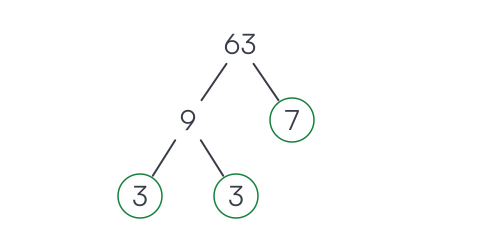
7 is prime, so that branch stops. But 9 can be broken into 3∗3.

A completed factor tree showing the prime factorization of a number
Factor tree (part 2)
Achievable
>

So the prime factorization of 63 is 3∗3∗7.

Because this is a square root, look for pairs of the same factor. The factor 3 appears twice, so it forms a pair. You can pull one 3 out of the square root, leaving 7​ inside:

63​=37​.

Steps taken:

  • Factor into primes
  • Find pairs
  • Simplify
Sidenote
Multiple roots

If we were simplifying a cubic root, we would look for sets of 3 identical factors to satisfy the root, for a fourth root, sets of 4, etc. This is because roots undo exponents, so only complete groups can come out of the radical—any leftover factors stay inside.

Example 3:

75​25⋅3​25​⋅3​5⋅3​53​​

Steps taken:

  • Factor the number
  • Identify perfect squares (or full groups)
  • Separate the root
  • Simplify

Knowledge check 1: Convert to Radical Form 432​

(spoiler)

316​ which can also be written as 342​

Knowledge check 2: Simplify 54​

(spoiler)

36​

Previous
Next  | 2.2.1 Systems of equations
All rights reserved ©2016 - 2026 Achievable, Inc.

Rules and operations

Absolute value

Definitions
Absolute value
The distance a number is from zero

Absolute value is the distance a number is from zero. Because a distance cannot be negative, the end result of an absolute value expression is always positive.

∣4∣∣−4∣​=4=4​

When working with equations that contain absolute value, there will be two possible answers: a positive and a negative one. Each value will make the equation true because your end result always turns positive.

Example:

∣−6x∣=30

To solve this equation, we need to get x by itself. −6x could equal either positive 30 or negative 30, as the absolute value sign would turn it positive. So we need to create two equations and set −6x to both 30 and −30 to find both possible values for x that would make the equation true.

−6x−6​−6​x​x​=30=−630​=−5​

−6x−6​−6​x​x​=−30=−6−30​=5​

So our solutions are x=5 and x=−5!

Steps taken:

  • Split into two cases
  • Solve each case

Try one on your own!

Knowledge check: Solve ∣−5+5x∣=20?

(spoiler)

x=5 and x=−3

Proportions

Definitions
Proportion
The relationship between two quantities that compares two equal ratios. Proportions are useful for finding an unknown value that keeps the ratios equivalent.

A proportion shows that two fractions (ratios) are equal. You’ll often use proportions to solve for a missing value.

For example:

21​=10x​

To solve, you are looking for the value of x that makes both sides equal.

One common way to solve proportions is cross multiplication (sometimes called the butterfly method). To use it:

  • Multiply the diagonals of the two fractions
  • Set those products equal to each other
  • Solve for the unknown This works because if two fractions are equal, the product of the cross terms will also be equal. Let’s practice!

Example 1:

52​2⋅1020520​4​=10x​=5x=5x=5​5​x​=x​

Example 2:

m−25​5⋅189090+121026102​17​=186​=(m−2)⋅6=6m−12=6m−12 (+12)​=6m=6​6​m​=m​

Exponents

Definitions
Exponents
The power that represents how many times a base number is being multiplied by itself

Exponents represent repeated multiplication of a base. For example, 34=3⋅3⋅3⋅3.

When working with exponents, there are a few key rules. You don’t need to memorize the rule names, but you do need to know what each rule does.

Here are the main exponent patterns you’ll use:

Name Rule Example
Zero Exponent Rule a0=1 20=1
Product Rule ab⋅ac=ab+c 23⋅24=27
Quotient Rule acab​=ab−c 2324​=21
Power of Power Rule (ab)c=ab⋅c (24)3=212
Power of Product Rule (ab)c=acbc (2b)3=23b3
Negative Exponent Rule a−b=ab1​ 2−3=231​

Example 1:

(42)0​=42⋅0=40=1​

Example 2:

(x2y−2)4​=x2⋅4y−2⋅4=x8y−8=y8x8​​

Steps taken:

  • Apply exponent rules
  • Simplify

Roots

Definitions
Roots
The reverse of an exponent, also called a radical, and can be written as fractional exponents (for example, a​=a21​)

Roots are the reverse of exponents. They help you find what number was multiplied to get a result.

Here’s how to convert from radical to exponential form:

cab​=acb​

The most common roots you’ll see on the ASVAB are square roots and cube roots. Knowing common squares and cubes will make these problems much faster. Many students memorize:

  • Square numbers up to 12
  • Cube numbers up to 5

Square roots to memorize

1​=1
4​=2
9​=3
16​=4
25​=5
36​=6
49​=7
64​=8
81​=9
100​=10
121​=11
144​=12

Cube roots to memorize

31​=1
38​=2
327​=3
364​=4
3125​=5

Example 1:

x2​​=x2/2=x​

Steps taken:

  • Rewrite as an exponent
  • Simplify

Simplifying radicals

When a problem includes roots, you’ll often be asked to simplify the radical as much as possible.

One common method is a factor tree. You start with the number inside the square root and break it into factors until you reach prime numbers. This is also called prime factorization.

Example 2:

Simplify:

63​

Break 63 into 9∗7.

>

7 is prime, so that branch stops. But 9 can be broken into 3∗3.

>

So the prime factorization of 63 is 3∗3∗7.

Because this is a square root, look for pairs of the same factor. The factor 3 appears twice, so it forms a pair. You can pull one 3 out of the square root, leaving 7​ inside:

63​=37​.

Steps taken:

  • Factor into primes
  • Find pairs
  • Simplify
Sidenote
Multiple roots

If we were simplifying a cubic root, we would look for sets of 3 identical factors to satisfy the root, for a fourth root, sets of 4, etc. This is because roots undo exponents, so only complete groups can come out of the radical—any leftover factors stay inside.

Example 3:

75​25⋅3​25​⋅3​5⋅3​53​​

Steps taken:

  • Factor the number
  • Identify perfect squares (or full groups)
  • Separate the root
  • Simplify

Knowledge check 1: Convert to Radical Form 432​

(spoiler)

316​ which can also be written as 342​

Knowledge check 2: Simplify 54​

(spoiler)

36​