


This browser is too old to run Achievable.

Update it, or open this page in a current version of Chrome, Safari, Firefox or Edge. On an iPhone or iPad, update iOS: every browser there runs on the version of Safari that comes with it.

Achievable logoAchievable logo
ASVAB
Sign in
Sign up
Purchase
Textbook
Practice exams
Support
How it works
Resources
Exam catalog
Mountain with a flag at the peak
Textbook
Introduction
1. Word Knowledge
2. Mathematics Knowledge
2.1 Foundational math
2.2 Pre-algebra
2.3 Algebra I
2.4 Geometry basics
2.4.1 Lines and slopes
2.4.2 Angles and transversals
2.4.3 Basic shapes and area
2.4.4 Circles, polygons, and coordinate geometry
2.5 Algebra II
2.6 Advanced geometry
2.7 Math strategies
3. Paragraph Comprehension
4. Arithmetic Reasoning
5. General Science
6. Mechanical Comprehension
7. Electronics Information
8. Shop Information
9. Auto Information
10. Assembling Objects
Wrapping up
Achievable logoAchievable logo
2.4.2 Angles and transversals
Achievable ASVAB
2. Mathematics Knowledge
2.4. Geometry basics
Our ASVAB course is currently in development and is a work-in-progress.

Angles and transversals

7 min read
Font
Discuss
Share
Feedback

Angles

Definitions
Vertex
The point where two lines or line segments meet to form an angle
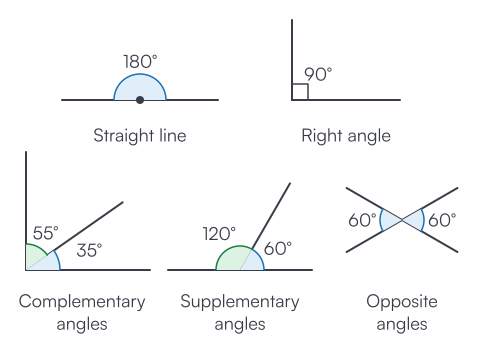
Straight line
Is 180°
Right angle
Is 90°
Complementary angles
Are two or more angles that add up to 90°
Supplementary angles
Are two or more angles that add up to 180°
Opposite angles
Are formed when two lines meet and are across from one another. These opposite angles are always congruent (equal).
Congruency
Angles, lines, or shapes that have the exact same measurement

An angle measures how two lines or line segments meet.

  • The point where they meet is called the vertex.
  • The size of the angle is measured in degrees.

Angles show how lines relate to each other. Understanding these relationships will help you solve problems where you need to find missing angle measures.

Five angle types. A straight line measures 180°. A right angle measures 90°. Complementary angles of 35° and 55° make 90°. Supplementary angles of 60° and 120° make a straight line. Two crossing lines make opposite angles, both 60°.
Angle definitions
Achievable
Sidenote
These angle types are often used together:

Complementary angles add to 90∘
Supplementary angles add to 180∘
Opposite (vertical) angles are always equal

Practice problem

Example:

If one angle is 40∘ and it forms a right angle with another angle, what is the second angle?

Because they are complementary:

90−40=50

The second angle is 50∘.

Steps taken:

  • Recognize the angles are complementary (they add to 90∘)
  • Subtract the known angle from 90∘
  • Calculate the missing angle
  • Write the final answer

Knowledge check: Two angles form a straight line. One angle is 110∘. What is the other angle?

(spoiler)

Straight lines are 180∘ (supplementary angles):

180−110=70

The other angle is 70∘.

Transversals

Definitions
Transversal
A line that cuts across two parallel lines, creating sets of angles that are either congruent or supplementary

When a transversal crosses parallel lines, it creates groups of angles that follow predictable patterns.

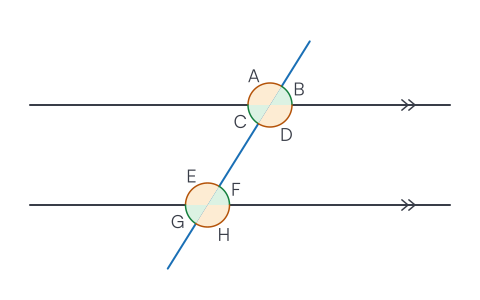
Two parallel lines crossed by a blue transversal rising to the right. At the top crossing, angles A (upper left), B (upper right), C (lower left) and D (lower right); at the bottom crossing, E, F, G and H in the same positions. The obtuse angles A, D, E and H are gold; the acute angles B, C, F and G are green.
Transversal crossing parallel lines
Achievable

Step 1: Look at one intersection

If we focus on the top cluster of angles:

  • ∠A and ∠D are opposite angles, so they are congruent.
  • ∠B and ∠C are also opposite angles, so they are congruent.

Now look at pairs that form a straight line:

  • ∠A and ∠B form a straight line, so they are supplementary angles.
  • The same is true for ∠B and ∠D, ∠D and ∠C, and ∠C and ∠A.

Step 2: Connect both intersections

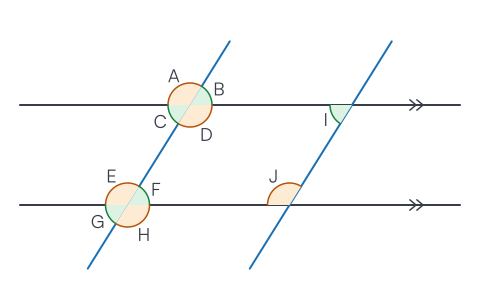
The same parallel lines and lettered angles A to H, with a second blue transversal parallel to the first. The two transversals and the parallel lines enclose a parallelogram. At the second transversal, angle I (lower left at the top line) is green and angle J (upper left at the bottom line) is gold.
Transversal (example 2)
Achievable

Now let’s connect the top cluster to the bottom cluster.

If we draw a second blue line (a transversal) parallel to the first transversal, we create a parallelogram with new angles ∠I and ∠J.

Sidenote
In a parallelogram:
  • Opposite angles are congruent
  • Adjacent angles are supplementary (like a rectangle pushed sideways)

Step 3: Follow the relationships

Now we use what we know to trace relationships across both intersections.

The same parallel lines and lettered angles A to H, with a second blue transversal parallel to the first. The two transversals and the parallel lines enclose a parallelogram. At the second transversal, angle I (lower left at the top line) is green and angle J (upper left at the bottom line) is gold.
Angle relationships across both intersections
Achievable
That means ∠D and ∠F are supplementary.

We already know ∠D and ∠C are supplementary, so ∠C and ∠F must be congruent.

From there:

  • ∠G is congruent to ∠F because they are opposite angles
  • ∠F and ∠E are supplementary because they form a straight line

In the image, green angles are supplementary with gold angles.

That means ∠E must match the gold angles, and ∠H (opposite and therefore congruent with ∠E) must also match.

We have now accounted for the relationships between all of the angles.

Practice problem

Example:

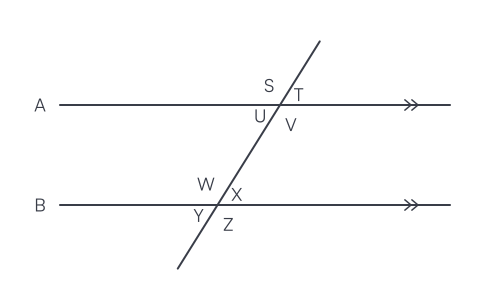
Parallel lines A and B cut by a transversal rising to the right. At the top crossing, angles S (upper left), T (upper right), U (lower left) and V (lower right); at the bottom crossing, W, X, Y and Z in the same positions.
Transversal example with labeled angles
Achievable

In the figure above, lines A and B are parallel. If ∠X is 55∘, what is the measure of ∠S?

This is asking: how can we connect ∠S to the angle we know?

  • ∠X and ∠U are congruent, so ∠U=55∘
  • ∠U and ∠S form a straight line, so they are supplementary

S+US+55S​=180=180=125​

∠S=125∘

Steps taken:

  • Find a congruent angle
  • Use a supplementary relationship
  • Solve for the unknown

Knowledge check: In a transversal diagram, two angles form a straight line. One angle measures 65∘. What is the measure of the other angle?

(spoiler)

Angles that form a straight line are supplementary, so they add to 180∘:

180−65=115

So the other angle is 115∘.

Angle basics

  • Vertex: point where lines/segments meet to form angle
  • Straight line = 180°; right angle = 90°
  • Complementary angles sum to 90°; supplementary angles sum to 180°
  • Opposite (vertical) angles are always congruent (equal)
  • Congruency = identical measurements

Solving for missing angles

  • Identify relationship type (complementary, supplementary, or opposite)
  • Subtract known angle from 90° (complementary) or 180° (supplementary) to find the missing angle
  • Opposite angles: just set equal, no subtraction needed

Transversals & parallel lines

  • Transversal: line crossing two parallel lines, creating congruent/supplementary angle sets
  • At each intersection: opposite angles congruent; adjacent angles (forming a straight line) supplementary
  • Pattern repeats at both intersections, linking all 8 angles into two congruent groups (e.g., all “green” angles equal each other, all “gold” angles equal each other, and green+gold pairs are supplementary)

Strategy for transversal problems

  • Trace from the known angle to the target angle using congruent (opposite/corresponding) and supplementary (straight line) relationships
  • Typical solving steps: find a congruent angle to the known one → apply supplementary relationship → solve equation like s+u=180

Sign up for free to take 6 quiz questions on this topic

Previous
Next  | 2.4.3 Basic shapes and area
All rights reserved ©2016 - 2026 Achievable, Inc.

Angles and transversals

Angles

Definitions
Vertex
The point where two lines or line segments meet to form an angle
Straight line
Is 180°
Right angle
Is 90°
Complementary angles
Are two or more angles that add up to 90°
Supplementary angles
Are two or more angles that add up to 180°
Opposite angles
Are formed when two lines meet and are across from one another. These opposite angles are always congruent (equal).
Congruency
Angles, lines, or shapes that have the exact same measurement

An angle measures how two lines or line segments meet.

  • The point where they meet is called the vertex.
  • The size of the angle is measured in degrees.

Angles show how lines relate to each other. Understanding these relationships will help you solve problems where you need to find missing angle measures.

Sidenote
These angle types are often used together:

Complementary angles add to 90∘
Supplementary angles add to 180∘
Opposite (vertical) angles are always equal

Practice problem

Example:

If one angle is 40∘ and it forms a right angle with another angle, what is the second angle?

Because they are complementary:

90−40=50

The second angle is 50∘.

Steps taken:

  • Recognize the angles are complementary (they add to 90∘)
  • Subtract the known angle from 90∘
  • Calculate the missing angle
  • Write the final answer

Knowledge check: Two angles form a straight line. One angle is 110∘. What is the other angle?

(spoiler)

Straight lines are 180∘ (supplementary angles):

180−110=70

The other angle is 70∘.

Transversals

Definitions
Transversal
A line that cuts across two parallel lines, creating sets of angles that are either congruent or supplementary

When a transversal crosses parallel lines, it creates groups of angles that follow predictable patterns.

Step 1: Look at one intersection

If we focus on the top cluster of angles:

  • ∠A and ∠D are opposite angles, so they are congruent.
  • ∠B and ∠C are also opposite angles, so they are congruent.

Now look at pairs that form a straight line:

  • ∠A and ∠B form a straight line, so they are supplementary angles.
  • The same is true for ∠B and ∠D, ∠D and ∠C, and ∠C and ∠A.

Step 2: Connect both intersections

Now let’s connect the top cluster to the bottom cluster.

If we draw a second blue line (a transversal) parallel to the first transversal, we create a parallelogram with new angles ∠I and ∠J.

Sidenote
In a parallelogram:
  • Opposite angles are congruent
  • Adjacent angles are supplementary (like a rectangle pushed sideways)

Step 3: Follow the relationships

Now we use what we know to trace relationships across both intersections. That means ∠D and ∠F are supplementary.

We already know ∠D and ∠C are supplementary, so ∠C and ∠F must be congruent.

From there:

  • ∠G is congruent to ∠F because they are opposite angles
  • ∠F and ∠E are supplementary because they form a straight line

In the image, green angles are supplementary with gold angles.

That means ∠E must match the gold angles, and ∠H (opposite and therefore congruent with ∠E) must also match.

We have now accounted for the relationships between all of the angles.

Practice problem

Example:

In the figure above, lines A and B are parallel. If ∠X is 55∘, what is the measure of ∠S?

This is asking: how can we connect ∠S to the angle we know?

  • ∠X and ∠U are congruent, so ∠U=55∘
  • ∠U and ∠S form a straight line, so they are supplementary

S+US+55S​=180=180=125​

∠S=125∘

Steps taken:

  • Find a congruent angle
  • Use a supplementary relationship
  • Solve for the unknown

Knowledge check: In a transversal diagram, two angles form a straight line. One angle measures 65∘. What is the measure of the other angle?

(spoiler)

Angles that form a straight line are supplementary, so they add to 180∘:

180−65=115

So the other angle is 115∘.

Key points

Angle basics

  • Vertex: point where lines/segments meet to form angle
  • Straight line = 180°; right angle = 90°
  • Complementary angles sum to 90°; supplementary angles sum to 180°
  • Opposite (vertical) angles are always congruent (equal)
  • Congruency = identical measurements

Solving for missing angles

  • Identify relationship type (complementary, supplementary, or opposite)
  • Subtract known angle from 90° (complementary) or 180° (supplementary) to find the missing angle
  • Opposite angles: just set equal, no subtraction needed

Transversals & parallel lines

  • Transversal: line crossing two parallel lines, creating congruent/supplementary angle sets
  • At each intersection: opposite angles congruent; adjacent angles (forming a straight line) supplementary
  • Pattern repeats at both intersections, linking all 8 angles into two congruent groups (e.g., all “green” angles equal each other, all “gold” angles equal each other, and green+gold pairs are supplementary)

Strategy for transversal problems

  • Trace from the known angle to the target angle using congruent (opposite/corresponding) and supplementary (straight line) relationships
  • Typical solving steps: find a congruent angle to the known one → apply supplementary relationship → solve equation like s+u=180

More from Geometry basics

  • Lines and slopes
  • Basic shapes and area
  • Circles, polygons, and coordinate geometry