



Economic growth
With short run fluctuations well discussed, we can move on to long run considerations. The first of them is economic growth, which we consider as a long run phenomenon.
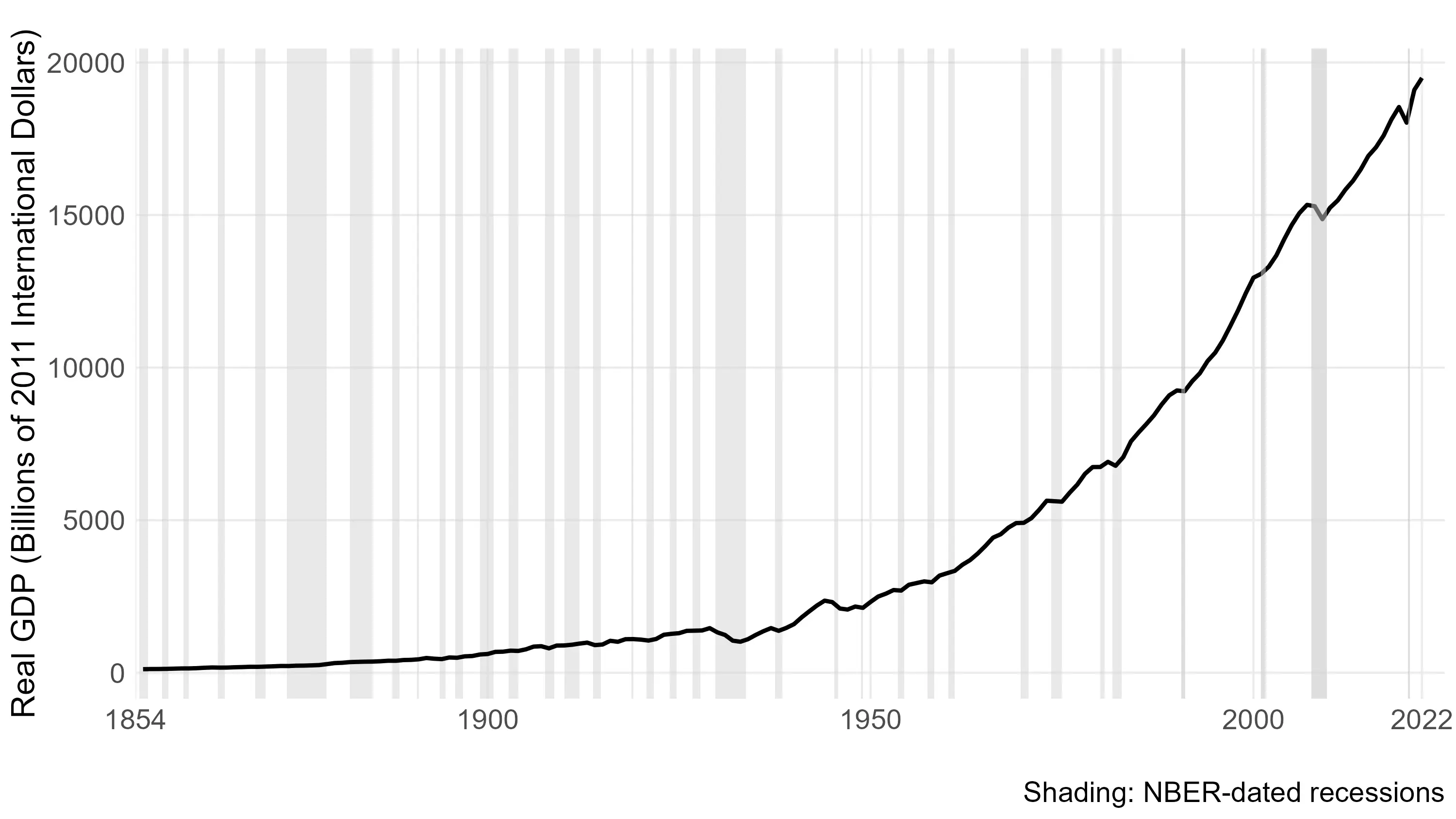
Returning to the chart of real GDP in the United States since 1854, the general trend of expansion over longer periods is clear. Even though the scale hides the size of recessions in the 19th century,
Growth calculations
Economic growth is calculated using the same method as the inflation rate
Growth rates make the most sense when compared to the previous year. When compared across many years, they must be adjusted to get the average yearly growth rate across the period being looked at. That is not something we are going cover.
So if real GDP in a country increases from 100 to 105, the growth rate is
Naturally, that is an easy example, but the method remains the same no matter what numbers are involved.
Now let us look at a more difficult example, one that is more like questions that are sometimes asked on the AP exam. An important note is that when these types of questions show up in the Free Response section, you are required to show your work.
The table below gives approximate values of real GDP and population for the United States, each expressed in millions.
| Year | Real GDP | Population |
|---|---|---|
| 2020 | 14,230,000 | 284 |
| 2025 | 24,125,000 | 343 |
Q: What is real GDP per capita in each year?
For 2020: .
For 2025:
Q: What is the growth rate of real GDP per capita from 2020 to 2025?
Alternatively and
Pay close attention to the units, if they are not the same one must be adjusted. For example, if GDP is measured in billions and population in millions, adding three zeros to GDP makes them both in millions and then you can divide them. This is what was done with the numbers in the table.
Another small note is that if population does not change, then growth in real GDP and growth in real GDP per capita must be exactly the same.
Theory of growth
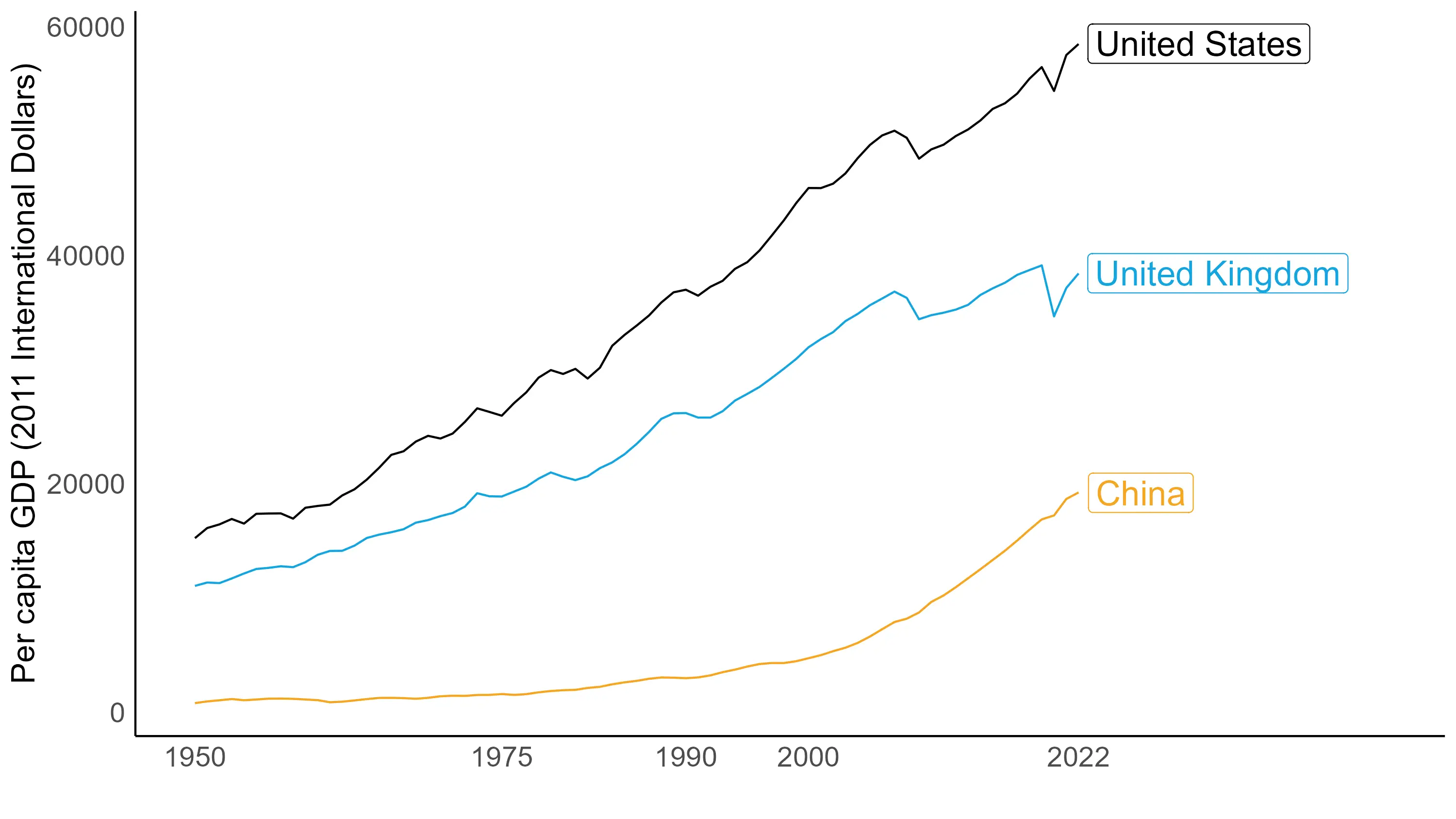
Over long periods of time growth in GDP per capita is a common story for many countries. As an example, here is a chart from the Maddison Project, which is dedicated to collecting research for historical estimates of GDP.
We can see that the United States has experienced faster growth than the United Kingdom since 1950 and we can also see that China has experienced tremendous growth since 1990. It is natural to wonder why. What leads countries to grow faster than others?
Additionally, long term growth is not true for every country. Another question we would like to address is why that is the case?
The broad answer is that it comes down to the growth factors and policies that will be discussed in this subchapter. We will mostly focus on examples that are “success stories” but there are more than a handful of examples of cautionary tales as well.
Benefits of economic growth
Economic growth is generally desirable. Higher real GDP means more goods and services are available, and higher real GDP per capita means higher income and thus higher living standards.
Even though GDP is not a perfect measure of well-being, higher GDP per capita is associated with improved outcomes in health, education and life expectancy.
A final benefit is that higher real GDP provides more opportunity for a government to collect revenue from taxes and thus makes it easier to fund programs.
Thus nearly always one long run policy goal will be to facilitate and encourage economic growth.
Sources of economic growth
To frame our discussion, here are real GDP values for select countries in 1953 and 2023, and their average growth rate over the 71 year period.
| Country | 1953 | 2022 | Average growth rate |
|---|---|---|---|
| Argentina | 7769 | 18292 | 1.22% |
| Chile | 6582 | 22741 | 1.77% |
| China | 1157 | 19238 | 4.02% |
| Spain | 4062 | 34123 | 3.04% |
| Mexico | 3602 | 16235 | 2.15% |
| United States | 16917 | 58487 | 1.77% |
Now we can start to answer a couple of key questions. First, what makes some countries richer than others? Second, why do some countries grow faster?
The sources of economic growth are
- Physical capital
- Human capital
- Technology
- Natural resources
- Institutions
The first two sources of growth are capital, which is the general term for resources used in production that are not used up. Physical capital, things like machines, factories and infrastructure, is generated through investment. The exact level of investment is determined in the loanable funds market, which will be discussed in a later subchapter.
Physical capital is not connected to a specific worker or set of workers. However, higher levels of capital per worker, capital deepening, is connected to higher levels of real GDP. The connection to growth is more complicated.
All factors of production generally face diminishing returns. For capital, this means that adding capital alone has a larger return when starting capital is lower compared to when starting capital is higher. Because of this adding capital per worker from a lower starting point can provide a temporary boost to a country’s growth, for example when a country industrializes or otherwise experiences a widespread adoption of new technology. Once a country’s capital per worker is built up, adding further capital has smaller impacts on growth.
This explains why low-income countries may experience higher growth than high-income countries. Looking at China, that is a major factor behind their higher growth over the past 71 years. It is not the only factor, however. We can also see from the table that Chile and Mexico started out poorer and did not experience such high growth.
Human capital refers to the knowledge and abilities of workers. This is linked to the worker and includes things like education, training and even the health of workers. Human capital may increase over time, in which case it should be called experience. But some ideas do wear out over time like physical capital, and require additional training or education to maintain.
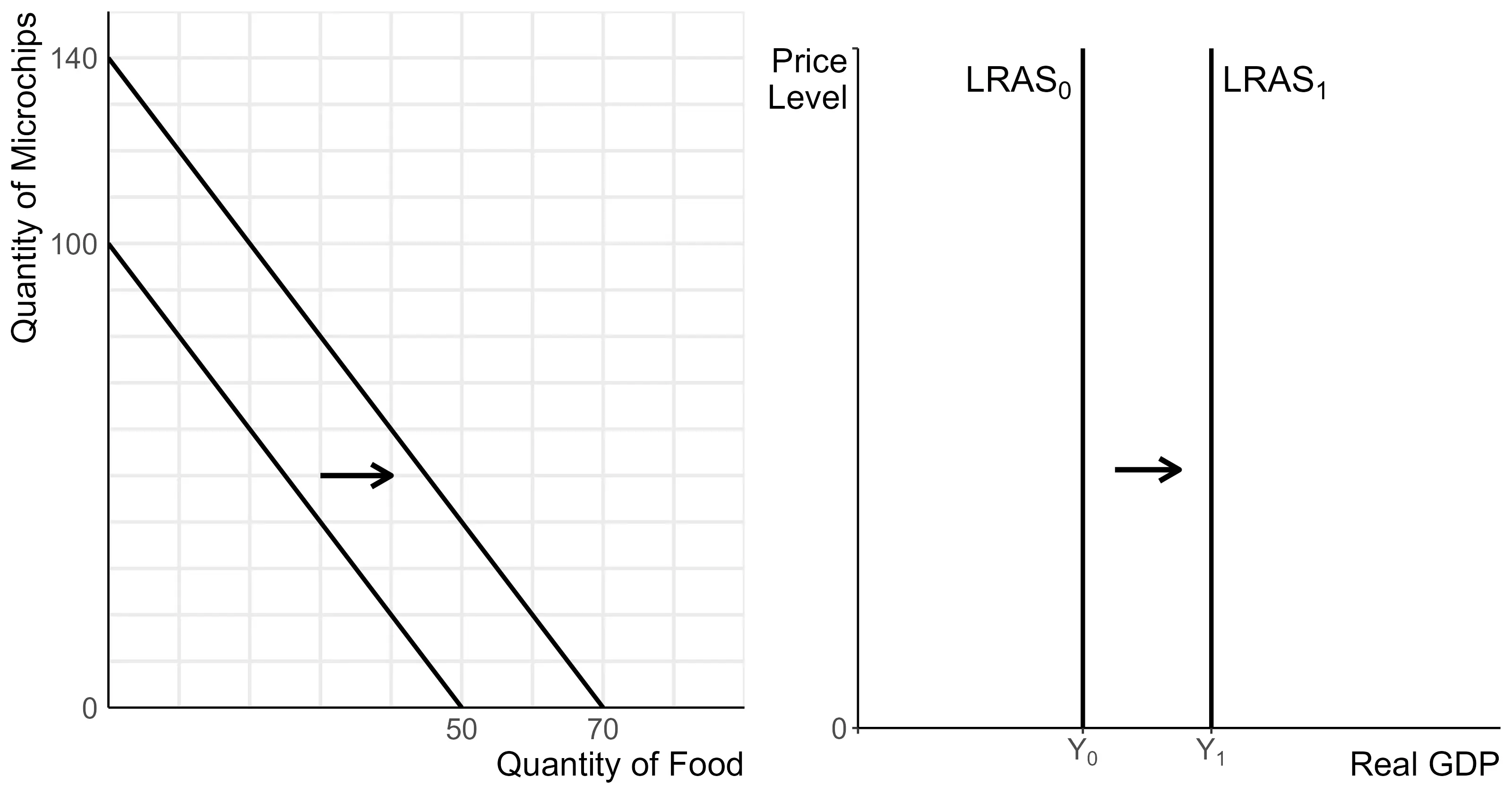
Technology generically refers to any changes that allow for more production using the same level of inputs. Thus technological improvements represent a shift in the production possibilities frontier and in the LRAS curve. Technology and productivity are similar at this level, so technology improvements can also be thought of as permanent increases in productivity.
Natural resources covers things that are used up in production and the size of the labor force. Things such as oil, gold, lumber, rare earth minerals, even water and land can enable economic growth and higher levels of real GDP. This is not the most important factor, because resource rich countries include more successful stories like the US, China and Canada as well as less successful stories such as Russia, the Democratic Republic of Congo and Argentina.
A major differentiator between these groups is institutions. This broadly covers legal structure and other societal factors not captured by other categories. Economists look for legal protections for property rights and the rule of law. Stronger property rights encourage investment by making it more likely the benefits are kept by whomever is making the investment. The rule of law refers to predictability and speed of legal processes, so faster and more predictable outcomes are more desirable. Weaker rule of law could also include wider acceptability of bribery, even in government settings, as well as misuse of program funds by government officials.
The Nobel Prize in 2024 was awarded to Daron Acemoglu, Simon Johnson and James A. Robinson for contributions in exploring the relationship between institutions and prosperity. A level-appropriate takeaway about institutions is that good rules do not guarantee growth, but they do make growth more likely.
Economic growth in our models
Economic growth can be viewed as an outward shift of either the or .
Growth enhancing policies
Policies that target economic growth are generally difficult to cost-effectively target in a predictable way. That does not stop nearly every country from trying.
Factors that governments attempt to encourage and that some cultures and social groups prioritize on their own include:
- Education/training
- Research and development
- Infrastructure
- Financial system stability
Education and training and lead to higher levels of human capital. Research and development is more about utilizing human capital to develop new ideas and technology, as well as making existing ideas and technology more efficient.
Infrastructure refers to basic facilities that enable economic activity. Things such as roads, highways, communications networks, and power and water delivery systems. These are often public goods, requiring significant investment from government to be provided at
Financial system stability is much like the rule of law, with each broadly referring to predictability and enforcement. On the financial side, this is often about the safety of funds in bank or investment accounts and the role of government if such companies do fail. In the United States, since the Great Depression banks have government run deposit insurance up a limit. So if your bank goes out of business, you do not lose your money as it was before this existed.
More severe recessions can result from breakdowns of these elements. As one example, recessions with financial crises tend to be “worse”, deeper and longer, than recessions without. A prolonged war could lead to damage to infrastructure and brain drain, the loss of human capital as educated citizens leave.
Supply side policies
Government policies that focus on incentivizing business behavior are referred to as supply side policies. One example is tax cuts or subsidies to encourage specific activities, such as investment or moving manufacturing from a foreign location to a domestic location. Also falling under this term is deregulation, the loosening or removal of previously established rules on business activity.
If such policies are applied to a large portion of the economy, then these can be thought of as shifters for the curve. Board changes in the corporate tax rate certainly qualify, but subsidies focused on one or two industries would likely not.
| Factor Increasing | Change in |
|---|---|
| Education or training | |
| Research or development | |
| Infrastructure | |
| Financial stability | |
| Rule of law (property rights) | |
| Taxes | |
| Subsidies | |
| Regulations |