


Achievable logoAchievable logo
AP Macroeconomics
Sign in
Sign up
Purchase
Textbook
Practice exams
Support
How it works
Exam catalog
Mountain with a flag at the peak
Textbook
Example
1. Core economic concepts
2. Measurement of economic performance
3. Modeling of income and prices
3.1 Aggregate demand
3.2 Aggregate supply and equilibrium in the short run
3.3 Aggregate supply and equilibrium in the long run
3.4 Output gaps and the self adjustment mechanism
3.5 Fiscal policy
3.6 Consumption modeling
3.7 Economic growth
4. Financial sector
5. Long-run consequences of stabilization policy
6. Open economy
Achievable logoAchievable logo
3.5 Fiscal policy
Achievable AP Macroeconomics
3. Modeling of income and prices
Our AP Macroeconomics course is currently in development and is a work-in-progress.

Fiscal policy

10 min read
Font
Discuss
Share
Feedback

To this point the government has been abstract. We have only discussed the impact of changes in government spending or taxation without worrying about where those changes come from. It is time to dive deeper into the workings and outcomes of choices the government makes.

Definitions
Fiscal policy
The use of taxation and spending by the government to pursue economic goals

Our discussions focus on the Federal government, since those changes in spending or taxes naturally affect the entire country. However, Federal government spending is only around one-third of total government spending. In the United States there are federal government programs that give funds to state governments who then complete the spending. As is common in GDP measurement, who actually buys the goods and services determines what category these activities fall under.

We are mostly going to ignore such complexities. They do exist, but they are something that our AD-AS framework does not capture well. For AP macro all spending is treated the same, whether it is federal, state or local.

Government spending and taxation are the main tools of fiscal policy. The standard economic goal of fiscal policy is stabilization, reducing or eliminating recessionary and inflationary gaps.

Stated another way, the goal is to move the short run equilibrium to the long run equilibrium. This can have different effects on inflation and unemployment. For now we will be looking at the short run impacts. Long run impacts will be discussed later on.

Tools of fiscal policy

Definitions
Government purchases and investment (G)
Spending on goods, services and gross investment by the government at all levels, federal, state and local.
Taxes (T)
Revenue from taxation, mainly lump sum taxes on households. For fiscal policy discussions any revenue from other taxes, such as business taxes and tariffs should be added if present.
Transfer payments (TR)
Any program or policy where the government gives households money instead of directly spending.

G is government purchases of goods and services plus government investment. Regardless of exactly which level of government raised the funds and where they were spent, all government spending is treated the same.

When discussing consumption, we also said that taxes should be treated as lump sum, flat amounts levied on everyone equally. This is not realistic, but it does simplify the analysis.

We may also consider revenue from other taxes, even if we do not . In the United States this includes corporate income taxes, investment taxes and tariffs. In other countries, European ones especially, this will include Value Added Taxes (VATs). This is a sort of national sales tax whose revenue goes to the government in the location where production activities take place.

In general, taxes on an activity will lead there to be less of it. If there are additional effects or a more complicated story to tell, that will be given when the relevant market is presented.

Transfer payments were mentioned in passing when we first introduced government spending. They cover any situation when the government gives households or businesses money rather than directly spending it themselves. Transfers can be programs that regularly provide money to specific groups, such as Social Security for retirees or unemployment benefits for some of the unemployed.

Transfers do not change GDP by themselves. Remember that GDP is only impacted when spending occurs, so if the government was going to spend the money anyways then handing it to consumers who spend it all has the same effect. Even if they save some, in a closed economy that turns into investment. So the net impact to GDP is the same.

Even so they may be desirable from the perspective of goals other than stabilization. One example is targeting poverty or otherwise reducing income inequality.

Expansionary policy vs contractionary policy

Our first categorization of fiscal policy is by the immediate impact it has on economic activity. Because fiscal policy almost always affects AD only, this can be simplified down to impacts on real GDP and unemployment.

Definitions
Expansionary fiscal policy
Any policy action that expands economic activity. Increases in real GDP and decreases in unemployment.
Contractionary fiscal policy
Any policy action that decreases economic activity. Decreases in real GDP and increases in unemployment.

The table below summarizes the effects of fiscal policy in the AD-AS model.

Fiscal policy tool Mechanism
Expansionary fiscal policy AD→
Transfers, G↑, T↓
Contractionary fiscal policy AD←
Transfers, G↓, T↑

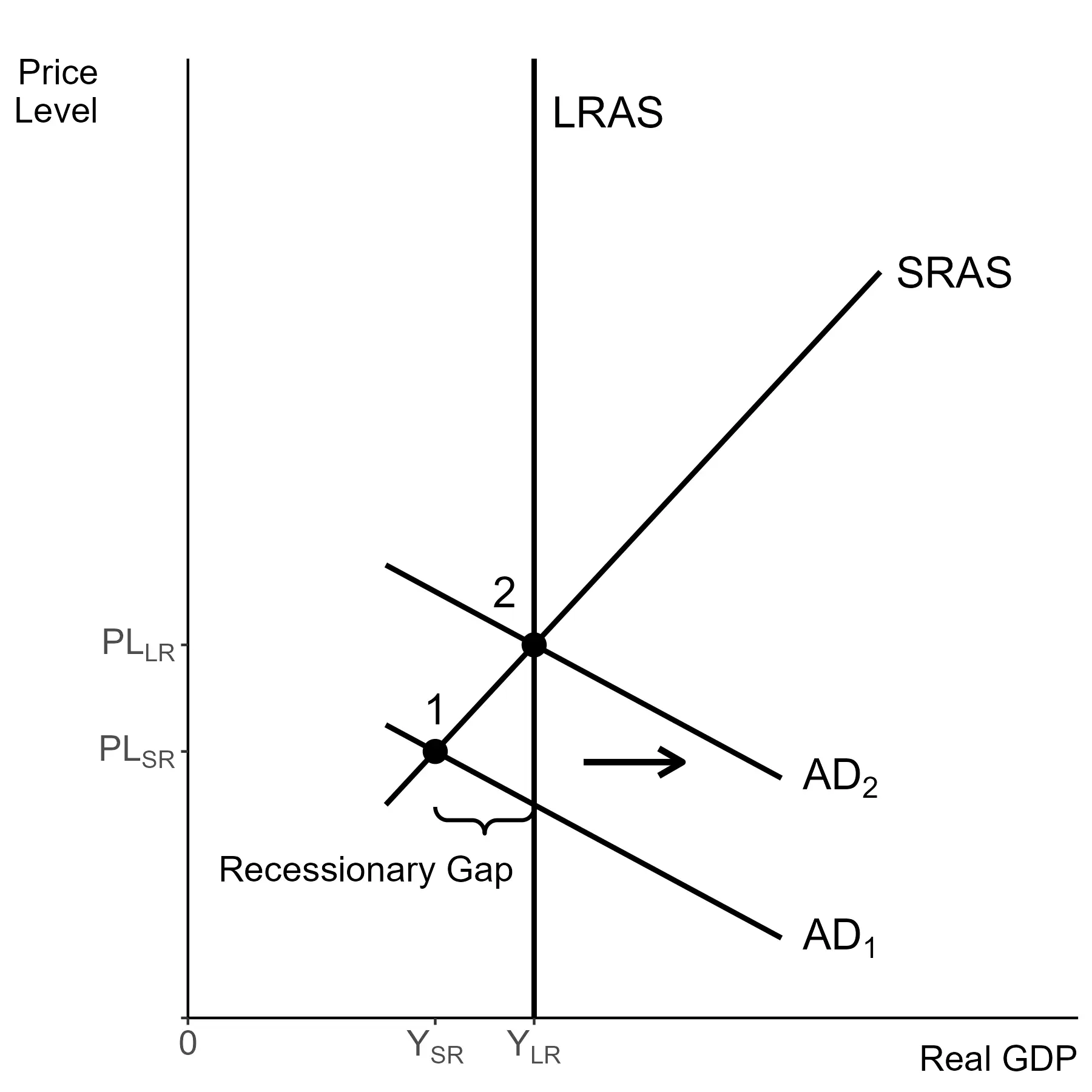
To reduce or eliminate a recessionary gap, the government can increase purchases, investment or transfers, or they can cut taxes. These policies do increase the price level, but if chosen correctly they also return real GDP to the long run equilibrium, Y⋆. The economy moves from point 1 to point 2, reducing unemployment and increasing the price level

Fiscal policy shifts $AD$ to the right in response to a recessionary gap
Fiscal response to a recessionary gap

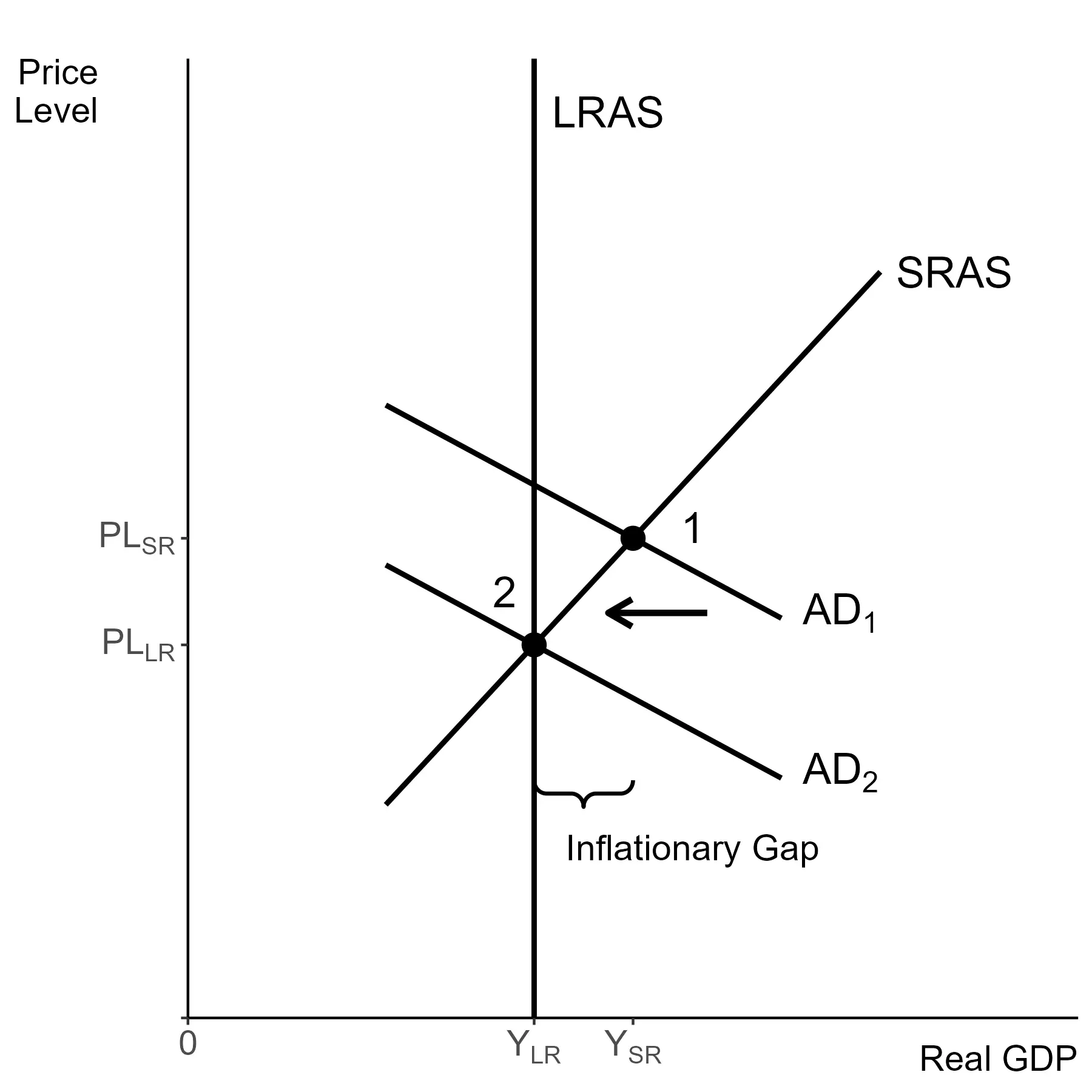
To use fiscal policy with an inflationary gap, the government should decrease spending, investment or transfers, or they can cut taxes. This decreases the price level and decreases GDP, moving the economy from point 1 to point 2. So there is a lower price level at the cost of higher unemployment.

Fiscal policy shifts $AD$ to the left in response to an inflationary gap
Fiscal response to an inflationary gap

Fiscal policy by type

Fiscal policy can also be sub-divided by how it is implemented.

Definitions
Discretionary fiscal policy
Changes in government spending or taxation directed at achieving economic goals that require new legislation.
Automatic stabilizers
Government programs that inherently smooth out business cycles. They act as a stimulus during recessions, and are contractionary during expansion periods, without the need for new legislation…
Supply-side policy
Policies aimed at impacting aggregate supply instead of aggregate demand.

Discretionary fiscal policy covers policies that require Congress to pass new bills. These include stimulus packages, tax cuts, subsidies for research or investment in capital projects in specific sectors or locations. These are often one-time policies, and a single recession may result in more than one stimulus bill.

In this century discretionary policy has often included one time transfer payments to counter the impact of recessions on households. These have been both lump sum payments and payments adjusted for household size. The largest case of this were Economic Impact Payments made in 2020-2021 in response to the COVID-19 pandemic. These totaled $837.5 billion dollars according to the Government Accounting Office.

Non-discretionary policy includes ongoing programs, such as Social Security and Medicare. Some of these policies are automatic stabilizers, programs that naturally adjust to business cycles without requiring new legislation.

Progressive income taxes rise and fall with income, naturally increasing income during a recession and decreasing it during an expansion. A transfer payment that acts as an automatic stabilizer is unemployment benefits. Payouts should rise when GDP falls (unemployment rises) and fall when GDP rises (unemployment falls).

Finally there is supply side policy, which attempts to move aggregate supply. This includes policy options such as tax incentives for technology adoption, deregulation, and funding for education and training of workers. If these policies can impact the natural rate of unemployment or productivity, then they will shift LRAS.

In practice, these goals are much more difficult to effectively target and it takes much longer for them to have an impact than direct spending, tax cuts or transfer payments. Because of this the main prescription of fiscal policy still follows the original thoughts of Keynes, direct spending is the most effective way to combat a recession.

Data: the US since 2002

If the government spends more than it raises in tax revenue in a year, we call that a government budget deficit. If the government raises more in tax revenue than it spends in a year, that is a government budget surplus. If G=T, that is a balanced budget.

In the US 49 states have a form of balanced budget rule, with Vermont as the only exception. Nationally there is no such rule and since 2001, the federal government has only run deficits.

The national debt is the adding up of previous deficits and surpluses for the federal government. Any interest from previous borrowing is already included, showing up in the current year’s government budget.

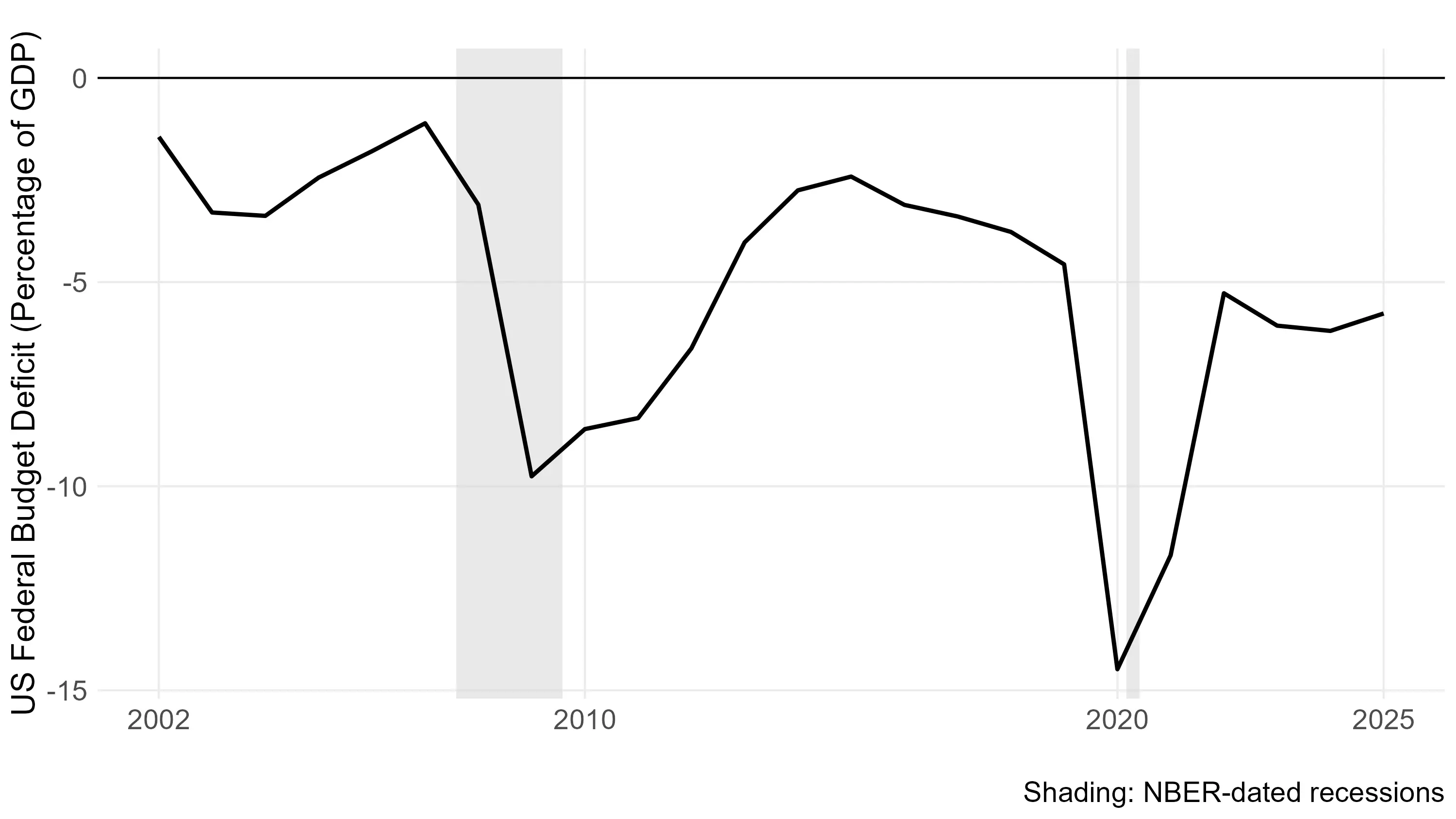
For some context, below is the US federal budget deficit since 2002 as a percent of GDP. Remember that dividing a piece of GDP by nominal GDP is a clever shortcut to show the real level across time.

GDP share of federal budget deficit, showing spikes around recessions
Federal budget deficit since 2002
U.S. Office of Management and Budget and Federal Reserve Bank of St. Louis
/
Public domain

The two recessions shown are the Great Recession and the COVID-19 recession. In each case we can see an increase in government spending.

During the Great Recession a tax rebate of $300 per person was issued in early 2008 and a stimulus package was passed in 2009. A small reduction in T and a larger increase in G. As a result the deficit temporarily increased.

The response to COVID-19 was larger in size and more expansive. The CARES act authorized spending that was roughly 10% of GDP. It included stimulus checks of $1200 per person, extensions of unemployment benefits, loans for small businesses and corporations, subsidies for health care and hospital industries and funds for state and local governments.

Each stimulus was the largest response in United States history at the time of its passage.

Although the US has mostly run government budget deficits, that is not the case in every country. Germany is the usual example of a country that runs persistent government budget surpluses. We will compare and contrast the US to Germany more once we are ready to add international financial flows.

Previous
Next  | 3.6 Consumption modeling
All rights reserved ©2016 - 2026 Achievable, Inc.

Fiscal policy

To this point the government has been abstract. We have only discussed the impact of changes in government spending or taxation without worrying about where those changes come from. It is time to dive deeper into the workings and outcomes of choices the government makes.

Definitions
Fiscal policy
The use of taxation and spending by the government to pursue economic goals

Our discussions focus on the Federal government, since those changes in spending or taxes naturally affect the entire country. However, Federal government spending is only around one-third of total government spending. In the United States there are federal government programs that give funds to state governments who then complete the spending. As is common in GDP measurement, who actually buys the goods and services determines what category these activities fall under.

We are mostly going to ignore such complexities. They do exist, but they are something that our AD-AS framework does not capture well. For AP macro all spending is treated the same, whether it is federal, state or local.

Government spending and taxation are the main tools of fiscal policy. The standard economic goal of fiscal policy is stabilization, reducing or eliminating recessionary and inflationary gaps.

Stated another way, the goal is to move the short run equilibrium to the long run equilibrium. This can have different effects on inflation and unemployment. For now we will be looking at the short run impacts. Long run impacts will be discussed later on.

Tools of fiscal policy

Definitions
Government purchases and investment (G)
Spending on goods, services and gross investment by the government at all levels, federal, state and local.
Taxes (T)
Revenue from taxation, mainly lump sum taxes on households. For fiscal policy discussions any revenue from other taxes, such as business taxes and tariffs should be added if present.
Transfer payments (TR)
Any program or policy where the government gives households money instead of directly spending.

G is government purchases of goods and services plus government investment. Regardless of exactly which level of government raised the funds and where they were spent, all government spending is treated the same.

When discussing consumption, we also said that taxes should be treated as lump sum, flat amounts levied on everyone equally. This is not realistic, but it does simplify the analysis.

We may also consider revenue from other taxes, even if we do not . In the United States this includes corporate income taxes, investment taxes and tariffs. In other countries, European ones especially, this will include Value Added Taxes (VATs). This is a sort of national sales tax whose revenue goes to the government in the location where production activities take place.

In general, taxes on an activity will lead there to be less of it. If there are additional effects or a more complicated story to tell, that will be given when the relevant market is presented.

Transfer payments were mentioned in passing when we first introduced government spending. They cover any situation when the government gives households or businesses money rather than directly spending it themselves. Transfers can be programs that regularly provide money to specific groups, such as Social Security for retirees or unemployment benefits for some of the unemployed.

Transfers do not change GDP by themselves. Remember that GDP is only impacted when spending occurs, so if the government was going to spend the money anyways then handing it to consumers who spend it all has the same effect. Even if they save some, in a closed economy that turns into investment. So the net impact to GDP is the same.

Even so they may be desirable from the perspective of goals other than stabilization. One example is targeting poverty or otherwise reducing income inequality.

Expansionary policy vs contractionary policy

Our first categorization of fiscal policy is by the immediate impact it has on economic activity. Because fiscal policy almost always affects AD only, this can be simplified down to impacts on real GDP and unemployment.

Definitions
Expansionary fiscal policy
Any policy action that expands economic activity. Increases in real GDP and decreases in unemployment.
Contractionary fiscal policy
Any policy action that decreases economic activity. Decreases in real GDP and increases in unemployment.

The table below summarizes the effects of fiscal policy in the AD-AS model.

Fiscal policy tool Mechanism
Expansionary fiscal policy AD→
Transfers, G↑, T↓
Contractionary fiscal policy AD←
Transfers, G↓, T↑

To reduce or eliminate a recessionary gap, the government can increase purchases, investment or transfers, or they can cut taxes. These policies do increase the price level, but if chosen correctly they also return real GDP to the long run equilibrium, Y⋆. The economy moves from point 1 to point 2, reducing unemployment and increasing the price level

To use fiscal policy with an inflationary gap, the government should decrease spending, investment or transfers, or they can cut taxes. This decreases the price level and decreases GDP, moving the economy from point 1 to point 2. So there is a lower price level at the cost of higher unemployment.

Fiscal policy by type

Fiscal policy can also be sub-divided by how it is implemented.

Definitions
Discretionary fiscal policy
Changes in government spending or taxation directed at achieving economic goals that require new legislation.
Automatic stabilizers
Government programs that inherently smooth out business cycles. They act as a stimulus during recessions, and are contractionary during expansion periods, without the need for new legislation…
Supply-side policy
Policies aimed at impacting aggregate supply instead of aggregate demand.

Discretionary fiscal policy covers policies that require Congress to pass new bills. These include stimulus packages, tax cuts, subsidies for research or investment in capital projects in specific sectors or locations. These are often one-time policies, and a single recession may result in more than one stimulus bill.

In this century discretionary policy has often included one time transfer payments to counter the impact of recessions on households. These have been both lump sum payments and payments adjusted for household size. The largest case of this were Economic Impact Payments made in 2020-2021 in response to the COVID-19 pandemic. These totaled $837.5 billion dollars according to the Government Accounting Office.

Non-discretionary policy includes ongoing programs, such as Social Security and Medicare. Some of these policies are automatic stabilizers, programs that naturally adjust to business cycles without requiring new legislation.

Progressive income taxes rise and fall with income, naturally increasing income during a recession and decreasing it during an expansion. A transfer payment that acts as an automatic stabilizer is unemployment benefits. Payouts should rise when GDP falls (unemployment rises) and fall when GDP rises (unemployment falls).

Finally there is supply side policy, which attempts to move aggregate supply. This includes policy options such as tax incentives for technology adoption, deregulation, and funding for education and training of workers. If these policies can impact the natural rate of unemployment or productivity, then they will shift LRAS.

In practice, these goals are much more difficult to effectively target and it takes much longer for them to have an impact than direct spending, tax cuts or transfer payments. Because of this the main prescription of fiscal policy still follows the original thoughts of Keynes, direct spending is the most effective way to combat a recession.

Data: the US since 2002

If the government spends more than it raises in tax revenue in a year, we call that a government budget deficit. If the government raises more in tax revenue than it spends in a year, that is a government budget surplus. If G=T, that is a balanced budget.

In the US 49 states have a form of balanced budget rule, with Vermont as the only exception. Nationally there is no such rule and since 2001, the federal government has only run deficits.

The national debt is the adding up of previous deficits and surpluses for the federal government. Any interest from previous borrowing is already included, showing up in the current year’s government budget.

For some context, below is the US federal budget deficit since 2002 as a percent of GDP. Remember that dividing a piece of GDP by nominal GDP is a clever shortcut to show the real level across time.

The two recessions shown are the Great Recession and the COVID-19 recession. In each case we can see an increase in government spending.

During the Great Recession a tax rebate of $300 per person was issued in early 2008 and a stimulus package was passed in 2009. A small reduction in T and a larger increase in G. As a result the deficit temporarily increased.

The response to COVID-19 was larger in size and more expansive. The CARES act authorized spending that was roughly 10% of GDP. It included stimulus checks of $1200 per person, extensions of unemployment benefits, loans for small businesses and corporations, subsidies for health care and hospital industries and funds for state and local governments.

Each stimulus was the largest response in United States history at the time of its passage.

Although the US has mostly run government budget deficits, that is not the case in every country. Germany is the usual example of a country that runs persistent government budget surpluses. We will compare and contrast the US to Germany more once we are ready to add international financial flows.

More from Modeling of income and prices

  • Aggregate demand
  • Aggregate supply and equilibrium in the short run
  • Aggregate supply and equilibrium in the long run
  • Output gaps and the self adjustment mechanism
  • Consumption modeling