



Limit definition of the derivative
Average rate of change
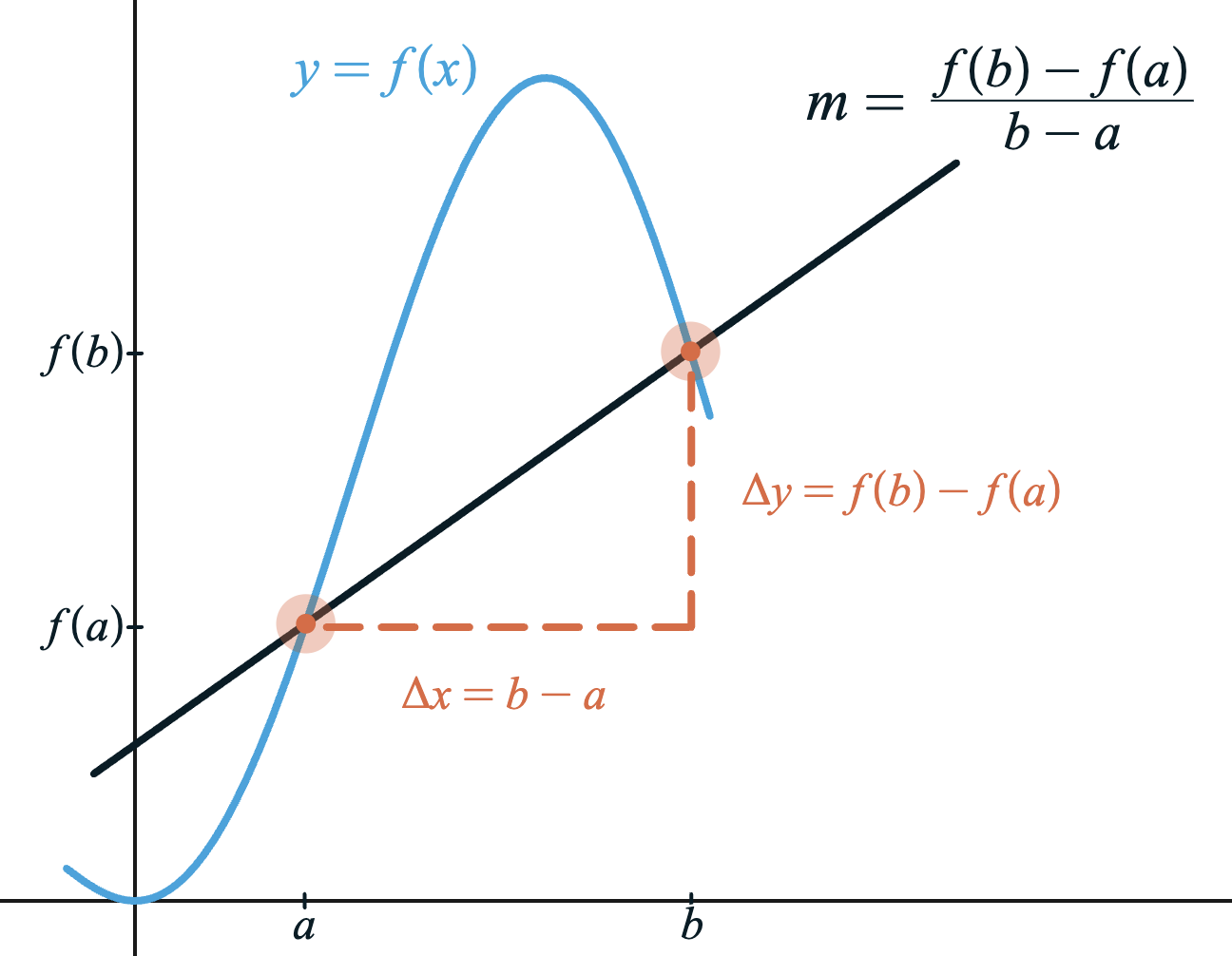
The average rate of change (ARC) of a function over the interval calculates the change in output per unit input. To calculate it, use the formula:
Geometrically, this is simply the slope of a line, from algebra: the change in -values divided by the change in -values for the line connecting two points on .
Example
Find the average rate of change of on .
Using the formula, the average rate of change of over is the slope
Instantaneous rate of change
While the average rate of change describes behavior over an interval, many quantities change unevenly.
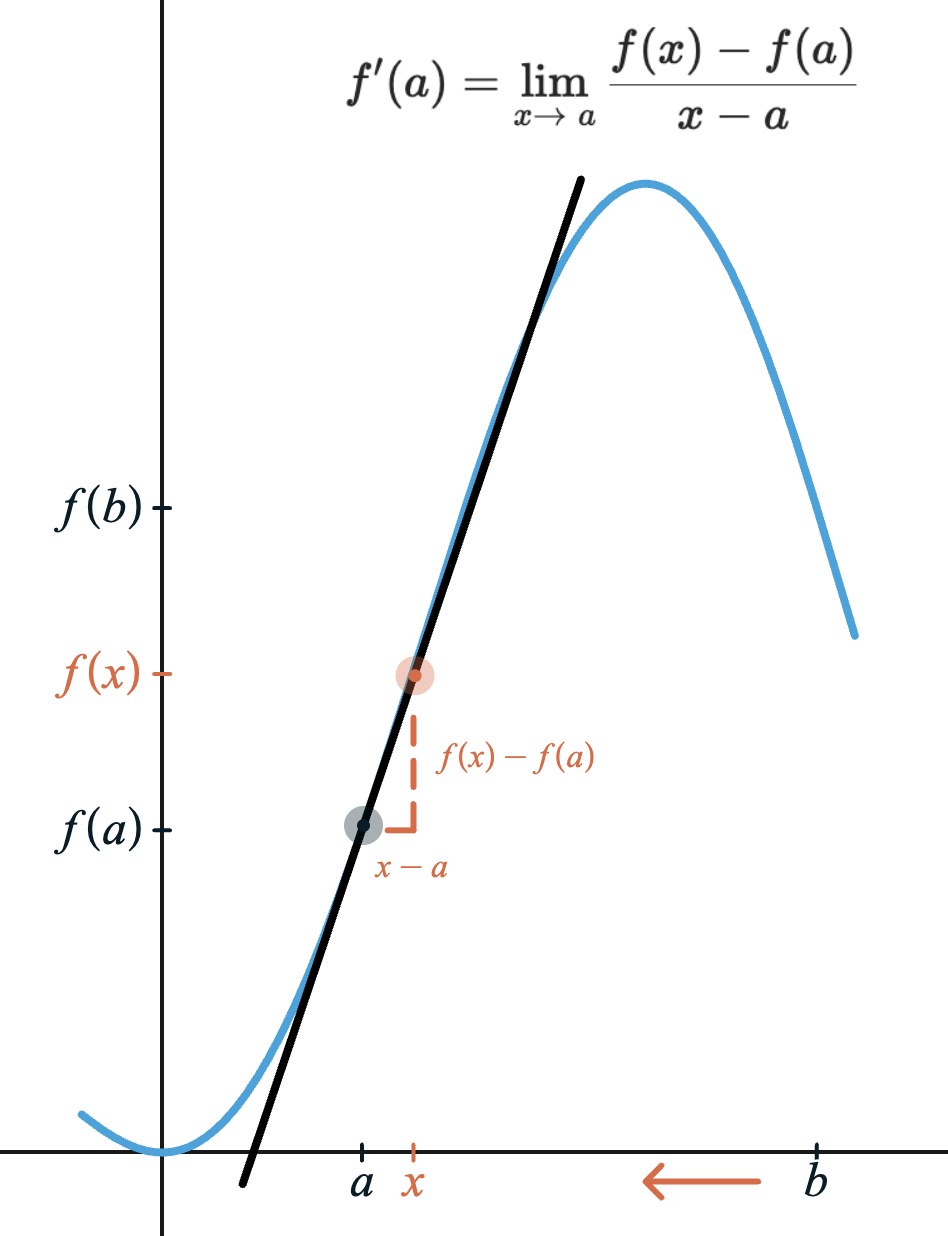
Instead of measuring an average over a span of time, the instantaneous rate of change (IROC) tells us how fast a variable is changing right now, at one exact instant. To describe the rate of change at a single moment, we analyze what happens as the interval shrinks toward zero.
This is where limits come in. Instead of using two fixed points and , we:
- Fix the point .
- Let another point move closer and closer to .
- Track what happens to the average rate of change as .
As approaches , the interval shrinks toward zero, and the limiting value gives the instantaneous rate of change at . This is also called the derivative of at :
The notation is read as “ prime of .” The prime symbol () is commonly used to indicate a derivative. Later, you’ll also see second derivatives, written as (“ double prime of ”).
Example
Find , the instantaneous rate of change of at , for the function .
Solution
Substitute a equals negative 3 into the limit definition. Simplify the fraction and cancel the matching factor of x plus 3. Then evaluate the limit to get f prime of negative 3 equals negative 6.
Using the limit definition of the derivative with ,
A different approach: We could also find the general expression for first by keeping as a variable:
Factor the numerator as a difference of squares and cancel the common factor. Take the limit as x approaches a to get f prime of a equals 2 a. Then substitute a equals negative 3 to find the same answer, negative 6.
Plugging in gives .
Alternative limit definition
The first definition defines the derivative at a point , although can be kept as a variable during the limit process to give a general expression like . However, to find a derivative function using standard variable notation, a second definition is more commonly used. Instead of moving toward , this form shrinks the actual distance, , between two points.
This time:
- Fix a point .
- Move a small amount away from it.
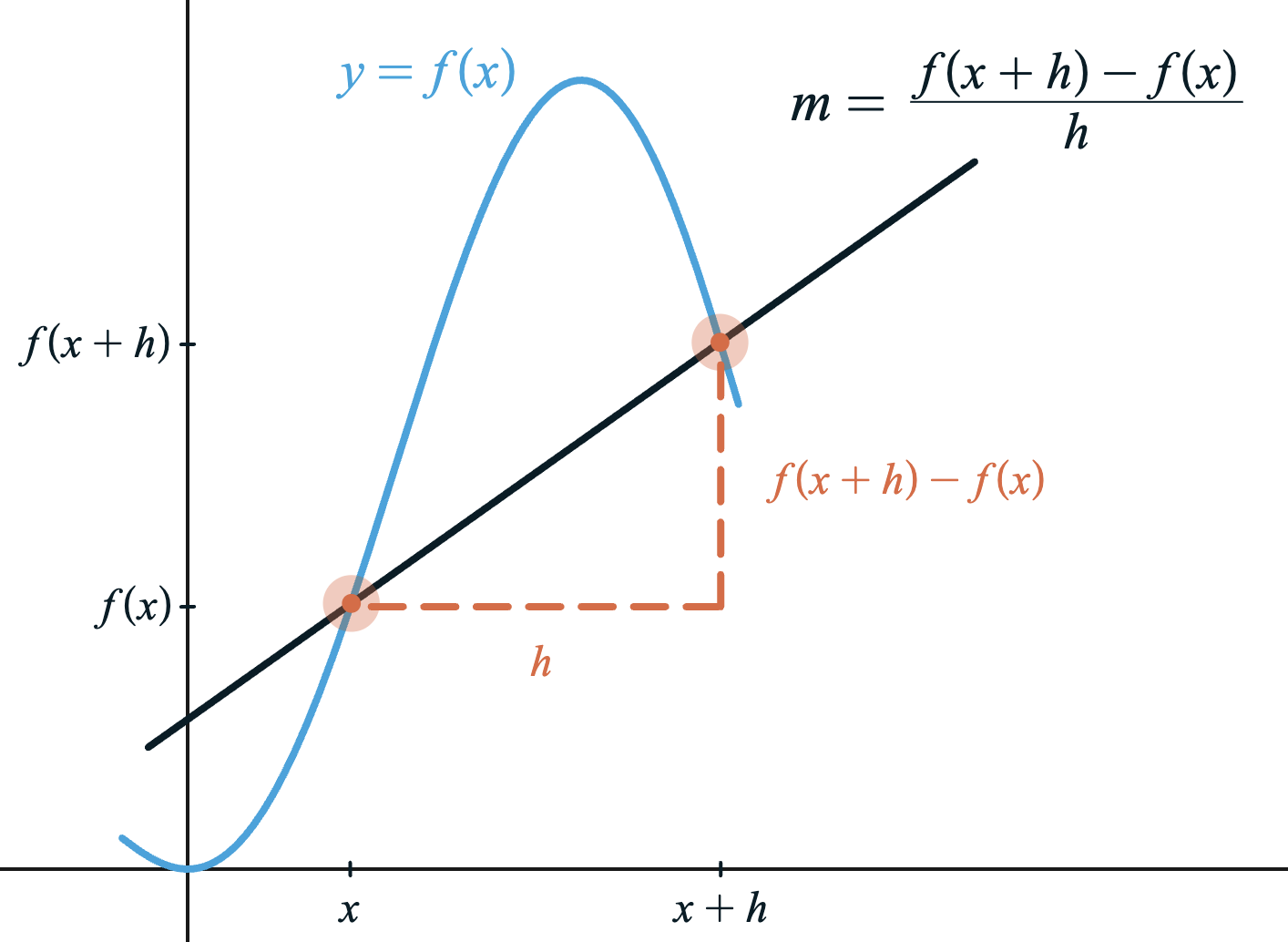
In this form, the average rate of change is called the difference quotient
which is the slope between the two points shown in the image below.
To obtain the instantaneous rate of change at , we make the interval as small as possible by letting , bringing to . This results in the alternative limit definition of the derivative:
This limit process creates a new function . Plugging in a value of gives the instantaneous rate of change at that point.
Both limit definitions will lead to the same answer for any problem, but one may be easier to work with than the other depending on the function.
Examples
- Find the derivative of .
Expand the squared binomial and cancel the matching x squared terms. Factor out h from the numerator and cancel it with the h in the denominator. Taking the limit as h approaches 0 gives f prime of x equals 2 x.
Since , then .
Then by the limit definition,
Inputting gives , the same result found using the 1st form.
Note that the limit process can also be completed by substituting from the start to arrive at the derivative value rather than the derivative function.
- Find for the function defined by , and use the derivative to find the instantaneous rate of change of at .
Set up the difference quotient using the square root function. Multiply by the conjugate to rationalize the numerator. Cancel the common factor of h. Then take the limit as h approaches 0. The derivative is f prime of x equals 1 over 2 times the square root of x. Evaluating at x equals 9 gives f prime of 9 equals 1 sixth.
Since , then .
Then by the limit definition,
Rationalizing using the conjugate:
Then evaluating at ,