


Achievable logoAchievable logo
AP Calculus AB
Sign in
Sign up
Purchase
Textbook
Practice exams
Support
How it works
Exam catalog
Mountain with a flag at the peak
Textbook
Introduction
1. Limits
2. Derivative basics
2.1 The derivative
2.1.1 Limit definition of the derivative
2.1.2 AP-style problems
2.2 Tangent lines & slopes
2.3 Power rule
2.4 Product & quotient rules
2.5 Special derivatives
2.6 Differentiability & continuity
3. Advanced differentiation
4. Contextual uses
5. Analytical uses
6. Integration
7. Differential equations
8. Applications of integrals
Wrapping up
Achievable logoAchievable logo
2.1.2 AP-style problems
Achievable AP Calculus AB
2. Derivative basics
2.1. The derivative
Our AP Calculus AB course is now in "early access" - get 50% off for a limited time.

AP-style problems

5 min read
Font
Discuss
Share
Feedback

What you’ll learn

  • Finding rates of change from tables and graphs
  • Recognizing limit expressions as derivative definitions

Using tables

The AP exam frequently uses tabular data to test your ability to connect core concepts like functions and derivatives. For example,

A bathtub is being filled with water and the depth of the water is measured over a few minutes. Based on the table below:

Time t (minutes) Depth (inches)
2 3
4 8
6 14
7 16
9 19

a) Find the average rate of change over the time interval 4≤t≤7.

b) Estimate the instantaneous rate of change at t=3.

Solutions

a) Average rate of change over [4,7]

(spoiler)

In AP Calculus, time t is often the input/independent variable. Let water depth be the function of time defined by D(t).

The average rate of change of the depth of the water over the interval [4,7] is

7−4D(7)−D(4)​=316−8​=38​

The units are inches per minute because depth (numerator) is measured in inches and time (denominator) is measured in minutes.

So on average, the water depth increased by 38​ inches per minute between minutes 4 and 7.

b) Instantaneous rate of change at t=3

(spoiler)

Without an explicit function, the best estimate that can be made for the instantaneous rate of change uses the average rate of change over a small nearby interval.

Use the closest values around 3 minutes: t=2 and t=4. The average rate of change over that interval is

4−2D(4)−D(2)​=28−3​=25​ in/min

This is the best estimate for how quickly the water level was changing at exactly 3 minutes.

Using graphs

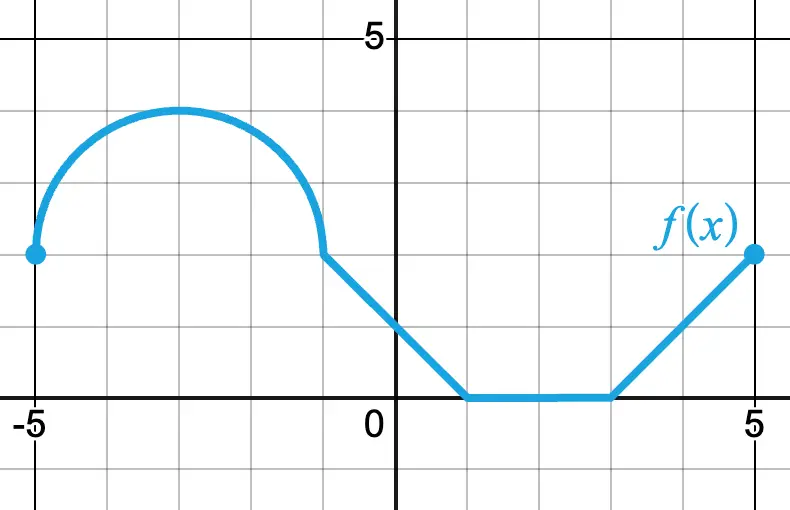
Shown below is the graph of function f.

Finding average rate of change

If g is the function defined by

g(x)=f(3x)

find the average rate of change of g(x) over the interval [−1,34​].

Solution

(spoiler)

The average rate of change of g over [−1,34​] is

34​−(−1)g(34​)−g(−1)​

Since g(x)=f(3x),

g(34​)=f(3⋅34​)=f(4)=1​

and

g(−1)=f(−3)=4​

Then the average rate of change of g is

34​+11−4​​=37​−3​=−79​​

Recognizing derivatives from the definition

Most derivative problems ask you to find f′(x) given a function f(x). However, some problems involve identifying the original function f(x) and the point a from a given limit expression.

The key is to recognize which limit definition is being used:

f′(a)=x→alim​x−af(x)−f(a)​orf′(a)=h→0lim​hf(a+h)−f(a)​

Examples

  1. Find a function f(x) and a number a such that the following limit represents f′(a).

h→0lim​h(3+h)2−9​

Solution

(spoiler)

Since the limit notation specifies h→0, match it to the 2nd definition

f′(a)=h→0lim​hf(a+h)−f(a)​

By matching the given expression to the template, we can identify a and f(x):

  • (3+h)2 matched to f(a+h) gives a=3 and f(x)=x2.

This is confirmed by checking f(a):

f(3)=(3)2=9

which matches the second constant term in the numerator of the limit expression.

Therefore, the limit represents the derivative of f(x)=x2 evaluated at x=3.

  1. The limit expression

h→0lim​h43+h−64​

represents the derivative of a function f(x) at x=a.

a) Write an equivalent limit expression for f′(a).

b) What is the value of f(2)?

Solutions

a) Equivalent limit expression

(spoiler)

Since the limit notation specifies h→0, this limit mirrors the definition:

f′(a)=h→0lim​hf(a+h)−f(a)​

Matching the expressions:

  • 43+h matched to f(a+h) gives a=3 and f(x)=4x.

Checking f(a),

f(3)=43=64

which matches the constant in the numerator.

Since f(x)=4x and a=3, then the equivalent limit expression in the form

f′(a)=x→alim​x−af(x)−f(a)​

is written as

f′(3)=x→3lim​x−34x−64​

b) Find f(2).

(spoiler)

Since f(x)=4x, then

f(2)=42=16

Working backwards from limit definitions

  • Two definitions to recognize: f′(a)=limx→a​x−af(x)−f(a)​ and f′(a)=limh→0​hf(a+h)−f(a)​
  • Identify which definition applies based on whether the limit is x→a or h→0
  • Extract f(x) and a by pattern-matching terms in the numerator, then verify by checking f(a)

Using tables for rates of change

  • Average rate of change over [a,b]: b−af(b)−f(a)​ using table values directly
  • Instantaneous rate of change at a point: use average rate of change over the smallest available surrounding interval as the best estimate
  • Always include units (e.g., inches per minute) when interpreting results

Sign up for free to take 6 quiz questions on this topic

All rights reserved ©2016 - 2026 Achievable, Inc.

AP-style problems

What you’ll learn

  • Finding rates of change from tables and graphs
  • Recognizing limit expressions as derivative definitions

Using tables

The AP exam frequently uses tabular data to test your ability to connect core concepts like functions and derivatives. For example,

A bathtub is being filled with water and the depth of the water is measured over a few minutes. Based on the table below:

Time t (minutes) Depth (inches)
2 3
4 8
6 14
7 16
9 19

a) Find the average rate of change over the time interval 4≤t≤7.

b) Estimate the instantaneous rate of change at t=3.

Solutions

a) Average rate of change over [4,7]

(spoiler)

In AP Calculus, time t is often the input/independent variable. Let water depth be the function of time defined by D(t).

The average rate of change of the depth of the water over the interval [4,7] is

7−4D(7)−D(4)​=316−8​=38​

The units are inches per minute because depth (numerator) is measured in inches and time (denominator) is measured in minutes.

So on average, the water depth increased by 38​ inches per minute between minutes 4 and 7.

b) Instantaneous rate of change at t=3

(spoiler)

Without an explicit function, the best estimate that can be made for the instantaneous rate of change uses the average rate of change over a small nearby interval.

Use the closest values around 3 minutes: t=2 and t=4. The average rate of change over that interval is

4−2D(4)−D(2)​=28−3​=25​ in/min

This is the best estimate for how quickly the water level was changing at exactly 3 minutes.

Using graphs

Shown below is the graph of function f.

If g is the function defined by

g(x)=f(3x)

find the average rate of change of g(x) over the interval [−1,34​].

Solution

(spoiler)

The average rate of change of g over [−1,34​] is

34​−(−1)g(34​)−g(−1)​

Since g(x)=f(3x),

g(34​)=f(3⋅34​)=f(4)=1​

and

g(−1)=f(−3)=4​

Then the average rate of change of g is

34​+11−4​​=37​−3​=−79​​

Recognizing derivatives from the definition

Most derivative problems ask you to find f′(x) given a function f(x). However, some problems involve identifying the original function f(x) and the point a from a given limit expression.

The key is to recognize which limit definition is being used:

f′(a)=x→alim​x−af(x)−f(a)​orf′(a)=h→0lim​hf(a+h)−f(a)​

Examples

  1. Find a function f(x) and a number a such that the following limit represents f′(a).

h→0lim​h(3+h)2−9​

Solution

(spoiler)

Since the limit notation specifies h→0, match it to the 2nd definition

f′(a)=h→0lim​hf(a+h)−f(a)​

By matching the given expression to the template, we can identify a and f(x):

  • (3+h)2 matched to f(a+h) gives a=3 and f(x)=x2.

This is confirmed by checking f(a):

f(3)=(3)2=9

which matches the second constant term in the numerator of the limit expression.

Therefore, the limit represents the derivative of f(x)=x2 evaluated at x=3.

  1. The limit expression

h→0lim​h43+h−64​

represents the derivative of a function f(x) at x=a.

a) Write an equivalent limit expression for f′(a).

b) What is the value of f(2)?

Solutions

a) Equivalent limit expression

(spoiler)

Since the limit notation specifies h→0, this limit mirrors the definition:

f′(a)=h→0lim​hf(a+h)−f(a)​

Matching the expressions:

  • 43+h matched to f(a+h) gives a=3 and f(x)=4x.

Checking f(a),

f(3)=43=64

which matches the constant in the numerator.

Since f(x)=4x and a=3, then the equivalent limit expression in the form

f′(a)=x→alim​x−af(x)−f(a)​

is written as

f′(3)=x→3lim​x−34x−64​

b) Find f(2).

(spoiler)

Since f(x)=4x, then

f(2)=42=16

Key points

Working backwards from limit definitions

  • Two definitions to recognize: f′(a)=limx→a​x−af(x)−f(a)​ and f′(a)=limh→0​hf(a+h)−f(a)​
  • Identify which definition applies based on whether the limit is x→a or h→0
  • Extract f(x) and a by pattern-matching terms in the numerator, then verify by checking f(a)

Using tables for rates of change

  • Average rate of change over [a,b]: b−af(b)−f(a)​ using table values directly
  • Instantaneous rate of change at a point: use average rate of change over the smallest available surrounding interval as the best estimate
  • Always include units (e.g., inches per minute) when interpreting results

More from The derivative

  • Limit definition of the derivative