



Tangent lines & slopes
Previously, the derivative was introduced as an instantaneous rate of change, which describes how quickly a function changes at a specific point.
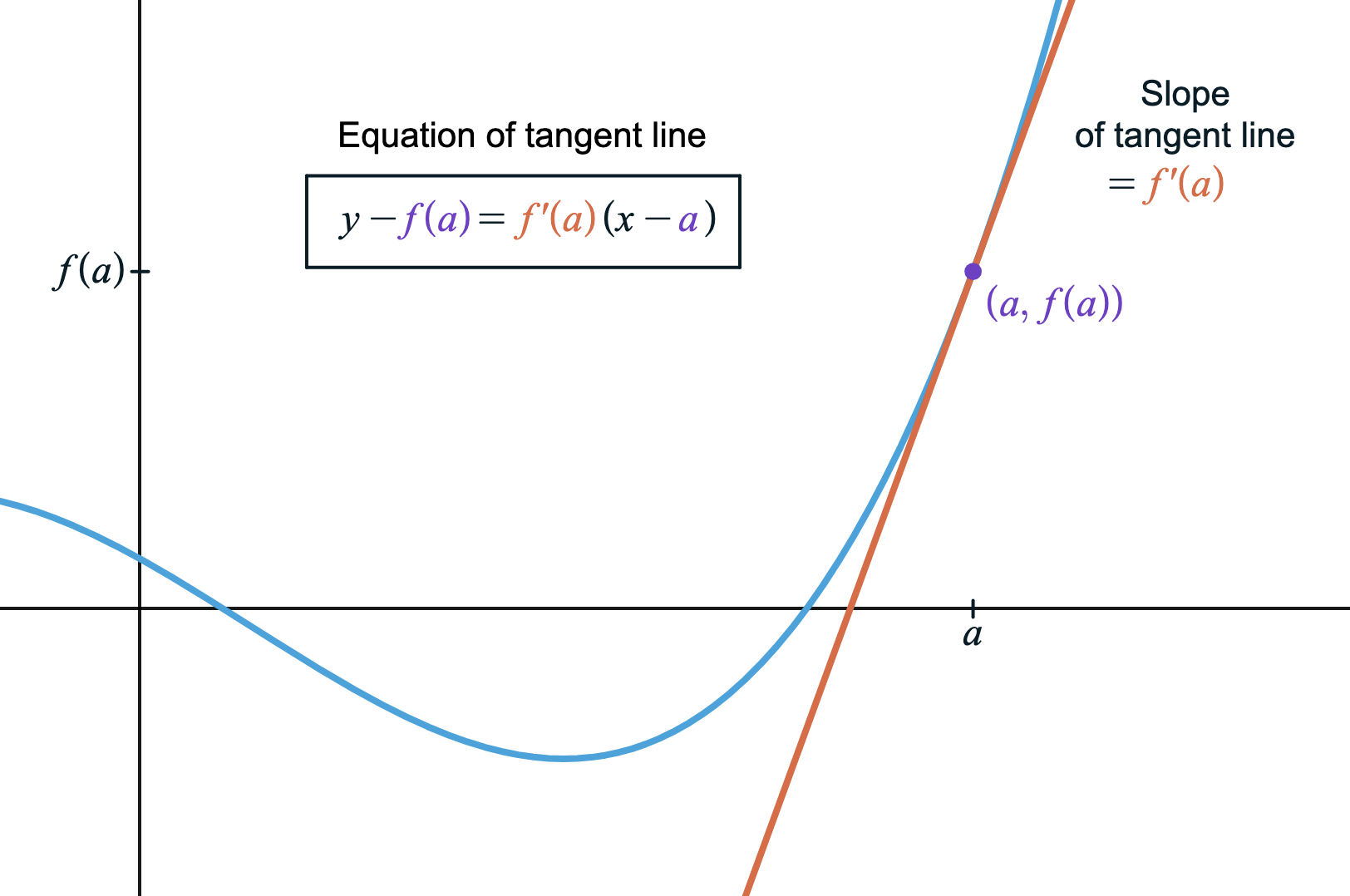
The derivative also provides the slope of the tangent line to the graph at that point.
To understand the tangent line, it helps to start with the secant line, a closely related concept.
As one of the points moves closer to the other (with approaching ) the secant line transforms into the tangent line at that point.
The slope of the tangent line is defined mathematically by:
This is the same limit definition used for the instantaneous rate of change at . So to find the slope of the tangent line to a function at , simply evaluate the derivative .
Equation of a tangent line
The equation of a line can be written in point-slope form
where is the slope of the line at the point .
In calculus notation, the tangent line at is written as:
Either form can be used as long as you correctly identify the point and the slope.
Example
Let be the function defined by
a) Find the equation of the tangent line to at .
b) Find the equation of the tangent line to that is parallel to the line . (Hint: parallel lines have the same slope.)
Solutions
a) Tangent line equation at
1. Identify the point of tangency :
The point of tangency is where the tangent line meets the curve. This is the function value:
2. Find the slope of the tangent line :
In chapter 2.1.1, the derivative of was found to be
The slope of the tangent line at is the derivative evaluated at the point:
3. Construct the equation of the tangent line:
The tangent line meets the curve at and has a slope of , so its equation is:
or in slope-intercept form,
It helps to plot both and in Desmos to see what a tangent line looks like relative to the curve.
b) Tangent line that is parallel to
1. Find the slope of the given line:
First, rewrite the line in slope-intercept form:
This equation shows the slope of the line is . Since parallel lines have the same slope, the tangent line to that we’re looking also has a slope of .
2. Find the point of tangency :
At the target point , the tangent line to has slope . In other words, . We just need to find .
Since the derivative of is , we solve:
Then the corresponding -value is
So the tangent line to meets it at .
3. Construct the equation of the tangent line:
The tangent line passes through and has a slope of , so its equation is
or in slope-intercept form,
Normal lines
A normal line is perpendicular to the tangent line at the point of tangency.
Perpendicular slopes are negative reciprocals of each other. For example, if the slope of the tangent line is , then the slope of the normal line at is
If (a horizontal tangent), the normal line is vertical and defined by .
Example
Find the equation of the normal line to
at .
Solution
1. Identify :
The function value at is
2. Find the slope of the normal line:
The derivative of is . Evaluate at for the slope of the tangent line:
The slope of the normal line is the negative reciprocal, or .
3. Construct the equation of the normal line:
Since the normal line to at the point has a slope of , its equation is
It helps to confirm visually by plotting the original function , the equation of the tangent line, and the equation of the normal line.
Challenge problems
- A ball is tossed into the air and follows the path , which represents its height (in meters) as a function of time (in seconds). At what time is the instantaneous rate of change of the ball’s height equal to ?
The instantaneous rate of change of the height means the derivative, . Our goal is to find the time such that .
Below is the derivative using the limit definition. To keep the notation clear, the height function is rewritten as .
Setting this equal to :
Therefore, the instantaneous rate of change of the ball’s height is when .
Observing the graph of the parabola, this is the highest point the ball reaches (the vertex), and the slope of the tangent line to the curve is .
- A line with slope , where , passes through the point and is tangent to the graph of . Find .
Solution
It’s highly recommended that you sketch a quick graph of . Try drawing the tangent line that passes through with a negative slope to see where it might meet the curve.
1. Identify the point of tangency:
The tangent line to meets it at the point .
2. Slope of the line
The slope can be expressed in two ways:
1. Using algebra:
Since the line passes through and , the slope can be expressed in terms of as:
2. Using calculus:
The slope of the tangent line at any point on is the derivative. Since , and is the slope at , then
3. Solve for :
Set the two expressions for equal to each other.
Since we want the line with a negative slope, take , which gives
Note that if the question asked for the positive slope (), we would take such that . This second tangent line also passes through but meets at instead.