



Differentiability & continuity
What is differentiability?
A function is differentiable at if its derivative exists at that point.
There are four common cases where a function is not differentiable at a point , meaning does not exist:
1. Discontinuities
A function must be continuous to be differentiable. If there is a removable, jump, or infinite discontinuity at , then the derivative does not exist at the point.
- Often seen in rational, piecewise, or logarithmic functions, which may have discontinuities and/or asymptotes
e.g.
2. Corners
The function changes direction abruptly. The one-sided derivatives exist, but they are not equal.
- Often seen in absolute value or piecewise functions
e.g.
3. Cusps
Cusps are like corners, but the slope becomes unbounded: one or both one-sided derivatives approach infinity, and they approach opposite infinities.
- Often seen in power functions with fractional exponents
e.g.
4. Vertical tangents
The tangent line becomes vertical. The one-sided derivatives both approach infinity with the same sign.
- Often seen in radical functions
e.g.
In the last three cases, the function is continuous, but the graph is not smooth at the non-differentiable point (for a visual, graph each in Desmos).
Checking for differentiability
To check if is differentiable at ,
-
Continuity: First check whether is continuous by verifying the conditions stated in Section 1.6: Continuity. If it’s not continuous at , then it’s not differentiable.
-
Differentiate: Find and look for any -values where is undefined.
-
If necessary (mostly for piecewise functions): Check that the one-sided derivatives at both exist, are finite, and match. In other words, there must be a finite value such that
Example 1: From functions
For each of the following functions, find the -value(s) at which it is non-differentiable.
a)
b)
c)
d)
Solutions
a)
Discontinuous at (vertical asymptote), so is not differentiable at .
b)
is continuous for all values of . To analyze the derivative, first rewrite as a piecewise function:
Then differentiate each piece:
Note that the equality is dropped because the derivative at is yet to be determined. Check the one-sided derivatives:
- Left:
- Right:
Since the two are unequal, does not exist. Graphically, this shows up as a sharp corner at .
c)
is continuous with derivative
is undefined (denominator equals ).
Notice the one-sided behavior:
-
Left:
-
Right:
Since the one-sided derivatives approach opposite infinities, the graph has a cusp at .
d)
is continuous with derivative
is undefined (denominator equals ).
As approaches from either side, approaches the same sign of (positive), meaning has a vertical tangent line of .
Example 2: From a graph
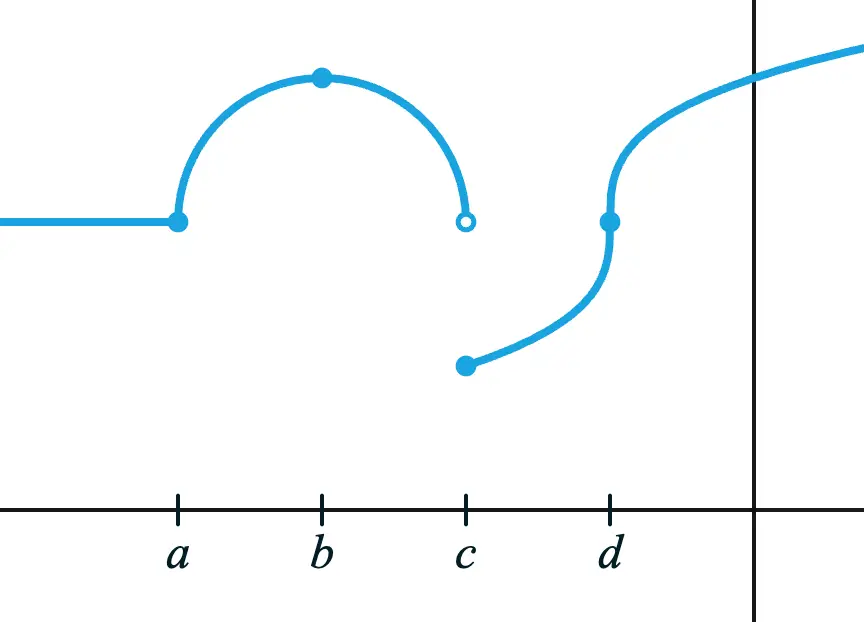
The graph of shown below has a horizontal tangent at and a vertical tangent at . At which of the values and is differentiable?
Solution
Answer: only
A function is differentiable only where it is continuous and has a finite slope.
- : Corner (different one-sided derivatives) not differentiable.
- : Horizontal tangent () differentiable.
- : Jump discontinuity not differentiable.
- : Vertical tangent ( doesn’t exist) not differentiable.
Example 3: Finding unknown variables
Let be the piecewise function defined as:
Find the values of and such that is differentiable for all values of .
Answer:
For a piecewise function to be differentiable at , it must be:
- Continuous at
- Have equal left and right derivatives at .
1. Continuity:
This requires
- Function value:
- Left-hand limit:
- Right-hand limit:
So continuity requires
This provides one equation involving and . To solve for both variables, we now use differentiability at .
2. Differentiability:
Differentiate each piece (treating and as constants):
For differentiability at , the one-sided derivatives must match.
-
Left-hand derivative:
-
Right-hand derivative:
Set equal:
3. Solve the system:
Solving the system of equations gives
as the values for to be differentiable.
Graph check (optional):
Graphing
in Desmos confirms the function is continuous and smooth at .