


Achievable logoAchievable logo
AP Calculus AB
Sign in
Sign up
Purchase
Textbook
Practice exams
Support
How it works
Exam catalog
Mountain with a flag at the peak
Textbook
Introduction
1. Limits
2. Derivative basics
3. Advanced differentiation
4. Contextual uses
5. Analytical uses
6. Integration
7. Differential equations
8. Applications of integrals
8.1 Average value of a function
8.2 Motion with integrals
8.3 Area between curves
8.4 Volume
8.4.1 Using cross sections
8.4.2 Disk method
8.4.3 Washer method
Wrapping up
Achievable logoAchievable logo
8.4.3 Washer method
Achievable AP Calculus AB
8. Applications of integrals
8.4. Volume
Our AP Calculus AB course is now in "early access" - get 50% off for a limited time.

Washer method

6 min read
Font
Discuss
Share
Feedback

What you’ll learn

  • Using the washer method to find volumes of solids of revolution

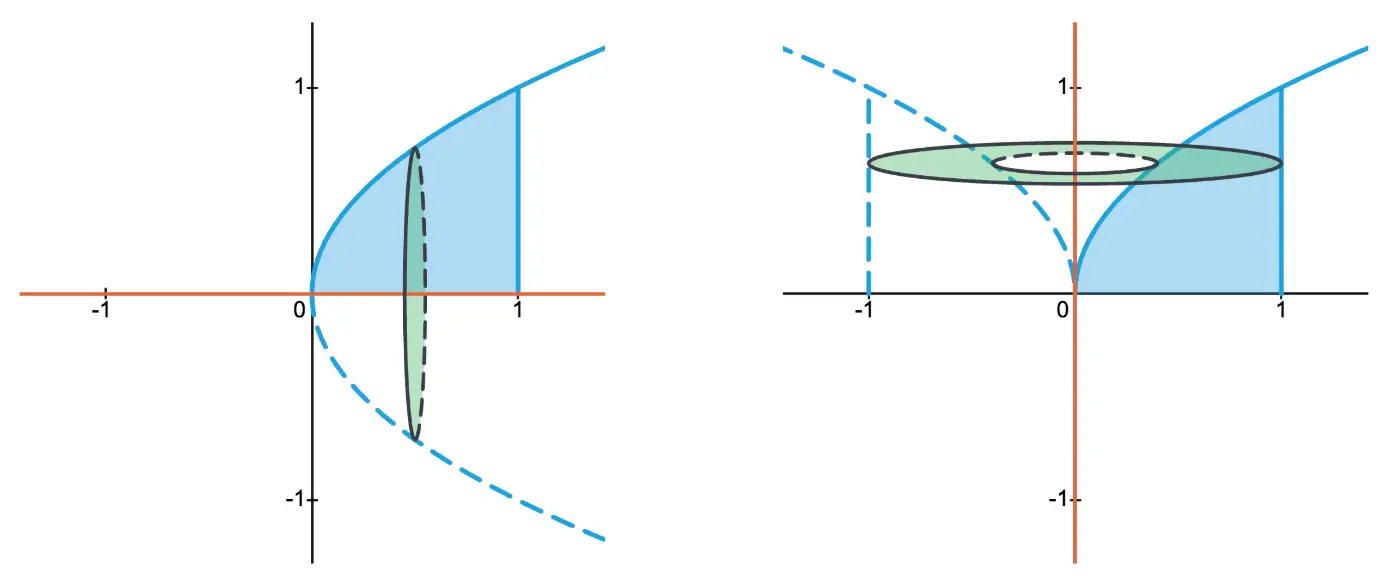
In the previous section, the disk method was used to find the volumes of solids of revolution. For solids that are hollow in the center, the washer method is used. Each cross-section is a washer: an outer circle minus an inner circle.

  • A disk is a full circle (no hole).
  • A washer is a circle with a smaller circle removed (a hole).

Washer method

If R(x) is the outer radius and r(x) is the inner radius when rotating about a horizontal axis,

Volume=π∫ab​[R(x)2−r(x)2]dx

As with the disk method, express functions in terms of y and use dy when rotating about a vertical axis.

AP tip:

The outer radius R(x) is always the distance/difference between the axis of revolution and the function that is farther from it.

The inner radius r(x) is the difference between the axis and the function closer to it.

Horizontal axis of rotation

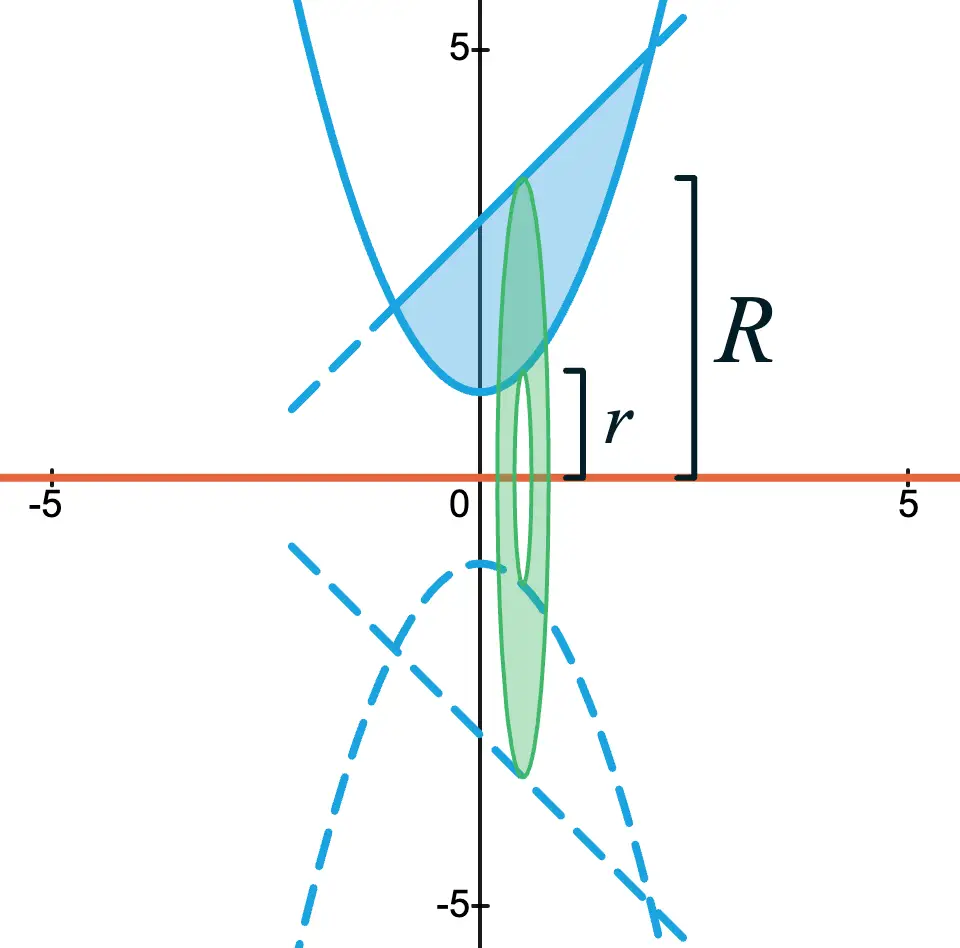
  1. The region bounded by y=x2+1 and y=x+3 is rotated about the x-axis. Determine the volume of the solid formed.
Washer method
Washer method

The axis of rotation is the x-axis (y=0), so radii are vertical distances to that axis.

  • Outer radius (farther from the axis): from y=x+3 down to y=0

R(x)=x+3

  • Inner radius (closer to the axis): from y=x2+1 down to y=0

r(x)=x2+1

Find the intersection points to set the bounds:

x2+1x2−x−2(x−2)(x+1)​=x+3=0=0​

So x=−1 and x=2 and the volume is

V=π∫−12​[(x+3)2−(x2+1)2]dx

=5117​π​

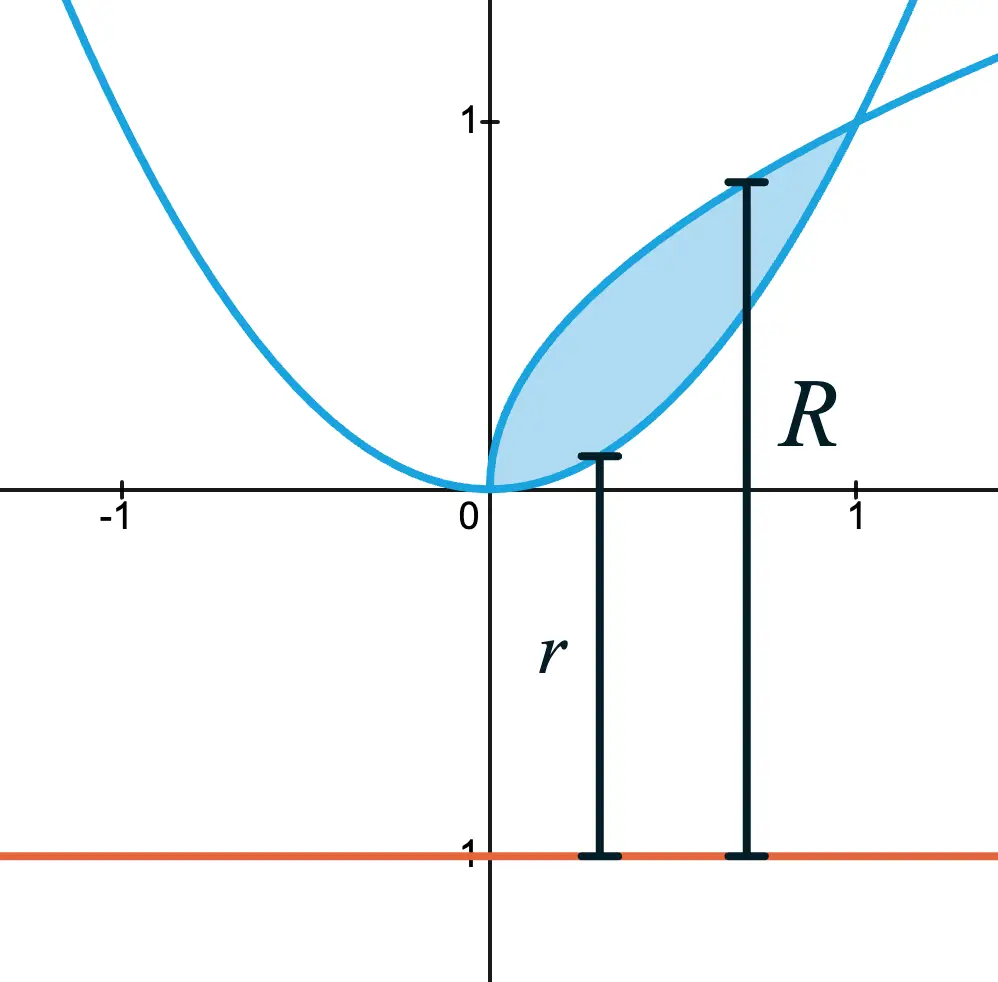
  1. The region bounded by y=x2 and y=x​ is rotated about the line y=−1. Determine the volume of the solid formed.
(spoiler)
Rotation about y = -1

The axis of rotation is y=−1, so each radius is a vertical distance up from y=−1.

  • Outer radius (farther from y=−1): from y=x​ to y=−1

R(x)=x​−(−1)

=x​+1

  • Inner radius (closer to y=−1): from y=x2 to y=−1

r(x)=x2−(−1)

=x2+1

The curves intersect where x2=x​, which occurs at x=0 and x=1. So

V=π∫01​[(x​+1)2−(x2+1)2]dx

=3029​π​

Vertical axis of rotation

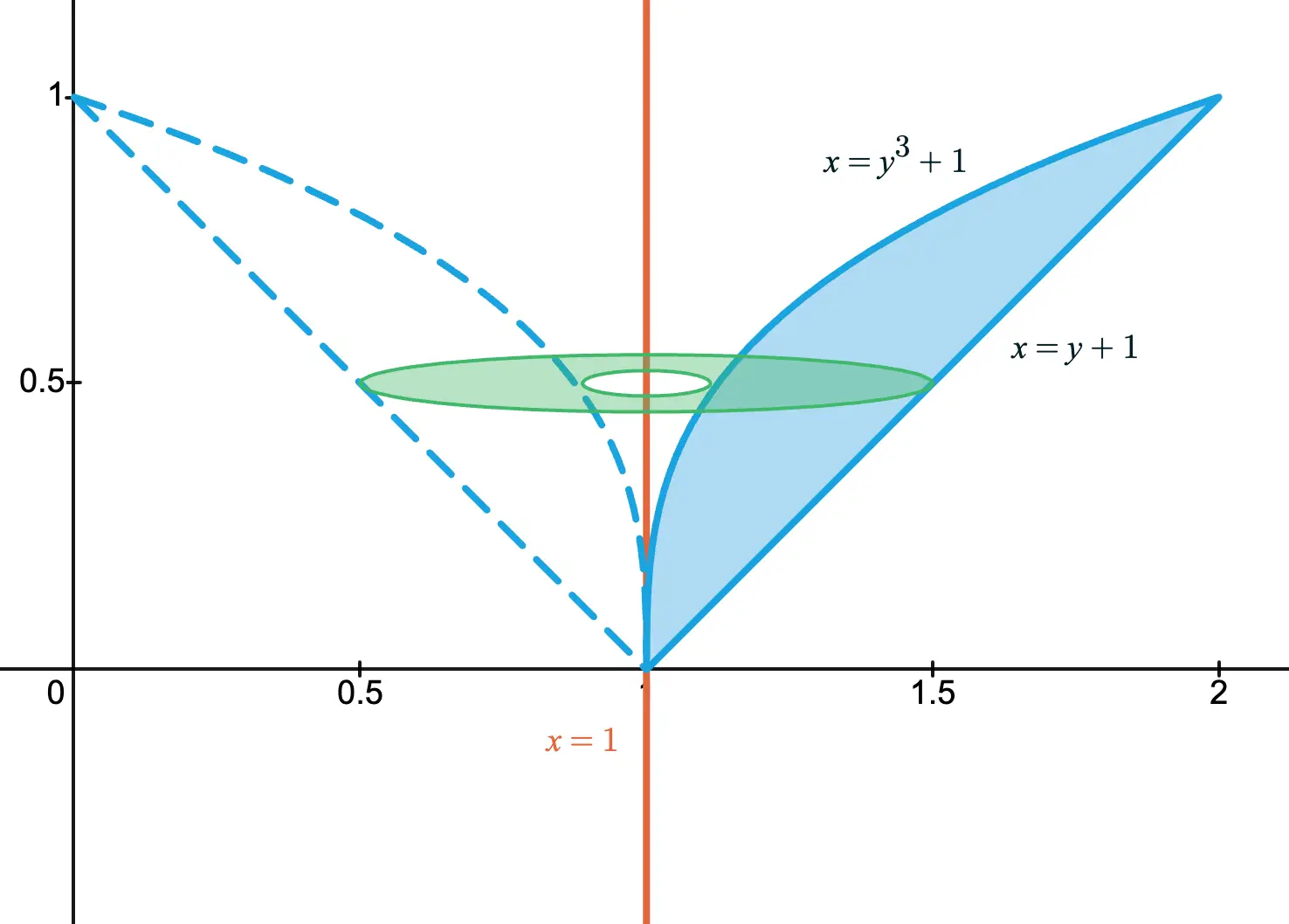
  1. The region bounded above by y=(x−1)1/3 and below by y=x−1 is rotated about the line x=1. Determine the volume of the solid formed.
(spoiler)
Washer method; vertical axis of rotation

Because the axis of revolution is vertical, write both curves as x in terms of y.

From y=(x−1)1/3:

x=y3+1

From y=x−1:

x=y+1

The axis of rotation is x=1, so radii are horizontal distances from x=1.

  • Outer radius (farther from the axis): to x=y+1

R(y)=(y+1)−1

=y

  • Inner radius (closer to the axis): to x=y3+1

r(y)=(y3+1)−1

=y3

The curves meet at (1,0) and (2,1), so y runs from 0 to 1. The volume is

V=π∫01​[y2−(y3)2]dy

=214​π​

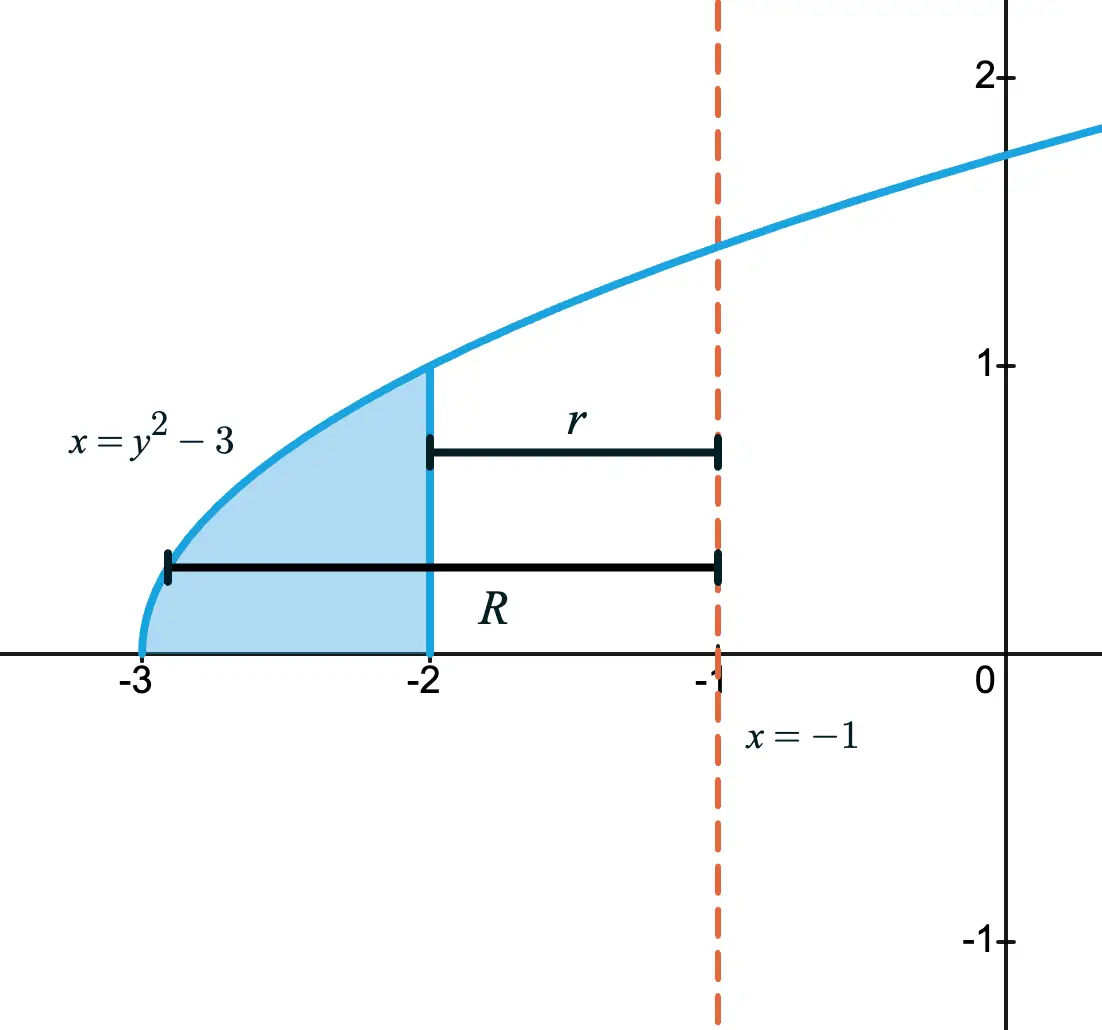
  1. The region bounded by y=x+3​, the line x=−2, and the x-axis is rotated about x=−1. Determine the volume of the solid formed.
(spoiler)
Washer method; rotation about x = -1

The axis of rotation is vertical, so rewrite y=x+3​ in terms of y. Squaring gives the (right-opening) parabola:

x=y2−3

Now measure horizontal distances from the axis x=−1.

  • Outer radius: from x=−1 to the curve x=y2−3

R(y)=−1−(y2−3)

=2−y2

  • Inner radius: from x=−1 to the line x=−2 (a constant distance)

r(y)=−1−(−2)

=1

The curve x=y2−3 meets x=−2 when y2−3=−2, so y=1 (using the upper half shown). The region runs from y=0 to y=1, so

V=π∫01​[(2−y2)2−12]dy

=1528​π​

Washer Method Overview

  • Used for hollow solids of revolution (disk with a hole)
  • Formula: V=π∫ab​[R(x)2−r(x)2]dx
  • Use dy and express in terms of y when rotating about a vertical axis

Identifying Radii

  • Outer radius R: distance from axis to the farther function
  • Inner radius r: distance from axis to the closer function
  • When axis is not at origin, add/subtract axis value to each radius

Horizontal Axis of Rotation

  • Radii are vertical distances measured from the axis
  • Find bounds by setting the two functions equal and solving
  • Axis shift example: rotating about y=−1 adds 1 to each radius

Vertical Axis of Rotation

  • Rewrite both curves as x in terms of y
  • Radii are horizontal distances from the vertical axis
  • Bounds come from y-values at intersection points
All rights reserved ©2016 - 2026 Achievable, Inc.

Washer method

What you’ll learn

  • Using the washer method to find volumes of solids of revolution

In the previous section, the disk method was used to find the volumes of solids of revolution. For solids that are hollow in the center, the washer method is used. Each cross-section is a washer: an outer circle minus an inner circle.

  • A disk is a full circle (no hole).
  • A washer is a circle with a smaller circle removed (a hole).

Washer method

If R(x) is the outer radius and r(x) is the inner radius when rotating about a horizontal axis,

Volume=π∫ab​[R(x)2−r(x)2]dx

As with the disk method, express functions in terms of y and use dy when rotating about a vertical axis.

AP tip:

The outer radius R(x) is always the distance/difference between the axis of revolution and the function that is farther from it.

The inner radius r(x) is the difference between the axis and the function closer to it.

Horizontal axis of rotation

  1. The region bounded by y=x2+1 and y=x+3 is rotated about the x-axis. Determine the volume of the solid formed.

The axis of rotation is the x-axis (y=0), so radii are vertical distances to that axis.

  • Outer radius (farther from the axis): from y=x+3 down to y=0

R(x)=x+3

  • Inner radius (closer to the axis): from y=x2+1 down to y=0

r(x)=x2+1

Find the intersection points to set the bounds:

x2+1x2−x−2(x−2)(x+1)​=x+3=0=0​

So x=−1 and x=2 and the volume is

V=π∫−12​[(x+3)2−(x2+1)2]dx

=5117​π​

  1. The region bounded by y=x2 and y=x​ is rotated about the line y=−1. Determine the volume of the solid formed.
(spoiler)

The axis of rotation is y=−1, so each radius is a vertical distance up from y=−1.

  • Outer radius (farther from y=−1): from y=x​ to y=−1

R(x)=x​−(−1)

=x​+1

  • Inner radius (closer to y=−1): from y=x2 to y=−1

r(x)=x2−(−1)

=x2+1

The curves intersect where x2=x​, which occurs at x=0 and x=1. So

V=π∫01​[(x​+1)2−(x2+1)2]dx

=3029​π​

Vertical axis of rotation

  1. The region bounded above by y=(x−1)1/3 and below by y=x−1 is rotated about the line x=1. Determine the volume of the solid formed.
(spoiler)

Because the axis of revolution is vertical, write both curves as x in terms of y.

From y=(x−1)1/3:

x=y3+1

From y=x−1:

x=y+1

The axis of rotation is x=1, so radii are horizontal distances from x=1.

  • Outer radius (farther from the axis): to x=y+1

R(y)=(y+1)−1

=y

  • Inner radius (closer to the axis): to x=y3+1

r(y)=(y3+1)−1

=y3

The curves meet at (1,0) and (2,1), so y runs from 0 to 1. The volume is

V=π∫01​[y2−(y3)2]dy

=214​π​

  1. The region bounded by y=x+3​, the line x=−2, and the x-axis is rotated about x=−1. Determine the volume of the solid formed.
(spoiler)

The axis of rotation is vertical, so rewrite y=x+3​ in terms of y. Squaring gives the (right-opening) parabola:

x=y2−3

Now measure horizontal distances from the axis x=−1.

  • Outer radius: from x=−1 to the curve x=y2−3

R(y)=−1−(y2−3)

=2−y2

  • Inner radius: from x=−1 to the line x=−2 (a constant distance)

r(y)=−1−(−2)

=1

The curve x=y2−3 meets x=−2 when y2−3=−2, so y=1 (using the upper half shown). The region runs from y=0 to y=1, so

V=π∫01​[(2−y2)2−12]dy

=1528​π​

Key points

Washer Method Overview

  • Used for hollow solids of revolution (disk with a hole)
  • Formula: V=π∫ab​[R(x)2−r(x)2]dx
  • Use dy and express in terms of y when rotating about a vertical axis

Identifying Radii

  • Outer radius R: distance from axis to the farther function
  • Inner radius r: distance from axis to the closer function
  • When axis is not at origin, add/subtract axis value to each radius

Horizontal Axis of Rotation

  • Radii are vertical distances measured from the axis
  • Find bounds by setting the two functions equal and solving
  • Axis shift example: rotating about y=−1 adds 1 to each radius

Vertical Axis of Rotation

  • Rewrite both curves as x in terms of y
  • Radii are horizontal distances from the vertical axis
  • Bounds come from y-values at intersection points

More from Volume

  • Using cross sections
  • Disk method