



Using cross sections
Previously, we found the areas of 2D regions by summing the areas of infinitely many thin rectangles. Similarly, the volume of a 3D solid can be found by summing the areas of infinitely many thin cross-sectional slices.
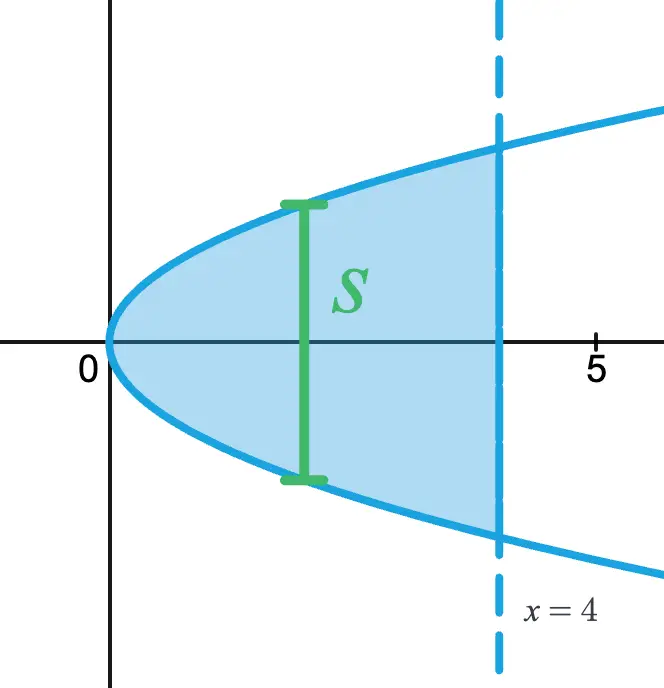
For these solids, the 2D region serves as the base, and the cross sections extend vertically out of the page. Because the distance between the bounding functions varies across the interval, the base side length, , of each cross section changes. the area of each cross section changes. This variable side length determines the cross-sectional area function, or . Integrating this area function over the interval accumulates the slices to give the total volume of the solid.
To see what solids with certain cross sections look like, visit this GeoGebra application.
Geometric area formulas
For all shapes, first find the base length (the distance between the boundary curves) and then plug it into the matching area formula:
| Cross-Sectional Shape | Area Formula | Notes |
|---|---|---|
| Square | Base is the entire side. | |
| Rectangle | Height is given as a constant or a function of . | |
| Equilateral triangle | Do not confuse with standard triangles. | |
| Isosceles right triangle (leg on base) | The base is one of the perpendicular legs. | |
| Isosceles right triangle (hypotenuse on base) | The base is the hypotenuse (). | |
| Semicircle | The base is the diameter, so radius . | |
| Quarter circle | The base is the full radius (). |
Example 1 Squares
The region bounded by , and forms the base of a solid. Find the volume if cross sections are squares perpendicular to:
a) The -axis.
b) The -axis.
Solutions
a) Perpendicular to -axis ()
Sketch the region and draw vertical slice from the upper function to the lower function. The length of this slice is the base, .
Note: The square cross sections extend directly out of the page toward you, using as their bottom edge.
1. Bounds:
- Integrating over the -bounds:
2. Find side length:
3. Area of each cross section (formula):
4. Volume integral:
b) Perpendicular to -axis ()
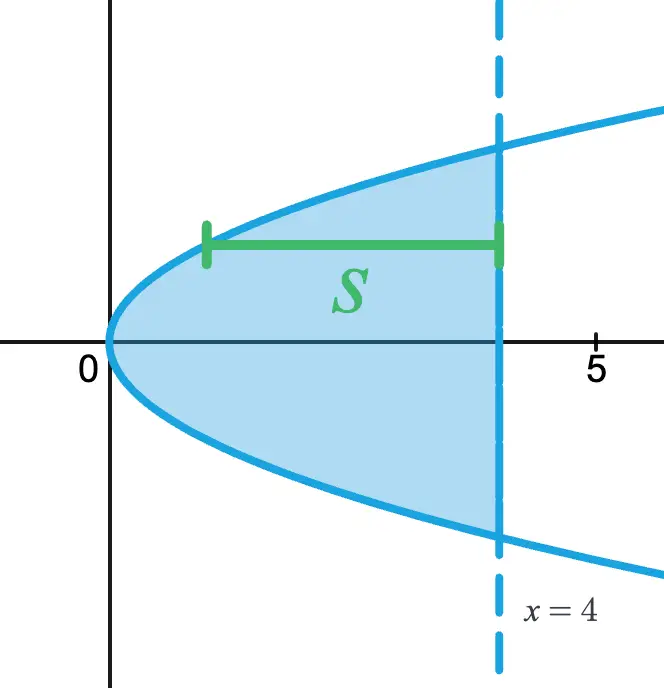
Shown below is a horizontal slice perpendicular to the -axis that spans from the left to the right boundary
For slices perpendicular to the -axis, the base length should be expressed as a function of , representing the horizontal distance between the left and right boundary curves at any .
1. Rewrite equations in terms of :
2. Bounds:
Find where intersects :
- -bounds:
3. Find side length:
4. Area formula:
5. Volume integral:
Example 2: Rectangles
The region bounded by and on forms the base of a solid. Find the volume if cross sections perpendicular to the -axis have a height that is times its width.
Solution
1. Bounds:
- -bounds:
2. Find base length:
3. Area formula:
- “Height is times its width” .
- So
4. Volume integral:
Example 3: Equilateral triangles
The region bounded by , , , and forms the base of a solid. Cross sections perpendicular to the -axis are equilateral triangles. Find the volume.
Solution
Perpendicular to integrate using
1. Bounds:
- -bounds:
2. Find base length:
3. Area formula:
4. Volume integral:
Example 4: Isosceles right triangles (leg vs. hypotenuse)
The region bounded by , the -axis, and the -axis forms a triangular base in the fourth quadrant. Find the volume if cross sections are isosceles right triangles with:
a) The hypotenuse lying along the base, sliced perpendicular to the -axis.
b) One leg lying along the base, sliced perpendicular to the -axis.
Solutions
a) Hypotenuse on base
Perpendicular to the -axis integrate using
1. Rewrite equation in terms of :
2. Bounds:
Find where meets both axes:
- -bounds:
3. Find side length:
4. Area formula:
- Area formula:
5. Volume integral:
b) Leg on base
1. Bounds:
- -bounds:
2. Find base length:
3. Area formula:
4. Volume integral:
Example 5: Semicircles
(Calculator active)
The region bounded by , , and the -axis forms the base of a solid. Find the volume if cross sections perpendicular to the -axis are semicircles.
Solution
-
Find intersection point with calculator: .
Bounds: Integrate over . -
Find diameter length:
-
Area formula:
-
Volume:
Example 6: Quarter circles - with a split base
(Calculator active)
The region bounded by , , and the -axis forms the base of a solid. Find the volume if cross sections perpendicular to the -axis are quarter circles.
Solution
Perpendicular to the -axis integrate using
1. Rewrite equations in terms of :
2. Bounds (Watch out!) + Base length:
The “left” function changes at the intersection level . Split the integral:
- Bottom section (): Bounded by and
- Top section (): Bounded by and
3. Area template:
4. Volume: