



Disk method
The disk method calculates the volume of a solid formed by revolving a region around an axis. The cross-sections perpendicular to the axis of revolution are circles with an area of .
Horizontal axes of revolution
Horizontal axes can be either the -axis or another horizontal line (like or ). Because the axis is horizontal, the entire integral - bounds, functions, and radius - must be in terms of .
Example 1: Revolving around the -axis
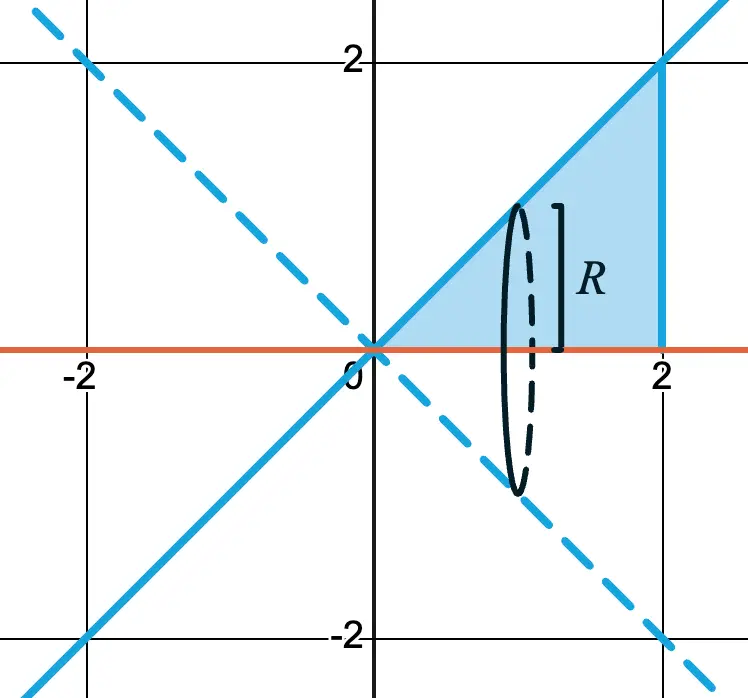
The region bounded by , the -axis, and is revolved about the -axis. Determine the volume of the solid formed.
Solution
To get started, make a quick sketch of the region:
- Pick a point on the function and draw a line segment straight to the axis of revolution.
- Imagine spinning the line segment a full rotation around the axis. The circle (disk) it sweeps out is a representative cross section of the solid. Label its radius .
1. Bounds:
- Integrate over -bounds:
2. Find the radius :
This is the vertical distance from the line to the -axis :
3. Integrate:
Notice the solid formed is a cone with radius and height . Using the formula for the volume of a cone, , also gives cubic units.
Example 2: Other horizontal axes
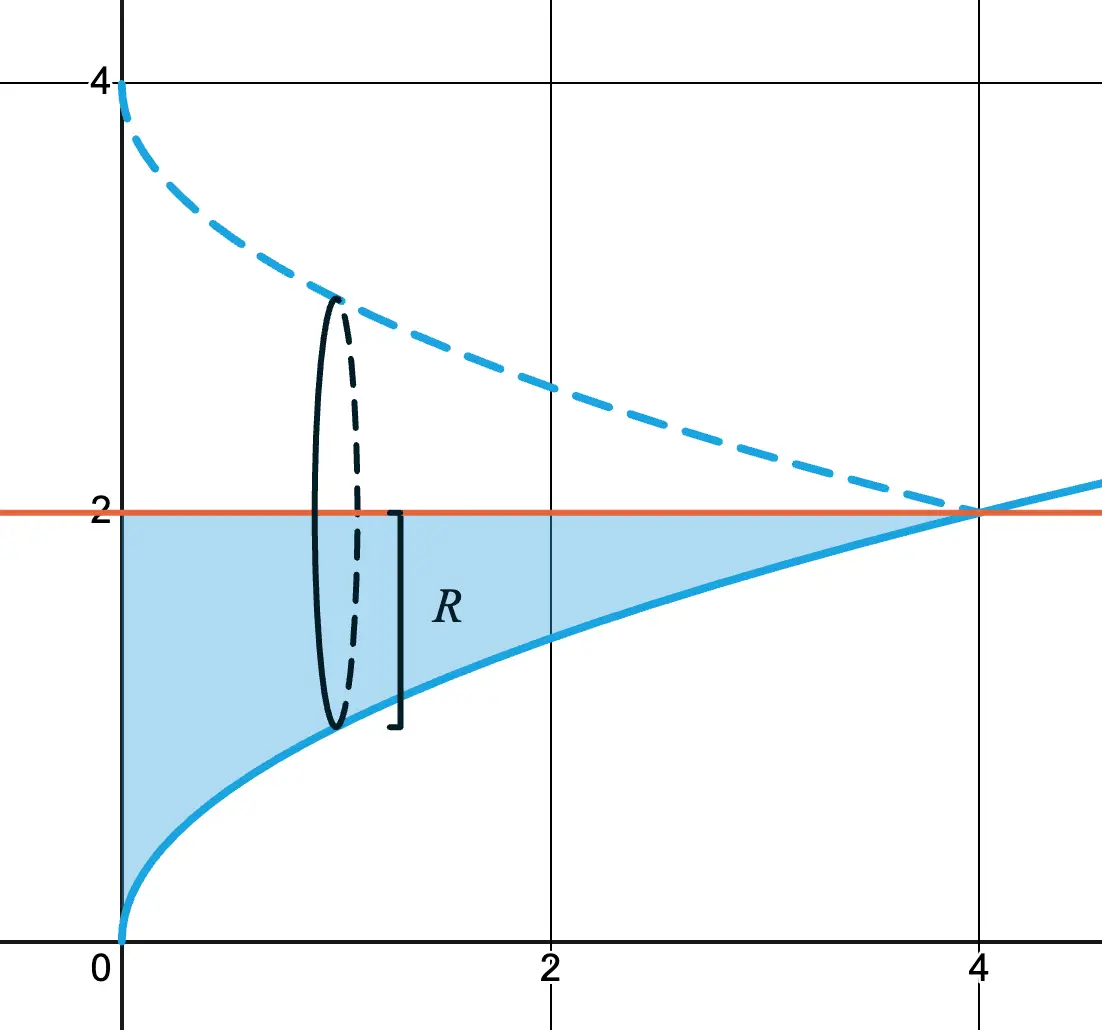
The region bounded by the -axis, the line , and the curve is revolved about the line . Determine the volume of the solid formed.
Solution
1. Bounds:
- -bounds:
The curve meets the line at the intersection point .
2. Find the radius :
This is the vertical distance between the curve and the axis of revolution :
Note: Even though substituting an -value within the interval bounds produces a negative radius, this can be ignored because is squared in the integral.
3. Integrate:
Vertical axes of revolution
Example 3: Revolving around the -axis
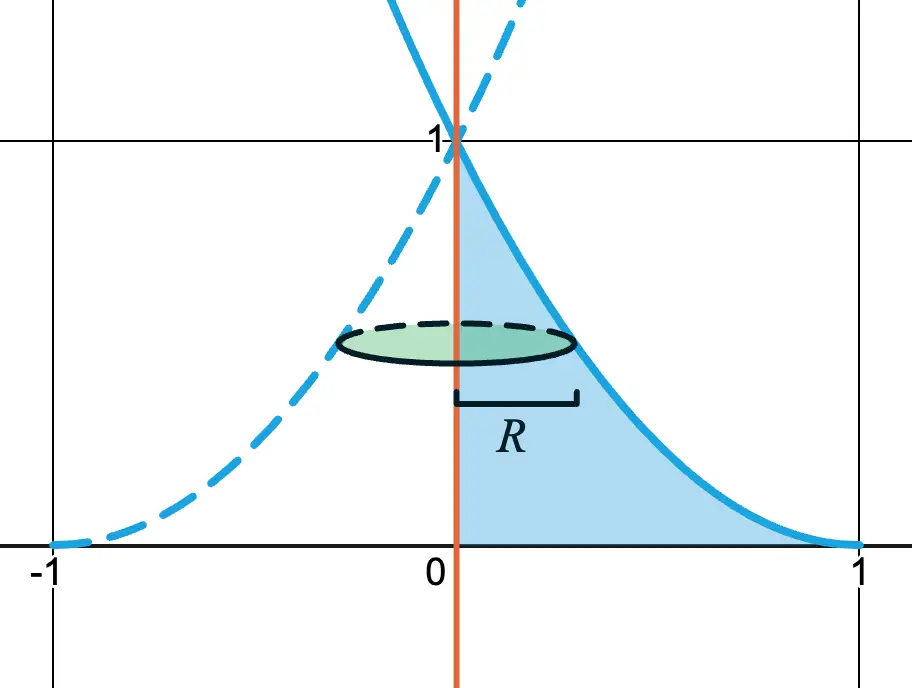
The region in the first quadrant bounded by and the coordinate axes is revolved about the -axis. Determine the volume of the solid formed.
Solution
1. Rewrite the equation in terms of :
The region is bounded by the left half of the parabola, so we choose the negative square root:
2. Bounds:
- -bounds:
- Lower bound: The curve meets the -axis at .
- Upper bound: The curve meets the -axis at .
3. Find the radius :
This is the horizontal distance between the curve and the -axis :
4. Integrate:
Example 4: Other vertical axes
The region bounded by , the -axis, and the line is revolved about . Determine the volume of the solid formed.
Solution
1. Rewrite the equation in terms of :
2. Bounds:
- -bounds:
- Lower bound: The region is bounded below by the -axis, where .
- Upper bound: The curve meets at .
3. Find the radius :
This is the horizontal distance between the curve and the line :
4. Integrate:
Challenge problem
The region bounded by , the coordinate axes, and the line is revolved about . Determine the volume of the solid formed.
Solution
1. Axis:
- Revolved about a vertical line use .
2. Rewrite the equation in terms of :
3. Bounds (Watch out!):
We must split the integral:
- Bottom section with -bounds :
-
Region is bounded on the left by (-axis) and on the right by .
-
When revolved about , the solid formed is a cylinder.
-
- Top section with -bounds :
- Region is now bounded on the left by and on the right by .
4. Find radii:
- For : The radius is a constant distance from to :
- For : The radius is the distance from the curve to :
5. Integrate:
Add the separate integrals together: