



Motion with integrals
Motion along a line is one of the most fundamental applications of calculus. Recall from section 4.2 that derivatives connect position, velocity, and acceleration.
Now, we work in reverse: if you have an acceleration function and an initial condition, you can integrate to find velocity, and integrate again to find position.
Displacement vs. total distance
While displacement measures the net change in an object’s position, total distance measures all ground covered, regardless of direction.
Example 1
A particle moves along the -axis so that its velocity at time is given by .
a) Find the displacement of the particle from time to .
b) Find the total distance traveled by the particle from time to .
Solutions
a) Displacement
Integrate velocity:
A displacement of means the particle ended exactly where it started.
b) Total distance
To integrate without a calculator, find where the velocity changes sign by setting :
Test intervals: Since is negative on and positive on , multiply the first integral by :
The particle traveled 6 units backward and 6 units forward, covering a total distance of 12 units.
Recovering position from velocity or acceleration
On the AP exam, questions frequently test your ability to navigate back and forth along the motion chain:
Finding position at a specific time
When given the velocity function and the object’s position at a given starting time, use the Fundamental theorem of calculus to find the position at any other time.
Conceptually: Current position = previous position + displacement.
This approach is common on the AP exam, particularly on the calculator-active section where you can evaluate the definite integral numerically.
Example 2
(Calculator-active question)
A particle moves along the -axis so that its velocity at time is given by . The position of the particle at time is . Find the position of the particle at time .
Solution
Answer:
To find the final position, add the given position to the net change in position (displacement).
In Desmos, define the velocity function:
Then substitute and evaluate by entering:
This gives approximately .
Recovering the position function
Sometimes the goal is to find a formula for the particle’s position. If you’re given acceleration and enough initial conditions, integrate twice.
- Integrate acceleration to find velocity.
- Use the velocity condition to determine the first constant of integration.
- Integrate velocity to find position.
- Use the position condition to determine the second constant of integration.
Example 3
A particle moves along the -axis so that its acceleration at time is given by . At time , the velocity of the particle is , and at time , the position of the particle is . Write an expression for the position function .
Solution
1. Integrate acceleration for velocity:
Use the initial condition to find :
So .
2. Integrate velocity for position:
Use to find .
Therefore the position function is:
Velocity graphs
Sometimes velocity is given as a graph rather than an algebraic formula. Because the definite integral represents the area under the curve, you can navigate the motion chain geometrically:
- Displacement: Calculate the net signed area (areas above the time axis are positive, areas below are negative).
- Total Distance: Calculate the total area (treat all areas as positive).
- Acceleration: Read the slope of the velocity graph at that point ().
Example 4
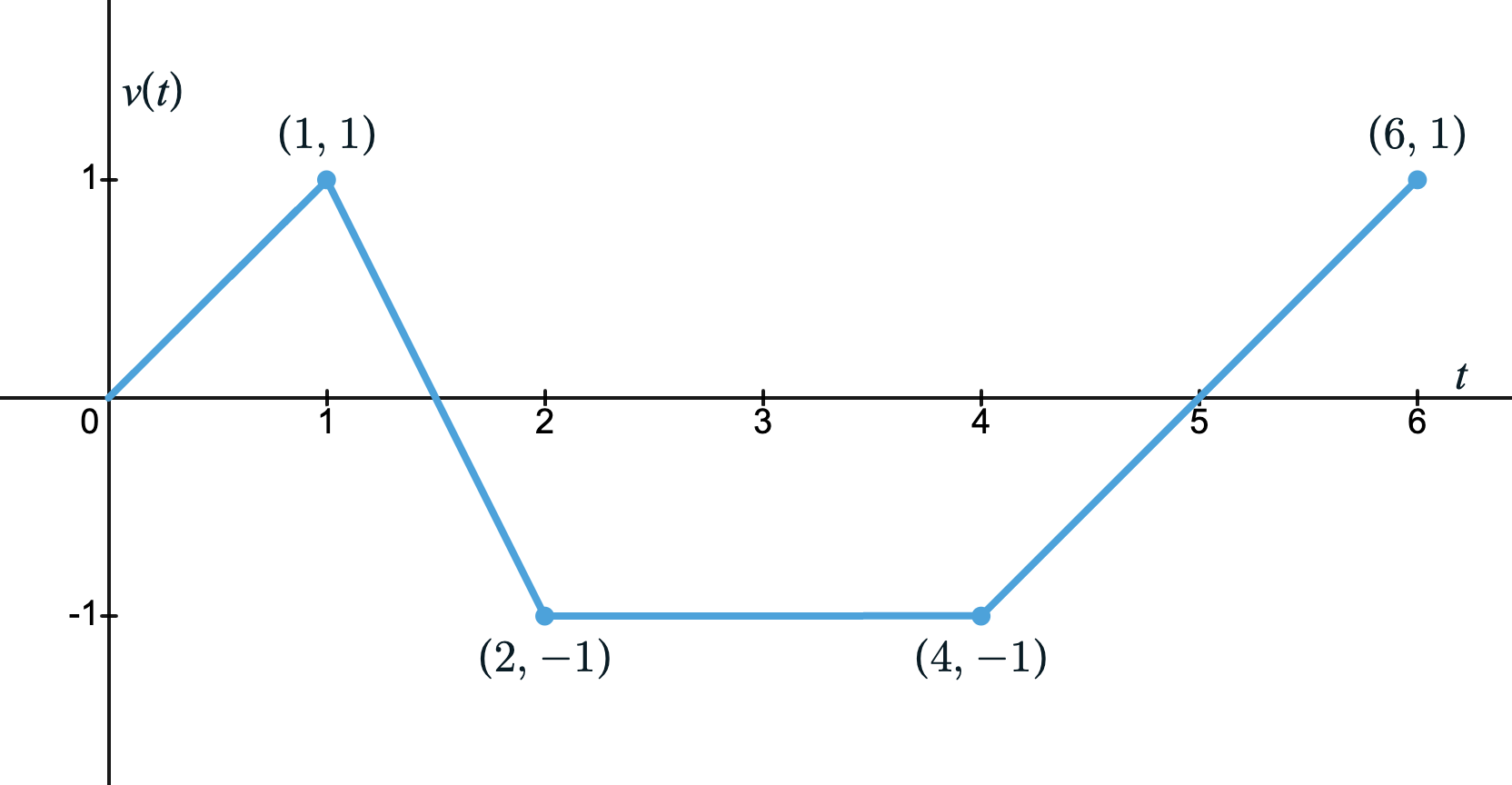
The graph of the velocity , consisting of line segments, is shown below for . At time , the position of the particle is .
a) Find the displacement of the particle from to .
b) Find the total distance traveled by the particle over .
c) Find the position of the particle at .
d) Find the acceleration of the particle at .
e) Is the speed of the particle increasing, decreasing, or not changing at ?
Answers
a) Displacement:
b) Total distance:
c)
d) Acceleration:
e) Not changing
Solutions
a) Displacement
To find displacement, add the signed areas (areas above the axis are positive; below are negative).
-
On the interval : Triangle (above axis)
-
On : Trapezoid (below axis)
-
On : Triangle (above axis)
Adding these values gives a displacement of
b) Total distance
Total distance is the sum of the absolute values of those areas:
c) Position at
The final position is the initial position plus the displacement from to :
is the net signed area from to :
-
On : (rectangle below axis)
-
On : (triangles above and below cancel out)
So . Substitute this and to find :
d) Acceleration at
Acceleration is the derivative of velocity. To find , look at the slope of the line segment that connects points and .
e) Speed behavior at
- Speed increases when and have the same sign.
- It decreases when and have opposing signs.
- It’s constant when .
At , and (horizontal tangent line).
Therefore, the speed of the particle is not changing at .