


Achievable logoAchievable logo
Praxis Core: Math (5733)
Sign in
Sign up
Purchase
Textbook
Practice exams
Support
How it works
Exam catalog
Mountain with a flag at the peak
Textbook
Introduction
1. Number and quantity
2. Data analysis, statistics, and probability
3. Algebra and geometry
3.1 Manipulating algebraic expressions and equations
3.2 Solving equations and inequalities
3.3 Functions, graphs, and set relationships
3.4 Basic geometric properties and shapes
3.5 Understanding angles, congruence, and similarity
3.6 Circles, shapes, and solids: Understanding measurement in geometry
Wrapping up
Achievable logoAchievable logo
3.5 Understanding angles, congruence, and similarity
Achievable Praxis Core: Math (5733)
3. Algebra and geometry
Our Praxis Core: Math course is currently in development and is a work-in-progress.

Understanding angles, congruence, and similarity

15 min read
Font
Discuss
Share
Feedback

This section focuses on common angle relationships, how to use angle rules to find unknown measures, and how to decide when triangles are congruent or similar. You’ll also see how changing the size of similar figures affects perimeter, area, and volume - and why those changes involve k, k2, and k3.

Definitions
Angle
The figure formed by two rays with a common endpoint (the vertex), measured in degrees.
Vertical angles
Angles opposite each other when two lines intersect; always congruent.
Complementary angles
Two angles whose measures add to 90∘.
Supplementary angles
Two angles whose measures add to 180∘.
Congruent triangles
Triangles that are identical in both shape and size, with all corresponding sides and angles equal.
Similar figures
Figures that have the same shape but different sizes, with all corresponding angles equal and side lengths proportional.
Scale factor k
The ratio of corresponding side lengths between two similar figures.

Angle relationships

When two lines intersect, or when a transversal crosses parallel lines, certain angle pairs always have predictable relationships. Once you recognize the pattern, you can set up an equation and solve for unknown angle measures.

  • Vertical angles: When two lines intersect, the opposite angles (across from each other) are equal because they represent the same rotation.
  • Complementary angles: Two angles are complementary if they add up to 90∘ (they form a right angle).
  • Supplementary angles: Two angles are supplementary if they add up to 180∘ (they form a straight line). Supplementary angles do not have to be right angles; for example, 120∘ and 60∘ are supplementary.
  • Angles formed by parallel lines and a transversal:
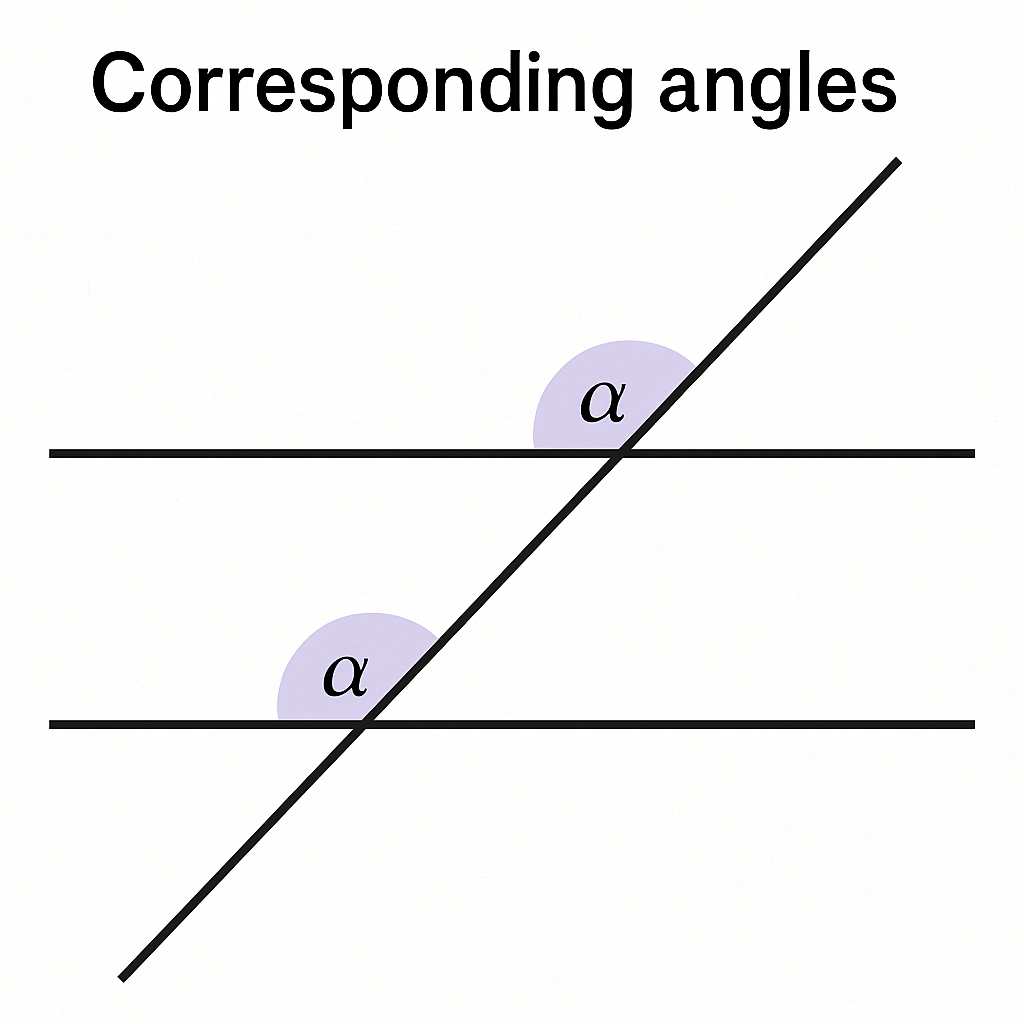
    • Corresponding angles are in the same position on each parallel line and are always equal.
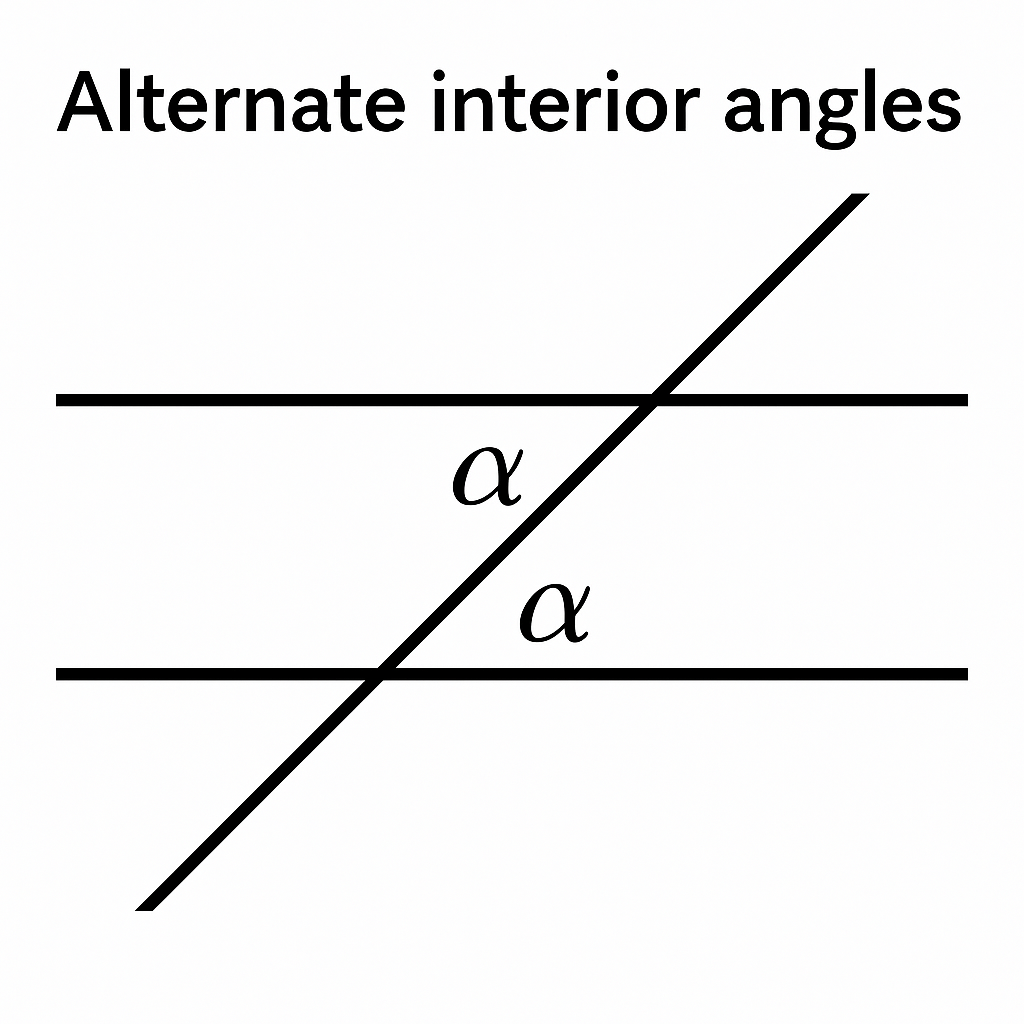
    • Alternate interior angles are inside the parallel lines but on opposite sides of the transversal and are always equal.
    • Alternate exterior angles are outside the parallel lines but on opposite sides of the transversal and are always equal.
    • Same-side interior angles are inside the parallel lines on the same side of the transversal and always add up to 180∘ (supplementary).
Vertical angles
Vertical angles
Alternate interior angles
Alternate exterior angles
Corresponding angles
Same-side interior
Same-side interior

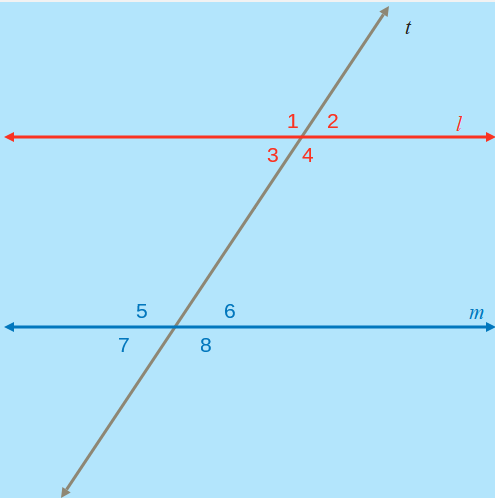
Example: Supplementary angles Two angles are supplementary, m∠1 is 3x and m∠7 is 2x+20. Find the value of x and both angles.

Transversal angle measurements
  • Supplementary means:

    3x+(2x+20)=180

  • Combine like terms:

    5x+20=180

  • Subtract 20:

    5x=160

  • Divide by 5:

    x=32

  • m∠1=32⋅3=96∘ and m∠7=2⋅32+20=84∘

Answer: x=32, m∠1=96∘, m∠7=84∘

Example: Transversal angle measurements A transversal crosses two parallel lines. If m∠6=(x+10)∘ and m∠3=70∘, solve for x and find the measurement of all 8 angles.

Transversal angle measurements
(spoiler)
  • Use alternate interior angles. Since angles 3 and 6 are alternate interior angles, they are congruent:

    x+10=70

  • Solve for x:

    x=70−10=60

  • Plug in to find m∠6:

    m∠6=x+10=60+10=70∘

  • Use angle relationships. Vertical angles are equal, and adjacent angles on a straight line are supplementary.
    • m∠1=110∘
    • m∠2=70∘
    • m∠3=70∘
    • m∠4=110∘
    • m∠5=110∘
    • m∠6=70∘
    • m∠7=70∘
    • m∠8=110∘

Answer: x=60; angles are 70∘ and 110∘

Congruent triangles

Two triangles are congruent when they match exactly in both shape and size. That means all corresponding sides and angles are equal.

Checking all six parts works, but it’s usually faster to use one of the standard congruence tests:

  • SSS: All three sides are equal.
  • SAS: Two sides and the angle between them are equal.
  • ASA: Two angles and the included side are equal.
  • AAS: Two angles and any side are equal.
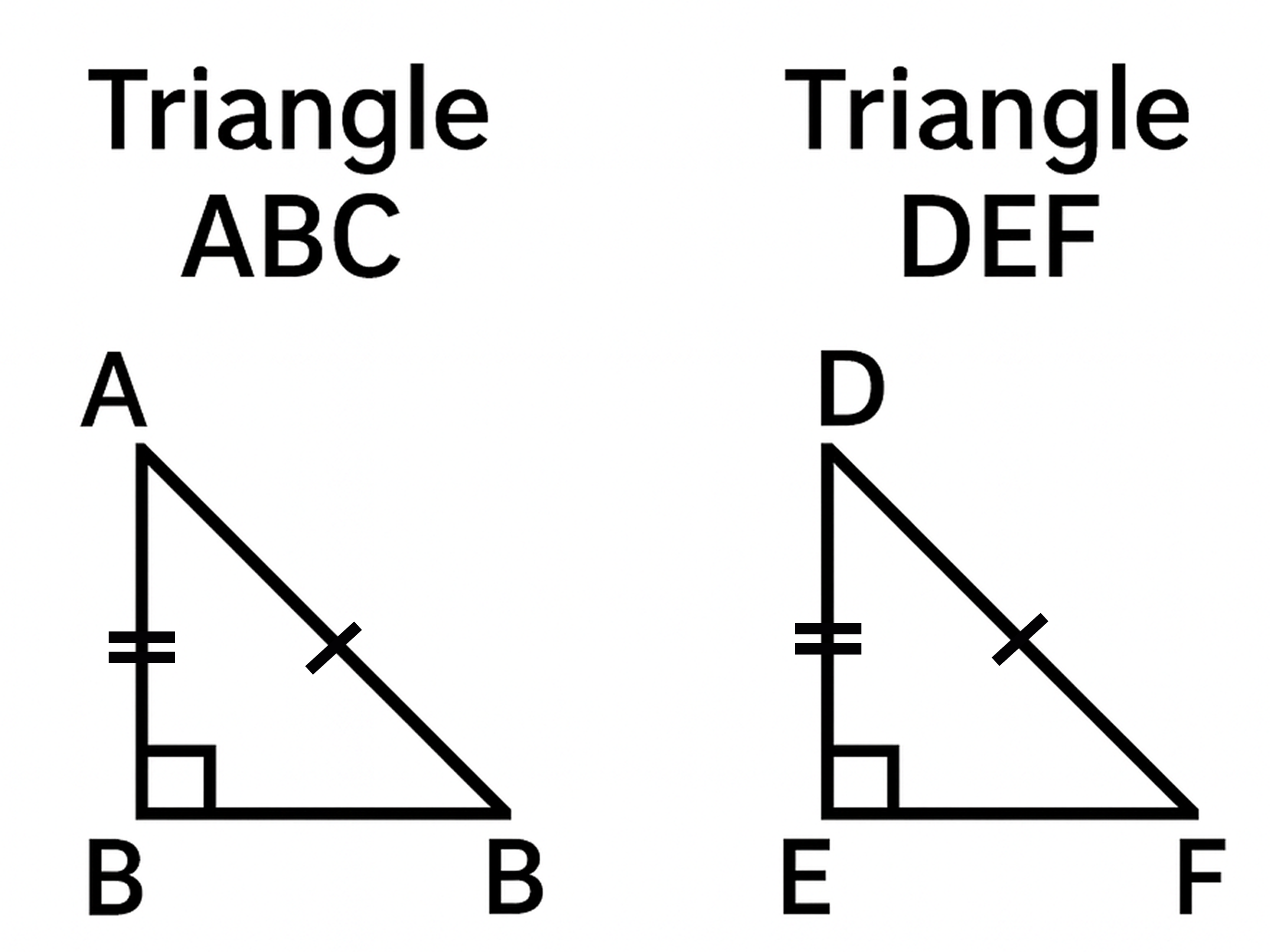
  • HL: Hypotenuse and one leg in a right triangle are equal.

Below are examples of each of the five ways to show two triangles are congruent.

SSS congruence
SSS congruence
SAS congruence
SAS congruence
ASA congruence
ASA congruence
AAS congruence
AAS congruence
HL congruence
HL congruence

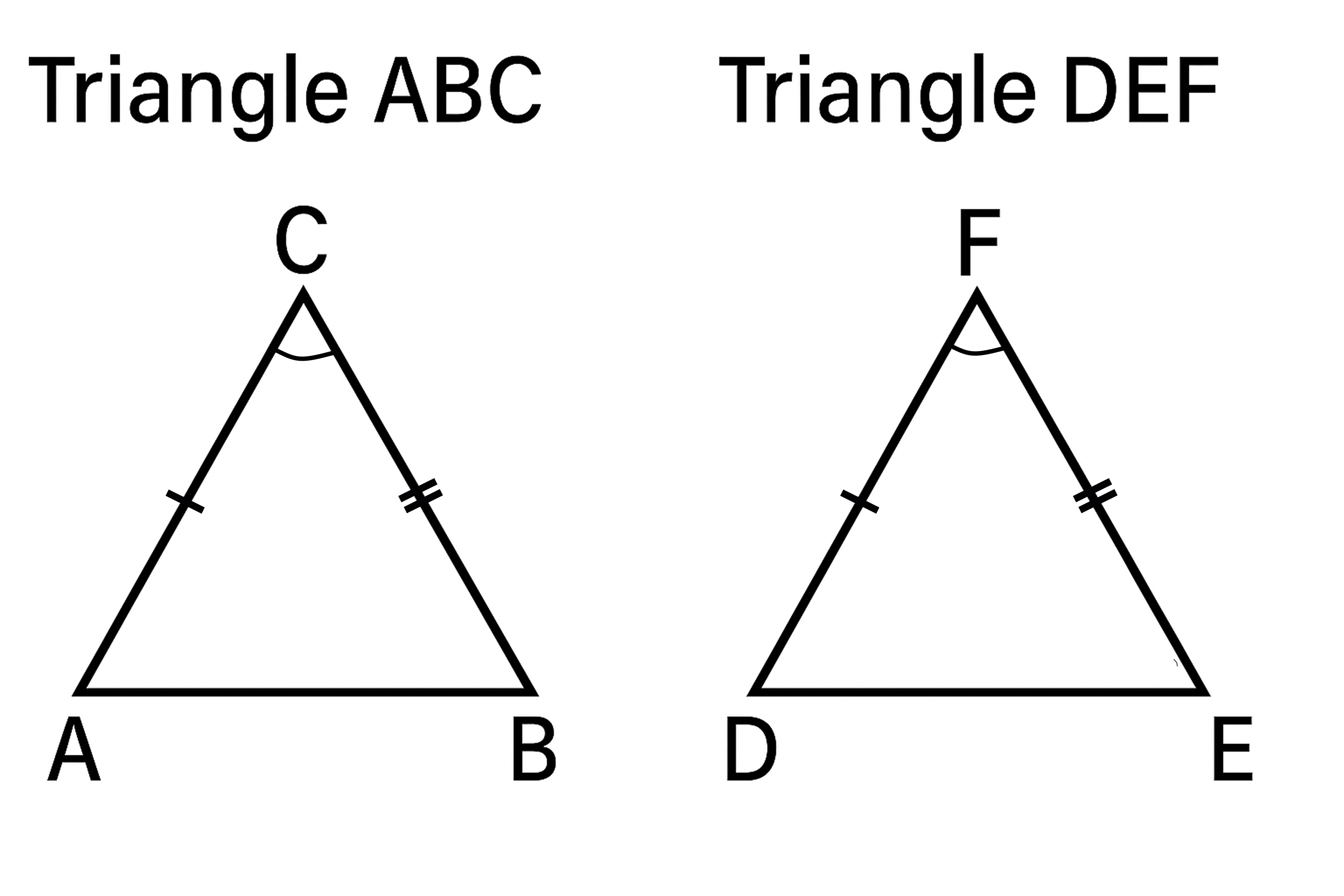
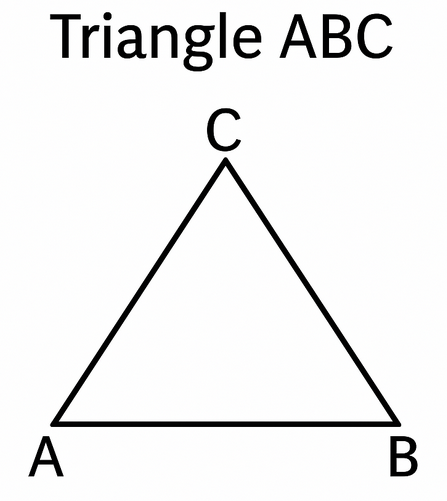
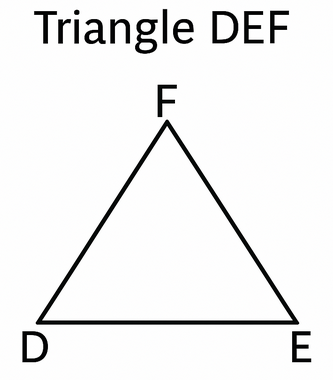
Example: Determining congruence (AAS) Given triangle ABC and triangle DEF with the following:

  • AB=3, DE=3
  • ∠B=72∘, ∠E=72∘
  • ∠A=25∘, ∠F=83∘ Are the triangles congruent? If so, state why and find all missing side lengths and angles.
    Triangle ABC
    Triangle ABC
    Triangle DEF
    Triangle DEF

Since ∠A=25∘ and ∠B=72∘, then ∠C=180∘−25∘−72∘=83∘. Since ∠E=72∘ and ∠F=83∘, then ∠D=180∘−72∘−83∘=25∘. All angles match: ∠A=∠D=25∘, ∠B=∠E=72∘, ∠C=∠F=83∘. AB=DE=3, and the side is adjacent to the same two angles in both triangles, so the triangles are congruent by AAS. Therefore:

  • △ABC≅△DEF by AAS
  • BC=EF, CA=FD, AB=DE=3
  • ∠A=∠D=25∘
  • ∠B=∠E=72∘
  • ∠C=∠F=83∘

Answer: Yes, congruent by AAS

Example: Determining congruence (SAS) Given triangle XYZ and triangle PQR with the following:

  • XY=5, PQ=5
  • YZ=6, QR=6
  • ∠Y=40∘, ∠Q=40∘ Are the triangles congruent? If so, state why and find all missing side lengths and angles.
    Triangle XYZ
    Triangle XYZ
    Triangle PQR
    Triangle PQR
(spoiler)

Since two sides and the included angle are congruent between both triangles, the triangles are congruent by SAS. Therefore:

  • △XYZ≅△PQR by SAS
  • XZ=PR
  • ∠X=∠P
  • ∠Z=∠R
  • XY=PQ=5, YZ=QR=6, ∠Y=∠Q=40∘

Answer: Yes, congruent by SAS

Similar figures and scaling

Two figures are similar if they have the same shape but different sizes. In similar figures:

  • All corresponding angles are equal.
  • All corresponding side lengths are proportional by a constant scale factor, denoted k.

When figures are similar:

  • Angles remain unchanged.
  • Side lengths scale by a factor of k.
  • Perimeter scales by k, since each linear measurement is multiplied by k.
  • Area scales by k2, because area depends on two dimensions.
  • Volume scales by k3, because volume depends on three dimensions.

These powers of k occur because the scale factor applies once for each dimension:

  • A one-dimensional measurement (length) changes by a factor of k.
  • A two-dimensional measurement (area) changes by k⋅k=k2.
  • A three-dimensional measurement (volume) changes by k⋅k⋅k=k3.

When no diagram is provided, corresponding sides and angles are identified using the order of the letters in the figure names. For example, if triangle ABC is similar to triangle DEF, then:

  • ∠A≅∠D, ∠B≅∠E, and ∠C≅∠F.
  • Side AB corresponds to DE, BC corresponds to EF, and AC corresponds to DF.

Maintaining this letter order is essential when setting up proportions or ratios to solve similarity problems, as it ensures the correct parts of each figure are being compared.

Example: Solving for a side in similar polygons Pentagon ABCDE is similar to pentagon PQRST. If AB=6.4cm, PQ=10cm, and BC=8.1cm, find the length of QR. Since the pentagons are similar, their corresponding sides are in proportion. AB corresponds to PQ and BC corresponds to QR, so we write:

>PQAB​=QRBC​⇒106.4​=QR8.1​

Solve the proportion:

  • Cross-multiply: 6.4⋅QR=10⋅8.1
  • Multiply: 6.4QR=81
  • Divide: QR=6.481​≈12.66 So, the length of QR is approximately 12.66 cm

Answer: 12.66 cm

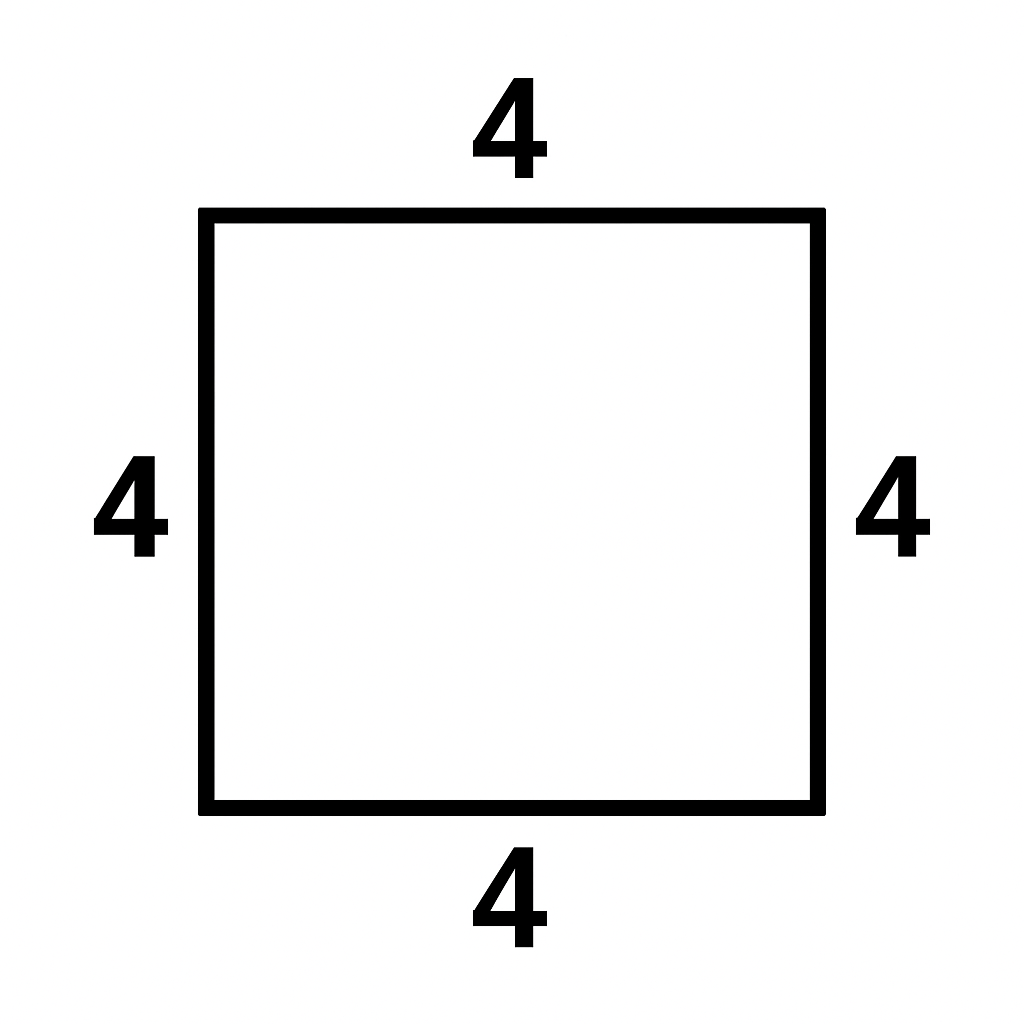
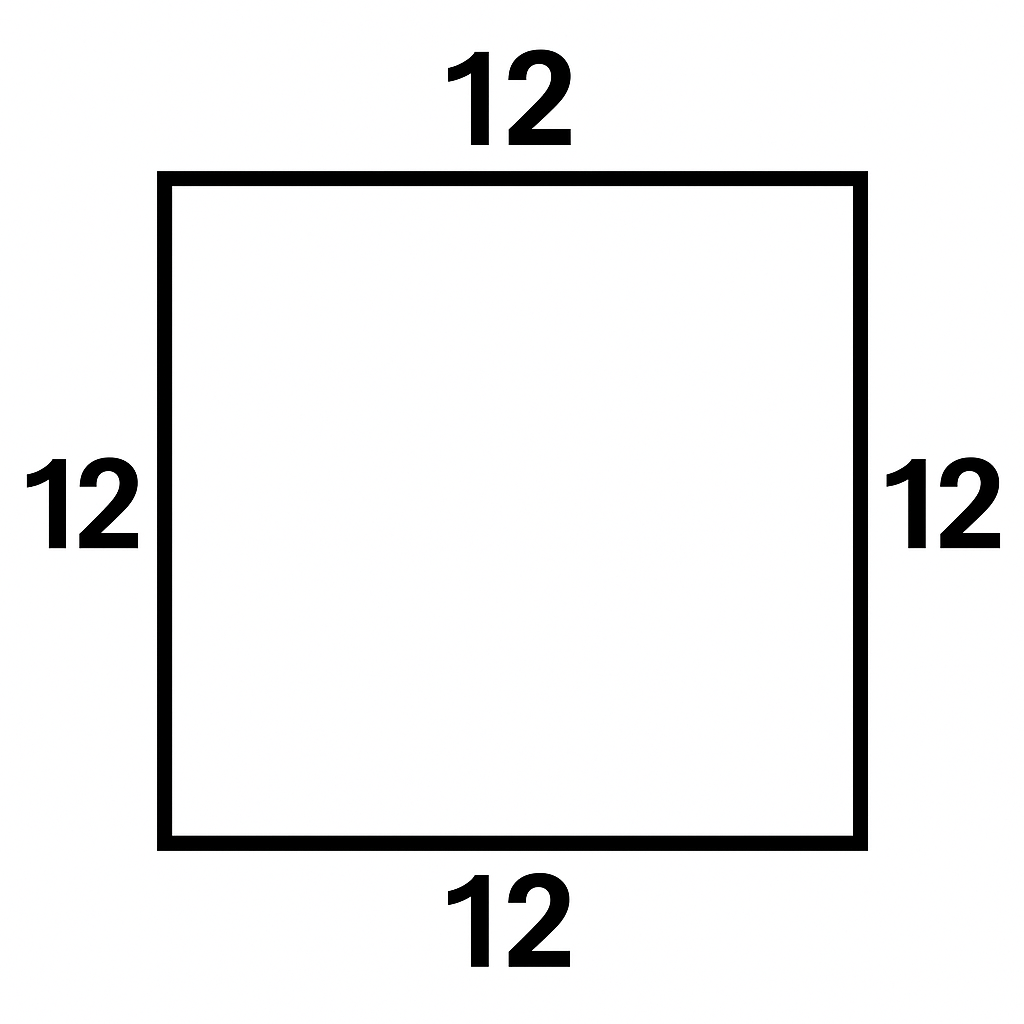
Example: Scale factor with area Suppose a square has side length 4, so its area is 4⋅4=16. If each side is scaled by a factor of 3 (k=3), the new side length becomes 12, and the new area is 12⋅12=144. This is 32=9 times larger than the original area:

>16144​=9

Square
Square
Square scaled by 3
Square scaled by 3
Note the perimeter is only scaled by k. The perimeter is 4⋅4=16 for the original square. The scaled square has side length 12 since 4⋅3=12, so the perimeter is 12⋅4=48:

>1648​=3=k

Answer: 9 times larger area

Example: Scale factor with volume Suppose a cube has side length 2, so its volume is 2⋅2⋅2=8. If each side is scaled by a factor of 3 (k=3), the new side length becomes 6, and the new volume is 6⋅6⋅6=216. This is 33=27 times larger than the original volume:

>8216​=27

Cube
Cube
Cube scaled by 3
Cube scaled by 3

Answer: 27 times larger volume

  • Vertical angles are congruent; linear pairs are supplementary.

  • Complementary angles sum to 90∘; supplementary angles sum to 180∘.

  • Parallel lines cut by a transversal form congruent corresponding, alternate interior, and alternate exterior angles; same-side interior angles are supplementary.

  • Prove triangle congruence using SSS, SAS, ASA, AAS, or HL (SSA is invalid).

  • Similar figures have equal angles and proportional sides.

  • For scale factor k, perimeter scales by k, area by k2, and volume by k3.

  • Match corresponding parts using the letter order in figure names to solve similarity problems without diagrams.

Sign up for free to take 5 quiz questions on this topic

All rights reserved ©2016 - 2026 Achievable, Inc.

Understanding angles, congruence, and similarity

This section focuses on common angle relationships, how to use angle rules to find unknown measures, and how to decide when triangles are congruent or similar. You’ll also see how changing the size of similar figures affects perimeter, area, and volume - and why those changes involve k, k2, and k3.

Definitions
Angle
The figure formed by two rays with a common endpoint (the vertex), measured in degrees.
Vertical angles
Angles opposite each other when two lines intersect; always congruent.
Complementary angles
Two angles whose measures add to 90∘.
Supplementary angles
Two angles whose measures add to 180∘.
Congruent triangles
Triangles that are identical in both shape and size, with all corresponding sides and angles equal.
Similar figures
Figures that have the same shape but different sizes, with all corresponding angles equal and side lengths proportional.
Scale factor k
The ratio of corresponding side lengths between two similar figures.

Angle relationships

When two lines intersect, or when a transversal crosses parallel lines, certain angle pairs always have predictable relationships. Once you recognize the pattern, you can set up an equation and solve for unknown angle measures.

  • Vertical angles: When two lines intersect, the opposite angles (across from each other) are equal because they represent the same rotation.
  • Complementary angles: Two angles are complementary if they add up to 90∘ (they form a right angle).
  • Supplementary angles: Two angles are supplementary if they add up to 180∘ (they form a straight line). Supplementary angles do not have to be right angles; for example, 120∘ and 60∘ are supplementary.
  • Angles formed by parallel lines and a transversal:
    • Corresponding angles are in the same position on each parallel line and are always equal.
    • Alternate interior angles are inside the parallel lines but on opposite sides of the transversal and are always equal.
    • Alternate exterior angles are outside the parallel lines but on opposite sides of the transversal and are always equal.
    • Same-side interior angles are inside the parallel lines on the same side of the transversal and always add up to 180∘ (supplementary).

Example: Supplementary angles Two angles are supplementary, m∠1 is 3x and m∠7 is 2x+20. Find the value of x and both angles.

  • Supplementary means:

    3x+(2x+20)=180

  • Combine like terms:

    5x+20=180

  • Subtract 20:

    5x=160

  • Divide by 5:

    x=32

  • m∠1=32⋅3=96∘ and m∠7=2⋅32+20=84∘

Answer: x=32, m∠1=96∘, m∠7=84∘

Example: Transversal angle measurements A transversal crosses two parallel lines. If m∠6=(x+10)∘ and m∠3=70∘, solve for x and find the measurement of all 8 angles.

(spoiler)
  • Use alternate interior angles. Since angles 3 and 6 are alternate interior angles, they are congruent:

    x+10=70

  • Solve for x:

    x=70−10=60

  • Plug in to find m∠6:

    m∠6=x+10=60+10=70∘

  • Use angle relationships. Vertical angles are equal, and adjacent angles on a straight line are supplementary.
    • m∠1=110∘
    • m∠2=70∘
    • m∠3=70∘
    • m∠4=110∘
    • m∠5=110∘
    • m∠6=70∘
    • m∠7=70∘
    • m∠8=110∘

Answer: x=60; angles are 70∘ and 110∘

Congruent triangles

Two triangles are congruent when they match exactly in both shape and size. That means all corresponding sides and angles are equal.

Checking all six parts works, but it’s usually faster to use one of the standard congruence tests:

  • SSS: All three sides are equal.
  • SAS: Two sides and the angle between them are equal.
  • ASA: Two angles and the included side are equal.
  • AAS: Two angles and any side are equal.
  • HL: Hypotenuse and one leg in a right triangle are equal.

Below are examples of each of the five ways to show two triangles are congruent.

Example: Determining congruence (AAS) Given triangle ABC and triangle DEF with the following:

  • AB=3, DE=3
  • ∠B=72∘, ∠E=72∘
  • ∠A=25∘, ∠F=83∘ Are the triangles congruent? If so, state why and find all missing side lengths and angles.

Since ∠A=25∘ and ∠B=72∘, then ∠C=180∘−25∘−72∘=83∘. Since ∠E=72∘ and ∠F=83∘, then ∠D=180∘−72∘−83∘=25∘. All angles match: ∠A=∠D=25∘, ∠B=∠E=72∘, ∠C=∠F=83∘. AB=DE=3, and the side is adjacent to the same two angles in both triangles, so the triangles are congruent by AAS. Therefore:

  • △ABC≅△DEF by AAS
  • BC=EF, CA=FD, AB=DE=3
  • ∠A=∠D=25∘
  • ∠B=∠E=72∘
  • ∠C=∠F=83∘

Answer: Yes, congruent by AAS

Example: Determining congruence (SAS) Given triangle XYZ and triangle PQR with the following:

  • XY=5, PQ=5
  • YZ=6, QR=6
  • ∠Y=40∘, ∠Q=40∘ Are the triangles congruent? If so, state why and find all missing side lengths and angles.
(spoiler)

Since two sides and the included angle are congruent between both triangles, the triangles are congruent by SAS. Therefore:

  • △XYZ≅△PQR by SAS
  • XZ=PR
  • ∠X=∠P
  • ∠Z=∠R
  • XY=PQ=5, YZ=QR=6, ∠Y=∠Q=40∘

Answer: Yes, congruent by SAS

Similar figures and scaling

Two figures are similar if they have the same shape but different sizes. In similar figures:

  • All corresponding angles are equal.
  • All corresponding side lengths are proportional by a constant scale factor, denoted k.

When figures are similar:

  • Angles remain unchanged.
  • Side lengths scale by a factor of k.
  • Perimeter scales by k, since each linear measurement is multiplied by k.
  • Area scales by k2, because area depends on two dimensions.
  • Volume scales by k3, because volume depends on three dimensions.

These powers of k occur because the scale factor applies once for each dimension:

  • A one-dimensional measurement (length) changes by a factor of k.
  • A two-dimensional measurement (area) changes by k⋅k=k2.
  • A three-dimensional measurement (volume) changes by k⋅k⋅k=k3.

When no diagram is provided, corresponding sides and angles are identified using the order of the letters in the figure names. For example, if triangle ABC is similar to triangle DEF, then:

  • ∠A≅∠D, ∠B≅∠E, and ∠C≅∠F.
  • Side AB corresponds to DE, BC corresponds to EF, and AC corresponds to DF.

Maintaining this letter order is essential when setting up proportions or ratios to solve similarity problems, as it ensures the correct parts of each figure are being compared.

Example: Solving for a side in similar polygons Pentagon ABCDE is similar to pentagon PQRST. If AB=6.4cm, PQ=10cm, and BC=8.1cm, find the length of QR. Since the pentagons are similar, their corresponding sides are in proportion. AB corresponds to PQ and BC corresponds to QR, so we write:

>PQAB​=QRBC​⇒106.4​=QR8.1​

Solve the proportion:

  • Cross-multiply: 6.4⋅QR=10⋅8.1
  • Multiply: 6.4QR=81
  • Divide: QR=6.481​≈12.66 So, the length of QR is approximately 12.66 cm

Answer: 12.66 cm

Example: Scale factor with area Suppose a square has side length 4, so its area is 4⋅4=16. If each side is scaled by a factor of 3 (k=3), the new side length becomes 12, and the new area is 12⋅12=144. This is 32=9 times larger than the original area:

>16144​=9

Note the perimeter is only scaled by k. The perimeter is 4⋅4=16 for the original square. The scaled square has side length 12 since 4⋅3=12, so the perimeter is 12⋅4=48:

>1648​=3=k

Answer: 9 times larger area

Example: Scale factor with volume Suppose a cube has side length 2, so its volume is 2⋅2⋅2=8. If each side is scaled by a factor of 3 (k=3), the new side length becomes 6, and the new volume is 6⋅6⋅6=216. This is 33=27 times larger than the original volume:

>8216​=27

Answer: 27 times larger volume

Key points
  • Vertical angles are congruent; linear pairs are supplementary.

  • Complementary angles sum to 90∘; supplementary angles sum to 180∘.

  • Parallel lines cut by a transversal form congruent corresponding, alternate interior, and alternate exterior angles; same-side interior angles are supplementary.

  • Prove triangle congruence using SSS, SAS, ASA, AAS, or HL (SSA is invalid).

  • Similar figures have equal angles and proportional sides.

  • For scale factor k, perimeter scales by k, area by k2, and volume by k3.

  • Match corresponding parts using the letter order in figure names to solve similarity problems without diagrams.