


Achievable logoAchievable logo
Praxis Core: Math (5733)
Sign in
Sign up
Purchase
Textbook
Practice exams
Support
How it works
Exam catalog
Mountain with a flag at the peak
Textbook
Introduction
1. Number and quantity
2. Data analysis, statistics, and probability
3. Algebra and geometry
3.1 Manipulating algebraic expressions and equations
3.2 Solving equations and inequalities
3.3 Functions, graphs, and set relationships
3.4 Basic geometric properties and shapes
3.5 Understanding angles, congruence, and similarity
3.6 Circles, shapes, and solids: Understanding measurement in geometry
Wrapping up
Achievable logoAchievable logo
3.2 Solving equations and inequalities
Achievable Praxis Core: Math (5733)
3. Algebra and geometry
Our Praxis Core: Math course is currently in development and is a work-in-progress.

Solving equations and inequalities

13 min read
Font
Discuss
Share
Feedback

In this section, you’ll learn how to solve linear equations, simple quadratic equations, and linear inequalities. You’ll also learn how to interpret compound inequalities and when to reverse an inequality sign. These skills help you find exact solutions as well as ranges of possible solutions.

Definitions
Variable
A symbol (often x) that represents an unknown number.
Equation
A statement that two expressions are equal, containing a variable to solve for.
Linear equation
An equation of the form ax+b=c where a=0, solved by isolating x using inverse operations.
Quadratic equation
A simple quadratic equation of the form x2=k where solutions come from taking square roots.
Inequality
A statement that two expressions are not necessarily equal, connected by one of the symbols <, >, ≤, or ≥.
Solution
A value of the variable that makes the equation true.
Root
Another term for a solution of an equation, especially used with quadratics.
Solution set
The collection of all values that satisfy an equation or an inequality.

Solving equations and inequalities means isolating the variable or describing its solution range. Use these guidelines:

  • Keep balance: whatever you do to one side of =, <, or >, do to the other.
  • Undo operations in reverse order:
    1. Remove constants (addition/subtraction).
    2. Remove coefficients (multiplication/division).
    3. Distribute or factor to clear parentheses if needed.
  • Apply special rules:
    • For x2=k, take square roots and include both +k​ and −k​.
    • For inequalities, reverse the inequality sign when multiplying or dividing by a negative.

Solving linear equations

Example: Solve a basic linear equation

3x+53xx​=20=15=5​

Steps taken:

  • Subtract 5 from both sides
  • Divide both sides by 3

Answer: x=5

Example: Solve a more complex equation

4(x−2)4x−82x−82xx​=2x+6=2x+6=6=14=7​

Steps taken:

  • Distribute 4 on the left
  • Subtract 2x from both sides
  • Add 8 to both sides
  • Divide both sides by 2

Answer: x=7

Example: Solve a linear equation with distribution

−2(x−3)+4=6

(spoiler)

−2(x−3)+4−2x+6+4−2x+10−2xx​=6=6=6=−4=2​

Steps taken:

  • Distribute -2
  • Combine like terms
  • Subtract 10 from both sides
  • Divide both sides by -2

Answer: x=2

Solving simple quadratic equations

Quadratic equations often appear when a variable is squared. Unlike linear equations (which have one solution), quadratic equations often have two solutions because both a positive and a negative number can square to the same value. In this section, we focus on two common simple forms you’ll see on the exam.

Quadratic equations often appear in two main forms:

  • Square-root method: for equations like (x−a)2=k, solve by taking

x−a=±k​

then isolate x.

  • Factoring method: for equations of the form x2+bx+c=0, factor into (x+m)(x+n)=0 and set each factor equal to zero.

Square-root method

Use this method when the variable is contained in a single squared expression, such as x2=k or (x−a)2=k. The key idea is that squaring hides sign information:

  • If u2=k, then u=±k​.

This is because both positive and negative numbers square to the same value. For example, 32=9 and (−3)2=9, so if x2=9, then x=3 or x=−3.

Steps to follow:

  • Isolate the squared expression on one side of the equation.
  • Take the square root of both sides and include the ±.
  • Solve the two resulting linear equations.
  • If k<0, there is no real-number solution.

Factoring method

Use this method when the equation is written as a quadratic equal to zero, such as x2+bx+c=0. This method relies on the zero product property:

  • If AB=0, then A=0 or B=0.

After factoring a quadratic into a product of two binomials, each factor represents a possible way for the product to be zero.

Steps to follow:

  • Rewrite the equation so one side is 0.
  • Factor the quadratic completely.
  • Set each factor equal to zero.
  • Solve each resulting linear equation.
  • List all solutions together as the solution set.

For example, if (x+2)(x−5)=0, then either x+2=0 or x−5=0, which gives x=−2 or x=5. Both values satisfy the original equation.

Example: Solve by square roots

  • If (3x−5​)2=916​, what two values of x are solutions?
  • Take the square root of both sides

3x−5​=±34​

  • Multiply both sides by 3

x−5=±4

  • Case 1: x−5=4⇒x=9
  • Case 2: x−5=−4⇒x=1

Answer: x=1 or x=9

Example: Solve by factoring

x2−5x+6=0

  • Factor into (x−2)(x−3)=0
  • x−2=0⇒x=2
  • x−3=0⇒x=3

Answer: x=2 or x=3

Example: Solve by factoring

x2−4x−5=0

(spoiler)

Factor into (x−5)(x+1)=0

  • x−5=0⇒x=5
  • x+1=0⇒x=−1

Answer: x=5 or x=−1

Translating verbal descriptions

Translate words into algebra by identifying operations and order:

  • Multiplication (“times,” “product of”) → × or ⋅
  • Addition (“sum,” “more than”) → +
  • Subtraction (“difference,” “less than”) → −
  • Division (“quotient,” “per”) → ÷ or a fraction bar

Example: Translate “2 less than 3 times x”

  • “3 times x” → 3x
  • “2 less than” → subtract 2
  • 3x−2

Answer: 3x−2

Example: Write and solve a verbal equation Step 1: Choose a number y Step 2: Subtract 7 Step 3: Multiply by 5 Step 4: Add 8 If the result is 28, find y.

(spoiler)

Start with the equation:

5(y−7)+85(y−7)y−7y​=28=20=4=11​

Steps taken:

  • Subtract 8 from both sides
  • Divide both sides by 5
  • Add 7 to both sides

Answer: y=11

Why this matters: Translating words into algebra connects real-world situations to equations and inequalities you can solve.

Real-world applications

Equations and inequalities are tools for modeling real situations where quantities change, accumulate, or are restricted by limits. In real-world problems, variables represent meaningful quantities such as distance, cost, time, or quantity, and the equation or inequality describes how those quantities are related.

When modeling a situation:

  • An equation is used when the relationship is exact, such as calculating a total cost or determining when two quantities are equal.
  • An inequality is used when there is a limit or constraint, such as a budget, capacity, minimum requirement, or maximum allowance.

The goal is not only to write a correct mathematical statement, but also to interpret what the solution means in context. This includes identifying what the variable represents, what values are reasonable, and whether the solution describes a single value or a range of possible values.

Being able to translate words into equations or inequalities and interpret the result is a key skill tested on the Praxis exam, especially in applied and word-based questions.

Example: Modeling cost A car rental company charges a flat fee of $50 plus $0.20 per mile. Write an equation for total cost C in terms of miles x.

  • Flat fee: $50
  • Per mile: $0.20

C=50+0.20x

Answer: C=50+0.20x Example: Shopping budget You have $150. Apples cost 2perpound(a$), bread 3perloaf(b$), and milk 4pergallon(m$). Write an inequality that models your budget.

(spoiler)
  • Apples cost $2 per pound, so the total cost for apples is 2a.
  • Bread costs $3 per loaf, so the total cost for bread is 3b.
  • Milk costs $4 per gallon, so the total cost for milk is 4m.

The total cost of all items is the sum of these amounts: 2a+3b+4m

Since you cannot spend more than $150, the total cost must be less than or equal to 150.

2a+3b+4m≤150

Answer: 2a+3b+4m≤150

Solving linear inequalities

An inequality ax+b<c or ax+b≥c is solved much like an equation, except:

  • If you multiply or divide both sides by a negative number, reverse the inequality sign.

  • After solving for x, represent the solution on a number line with:

    • Open circle for < or > (boundary not included).
    • Closed circle for ≤ or ≥ (boundary included).
  • Reversing the inequality sign preserves the true order: if a<b then −a>−b. For instance, 3<5, and −3>−5.

Graphing inequalities on a number line

When you solve an inequality, you often want to show its solution visually on a number line. Follow these rules:

  • Open circle: use for < or >, meaning the boundary value is not included.
  • Closed circle: use for ≤ or ≥, meaning the boundary value is included.
  • Interval notation:
    • Parentheses () correspond to open circles.
    • Brackets [] correspond to closed circles.
    • Always list the left endpoint first, then the right.
    • Use −∞ or ∞ with a parenthesis, since infinity is never included.

Example: Solve an inequality

2x−52xx​<7<12<6​

Steps taken:

  • Add 5 to both sides
  • Divide both sides by 2

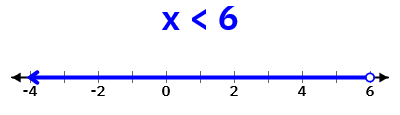
Answer: x<6

Less than inequality

Answer: x<6

Example: Solve an inequality with negatives

−3x+4−3xx​≥10≥6≤−2​

Steps taken:

  • Subtract 4 from both sides
  • Divide both sides by -3 and reverse the inequality sign

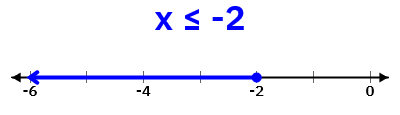
Answer: x≤−2

Less than or equal to inequality

Answer: x≤−2

Compound inequalities

A compound inequality combines two inequalities into a single statement. Instead of finding just one condition that must be true, you’re describing a range of values or multiple possible regions on the number line.

There are two main types of compound inequalities, and the word connecting them tells you how to think about the solution.

  • “And” compound a<x≤b This means that both inequalities must be true at the same time. The solution is the set of values that satisfy every condition simultaneously. Graphically, this produces a continuous interval on the number line. Algebraically, you solve all parts together and keep only the values that work for all inequalities.

  • “Or” compound x<a∨x>b This means that either inequality can be true. The solution is the set of values that satisfy at least one of the conditions. Graphically, this produces two separate regions on the number line. Algebraically, you solve each inequality separately and then combine all valid solutions.

A useful way to remember the difference:

  • “And” means inside a range (intersection).

  • “Or” means outside a range (union).

  • Fractions: when a compound inequality contains fractions, clear denominators by multiplying every part of the inequality by the least common denominator. If the number you multiply by is negative, remember to reverse every inequality sign to keep the statement true.

Example: Solve an “and” compound inequality

100​≤2x+1<7≤2x<6≤x<3​

Steps taken:

  • Subtract 1 from all parts
  • Divide all parts by 2

Answer: 0≤x<3

Compound and inequality

Answer: 0≤x<3

Example: Solve an “or” compound

3x−2<1∨3x−2>7

  • First: 3x−2<1
    • Add 2: 3x<3
    • Divide by 3: x<1
  • Second: 3x−2>7
    • Add 2: 3x>9
    • Divide by 3: x>3
  • Combined solution: x<1 or x>3
    Compound or inequality
    Compound or inequality

Answer: x<1∨x>3

Example: Solve the compound inequality

−2≤3x−1<8

(spoiler)

−2−1−31​​≤3x−1<8≤3x<9≤x<3​

Steps taken:

  • Add 1 to all three parts
  • Divide all parts by 3

Answer: −31​≤x<3

Inclusive and exclusive inequality

Answer: −31​≤x<3

  • Solve equations by isolating the variable and checking by substitution.
  • For x2=k, include both solutions x=±k​.
  • Solve inequalities like equations, but reverse the sign when multiplying or dividing by a negative.
  • Use open circles for < or > and closed circles for ≤ or ≥, shading the solution region.
  • For compound inequalities, “and” means intersection; “or” means union.
  • Clear fractions by multiplying every term by the LCD (reverse the sign if the LCD is negative).
  • Verify inequality solutions with a test value.

Sign up for free to take 5 quiz questions on this topic

All rights reserved ©2016 - 2026 Achievable, Inc.

Solving equations and inequalities

In this section, you’ll learn how to solve linear equations, simple quadratic equations, and linear inequalities. You’ll also learn how to interpret compound inequalities and when to reverse an inequality sign. These skills help you find exact solutions as well as ranges of possible solutions.

Definitions
Variable
A symbol (often x) that represents an unknown number.
Equation
A statement that two expressions are equal, containing a variable to solve for.
Linear equation
An equation of the form ax+b=c where a=0, solved by isolating x using inverse operations.
Quadratic equation
A simple quadratic equation of the form x2=k where solutions come from taking square roots.
Inequality
A statement that two expressions are not necessarily equal, connected by one of the symbols <, >, ≤, or ≥.
Solution
A value of the variable that makes the equation true.
Root
Another term for a solution of an equation, especially used with quadratics.
Solution set
The collection of all values that satisfy an equation or an inequality.

Solving equations and inequalities means isolating the variable or describing its solution range. Use these guidelines:

  • Keep balance: whatever you do to one side of =, <, or >, do to the other.
  • Undo operations in reverse order:
    1. Remove constants (addition/subtraction).
    2. Remove coefficients (multiplication/division).
    3. Distribute or factor to clear parentheses if needed.
  • Apply special rules:
    • For x2=k, take square roots and include both +k​ and −k​.
    • For inequalities, reverse the inequality sign when multiplying or dividing by a negative.

Solving linear equations

Example: Solve a basic linear equation

3x+53xx​=20=15=5​

Steps taken:

  • Subtract 5 from both sides
  • Divide both sides by 3

Answer: x=5

Example: Solve a more complex equation

4(x−2)4x−82x−82xx​=2x+6=2x+6=6=14=7​

Steps taken:

  • Distribute 4 on the left
  • Subtract 2x from both sides
  • Add 8 to both sides
  • Divide both sides by 2

Answer: x=7

Example: Solve a linear equation with distribution

−2(x−3)+4=6

(spoiler)

−2(x−3)+4−2x+6+4−2x+10−2xx​=6=6=6=−4=2​

Steps taken:

  • Distribute -2
  • Combine like terms
  • Subtract 10 from both sides
  • Divide both sides by -2

Answer: x=2

Solving simple quadratic equations

Quadratic equations often appear when a variable is squared. Unlike linear equations (which have one solution), quadratic equations often have two solutions because both a positive and a negative number can square to the same value. In this section, we focus on two common simple forms you’ll see on the exam.

Quadratic equations often appear in two main forms:

  • Square-root method: for equations like (x−a)2=k, solve by taking

x−a=±k​

then isolate x.

  • Factoring method: for equations of the form x2+bx+c=0, factor into (x+m)(x+n)=0 and set each factor equal to zero.

Square-root method

Use this method when the variable is contained in a single squared expression, such as x2=k or (x−a)2=k. The key idea is that squaring hides sign information:

  • If u2=k, then u=±k​.

This is because both positive and negative numbers square to the same value. For example, 32=9 and (−3)2=9, so if x2=9, then x=3 or x=−3.

Steps to follow:

  • Isolate the squared expression on one side of the equation.
  • Take the square root of both sides and include the ±.
  • Solve the two resulting linear equations.
  • If k<0, there is no real-number solution.

Factoring method

Use this method when the equation is written as a quadratic equal to zero, such as x2+bx+c=0. This method relies on the zero product property:

  • If AB=0, then A=0 or B=0.

After factoring a quadratic into a product of two binomials, each factor represents a possible way for the product to be zero.

Steps to follow:

  • Rewrite the equation so one side is 0.
  • Factor the quadratic completely.
  • Set each factor equal to zero.
  • Solve each resulting linear equation.
  • List all solutions together as the solution set.

For example, if (x+2)(x−5)=0, then either x+2=0 or x−5=0, which gives x=−2 or x=5. Both values satisfy the original equation.

Example: Solve by square roots

  • If (3x−5​)2=916​, what two values of x are solutions?
  • Take the square root of both sides

3x−5​=±34​

  • Multiply both sides by 3

x−5=±4

  • Case 1: x−5=4⇒x=9
  • Case 2: x−5=−4⇒x=1

Answer: x=1 or x=9

Example: Solve by factoring

x2−5x+6=0

  • Factor into (x−2)(x−3)=0
  • x−2=0⇒x=2
  • x−3=0⇒x=3

Answer: x=2 or x=3

Example: Solve by factoring

x2−4x−5=0

(spoiler)

Factor into (x−5)(x+1)=0

  • x−5=0⇒x=5
  • x+1=0⇒x=−1

Answer: x=5 or x=−1

Translating verbal descriptions

Translate words into algebra by identifying operations and order:

  • Multiplication (“times,” “product of”) → × or ⋅
  • Addition (“sum,” “more than”) → +
  • Subtraction (“difference,” “less than”) → −
  • Division (“quotient,” “per”) → ÷ or a fraction bar

Example: Translate “2 less than 3 times x”

  • “3 times x” → 3x
  • “2 less than” → subtract 2
  • 3x−2

Answer: 3x−2

Example: Write and solve a verbal equation Step 1: Choose a number y Step 2: Subtract 7 Step 3: Multiply by 5 Step 4: Add 8 If the result is 28, find y.

(spoiler)

Start with the equation:

5(y−7)+85(y−7)y−7y​=28=20=4=11​

Steps taken:

  • Subtract 8 from both sides
  • Divide both sides by 5
  • Add 7 to both sides

Answer: y=11

Why this matters: Translating words into algebra connects real-world situations to equations and inequalities you can solve.

Real-world applications

Equations and inequalities are tools for modeling real situations where quantities change, accumulate, or are restricted by limits. In real-world problems, variables represent meaningful quantities such as distance, cost, time, or quantity, and the equation or inequality describes how those quantities are related.

When modeling a situation:

  • An equation is used when the relationship is exact, such as calculating a total cost or determining when two quantities are equal.
  • An inequality is used when there is a limit or constraint, such as a budget, capacity, minimum requirement, or maximum allowance.

The goal is not only to write a correct mathematical statement, but also to interpret what the solution means in context. This includes identifying what the variable represents, what values are reasonable, and whether the solution describes a single value or a range of possible values.

Being able to translate words into equations or inequalities and interpret the result is a key skill tested on the Praxis exam, especially in applied and word-based questions.

Example: Modeling cost A car rental company charges a flat fee of $50 plus $0.20 per mile. Write an equation for total cost C in terms of miles x.

  • Flat fee: $50
  • Per mile: $0.20

C=50+0.20x

Answer: C=50+0.20x Example: Shopping budget You have $150. Apples cost 2perpound(a$), bread 3perloaf(b$), and milk 4pergallon(m$). Write an inequality that models your budget.

(spoiler)
  • Apples cost $2 per pound, so the total cost for apples is 2a.
  • Bread costs $3 per loaf, so the total cost for bread is 3b.
  • Milk costs $4 per gallon, so the total cost for milk is 4m.

The total cost of all items is the sum of these amounts: 2a+3b+4m

Since you cannot spend more than $150, the total cost must be less than or equal to 150.

2a+3b+4m≤150

Answer: 2a+3b+4m≤150

Solving linear inequalities

An inequality ax+b<c or ax+b≥c is solved much like an equation, except:

  • If you multiply or divide both sides by a negative number, reverse the inequality sign.

  • After solving for x, represent the solution on a number line with:

    • Open circle for < or > (boundary not included).
    • Closed circle for ≤ or ≥ (boundary included).
  • Reversing the inequality sign preserves the true order: if a<b then −a>−b. For instance, 3<5, and −3>−5.

Graphing inequalities on a number line

When you solve an inequality, you often want to show its solution visually on a number line. Follow these rules:

  • Open circle: use for < or >, meaning the boundary value is not included.
  • Closed circle: use for ≤ or ≥, meaning the boundary value is included.
  • Interval notation:
    • Parentheses () correspond to open circles.
    • Brackets [] correspond to closed circles.
    • Always list the left endpoint first, then the right.
    • Use −∞ or ∞ with a parenthesis, since infinity is never included.

Example: Solve an inequality

2x−52xx​<7<12<6​

Steps taken:

  • Add 5 to both sides
  • Divide both sides by 2

Answer: x<6

Answer: x<6

Example: Solve an inequality with negatives

−3x+4−3xx​≥10≥6≤−2​

Steps taken:

  • Subtract 4 from both sides
  • Divide both sides by -3 and reverse the inequality sign

Answer: x≤−2

Answer: x≤−2

Compound inequalities

A compound inequality combines two inequalities into a single statement. Instead of finding just one condition that must be true, you’re describing a range of values or multiple possible regions on the number line.

There are two main types of compound inequalities, and the word connecting them tells you how to think about the solution.

  • “And” compound a<x≤b This means that both inequalities must be true at the same time. The solution is the set of values that satisfy every condition simultaneously. Graphically, this produces a continuous interval on the number line. Algebraically, you solve all parts together and keep only the values that work for all inequalities.

  • “Or” compound x<a∨x>b This means that either inequality can be true. The solution is the set of values that satisfy at least one of the conditions. Graphically, this produces two separate regions on the number line. Algebraically, you solve each inequality separately and then combine all valid solutions.

A useful way to remember the difference:

  • “And” means inside a range (intersection).

  • “Or” means outside a range (union).

  • Fractions: when a compound inequality contains fractions, clear denominators by multiplying every part of the inequality by the least common denominator. If the number you multiply by is negative, remember to reverse every inequality sign to keep the statement true.

Example: Solve an “and” compound inequality

100​≤2x+1<7≤2x<6≤x<3​

Steps taken:

  • Subtract 1 from all parts
  • Divide all parts by 2

Answer: 0≤x<3

Answer: 0≤x<3

Example: Solve an “or” compound

3x−2<1∨3x−2>7

  • First: 3x−2<1
    • Add 2: 3x<3
    • Divide by 3: x<1
  • Second: 3x−2>7
    • Add 2: 3x>9
    • Divide by 3: x>3
  • Combined solution: x<1 or x>3

Answer: x<1∨x>3

Example: Solve the compound inequality

−2≤3x−1<8

(spoiler)

−2−1−31​​≤3x−1<8≤3x<9≤x<3​

Steps taken:

  • Add 1 to all three parts
  • Divide all parts by 3

Answer: −31​≤x<3

Answer: −31​≤x<3

Key points
  • Solve equations by isolating the variable and checking by substitution.
  • For x2=k, include both solutions x=±k​.
  • Solve inequalities like equations, but reverse the sign when multiplying or dividing by a negative.
  • Use open circles for < or > and closed circles for ≤ or ≥, shading the solution region.
  • For compound inequalities, “and” means intersection; “or” means union.
  • Clear fractions by multiplying every term by the LCD (reverse the sign if the LCD is negative).
  • Verify inequality solutions with a test value.