



Basic geometric properties and shapes
Identifying angles
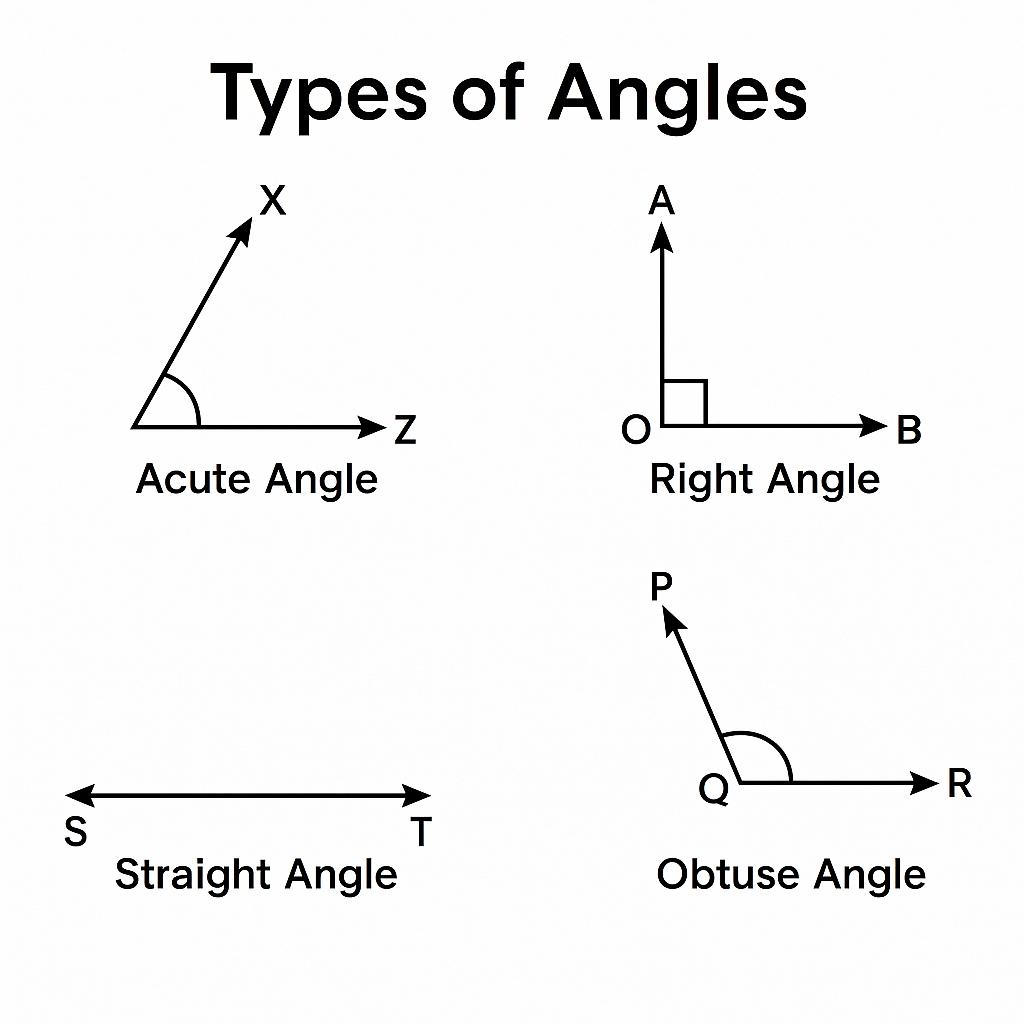
Angles are classified by their measure in degrees. Recognizing angle types quickly helps you classify triangles and solve many geometry problems.
- Right angle: exactly ; marked in diagrams with a small square.
- Acute angle: greater than and less than .
- Obtuse angle: greater than and less than .
- Straight angle: exactly ; forms a straight line.
Solving problems with angles in triangles
The interior angles of any triangle always add up to :
This lets you set up an equation and use algebra to find missing angles, including angles written in terms of variables.
Example: Solve missing angles in a triangle
Triangle is isosceles with base angles and . The measure of angle is . Find the measure of angle .
Because the triangle is isosceles, the base angles are equal:
Use the triangle angle sum:
Subtract from both sides:
Divide by :
Answer:
Example: Solve for the angles and classify the triangle
A triangle has angles , , and . Find the angle measures and classify the triangle.
Set up the equation using the angle sum:
Substitute back:
The triangle contains a angle.
Answer: Right triangle
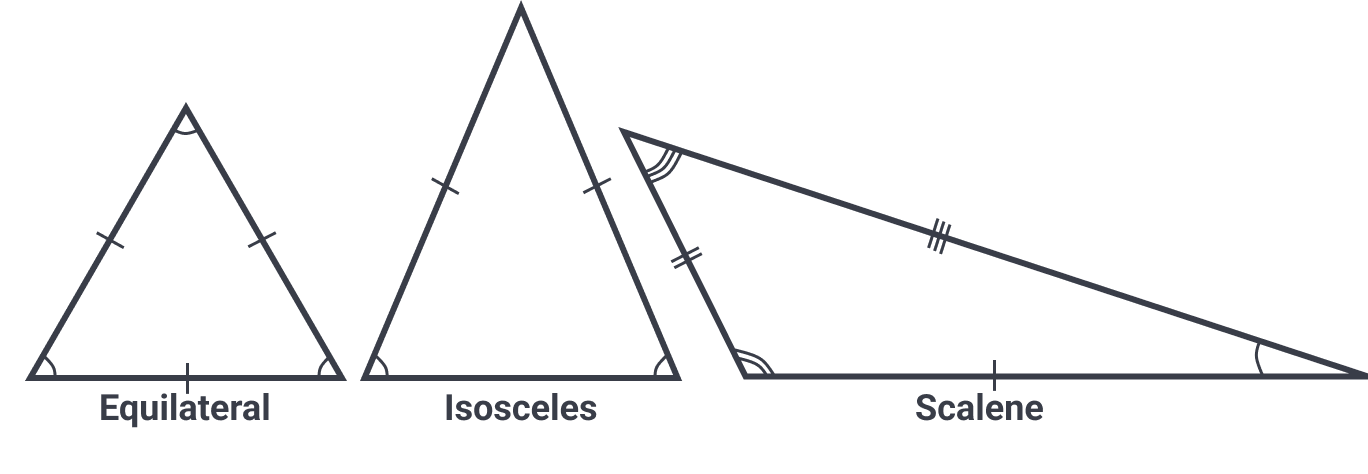
Triangles can be classified using either their side lengths or their angle measures. In many problems, you’ll first solve for unknown angles and then use those measures to classify the triangle.
When triangles are given by coordinates, you typically classify them using distances (for side lengths) and slopes (for right angles), rather than measuring angles directly.
To classify a triangle with vertices , , and :
-
Compute side lengths using the distance formula:
-
Compare lengths:
- All three equal equilateral
- Exactly two equal isosceles
- All different scalene
-
Check for a right angle using the converse of the Pythagorean theorem:
where is the longest side.
Example: Classify a triangle with sides , , and
Assign , , (longest side).
Compare with :
Since , the triangle is acute.
Answer: Acute triangle
Finding plausible third sides of triangles
For any triangle with sides of lengths , , and , all three of the following conditions must hold:
These are the triangle inequalities. They guarantee that the sum of any two sides is greater than the remaining side.
Example: If two sides of a triangle measure and , what are the possible lengths of the third side?
- Let the third side be .
- Apply the triangle inequalities:
- (always true for )
- Combine the valid bounds.
Answer:
Classifying quadrilaterals
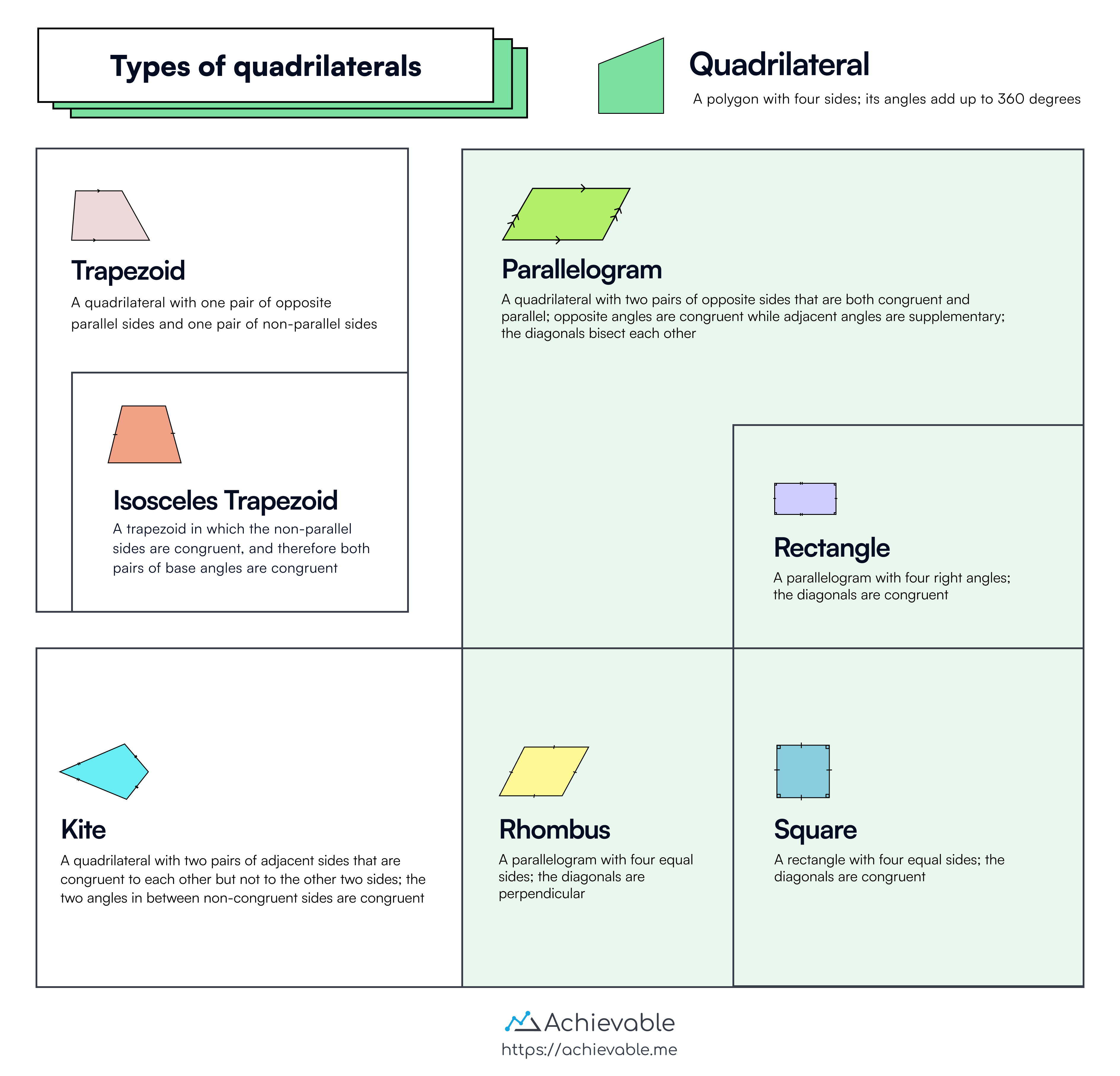
Every rectangle, rhombus, and square is also a parallelogram, so each has every parallelogram property in the table as well as its own. A rectangle’s diagonals, for example, bisect each other and are equal in length, but they are perpendicular only when the rectangle is a square.
On the coordinate plane, you can classify polygons using distances and slopes:
- Distances let you compare side lengths.
- Slopes help you identify parallel and perpendicular sides.
For any two points and :
Equal slopes indicate parallel sides; slopes with a product of indicate perpendicular sides. A quick reference for common shapes:
- Parallelogram: opposite sides parallel (, ) and equal in length.
- Rectangle: parallelogram with perpendicular adjacent sides ().
- Rhombus: parallelogram with all four sides equal.
- Square: both rectangle and rhombus conditions hold.
- Isosceles trapezoid: exactly one pair of parallel sides, with non-parallel sides equal in length.
- Kite: two pairs of consecutive equal sides, no pair of opposite sides equal.
Example: Classifying a quadrilateral
A quadrilateral has opposite sides parallel and equal in length. All of its angles are , but not all sides are equal. What type of quadrilateral is it?
- Opposite sides parallel and equal imply a parallelogram or rectangle.
- All angles are , consistent with a rectangle or square.
- Not all sides are equal, which eliminates square.
Answer: Rectangle
Special quadrilateral Venn diagram
The diagram below shows how special quadrilaterals nest inside broader categories - for example, every square is both a rectangle and a rhombus, and every rectangle is a parallelogram.