


Achievable logoAchievable logo
Praxis Core: Math (5733)
Sign in
Sign up
Purchase
Textbook
Practice exams
Support
How it works
Exam catalog
Mountain with a flag at the peak
Textbook
Introduction
1. Number and quantity
2. Data analysis, statistics, and probability
3. Algebra and geometry
3.1 Manipulating algebraic expressions and equations
3.2 Solving equations and inequalities
3.3 Functions, graphs, and set relationships
3.4 Basic geometric properties and shapes
3.5 Understanding angles, congruence, and similarity
3.6 Circles, shapes, and solids: Understanding measurement in geometry
Wrapping up
Achievable logoAchievable logo
3.3 Functions, graphs, and set relationships
Achievable Praxis Core: Math (5733)
3. Algebra and geometry
Our Praxis Core: Math course is currently in development and is a work-in-progress.

Functions, graphs, and set relationships

12 min read
Font
Discuss
Share
Feedback

This section explains what functions are and how they relate to relations. You’ll learn how to evaluate and graph functions, how to determine domain and range, and how to read key features of a line such as slope and intercepts. We also cover common linear equation forms - slope-intercept, point-slope, and standard - and use the intercept method to graph equations in standard form. Finally, we use Venn diagrams to visualize relationships between sets, which helps connect the idea of relations to functions.

Definitions
Function
A rule that assigns exactly one output to each input in its domain.
Relation
Any collection of ordered pairs (x,y).
Domain
The set of all possible inputs x for which f(x) is defined.
Range
The set of all possible outputs f(x) can produce.
Function notation
Writing f(x) rather than y emphasizes that the output depends on the input x.
Linear function
A function of the form f(x)=mx+b whose graph is a line.
Slope-intercept form
y=mx+b, where m is the slope and b is the y-intercept.
Point-slope form
y−y1​=m(x−x1​), given a known point (x1​,y1​) and slope m.
Standard form
Ax+By=C, where A,B,C are constants.
Slope
The rate of change, m=ΔxΔy​. This is commonly taught as rise over run.
y-intercept
The point where the graph crosses the y-axis, at (0,b).
x-intercept
The point where the graph crosses the x-axis, found by setting y=0.

Defining functions

A relation is any collection of ordered pairs (x,y). Each ordered pair matches an input value x with an output value y.

A function is a relation that follows one key rule:

  • Each input x in the domain is paired with exactly one output y.

So, one input can’t produce two different outputs. However, different inputs can share the same output.

For example:

  • The pairs (1,2) and (2,2) can both belong to a function because the inputs are different.
  • The pairs (1,2) and (1,3) cannot belong to a function because the same input 1 is paired with two different outputs.

You’ll also see the rule stated this way:

No two ordered pairs in a function may have the same first coordinate but different second coordinates.

That’s what makes a function’s output well-defined for every allowed input.

Vertical-line test

The vertical-line test checks whether a graphed relation is a function.

  • Draw (or imagine) vertical lines through the graph.
  • If any vertical line intersects the graph more than once, the relation is not a function.
  • If every vertical line intersects at most once, the relation is a function.

A graph is a picture of a relation or function made by plotting points (x,y) on the xy-plane.

Function vertical line test
Non-function vertical line test
Sidenote
Why the vertical-line test works

When you graph a relation on the xy-plane, each ordered pair (x,y) becomes a point. For any fixed input x=c:

  • If the graph passes the vertical-line test (every line x=c intersects at most once), it is a function.
  • If any vertical line meets the graph more than once, it is not a function.

This matches the definition of a function: one input x must correspond to exactly one output y. If a vertical line hits the graph twice, that single x value is paired with two different y values.

Example: Determine if a relation is a function Given the ordered pairs (−2,1), (0,3), (1,4), (2,3)

  • List the inputs: −2,0,1,2.
  • Confirm no input repeats.

Answer: Function

Example: Determine if a relation is a function

(spoiler)

Given the ordered pairs (1,2), (1,3), (2,4)

  • The input 1 appears twice with different outputs.
  • Fails the vertical-line test.

Answer: Not a function

Evaluating functions

Evaluating a function means finding the output for a specific input. The notation f(a) means “the value of the function when x=a.”

The main skill is substitution:

  • Replace every x in the formula with the given input value.
  • Use parentheses around the substituted value.
  • Simplify using the order of operations.

Parentheses matter most when the input is negative or when the expression includes exponents or fractions.

Example: Evaluate a quadratic function Let f(x)=2x2−3x+5. Find f(2).

  • Substitute: f(2)=2(2)2−3(2)+5.
  • Compute: 2⋅4−6+5=8−6+5=7.

Answer: 7

Example: Evaluate a rational function Let g(x)=x+2x−1​. Find g(−1).

(spoiler)

Substitute x=−1 and use parentheses:

g(−1)=−1+2−1−1​=1−2​=−2

Answer: −2

Domain and range

The domain of a function is the set of all input values x for which the function is defined. In practice, you look for inputs that make the expression invalid and exclude them.

Common restrictions include:

  • Division by zero: denominators cannot equal 0.
  • Even roots (such as square roots): the expression inside the root must be greater than or equal to 0.

The range is the set of all possible output values f(x) produced by inputs in the domain. On the Praxis exam, range questions are typically limited to cases you can read from the form or the graph.

Example: Find the domain

>h(x)=x−43​

  • The denominator x−4 cannot equal 0.
  • Solve x−4=0⇒x=4.
  • Exclude this value from the domain.

Answer: x=4

Example: Find the domain

>k(x)=x+5​

(spoiler)

The expression under the square root must be nonnegative:

x+5≥0

Solve the inequality:

x≥−5

This means all inputs greater than or equal to −5 are allowed.

Answer: [−5,∞)

Sidenote
Praxis does not test on finding the range of complex functions

For linear functions and polynomial functions of any odd degree, the range is always

(−∞,∞).

For quadratic functions, the range depends on the vertex:

  • If the parabola opens upward, the vertex gives the minimum value.
  • If it opens downward, the vertex gives the maximum value.

From the vertex, the graph extends infinitely in the opposite direction.

Graphing linear functions

Graphing a linear function shows all solutions to the equation. Each point on the graph is an ordered pair (x,y) that satisfies the equation, and all of those points lie on a straight line.

Because a linear function has a constant rate of change, its graph extends infinitely in both directions unless the problem states a restriction.

The method you use depends on the form of the equation:

  • Some forms make slope and intercepts easy to read.
  • Other forms are more convenient when you’re given a point on the line.

On the Praxis exam, you may be asked to:

  • Graph a line given its equation.
  • Identify slope or intercepts from a graph.
  • Choose the correct graph that matches a given equation.

Being able to move between equations, tables, and graphs makes these questions much faster.

Slope-intercept form

For f(x)=mx+b:

  1. Plot the y-intercept (0,b).
  2. Use slope m=ΔxΔy​ to find a second point.
  3. Draw the line through both points.

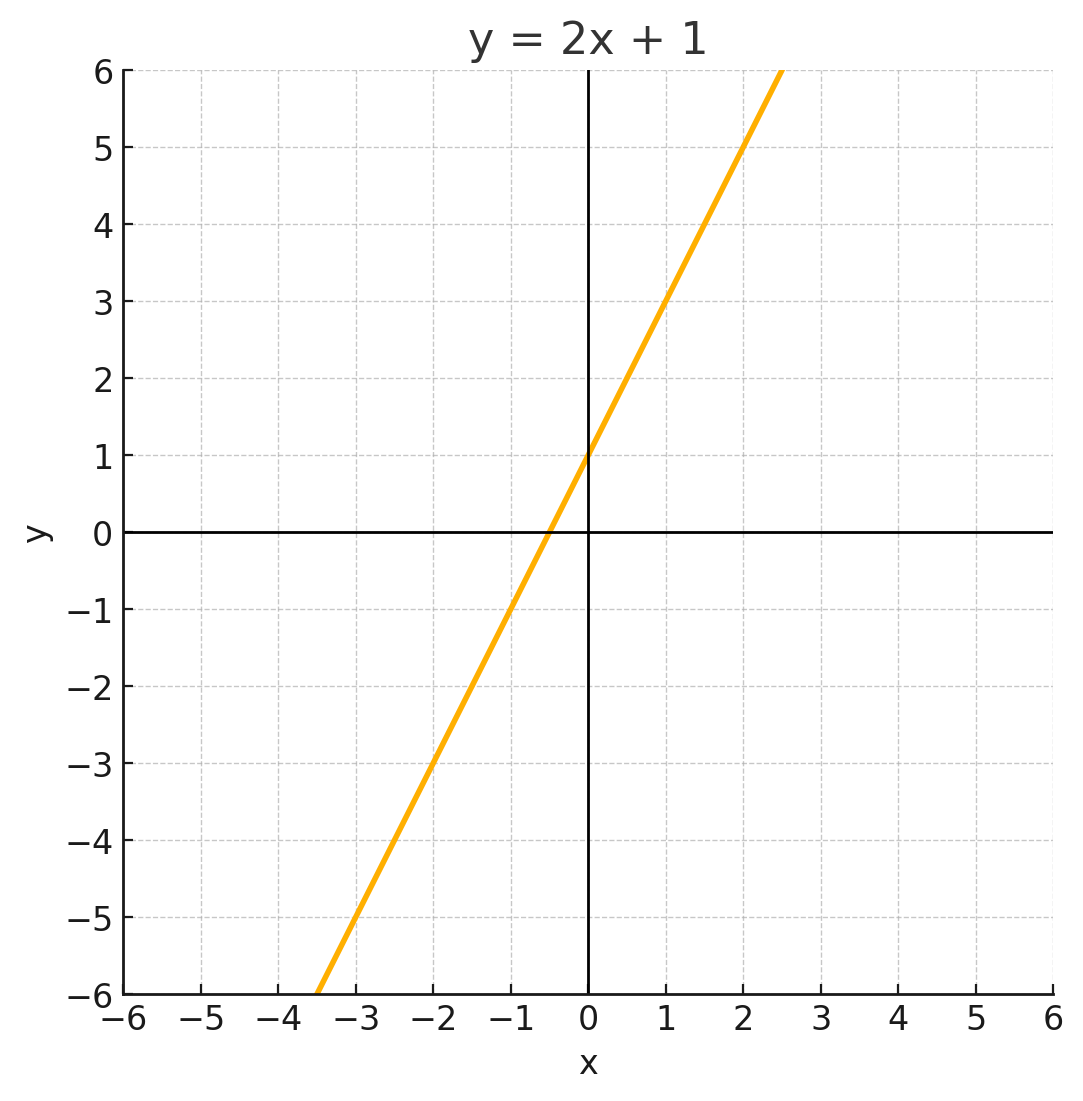
Example: Graph y=2x+1

  • y-intercept: (0,1).
  • Slope 2=12​, so from (0,1) go right 1 and up 2 to (1,3).
    Linear function slope of two
    Linear function slope of two

Answer: See graph

Example: Graph y=−21​x+3

(spoiler)
  • y-intercept: (0,3).
  • Slope −21​, so from (0,3) go right 2 and down 1 to (2,2).
    Linear function with negative slope
    Linear function with negative slope

Answer: See graph

Point-slope form

Point-slope form is useful when you know a slope and a point on the line that isn’t necessarily an intercept.

The form

y−y1​=m(x−x1​)

builds the line around the point (x1​,y1​). If you substitute x=x1​, the right side becomes 0, so the equation forces y=y1​. That’s why the given point always lies on the line.

When you know (x1​,y1​) and slope m:

  1. Write y−y1​=m(x−x1​).
  2. Use the slope to plot additional points, or rearrange into slope-intercept form if needed.

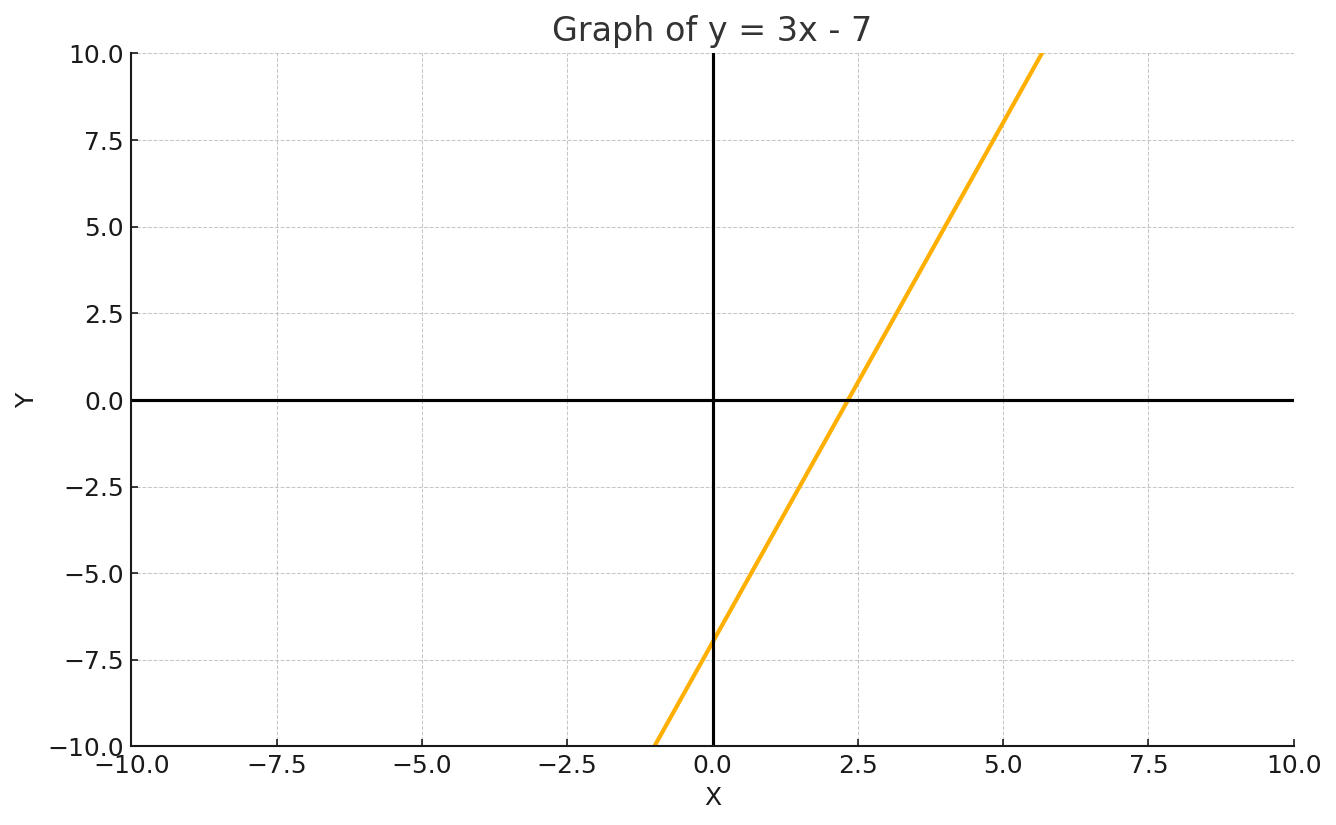
Example: Graph using point-slope form Graph slope 3 through (2,−1).

  • Start with the point-slope formula and substitute the given values: y−(−1)=3(x−2).
  • Simplify the equation: y+1=3x−6, so y=3x−7.
  • Plot the given point (2,−1).
  • Use the slope 3=13​ to move right 1 and up 3 to (3,2).
    Linear function with slope of three
    Linear function with slope of three

Answer: See graph

Standard form and intercept method

Standard form,

Ax+By=C,

often appears when the equation isn’t written to show slope or intercepts right away. In this form, the intercept method is a quick way to graph without rearranging.

The idea is to find where the line crosses each axis:

  • The x-intercept occurs where the graph crosses the x-axis, which happens when y=0.
  • The y-intercept occurs where the graph crosses the y-axis, which happens when x=0.

Once you have both intercepts, plot them and draw the line through the two points.

Example: Find the intercepts of 2x+3y=6

  • Set y=0 to find the x-intercept: 2x=6⇒x=3, so (3,0).
  • Set x=0 to find the y-intercept: 3y=6⇒y=2, so (0,2).

Answer: (3,0) and (0,2)

Example: Find the intercepts of 4x−y=8

(spoiler)
  • Set y=0 to find the x-intercept: 4x=8⇒x=2, so (2,0).
  • Set x=0 to find the y-intercept: −y=8⇒y=−8, so (0,−8).

Answer: (2,0) and (0,−8)

Interpreting graphs: slope and intercepts

Once a line is graphed, you can read key features directly from the picture.

From a plotted line:

  • Slope represents the rate of change and is calculated as rise over run between two clear points.
  • The y-intercept is the point where the line crosses the y-axis, which occurs when x=0.
  • The x-intercept is the point where the line crosses the x-axis, which occurs when y=0.

Example: Read from a graph

Positive slope between two points
Line passes through (0,2) and (3,5).

  • Slope: m=3−05−2​=33​=1.
  • y-intercept: (0,2).
  • x-intercept: 0=1⋅x+2⇒x=−2, so (−2,0).

Answer: Slope 1, y-intercept (0,2), x-intercept (−2,0)

Example: Read from a graph

Negative slope between two points
(spoiler)
  • Line passes through (−1,4) and (2,1).
  • Slope: m=2−(−1)1−4​=3−3​=−1.
  • y-intercept: (0,3).
  • x-intercept: 0=−1⋅x+3⇒x=3, so (3,0).

Answer: Slope −1, y-intercept (0,3), x-intercept (3,0)

  • A function assigns exactly one output to each input; use the vertical-line test to verify.
  • To evaluate f(a), substitute x=a and simplify.
  • The domain excludes inputs that cause division by zero or invalid roots; the range is the set of possible outputs.
  • Choose a graph form:
    • Slope-intercept form y=mx+b: plot (0,b) and use slope m=ΔxΔy​.
    • Point-slope form y−y1​=m(x−x1​): use when a point (x1​,y1​) and slope m are known.
    • Standard form Ax+By=C: use intercepts (AC​,0) and (0,BC​).
  • Read intercepts by setting x=0 or y=0.
  • Plot at least two accurate points before drawing the line.

Sign up for free to take 6 quiz questions on this topic

All rights reserved ©2016 - 2026 Achievable, Inc.

Functions, graphs, and set relationships

This section explains what functions are and how they relate to relations. You’ll learn how to evaluate and graph functions, how to determine domain and range, and how to read key features of a line such as slope and intercepts. We also cover common linear equation forms - slope-intercept, point-slope, and standard - and use the intercept method to graph equations in standard form. Finally, we use Venn diagrams to visualize relationships between sets, which helps connect the idea of relations to functions.

Definitions
Function
A rule that assigns exactly one output to each input in its domain.
Relation
Any collection of ordered pairs (x,y).
Domain
The set of all possible inputs x for which f(x) is defined.
Range
The set of all possible outputs f(x) can produce.
Function notation
Writing f(x) rather than y emphasizes that the output depends on the input x.
Linear function
A function of the form f(x)=mx+b whose graph is a line.
Slope-intercept form
y=mx+b, where m is the slope and b is the y-intercept.
Point-slope form
y−y1​=m(x−x1​), given a known point (x1​,y1​) and slope m.
Standard form
Ax+By=C, where A,B,C are constants.
Slope
The rate of change, m=ΔxΔy​. This is commonly taught as rise over run.
y-intercept
The point where the graph crosses the y-axis, at (0,b).
x-intercept
The point where the graph crosses the x-axis, found by setting y=0.

Defining functions

A relation is any collection of ordered pairs (x,y). Each ordered pair matches an input value x with an output value y.

A function is a relation that follows one key rule:

  • Each input x in the domain is paired with exactly one output y.

So, one input can’t produce two different outputs. However, different inputs can share the same output.

For example:

  • The pairs (1,2) and (2,2) can both belong to a function because the inputs are different.
  • The pairs (1,2) and (1,3) cannot belong to a function because the same input 1 is paired with two different outputs.

You’ll also see the rule stated this way:

No two ordered pairs in a function may have the same first coordinate but different second coordinates.

That’s what makes a function’s output well-defined for every allowed input.

Vertical-line test

The vertical-line test checks whether a graphed relation is a function.

  • Draw (or imagine) vertical lines through the graph.
  • If any vertical line intersects the graph more than once, the relation is not a function.
  • If every vertical line intersects at most once, the relation is a function.

A graph is a picture of a relation or function made by plotting points (x,y) on the xy-plane.

Sidenote
Why the vertical-line test works

When you graph a relation on the xy-plane, each ordered pair (x,y) becomes a point. For any fixed input x=c:

  • If the graph passes the vertical-line test (every line x=c intersects at most once), it is a function.
  • If any vertical line meets the graph more than once, it is not a function.

This matches the definition of a function: one input x must correspond to exactly one output y. If a vertical line hits the graph twice, that single x value is paired with two different y values.

Example: Determine if a relation is a function Given the ordered pairs (−2,1), (0,3), (1,4), (2,3)

  • List the inputs: −2,0,1,2.
  • Confirm no input repeats.

Answer: Function

Example: Determine if a relation is a function

(spoiler)

Given the ordered pairs (1,2), (1,3), (2,4)

  • The input 1 appears twice with different outputs.
  • Fails the vertical-line test.

Answer: Not a function

Evaluating functions

Evaluating a function means finding the output for a specific input. The notation f(a) means “the value of the function when x=a.”

The main skill is substitution:

  • Replace every x in the formula with the given input value.
  • Use parentheses around the substituted value.
  • Simplify using the order of operations.

Parentheses matter most when the input is negative or when the expression includes exponents or fractions.

Example: Evaluate a quadratic function Let f(x)=2x2−3x+5. Find f(2).

  • Substitute: f(2)=2(2)2−3(2)+5.
  • Compute: 2⋅4−6+5=8−6+5=7.

Answer: 7

Example: Evaluate a rational function Let g(x)=x+2x−1​. Find g(−1).

(spoiler)

Substitute x=−1 and use parentheses:

g(−1)=−1+2−1−1​=1−2​=−2

Answer: −2

Domain and range

The domain of a function is the set of all input values x for which the function is defined. In practice, you look for inputs that make the expression invalid and exclude them.

Common restrictions include:

  • Division by zero: denominators cannot equal 0.
  • Even roots (such as square roots): the expression inside the root must be greater than or equal to 0.

The range is the set of all possible output values f(x) produced by inputs in the domain. On the Praxis exam, range questions are typically limited to cases you can read from the form or the graph.

Example: Find the domain

>h(x)=x−43​

  • The denominator x−4 cannot equal 0.
  • Solve x−4=0⇒x=4.
  • Exclude this value from the domain.

Answer: x=4

Example: Find the domain

>k(x)=x+5​

(spoiler)

The expression under the square root must be nonnegative:

x+5≥0

Solve the inequality:

x≥−5

This means all inputs greater than or equal to −5 are allowed.

Answer: [−5,∞)

Sidenote
Praxis does not test on finding the range of complex functions

For linear functions and polynomial functions of any odd degree, the range is always

(−∞,∞).

For quadratic functions, the range depends on the vertex:

  • If the parabola opens upward, the vertex gives the minimum value.
  • If it opens downward, the vertex gives the maximum value.

From the vertex, the graph extends infinitely in the opposite direction.

Graphing linear functions

Graphing a linear function shows all solutions to the equation. Each point on the graph is an ordered pair (x,y) that satisfies the equation, and all of those points lie on a straight line.

Because a linear function has a constant rate of change, its graph extends infinitely in both directions unless the problem states a restriction.

The method you use depends on the form of the equation:

  • Some forms make slope and intercepts easy to read.
  • Other forms are more convenient when you’re given a point on the line.

On the Praxis exam, you may be asked to:

  • Graph a line given its equation.
  • Identify slope or intercepts from a graph.
  • Choose the correct graph that matches a given equation.

Being able to move between equations, tables, and graphs makes these questions much faster.

Slope-intercept form

For f(x)=mx+b:

  1. Plot the y-intercept (0,b).
  2. Use slope m=ΔxΔy​ to find a second point.
  3. Draw the line through both points.

Example: Graph y=2x+1

  • y-intercept: (0,1).
  • Slope 2=12​, so from (0,1) go right 1 and up 2 to (1,3).

Answer: See graph

Example: Graph y=−21​x+3

(spoiler)
  • y-intercept: (0,3).
  • Slope −21​, so from (0,3) go right 2 and down 1 to (2,2).

Answer: See graph

Point-slope form

Point-slope form is useful when you know a slope and a point on the line that isn’t necessarily an intercept.

The form

y−y1​=m(x−x1​)

builds the line around the point (x1​,y1​). If you substitute x=x1​, the right side becomes 0, so the equation forces y=y1​. That’s why the given point always lies on the line.

When you know (x1​,y1​) and slope m:

  1. Write y−y1​=m(x−x1​).
  2. Use the slope to plot additional points, or rearrange into slope-intercept form if needed.

Example: Graph using point-slope form Graph slope 3 through (2,−1).

  • Start with the point-slope formula and substitute the given values: y−(−1)=3(x−2).
  • Simplify the equation: y+1=3x−6, so y=3x−7.
  • Plot the given point (2,−1).
  • Use the slope 3=13​ to move right 1 and up 3 to (3,2).

Answer: See graph

Standard form and intercept method

Standard form,

Ax+By=C,

often appears when the equation isn’t written to show slope or intercepts right away. In this form, the intercept method is a quick way to graph without rearranging.

The idea is to find where the line crosses each axis:

  • The x-intercept occurs where the graph crosses the x-axis, which happens when y=0.
  • The y-intercept occurs where the graph crosses the y-axis, which happens when x=0.

Once you have both intercepts, plot them and draw the line through the two points.

Example: Find the intercepts of 2x+3y=6

  • Set y=0 to find the x-intercept: 2x=6⇒x=3, so (3,0).
  • Set x=0 to find the y-intercept: 3y=6⇒y=2, so (0,2).

Answer: (3,0) and (0,2)

Example: Find the intercepts of 4x−y=8

(spoiler)
  • Set y=0 to find the x-intercept: 4x=8⇒x=2, so (2,0).
  • Set x=0 to find the y-intercept: −y=8⇒y=−8, so (0,−8).

Answer: (2,0) and (0,−8)

Interpreting graphs: slope and intercepts

Once a line is graphed, you can read key features directly from the picture.

From a plotted line:

  • Slope represents the rate of change and is calculated as rise over run between two clear points.
  • The y-intercept is the point where the line crosses the y-axis, which occurs when x=0.
  • The x-intercept is the point where the line crosses the x-axis, which occurs when y=0.

Example: Read from a graph Line passes through (0,2) and (3,5).

  • Slope: m=3−05−2​=33​=1.
  • y-intercept: (0,2).
  • x-intercept: 0=1⋅x+2⇒x=−2, so (−2,0).

Answer: Slope 1, y-intercept (0,2), x-intercept (−2,0)

Example: Read from a graph

(spoiler)
  • Line passes through (−1,4) and (2,1).
  • Slope: m=2−(−1)1−4​=3−3​=−1.
  • y-intercept: (0,3).
  • x-intercept: 0=−1⋅x+3⇒x=3, so (3,0).

Answer: Slope −1, y-intercept (0,3), x-intercept (3,0)

Key points
  • A function assigns exactly one output to each input; use the vertical-line test to verify.
  • To evaluate f(a), substitute x=a and simplify.
  • The domain excludes inputs that cause division by zero or invalid roots; the range is the set of possible outputs.
  • Choose a graph form:
    • Slope-intercept form y=mx+b: plot (0,b) and use slope m=ΔxΔy​.
    • Point-slope form y−y1​=m(x−x1​): use when a point (x1​,y1​) and slope m are known.
    • Standard form Ax+By=C: use intercepts (AC​,0) and (0,BC​).
  • Read intercepts by setting x=0 or y=0.
  • Plot at least two accurate points before drawing the line.