


Achievable logoAchievable logo
Praxis Core: Math (5733)
Sign in
Sign up
Purchase
Textbook
Practice exams
Support
How it works
Exam catalog
Mountain with a flag at the peak
Textbook
Introduction
1. Number and quantity
2. Data analysis, statistics, and probability
3. Algebra and geometry
3.1 Manipulating algebraic expressions and equations
3.2 Solving equations and inequalities
3.3 Functions, graphs, and set relationships
3.4 Basic geometric properties and shapes
3.5 Understanding angles, congruence, and similarity
3.6 Circles, shapes, and solids: Understanding measurement in geometry
Wrapping up
Achievable logoAchievable logo
3.6 Circles, shapes, and solids: Understanding measurement in geometry
Achievable Praxis Core: Math (5733)
3. Algebra and geometry
Our Praxis Core: Math course is currently in development and is a work-in-progress.

Circles, shapes, and solids: Understanding measurement in geometry

13 min read
Font
Discuss
Share
Feedback

In this section, you’ll use formulas for the perimeter, area, and volume of common geometric shapes - such as triangles, rectangles, circles, and rectangular prisms - as well as three-dimensional solids like cylinders, cones, and spheres. You’ll also work with key circle ideas such as radius, diameter, arc length, sectors, tangents, and inscribed angles, and use them to solve real-world problems involving distance, space, and measurement.

A major goal here is to understand not only how to use each formula, but also why it works and how to choose the right one for a given situation.

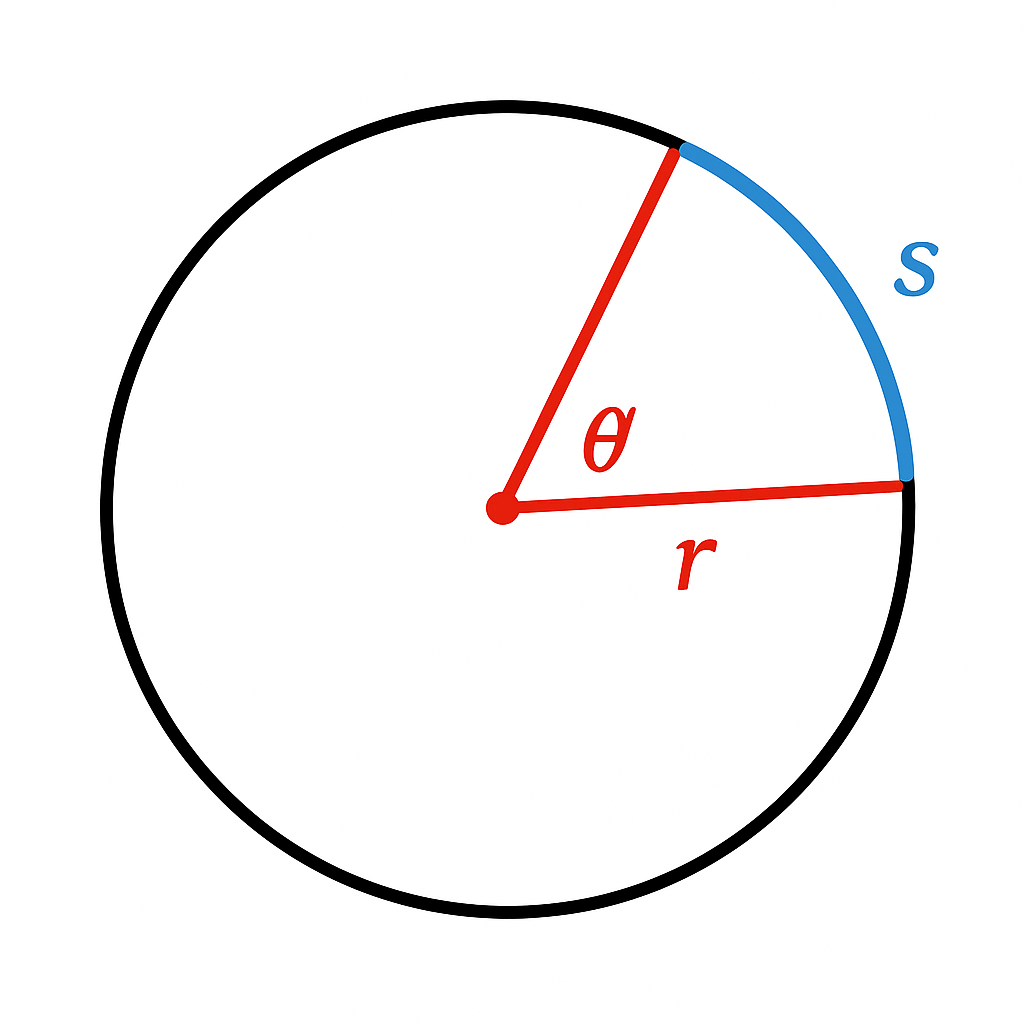
Note: s= arc length, h= height, r= radius, b= base, d= diameter, l= length, w= width.

Definitions
Radius
Distance from the center of a circle to its edge.
Diameter
A line through the center of a circle; twice the radius (d=2r).
Circumference of a circle
The perimeter of a circle (C=2πr=πd).
Area of a circle
The space enclosed by a circle (A=πr2).
Perimeter
The total distance around a polygon.
Area of a rectangle
A=l×w
Perimeter of a rectangle
P=2(l+w)
Perimeter of a triangle
P=a+b+c
Area of a triangle
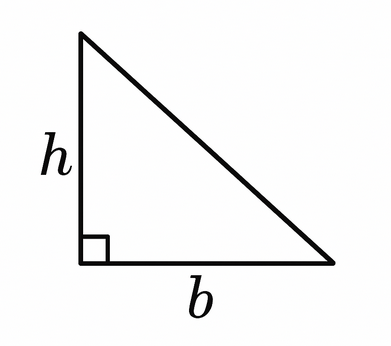
A=21​bh
Volume of a rectangular prism
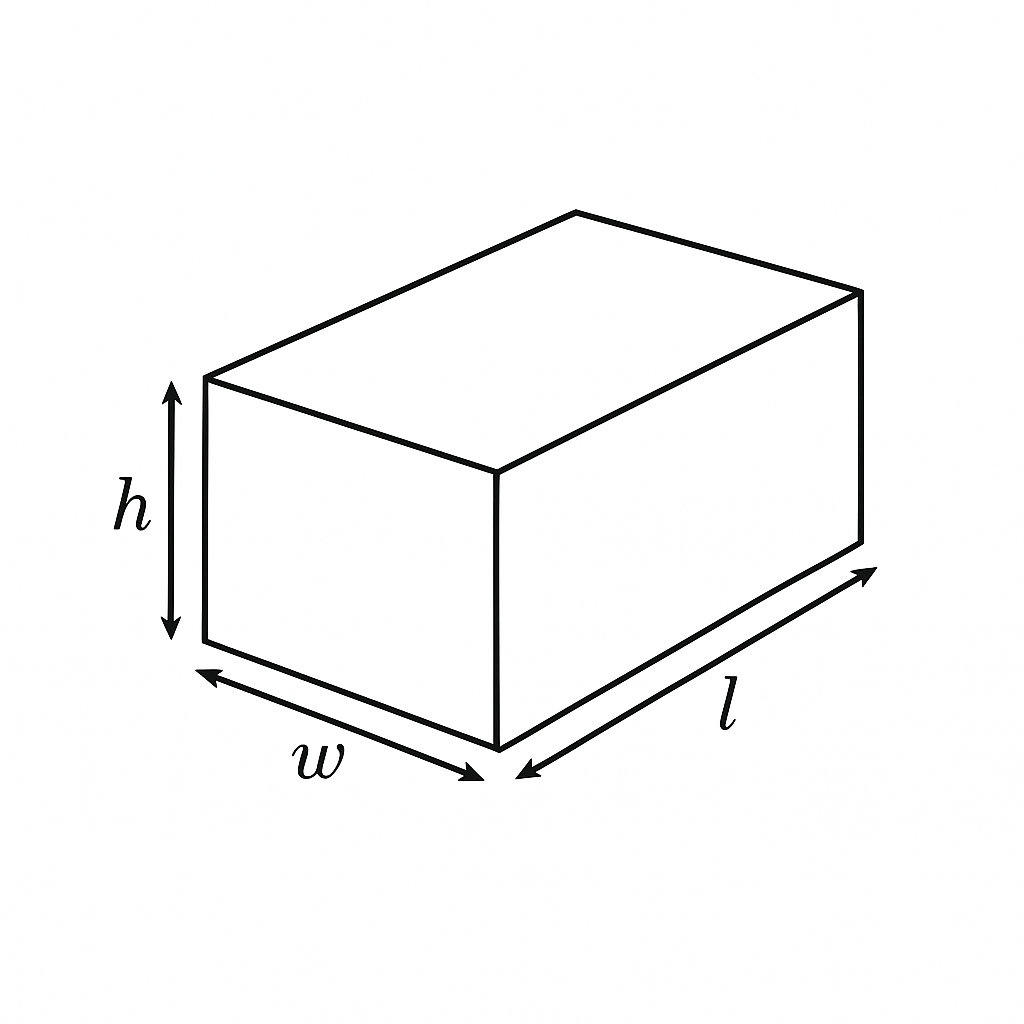
V=lwh
Volume of a cylinder
V=πr2h
Volume of a cone
V=31​πr2h
Volume of a sphere
V=34​πr3
Sector of a circle
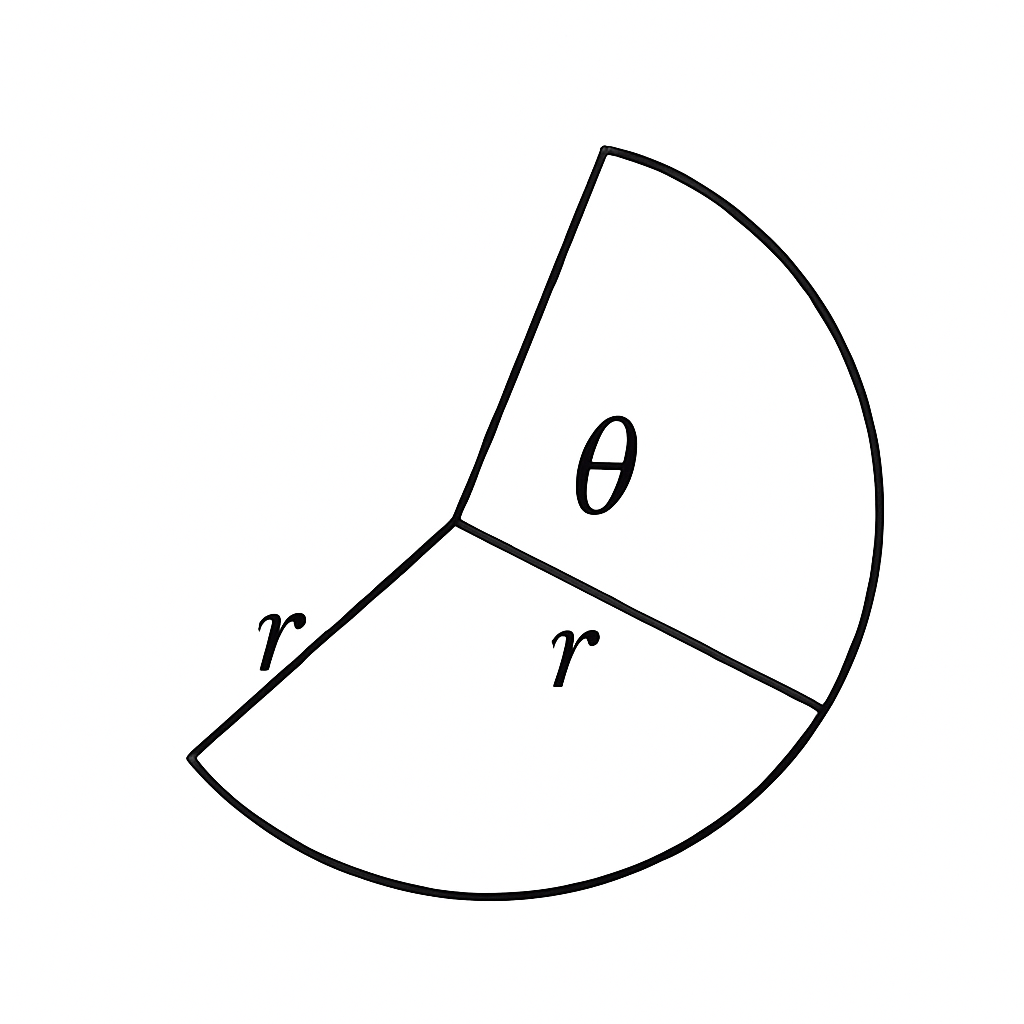
A slice of a circle defined by a central angle θ. Area: A=360∘θ​⋅πr2; Arc length: s=360∘θ​⋅2πr.

Circles: area and circumference

A circle is a two-dimensional shape where every point on the edge is the same distance from the center. That constant distance is the radius. The circumference is the distance around the circle (the circle’s perimeter), and the area is the amount of space inside the circle.

Most circle problems come down to moving between radius, diameter, circumference, and area.

Generic circle
Generic circle

Strategy tip: Use d=2r to switch between radius and diameter, depending on what the problem gives you.

Example: Circle calculations A circle has a radius of 6 cm. Find its area and circumference.

  • Circumference: C=2πr=2π⋅6=12π≈37.70 cm
  • Area: A=πr2=π⋅36=36π≈113.10 cm2 Answer: C≈37.70 cm, A≈113.10 cm2

Example: Circumference from diameter A circle has diameter 14 m. What is its circumference?

(spoiler)

Use C=πd=π⋅14=14π≈43.98 m Answer: 43.98 m

Rectangles and triangles: perimeter and area

Rectangles and triangles are the standard starting point for perimeter and area.

  • Perimeter is the total distance around a polygon. You find it by adding the side lengths. This often models fencing, framing, or outlining a region.
  • Area measures how much flat (two-dimensional) space a shape covers. This comes up in tiling, painting, and covering surfaces. Area is measured in square units, while perimeter is measured in linear units.

Rectangles are especially direct: their right angles make the area simply length times width. For triangles, the area formula is always one-half the product of a base and its perpendicular height. The main challenge is identifying the correct height.

These ideas show up again later in composite figures, coordinate geometry, and surface area.

Generic rectangle
Generic rectangle
Generic triangle
Generic triangle
Sidenote
Area of triangles

For triangle area, the height must be perpendicular to the base. The height is not always a side of the triangle. In many triangles, especially obtuse or scalene triangles, the height may fall inside the triangle, outside the triangle, or may need to be drawn as an extension of a side. The base can be any side of the triangle, but once a base is chosen, the height must form a right angle with that base.

When reading diagrams, don’t assume that a slanted side represents the height unless it is clearly perpendicular to the base. Look for right-angle markings, dashed altitude lines, or directions in the problem statement. If no height is drawn, you may need to sketch it yourself before applying the area formula. Identifying the correct height ensures the formula A=21​bh is applied correctly and helps avoid common mistakes on geometry problems.

Example: Rectangle calculations A rectangle has length 9 ft and width 5 ft.

  • Area: A=9⋅5=45 ft2
  • Perimeter: P=2(9+5)=28 ft Answer: A=45 ft2,P=28 ft

Example: Triangle perimeter A triangle has sides 3 cm, 4 cm, and 5 cm. Find the perimeter.

(spoiler)

P=3+4+5=12 cm Answer: 12 cm

Volume measures how much three-dimensional space an object occupies, so it applies only to solid figures. You can think of volume as capacity (how much something can hold) or as the amount of material needed to fill a shape.

Each volume formula matches the structure of the solid:

  • A rectangular prism stacks rectangular layers, so you multiply length, width, and height.
  • A cylinder stacks circular layers, so you use (area of a circle) × height.
  • A cone tapers to a point, so it has one-third the volume of a cylinder with the same base and height.
  • A sphere grows equally in all directions, so its volume depends on the cube of the radius.

When working with volume, keep these checks in mind:

  • Make sure units are consistent.

  • Don’t mix up radius and diameter.

  • Height is measured perpendicular to the base.

  • Rectangular prism: V=lwh

  • Cylinder: V=πr2h

  • Cone: V=31​πr2h

  • Sphere: V=34​πr3

Rectangular prism
Rectangular prism
Cylinder
Cylinder
Cone
Cone
Sphere
Sphere

Example: Volume of a cylinder A cylinder has radius 4 in and height 10 in.

  • V=πr2h=π⋅16⋅10=160π≈502.65 in3 Answer: 502.65 in3

Example: Volume of a prism A rectangular prism is 7 m long, 2 m wide, and 3 m tall.

(spoiler)

V=7⋅2⋅3=42 m3 Answer: 42 m3

Sectors and arcs

A sector is a portion of a circle defined by a central angle measured at the center of the circle. You can picture it as a “slice” of the circle. The size of the slice depends on how large the central angle is compared to a full 360∘ turn.

Two common measurements come from a sector:

  • Arc length: the curved distance along the outside edge of the sector
  • Sector area: the area inside that slice

Both rely on the same idea: the central angle tells you what fraction of the whole circle you’re using. The fraction is 360∘θ​. Apply that fraction to:

  • the full circumference to get arc length
  • the full circle area to get sector area

This is why sector and arc problems are really extensions of the circle formulas you already know.

Generic circle sector
Arc length
Arc length

Example: Sector calculations A sector has radius 6 cm and angle 60∘.

  • Sector area: A=36060​⋅π⋅36=6π≈18.85 cm2
  • Arc length: s=36060​⋅2π⋅6=2π≈6.28 cm Answer: Area ≈18.85 cm2, Arc ≈6.28 cm

Example: Arc length Find the arc length of a circle with r=5 cm and θ=90∘.

(spoiler)

s=36090​⋅2π⋅5=2.5π≈7.85 cm Answer: 7.85 cm

Tangents and inscribed angles

Tangents and inscribed angles describe two reliable angle relationships in circle diagrams.

A tangent is a line that touches a circle at exactly one point (the point of tangency). The key fact to use is:

  • A tangent line is perpendicular to the radius drawn to the point of tangency.

An inscribed angle is formed when two chords meet at a point on the circle. The angle intercepts an arc. The key relationship is:

  • An inscribed angle equals one-half the measure of the central angle that intercepts the same arc.

Example: Tangent angle A radius is drawn to a point of tangency. What angle does it make with the tangent? Answer: 90∘

Example: Inscribed angle A central angle measures 120∘. What is the inscribed angle?

(spoiler)

2120∘​=60∘ Answer: 60∘

Classifying 2-D and 3-D shapes

Before you choose a formula, identify whether the figure is two-dimensional or three-dimensional.

  • Two-dimensional (2-D) shapes lie in a plane. You use perimeter and area.
  • Three-dimensional (3-D) shapes extend into space. You use volume (and often surface area).

A quick check is thickness:

  • 2-D shapes are flat (no depth).
  • 3-D shapes have depth and occupy space.

For 2-D shapes, we focus on measurements around and across the shape:

  • Perimeter measures the distance around the outside of the shape.
  • Area measures how much flat space the shape covers.
2-d shape Properties
Square 4 equal sides, 4 right angles
Triangle 3 sides, interior angle sum 180∘
Circle Curved boundary, no sides or vertices

For 3-D shapes, we focus on measurements that describe space:

  • Volume measures how much space the object occupies.
  • Surface area measures the total area of all outer faces or surfaces.
3-d shape Properties
Cube 6 equal square faces
Rectangular prism 6 rectangular faces
Cylinder 2 circular bases and one curved surface
Sphere Perfectly round, no faces, edges, or vertices

Correct classification helps you avoid common mix-ups, like trying to find the volume of a flat figure or the perimeter of a solid.

Real-life geometry examples

Geometry formulas show up in practical situations involving measurement, construction, design, and planning.

Example: Sandbox volume A sandbox is 10 ft by 6 ft and filled to 1 ft deep.

  • Volume =10⋅6⋅1=60 ft3 Answer: 60 ft3

Example: Garden area A garden is circular with radius 3 m. What is the area?

(spoiler)

A=πr2=9π≈28.27 m2 Answer: 28.27 m2

  • Use correct formulas for perimeter, area, and volume based on the shape.
  • Convert between radius and diameter when working with circles.
  • Sector and arc problems use a fraction of 360∘.
  • Tangents form right angles with radii; inscribed angles are half central angles.
  • Distinguish between 2-D and 3-D shapes to choose the correct measurements.
  • Reverse problems require solving formulas algebraically for unknown values.

Sign up for free to take 5 quiz questions on this topic

All rights reserved ©2016 - 2026 Achievable, Inc.

Circles, shapes, and solids: Understanding measurement in geometry

In this section, you’ll use formulas for the perimeter, area, and volume of common geometric shapes - such as triangles, rectangles, circles, and rectangular prisms - as well as three-dimensional solids like cylinders, cones, and spheres. You’ll also work with key circle ideas such as radius, diameter, arc length, sectors, tangents, and inscribed angles, and use them to solve real-world problems involving distance, space, and measurement.

A major goal here is to understand not only how to use each formula, but also why it works and how to choose the right one for a given situation.

Note: s= arc length, h= height, r= radius, b= base, d= diameter, l= length, w= width.

Definitions
Radius
Distance from the center of a circle to its edge.
Diameter
A line through the center of a circle; twice the radius (d=2r).
Circumference of a circle
The perimeter of a circle (C=2πr=πd).
Area of a circle
The space enclosed by a circle (A=πr2).
Perimeter
The total distance around a polygon.
Area of a rectangle
A=l×w
Perimeter of a rectangle
P=2(l+w)
Perimeter of a triangle
P=a+b+c
Area of a triangle
A=21​bh
Volume of a rectangular prism
V=lwh
Volume of a cylinder
V=πr2h
Volume of a cone
V=31​πr2h
Volume of a sphere
V=34​πr3
Sector of a circle
A slice of a circle defined by a central angle θ. Area: A=360∘θ​⋅πr2; Arc length: s=360∘θ​⋅2πr.

Circles: area and circumference

A circle is a two-dimensional shape where every point on the edge is the same distance from the center. That constant distance is the radius. The circumference is the distance around the circle (the circle’s perimeter), and the area is the amount of space inside the circle.

Most circle problems come down to moving between radius, diameter, circumference, and area.

Strategy tip: Use d=2r to switch between radius and diameter, depending on what the problem gives you.

Example: Circle calculations A circle has a radius of 6 cm. Find its area and circumference.

  • Circumference: C=2πr=2π⋅6=12π≈37.70 cm
  • Area: A=πr2=π⋅36=36π≈113.10 cm2 Answer: C≈37.70 cm, A≈113.10 cm2

Example: Circumference from diameter A circle has diameter 14 m. What is its circumference?

(spoiler)

Use C=πd=π⋅14=14π≈43.98 m Answer: 43.98 m

Rectangles and triangles: perimeter and area

Rectangles and triangles are the standard starting point for perimeter and area.

  • Perimeter is the total distance around a polygon. You find it by adding the side lengths. This often models fencing, framing, or outlining a region.
  • Area measures how much flat (two-dimensional) space a shape covers. This comes up in tiling, painting, and covering surfaces. Area is measured in square units, while perimeter is measured in linear units.

Rectangles are especially direct: their right angles make the area simply length times width. For triangles, the area formula is always one-half the product of a base and its perpendicular height. The main challenge is identifying the correct height.

These ideas show up again later in composite figures, coordinate geometry, and surface area.

Sidenote
Area of triangles

For triangle area, the height must be perpendicular to the base. The height is not always a side of the triangle. In many triangles, especially obtuse or scalene triangles, the height may fall inside the triangle, outside the triangle, or may need to be drawn as an extension of a side. The base can be any side of the triangle, but once a base is chosen, the height must form a right angle with that base.

When reading diagrams, don’t assume that a slanted side represents the height unless it is clearly perpendicular to the base. Look for right-angle markings, dashed altitude lines, or directions in the problem statement. If no height is drawn, you may need to sketch it yourself before applying the area formula. Identifying the correct height ensures the formula A=21​bh is applied correctly and helps avoid common mistakes on geometry problems.

Example: Rectangle calculations A rectangle has length 9 ft and width 5 ft.

  • Area: A=9⋅5=45 ft2
  • Perimeter: P=2(9+5)=28 ft Answer: A=45 ft2,P=28 ft

Example: Triangle perimeter A triangle has sides 3 cm, 4 cm, and 5 cm. Find the perimeter.

(spoiler)

P=3+4+5=12 cm Answer: 12 cm

Volume measures how much three-dimensional space an object occupies, so it applies only to solid figures. You can think of volume as capacity (how much something can hold) or as the amount of material needed to fill a shape.

Each volume formula matches the structure of the solid:

  • A rectangular prism stacks rectangular layers, so you multiply length, width, and height.
  • A cylinder stacks circular layers, so you use (area of a circle) × height.
  • A cone tapers to a point, so it has one-third the volume of a cylinder with the same base and height.
  • A sphere grows equally in all directions, so its volume depends on the cube of the radius.

When working with volume, keep these checks in mind:

  • Make sure units are consistent.

  • Don’t mix up radius and diameter.

  • Height is measured perpendicular to the base.

  • Rectangular prism: V=lwh

  • Cylinder: V=πr2h

  • Cone: V=31​πr2h

  • Sphere: V=34​πr3

Example: Volume of a cylinder A cylinder has radius 4 in and height 10 in.

  • V=πr2h=π⋅16⋅10=160π≈502.65 in3 Answer: 502.65 in3

Example: Volume of a prism A rectangular prism is 7 m long, 2 m wide, and 3 m tall.

(spoiler)

V=7⋅2⋅3=42 m3 Answer: 42 m3

Sectors and arcs

A sector is a portion of a circle defined by a central angle measured at the center of the circle. You can picture it as a “slice” of the circle. The size of the slice depends on how large the central angle is compared to a full 360∘ turn.

Two common measurements come from a sector:

  • Arc length: the curved distance along the outside edge of the sector
  • Sector area: the area inside that slice

Both rely on the same idea: the central angle tells you what fraction of the whole circle you’re using. The fraction is 360∘θ​. Apply that fraction to:

  • the full circumference to get arc length
  • the full circle area to get sector area

This is why sector and arc problems are really extensions of the circle formulas you already know.

Example: Sector calculations A sector has radius 6 cm and angle 60∘.

  • Sector area: A=36060​⋅π⋅36=6π≈18.85 cm2
  • Arc length: s=36060​⋅2π⋅6=2π≈6.28 cm Answer: Area ≈18.85 cm2, Arc ≈6.28 cm

Example: Arc length Find the arc length of a circle with r=5 cm and θ=90∘.

(spoiler)

s=36090​⋅2π⋅5=2.5π≈7.85 cm Answer: 7.85 cm

Tangents and inscribed angles

Tangents and inscribed angles describe two reliable angle relationships in circle diagrams.

A tangent is a line that touches a circle at exactly one point (the point of tangency). The key fact to use is:

  • A tangent line is perpendicular to the radius drawn to the point of tangency.

An inscribed angle is formed when two chords meet at a point on the circle. The angle intercepts an arc. The key relationship is:

  • An inscribed angle equals one-half the measure of the central angle that intercepts the same arc.

Example: Tangent angle A radius is drawn to a point of tangency. What angle does it make with the tangent? Answer: 90∘

Example: Inscribed angle A central angle measures 120∘. What is the inscribed angle?

(spoiler)

2120∘​=60∘ Answer: 60∘

Classifying 2-D and 3-D shapes

Before you choose a formula, identify whether the figure is two-dimensional or three-dimensional.

  • Two-dimensional (2-D) shapes lie in a plane. You use perimeter and area.
  • Three-dimensional (3-D) shapes extend into space. You use volume (and often surface area).

A quick check is thickness:

  • 2-D shapes are flat (no depth).
  • 3-D shapes have depth and occupy space.

For 2-D shapes, we focus on measurements around and across the shape:

  • Perimeter measures the distance around the outside of the shape.
  • Area measures how much flat space the shape covers.
2-d shape Properties
Square 4 equal sides, 4 right angles
Triangle 3 sides, interior angle sum 180∘
Circle Curved boundary, no sides or vertices

For 3-D shapes, we focus on measurements that describe space:

  • Volume measures how much space the object occupies.
  • Surface area measures the total area of all outer faces or surfaces.
3-d shape Properties
Cube 6 equal square faces
Rectangular prism 6 rectangular faces
Cylinder 2 circular bases and one curved surface
Sphere Perfectly round, no faces, edges, or vertices

Correct classification helps you avoid common mix-ups, like trying to find the volume of a flat figure or the perimeter of a solid.

Real-life geometry examples

Geometry formulas show up in practical situations involving measurement, construction, design, and planning.

Example: Sandbox volume A sandbox is 10 ft by 6 ft and filled to 1 ft deep.

  • Volume =10⋅6⋅1=60 ft3 Answer: 60 ft3

Example: Garden area A garden is circular with radius 3 m. What is the area?

(spoiler)

A=πr2=9π≈28.27 m2 Answer: 28.27 m2

Key points
  • Use correct formulas for perimeter, area, and volume based on the shape.
  • Convert between radius and diameter when working with circles.
  • Sector and arc problems use a fraction of 360∘.
  • Tangents form right angles with radii; inscribed angles are half central angles.
  • Distinguish between 2-D and 3-D shapes to choose the correct measurements.
  • Reverse problems require solving formulas algebraically for unknown values.