



Variable Insurance Products
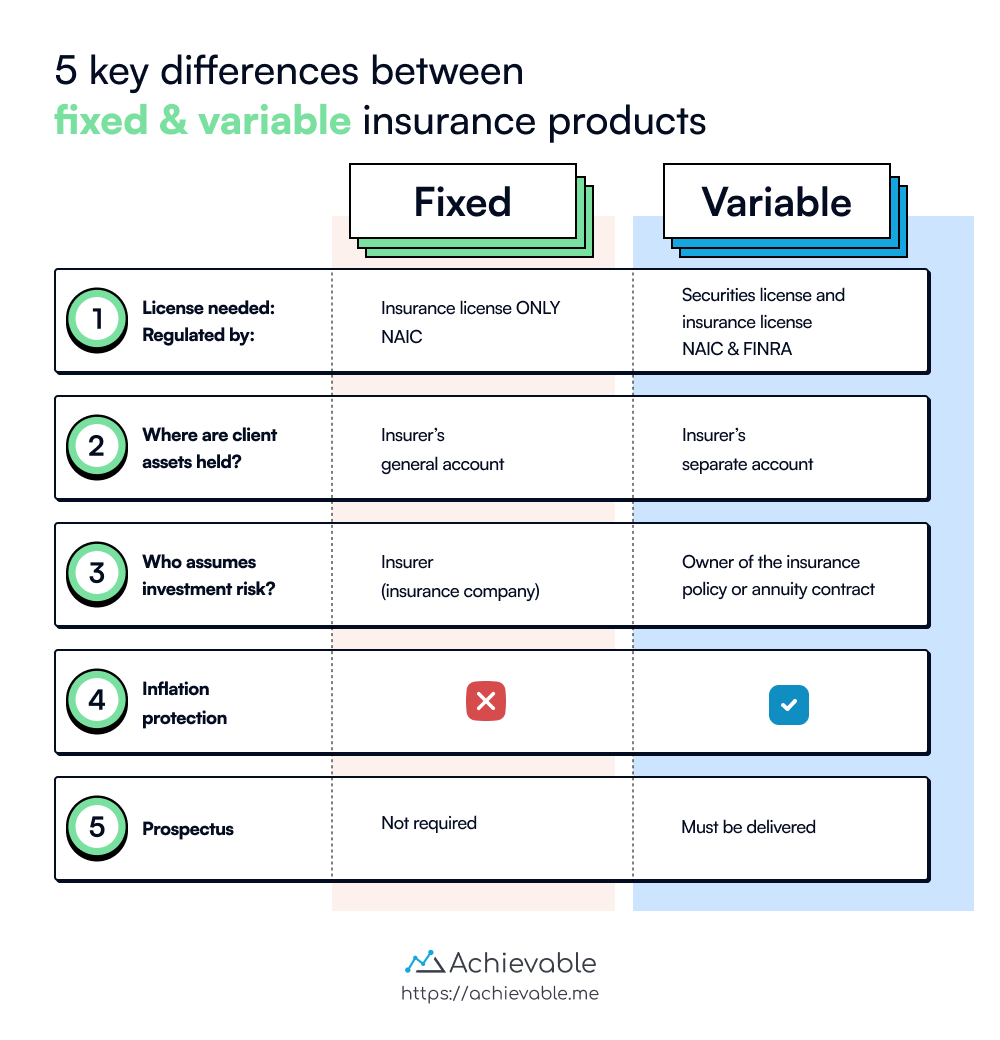
The differences between variable and fixed products are highly testable. The following 5 concepts sum up the key differences:
- Licenses needed/regulated
- Assumption of investment risk
- Separate vs. general account
- Variable contracts hedge against inflation
- Prospectus required with sale of variable contract
Licenses
The term “variable contract” includes variable life insurance policies and variable annuities.
- Variable contracts are insurance products, so they’re guided by the NAIC (National Association of Insurance Commissioners). Because they’re insurance, you need an insurance license to sell them.
- Variable contracts are also securities, so they’re regulated by the SEC.
Because variable contracts are both insurance products and securities, selling them requires:
- An insurance license, and
- A Series 6 or Series 7 investment license
Separate vs. general account
The assets in an insurance company’s general account are attachable by claims of the insurance company’s creditors. The premiums and cash values of traditional or fixed insurance products are held in the general account. If the insurance company becomes insolvent, those assets may be forfeited to the creditors of the insurance company.
A separate account is an investment fund kept separate from the insurance company’s general account and is not attachable by creditors of the insurance company. As required by the SEC, cash values of variable contracts are held in the insurance company’s separate account.
Assumption of investment risk
A fixed contract is issued with a stated rate of return (4%, for example). If the insurance company is unable to earn 4% on the assets in the product, the insurance company loses money. Because a fixed contract has a guaranteed rate of return and the principal or cash value in a fixed product is also guaranteed not to decline, the insurance company assumes the investment risk.
With a variable contract, there are no guarantees as to rate of return or principal invested. The assets in a variable contract are invested in securities. As the market value of the securities fluctuates, so will the value of the contract itself. The investor could lose some or all of their money.
All variable contracts must be convertible (at the discretion of the owner) into fixed contracts for at least 24 months from issuance. This is intended to accommodate investors who may not have initially understood the risks associated with variable contracts.
Hedge against inflation
Historically, the stock market has outpaced inflation. Theoretically, over any extended period, the market value of publicly traded securities will increase with inflation. As a result, variable contracts offer a hedge against inflation. If inflation is high, the return of a variable contract should go up due to the increase in the value of the underlying securities.
A fixed contract, by contrast, can produce a negative “real return” (meaning purchasing power falls) when inflation is higher than the contract’s guaranteed rate.
For example, let’s look at two quick scenarios assuming you have a fixed annuity that is paying a guaranteed rate of
-
Inflationary period (prices are rising):
- Let’s say inflation is .
- Your annuity gives you a return.
- So, your real rate of return .
- Because prices are rising, your money buys less each year. In this scenario, during a period where inflation is , earning means you’re losing purchasing power because you aren’t keeping pace with inflation.
-
Deflationary period (prices are falling):
- Let’s say prices drop by per year (deflation ).
- Your annuity still gives you a return.
- So, your real rate of return .
- Because prices are dropping (which is rare in the real world), your money buys more every year. Purchasing power of a fixed return increases with deflation.
Prospectus
When an insurance company issues a variable policy or annuity (or any other issuer sells a security), the transaction is called a “primary market transaction.”
Before securities can be offered to the public, a registration statement must be filed with the SEC. The registration statement announces the issuers’ intent to sell the security. Along with the registration statement, the issuer files a copy of the prospectus with the SEC.
The prospectus is intended to provide full and fair disclosure to the potential investor. It is a formal written offer to sell securities that discloses facts investors need to make informed decisions.
With the sale of a variable product:
- A prospectus must be delivered at time of solicitation prior to accepting premium.
- Variable life insurance policies require a 10-day free-look provision from the date of policy delivery.
Lesson summary
The differences between variable and fixed products can be summarized through 5 key concepts:
-
Licenses needed/regulated
- Variable contracts are insurance products regulated by the NAIC, requiring an insurance license to sell. They are also securities regulated by the SEC, necessitating a Series 6 or Series 7 investment license in addition to the insurance license.
-
Assumption of investment risk:
- Fixed contracts have a guaranteed rate of return, where the insurance company assumes the investment risk. Variable contracts have no guaranteed rate of return on principal, relying on investments in securities that can fluctuate in value, exposing investors to potential losses.
-
Separate vs. general account:
- General accounts hold funds of fixed products, which are accessible to the insurance company’s creditors if it becomes insolvent. Separate accounts, mandated by the SEC, hold cash values of variable contracts and are not attachable by the insurance company’s creditors.
-
Variable contracts hedge against inflation:
- Variable contracts offer a hedge against inflation as their market value tends to increase with inflation, unlike fixed contracts that may result in a negative “real return” during periods of high inflation.
-
Prospectus required with sale of variable contract:
- Before offering securities, including variable contracts, a registration statement must be filed with the SEC along with a prospectus. The prospectus provides comprehensive information to potential investors, enabling informed decision-making. It must be delivered during solicitation before premium acceptance.