



Underwriting
Insurers are in the business of accepting risks and insuring against the financial loss associated with those risks. That doesn’t mean they want to (or have to) accept every application for insurance. Accepting too many bad risks can threaten an insurer with insolvency.
An insurer’s underwriting department carefully reviews each application for insurance to decide whether it represents an acceptable (standard) risk. The objective of risk selection is to provide equity among all classes of risks.
Sources of underwriting information
How do underwriters determine whether an applicant is standard, substandard, preferred, or uninsurable? The most important source of information is the application. The application contains a considerable amount of information that helps the underwriter determine an adequate premium level.
The questions on the application are designed to provide a complete picture of the applicant, including any physical, moral, or morale hazards. For example:
- The applicant’s gender matters because, statistically, females live longer than males.
- Physical factors such as age, weight, and health condition are important.
- The applicant’s activities and personal characteristics can also affect risk.
One of the most important parts of the application is the authorization the applicant signs. By signing this form, the applicant authorizes the insurer to access personal medical records from any doctor or hospital that may have examined or treated the proposed insured. State privacy laws may limit how long this authorization stays valid. In states that adopted the NAIC’s Insurance Information and Privacy Protection Model Act, an authorization signed with an application for life, health or disability insurance is valid for no more than 30 months from the date it is signed. The same model act requires the insurer or producer to give the applicant a written notice of insurance information practices, explaining what personal information may be collected and from what kinds of sources, and when it may be disclosed without the applicant’s authorization. The notice is due no later than delivery of the policy, or, if information will be collected from anyone other than the applicant or public records, no later than when that collection begins.
Another invaluable source of information is the Medical Information Bureau (MIB). The MIB is a nonprofit organization to which most life and health insurers subscribe. The MIB contains medical information on insurance applicants, including any past treatment, recommendation, or diagnosis received that was covered by insurance.
Medical examination
Another source of information is the medical examination. Insurers routinely send applicants to physicians for a physical examination, and the insurer pays the cost.
Simplified issue insurance requires no medical exam and asks only very basic health-related questions on the application. Usually, this type of insurance is available only in low face amounts to reduce the risk of adverse selection.
HIV-related test results may be disclosed only with written consent, except as permitted or required by applicable state law.
If an insurer obtains confidential HIV-related information during the underwriting process, disclosure may be made only to authorized parties as permitted by law, such as the applicant, a physician or other person the applicant designates in writing, and public health officials when the law requires it. Confidential HIV-related information may not be disclosed to an applicant’s employer without proper authorization.
Field underwriting
Insurance producers are often the first point of contact and may have personal relationships with applicants. It’s becoming increasingly common for producers to be involved in field underwriting, which is a preliminary risk evaluation conducted through a face-to-face interaction. This can provide insights that may not appear on an application.
Field underwriting involves gathering key information to determine whether a potential client meets the insurer’s basic underwriting criteria before submitting a formal application.
An important source of underwriting information is the producer’s report, required by most companies. This report is completed by the agent and submitted with the application. It should include any information the agent observes that might affect the underwriter’s decision.
Application procedures
The application is the foundation of the contract, and completing it correctly is one of the producer’s most important field underwriting duties.
- Ask every question and record every answer. The producer asks each question as written and records the applicant’s answer accurately. A question left blank is not a “no.” An incomplete application is usually returned to the producer, which delays coverage
- Get the right signatures. The application is signed by the proposed insured and, if different, the policyowner. The producer signs as well, and in doing so attests to what they observed and to the accuracy of the answers they recorded
- Correct errors properly. A mistake is crossed out and the corrected answer written in, and the applicant initials the change. Correction fluid or erasures are not used, and a producer never changes an answer without the applicant’s knowledge
- Collect the initial premium when possible. Submitting the first premium with the application is what allows a conditional receipt to be issued (see the chapter on producer roles and receipt types)
- Submit promptly. The completed application, the producer’s report, any required authorizations and the premium go to the insurer promptly
- Deliver the required notices. The applicant receives the notice of the insurer’s information practices and any disclosures the law requires, such as a replacement notice when existing coverage is involved
When the policy is issued, a copy of the application is attached to the policy and becomes part of the entire contract. Anything the applicant said that is not in that attached application generally cannot later be used against them.
Warranties and representations
Answers on a life insurance application are treated as representations, not warranties. A representation is a statement the applicant believes to be true to the best of their knowledge. A warranty is a statement guaranteed to be literally true, where any inaccuracy, material or not, could void the contract.
The difference matters when an answer turns out to be wrong:
- An innocent, immaterial misstatement does not void the policy
- A material misrepresentation (one that would have changed the insurer’s decision to issue the policy or the premium it charged) may allow the insurer to rescind the policy, generally only during the contestable period
- Concealment, deliberately withholding a material fact, is treated the same way
This is why accurate field underwriting protects the client as much as the insurer. A producer who rushes the applicant through the medical questions, or who records an answer the applicant did not give, can leave a beneficiary with a contested claim.
Investigative consumer report
Another source of information is the investigative consumer report. An investigative consumer report may shed light on an applicant’s character, reputation, personal habits, credit history, and mode of living. If an investigative report is obtained, the applicant must be notified within three days of the date the report was requested.
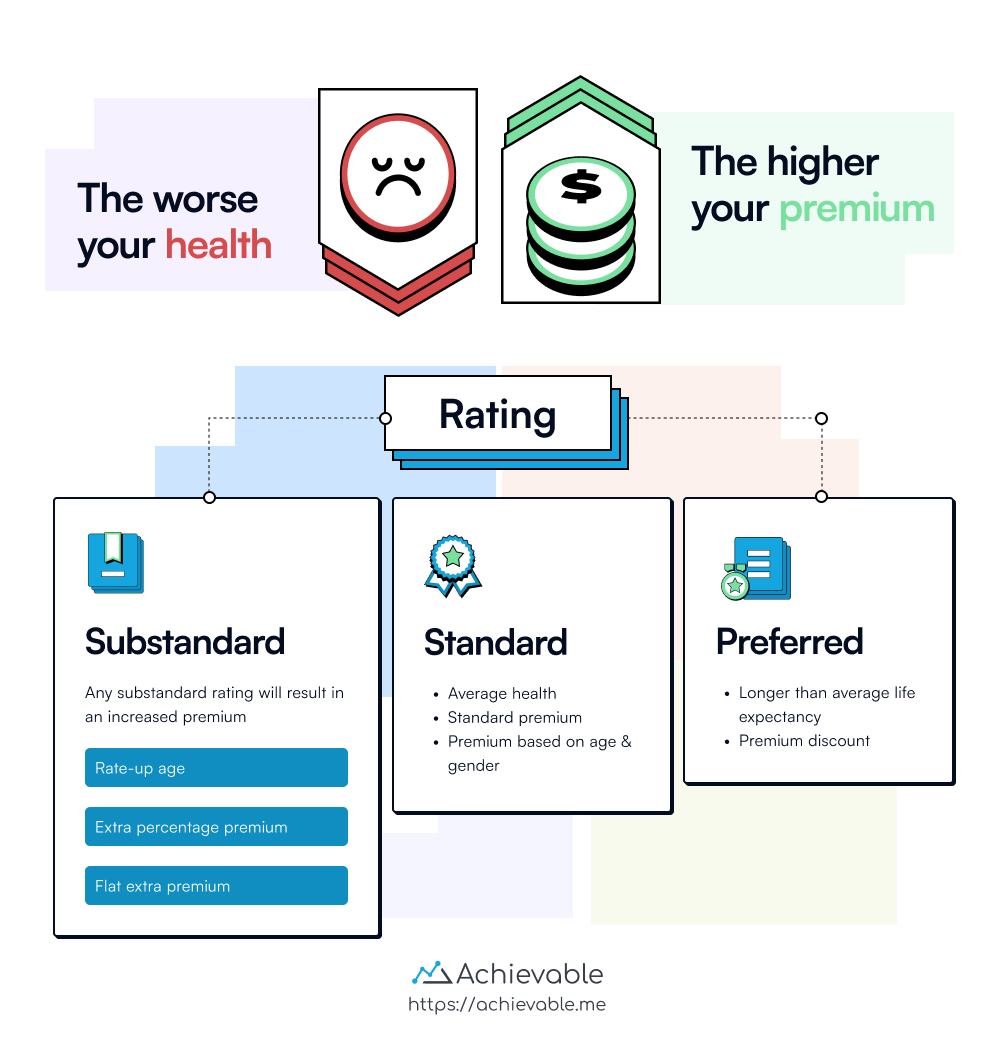
Applicants who smoke, are overweight, have a questionable medical history, or otherwise represent a greater risk than a healthy person should be expected to bear a heavier proportion of premium costs than an applicant of the same sex and age who does not have those hazards. The same is true for people who may be perfectly healthy but, because of their occupation or hobbies, represent a greater risk. Deep sea welders are a good example. The premium charged must fairly represent the mortality risk represented by the insured.
Under the federal Fair Credit Reporting Act (FCRA), if a consumer is denied insurance based on a report, they have 60 calendar days after receiving the adverse action notice to request a free copy of the report.
Underwriters must also guard against adverse selection, which is the tendency of those who are high risk (and know it) to try to obtain insurance. Many people who are not in perfect health can still expect to live a full life. However, situations can exist that make an applicant less attractive (from a risk standpoint) than a standard risk while still qualifying that person as insurable. Applicants in this gray area, between standard and uninsurable, are considered substandard risks.
While different insurers use different criteria to decide who is acceptable as a substandard risk, there are techniques used to rate them. A rated policy is one that has been modified, in its premium requirement, to compensate for an additional risk. A policy can be rated in three different ways:
1) Flat extra premium
- The premium for the policy is increased by a flat dollar amount per $1,000 of coverage to cover the additional risk. The flat extra premium may be permanent or temporary, depending on the reason for the rating. This is often an appropriate method when one clearly defined problem (that may go away) causes the substandard classification.
2) Extra percentage premium
- The premium amount is increased by a certain percentage. The percentage increase is based on tables used by underwriters. Generally, the extra percentage premium is used when the extra risk is expected to be permanent and/or is caused by a variety of hazards.
3) Rated-up
- In this approach, the applicant’s age is “rated up,” meaning the applicant is treated as older than their actual age. As a result, the premium is higher.
Some insurers recognize people who take extra steps to improve or maintain their good health. These people are rewarded through the use of preferred rates or some other form of premium discount.
Establishing premium rates
There are three components in the calculation of a life insurance premium rate:
- Mortality
- Expenses
- Interest
The number of exposure units is not used in calculating individual premium rates, even though it affects statistical accuracy in broader underwriting assumptions.
Mortality is the key variable in establishing premium rates for life insurance. It is the basis for predicting future claims. When calculating premium rates, a charge is made for anticipated mortality. The mortality charge for a 70-year-old applicant would be much higher than the mortality charge for a 30-year-old applicant. Mortality is the reason life insurance becomes more expensive with age. Mortality tables are based on average death rates for large groups of people.
Mortality and an assumed interest rate combine to form the net premium - the baseline cost of providing the death benefit. Another charge, loading, is made for expenses. This represents the basic operating cost of the company (including commissions and contingencies) and includes a profit factor. Adding the loading charge to the net premium produces the gross premium, which is the amount actually charged to the policyowner. Dividends are not part of the gross premium.
When a policy owner makes a premium payment, part of the premium is used to meet expenses and part is held in reserve to meet future claim commitments. These funds are placed in investments that earn interest. The net effect is to reduce the amount of premium that would otherwise be required. All premiums are calculated on an annual basis, but the policy’s mode of payment may be more frequent.
Lesson summary
Underwriting is how insurers accept risks and insure against financial loss, while avoiding insolvency by not accepting every application. The underwriting department reviews each application to determine whether it represents an acceptable risk. The main sources of underwriting information are the application, medical examination, producer’s report, and investigative consumer report. State privacy laws may limit how long the signed authorization stays valid; in states that adopted the NAIC’s privacy model act, the limit is 30 months for life, health or disability insurance.
- The application provides important information about the applicant’s physical, moral, and morale hazards. It includes an authorization allowing access to personal medical records and the Medical Information Bureau (MIB), and the applicant receives a notice of insurance information practices.
- Medical examinations are routine and may include confidential HIV-related information. Simplified issue insurance may not require a medical exam but has limitations.
- HIV testing requires written consent, and results may only be disclosed as allowed by law.
- Producer’s reports contain observations from agents that could affect the underwriter’s decision.
- In the field, the producer asks every application question, records answers accurately, has the insured and owner sign, has the applicant initial any correction, and submits the application promptly. The application attached to the policy becomes part of the entire contract.
- Application answers are representations, not warranties. Only a material misrepresentation or concealment may allow the insurer to rescind, generally within the contestable period. Investigative consumer reports shed light on an applicant’s character, reputation, and lifestyle.
Underwriters consider factors like age, gender, health condition, activities, and personal characteristics to determine risk categories such as standard, substandard, preferred, or uninsurable. Premium costs are adjusted based on the level of risk an applicant poses. Those in the gray area between standard and uninsurable are considered substandard risks and may be rated with a higher premium.
- Rated policies have modified premium requirements to compensate for additional risks. They can be rated with a flat extra premium, an extra percentage premium, or through rated-up age.
- Preferred risks may receive lower premiums.
- Insurers establish premium rates for life insurance based on mortality, expenses, and interest. Mortality is a key factor affecting premium rates, leading to higher costs for older applicants.
- The net premium is based on mortality and interest; adding the expense (loading) charge to the net premium produces the gross premium charged to the policyowner. Premium payments are used for expenses and reserves for future claims, with funds invested to earn interest.
Overall, underwriters aim to provide equity among all classes of risks, guard against adverse selection, and ensure fair premium rates based on an applicant’s risk level.