



Term Life Insurance
While life insurance products can seem endless, they all come from two basic forms. Over time, insurers have created variations on these two forms, so there’s now a life insurance product to fit almost any need.
Life insurance is provided through either a term policy or a permanent (whole life) policy. No matter how complex a policy name sounds, it’s term, whole life, or a combination of the two.
Term insurance
- Term insurance provides pure life insurance protection for a limited period of time (a term). It’s used to meet temporary insurance needs. Because it’s less expensive than permanent insurance, it may be the best option in many situations. Term policies do not build cash value. When a term policy expires, the policy owner should expect no financial return.
Permanent (whole life)
- Whole life insurance provides insurance protection for the insured’s whole life or until age 100 (or 121 in many modern policies), when the policy matures. Over time, the policy builds cash value, which is a key feature of permanent life insurance.
Term life policies
Because term policies have no savings element, premiums in the younger years of a policy owner’s life are low compared to a whole life policy. However, term insurance premium rates increase each time the policy is renewed. At advanced ages, term insurance rates can be much higher than the rates for a whole life policy, assuming both policies were purchased at a younger age.
Term insurance rates mainly reflect the mortality charge. Because mortality increases with age, term premiums generally increase with age as well.
Term insurance is appropriate when a person has a short-term or temporary need for life insurance. It’s also appropriate when the insured has a decreasing need for life insurance, needs life insurance but has budget constraints, or wants to protect future insurability (through the use of the convertibility rider).
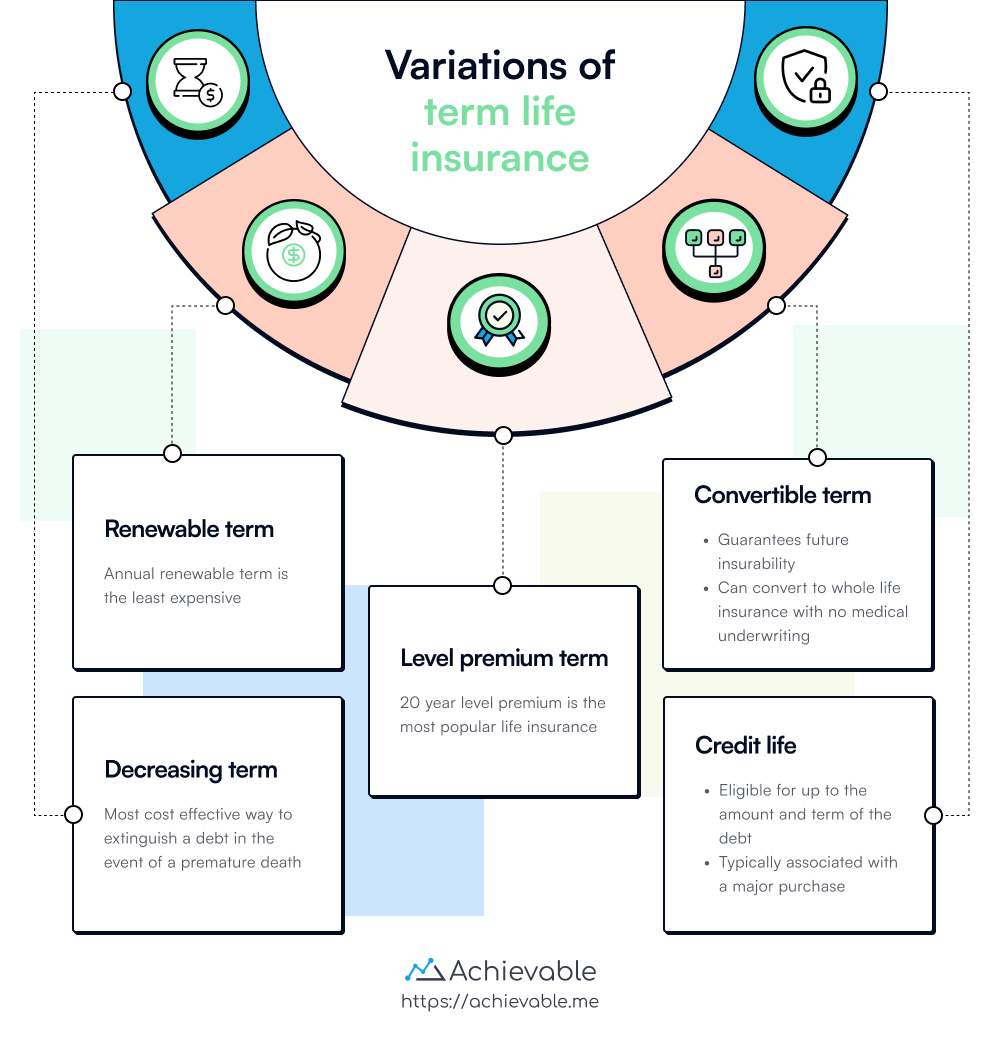
Renewable term
All term policies are issued with a stated termination date. That date may be expressed as a number of years or as a stated age. Term policies may be issued for a period as short as one year (annual renewable term).
Term policies with a renewability feature allow the policy owner to renew the policy at the end of the term without providing evidence of insurability. Because the insurer is taking on the risk that the insured’s health may have changed, a renewable term policy is more expensive than a non-renewable policy.
This renewability feature is especially valuable in 20- or 30-year policies. There’s always the risk that the policy owner’s health will deteriorate, making them uninsurable. When a policy is renewed, the new premium rate is based on the insured’s attained age.
Level premium term
Level premium term insurance keeps both the face amount and the premium level during the policy period. Level term insurance is appropriate when the amount of insurance needed stays the same, but only for a limited time.
For example, it can fit a parent who wants extra financial protection while children live at home, but won’t need that extra protection once the children are grown and financially independent.
Convertible term
Convertibility is a feature that may be added to a term policy. It gives the policy owner the right to convert the term policy to a whole life policy without providing evidence of insurability.
Decreasing term insurance
With this type of policy, the premium stays level, but the death benefit decreases each year. The most common use of decreasing term insurance is for mortgages and loans. As the loan balance decreases, the need for protection decreases as well.
Credit life insurance
Using decreasing term insurance to cover a debt is the basic principle behind credit life insurance. Written on the life of the debtor, the coverage may be individual or group, but it’s usually written on a group basis.
Proceeds are payable to the creditor to extinguish a debt. This type is often sold by car dealers, banks, and other creditors. The maximum policy period can’t exceed the life of the loan, and the policy benefit can’t exceed the amount owed. If the loan is paid off early, excess premiums are refunded to the policy owner.
Lesson summary
Life insurance products generally fall into two basic forms: term insurance and permanent (whole life) insurance. These forms have evolved over the years to meet various needs, resulting in a wide array of products. Here’s a breakdown:
- Term insurance:
- Provides pure life insurance protection for a limited period.
- Best for temporary insurance needs due to its lower cost compared to permanent insurance.
- No cash accumulation; expires without financial return.
- Premiums are lower in younger years but increase with each renewal.
- Permanent (whole life) insurance:
- Provides coverage for the insured’s entire life or until age 100 (or 121 many in modern policies).
- Includes a cash value accumulation feature.
Further details on term insurance:
- Renewable term:
- Policy can be renewed without proof of insurability, but at a higher cost.
- Level premium term:
- Maintains constant face amount and premiums during the policy’s lifetime.
- Suited for situations where insurance needs are temporary and static.
- Convertible term:
- Option to convert term policy to whole life without evidence of insurability.
- Decreasing term insurance:
- Premium remains level but death benefit decreases annually, commonly used for mortgages.
- Credit life insurance:
- Decreasing term insurance used to cover debts, often sold by creditors with proceeds payable towards debt.
- Policy period matches the loan term and benefits are capped at the owed amount.
- Excess premiums are refunded if the loan is paid off before the policy term.