



Consolidation and stress
This chapter covers the following:
- Consolidation
- Stress in soil mass
Consolidation of clay soils
Settlement of fine-grained soils occurs in three stages:
- Immediate settlement occurs rapidly and is based on elasticity theory.
- Primary consolidation occurs due to the expulsion of water under pressure.
- Secondary compression (also known as “creep”) occurs as soil particles readjust and compress over time, beginning only after all excess pore pressure () has dissipated.
Consolidation refers to the primary consolidation phase in fine-grained soils (silts and clays). Because these soils have low permeability, excess pore water pressure () dissipates slowly, so settlement takes time.
Coarse-grained soils (sands and gravels) also settle, but they do so much faster because their high permeability allows pore water pressure to dissipate quickly.
Compaction vs. consolidation
Compaction and consolidation both increase soil density, but they happen in different ways: compaction reduces air voids in an unsaturated soil, while consolidation increases the density of a saturated soil over time by squeezing water out.
Stress history of clay soils
-
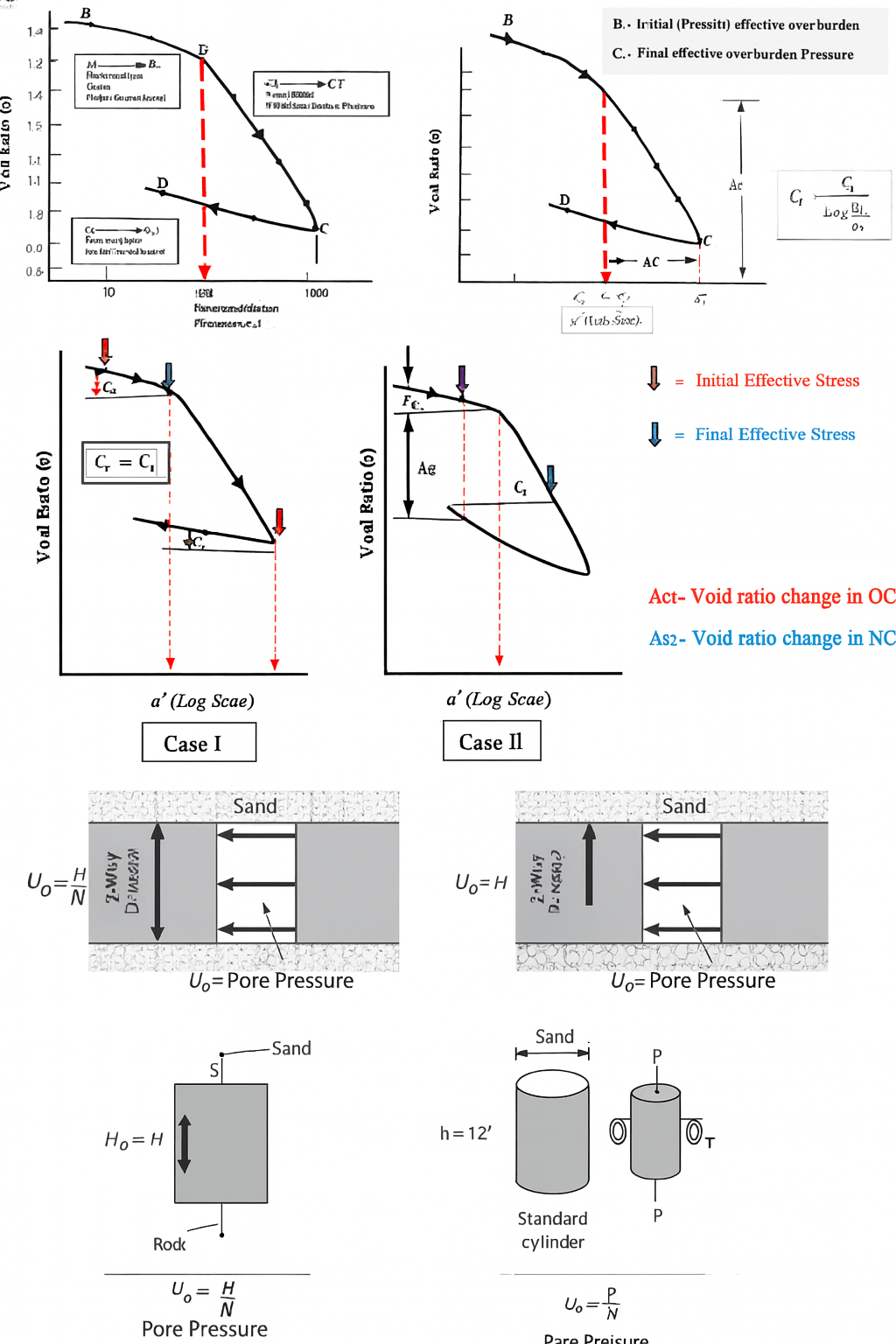
Normally consolidated (NC) clay: The present effective overburden pressure is the maximum pressure the soil has been subjected to in the recent past.
-
Overconsolidated (OC) clay: The present effective overburden pressure is less than what the soil has experienced in the past. The past maximum effective overburden pressure is called the preconsolidation pressure.
The stress history is summarized as:
-
For normally consolidated soils:
-
For overconsolidated soils:
Where:
- = Initial (present) effective overburden pressure
- = Preconsolidation pressure
The overconsolidation ratio (OCR) is defined as:
Consolidation of normally consolidated (NC) clays
For a normally consolidated (NC) soil, primary consolidation settlement is calculated using the compression index :
Where:
- = Primary consolidation settlement
- = Initial effective overburden pressure
- = Final effective overburden pressure ()
- = Thickness of soil layer
- = Compression index
- = Initial void ratio
Example: Primary consolidation settlement (NC clay)
A normally consolidated clay layer is thick, has an initial void ratio , and a compression index . The initial effective overburden pressure is , and a new structure increases the effective stress to . Find the primary consolidation settlement.
Answer: ()
Consolidation of overconsolidated (OC) clay
Case I:
Use the recompression index :
Case II:
Use both and :
The first term covers the stress increase from up to the preconsolidation pressure using the recompression index , and the second term covers the remaining increase beyond up to using the compression index . Always compare to first to decide whether Case I or Case II applies.
Empirical relationships of and
For all clays:
For undisturbed clays of low to moderate sensitivity:
Where:
- = Liquid limit
The compression index can also be found directly from two points on a consolidation test’s void ratio-effective stress curve:
Example: Computing from consolidation test data
A consolidation test on a clay sample shows a void ratio at , and at . Find .
Answer:
Rate of consolidation
Degree of consolidation using settlement ratio:
Where:
- = Settlement at time
- = Total settlement
Degree of consolidation using pore pressure:
Where:
- = Initial excess pore pressure
- = Excess pore pressure at time
Average degree of consolidation as a function of time factor:
Where:
- = time factor
- = coefficient of consolidation
- = time
- = length of the drainage path
- = for two-way drainage and for one-way drainage, where, is thickness of the layer.
Please refer to the FE Handbook for detailed variation of time factor with degree of consolidation.
Example: Time to reach a target degree of consolidation (double drainage)
A thick clay layer drains at both the top and bottom (double drainage) and has a coefficient of consolidation . Using for consolidation (per the FE Handbook), find the time required.
Because the layer drains both ways, the drainage path is half the layer thickness: .
Answer:
Stress in soil mass
Stress definitions
Describing the state of stress at a point in a soil mass means finding the principal stresses and the orientation of the plane they act on. The quantities below set up that problem.
Where:
These symbols stand for the mean normal stress, the maximum shear stress, and the major and minor principal stresses. They also cover the normal and shear stresses on the x and y planes, and the angle to the plane of the major principal stress.
- = mean normal stress
- = maximum shear stress
- = major principal stress
- = minor principal stress
- , = normal stresses on the x- and y-planes
- = shear stress on the x-y plane
- = orientation angle between the plane of existing normal stress and the plane of the major principal stress
The mean normal stress and maximum shear stress are found from the principal stresses:
When the state of stress is instead given in terms of , , and , the principal stresses are found from:
First average sigma x and sigma y. Then add or subtract the square root of half their difference, squared, plus tau x y squared. Adding gives the major principal stress, and subtracting gives the minor one.
Example: Principal stresses from , , and
At a point in a soil mass, , , and . Find the major and minor principal stresses.
Answer: ,
Total normal stress
Where:
- = normal force
- = cross-sectional area over which force acts
Effective stress
Effective stress governs soil strength and deformation:
Where:
- = uplift or pressure head
Shear stress
Where:
- = shearing force
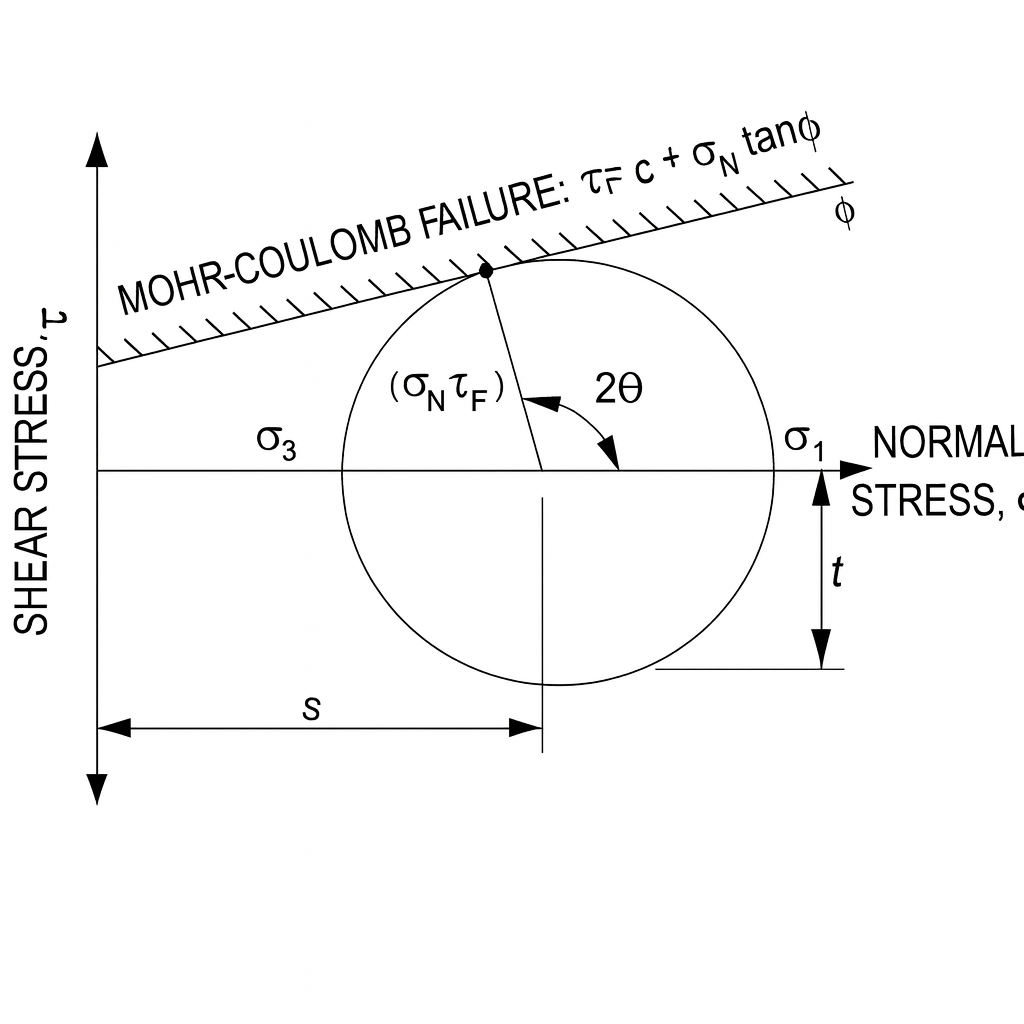
Shear stress at failure
Where:
- = cohesion
- = angle of internal friction