



Fluid statics
This chapter covers the following:
- Definitions
- Manometers and barometers
- Forces on submerged surfaces and the center of pressure
- Buoyancy and Archimedes principle
Fluid properties: definitions
In fluid mechanics, you’ll use a few core properties again and again. Three of the most common are density, specific weight, and specific gravity. We’ll define each one and show how to use the key equations.
Density ()
Equation:
Where:
- = density ( or )
- = mass ( or )
- = volume ( or )
Example:
The density of water at is:
Specific weight ()
Equation:
Where:
- = specific weight ( or )
- = density ( or )
- = acceleration due to gravity ( or )
Example:
The specific weight of water at is:
Note the unit reduction: , since .
Specific gravity (SG)
Equation (based on density):
Equation (based on specific weight):
Note: Since is constant, both definitions give the same value.
Example:
If a fluid has a density of , then its specific gravity is:
Pressure
Mathematical expression:
Where:
- = Pressure ( or )
- = Normal force acting perpendicular to the surface ()
- = Area over which the force is applied ()
Example:
Suppose a force of is applied on an area of . The pressure is:
Viscosity
There are two types:
- Dynamic (or absolute) viscosity () - measured in or .
- Kinematic viscosity () - the ratio of dynamic viscosity to density, measured in .
Where:
- = Kinematic viscosity
- = Dynamic viscosity
- = Fluid density
Newton’s law of viscosity states that shear stress between adjacent fluid layers is proportional to the velocity gradient perpendicular to flow, ; fluids that follow this relationship (water, air, most common oils) are called Newtonian fluids.
Surface tension
Mathematical expression:
Surface tension is defined as the force per unit length acting along the surface of a liquid at rest:
Where:
- = Force acting along the surface ()
- = Length over which the force acts ()
- = Surface tension ()
For example, surface tension lets water form spherical droplets and allows a water strider to walk on the surface.
Capillarity (capillary action)
- Adhesion: Attraction between liquid and tube wall
- Cohesion: Attraction between liquid molecules
Mathematical expression:
The height of capillary rise (or fall) is given by:
Where:
- = Capillary rise or fall ()
- = Surface tension of the liquid ()
- = Contact angle between liquid and solid surface
- = Density of the liquid ()
- = Acceleration due to gravity ()
- = Radius of the capillary tube ()
For example, water rises in a narrow glass tube because adhesion exceeds cohesion, while mercury is depressed because cohesion dominates.
The pressure field in a static fluid
In a static fluid, pressure increases with depth. The pressure difference between two points is given by , where point is located a vertical distance above point , and is the specific weight of the fluid.
Absolute pressure = atmospheric pressure + gauge pressure reading
Absolute pressure = atmospheric pressure - vacuum gauge pressure reading
Manometers and barometers
Manometer problem-solving procedure
The following is a general procedure for solving all manometer problems:
-
Start at one end (or any meniscus if the circuit is continuous) and write the pressure there in an appropriate unit or in an appropriate symbol if it is unknown.
-
Add the pressure change, in the same unit, from one meniscus to the next:
- Add if the next meniscus is lower.
- Subtract if the next meniscus is higher.
-
Continue until the other end of the gage (or the starting meniscus) is reached and equate the expression to the pressure at that point, whether known or unknown.
The expression will contain one unknown for a simple manometer or will give a difference in pressure for a differential manometer.
Example:
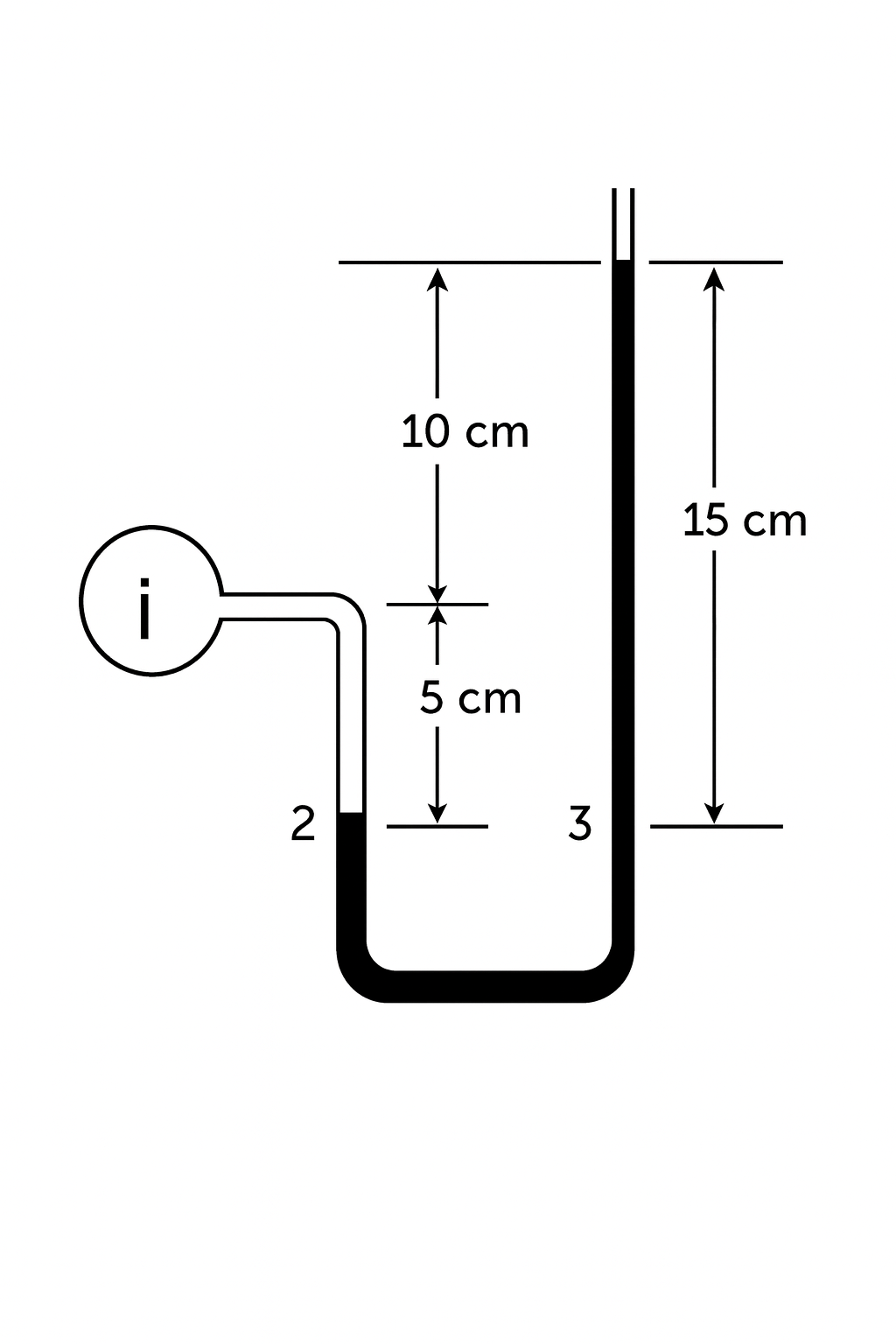
A U-tube manometer containing Hg (specific gravity = 13.6) has its right limb open to the atmosphere. The left limb is full of water and connected to a pipe containing water under pressure. Task: Find the pressure of water in the pipe above atmospheric pressure, given the manometer readings as shown in the figure.
Given
- Vertical distance from the pipe centerline (point 1) down to the mercury surface in the left limb (point 2):
- Difference between the mercury surface in the left limb (point 2) and the mercury surface in the right limb (point 3):
- Specific gravity of mercury:
Solution
Let represent the gauge pressure of the water in the pipe, expressed as an equivalent height of water. Because every term is expressed as an equivalent height of water, each column’s height is multiplied by its own specific gravity relative to water (1 for water, 13.6 for mercury) - this puts the mercury and water columns on the same water-based scale so they can be added and subtracted directly. Equating the pressure at points 2 and 3, measured from the same datum, we have:
or,
Therefore,
Barometer
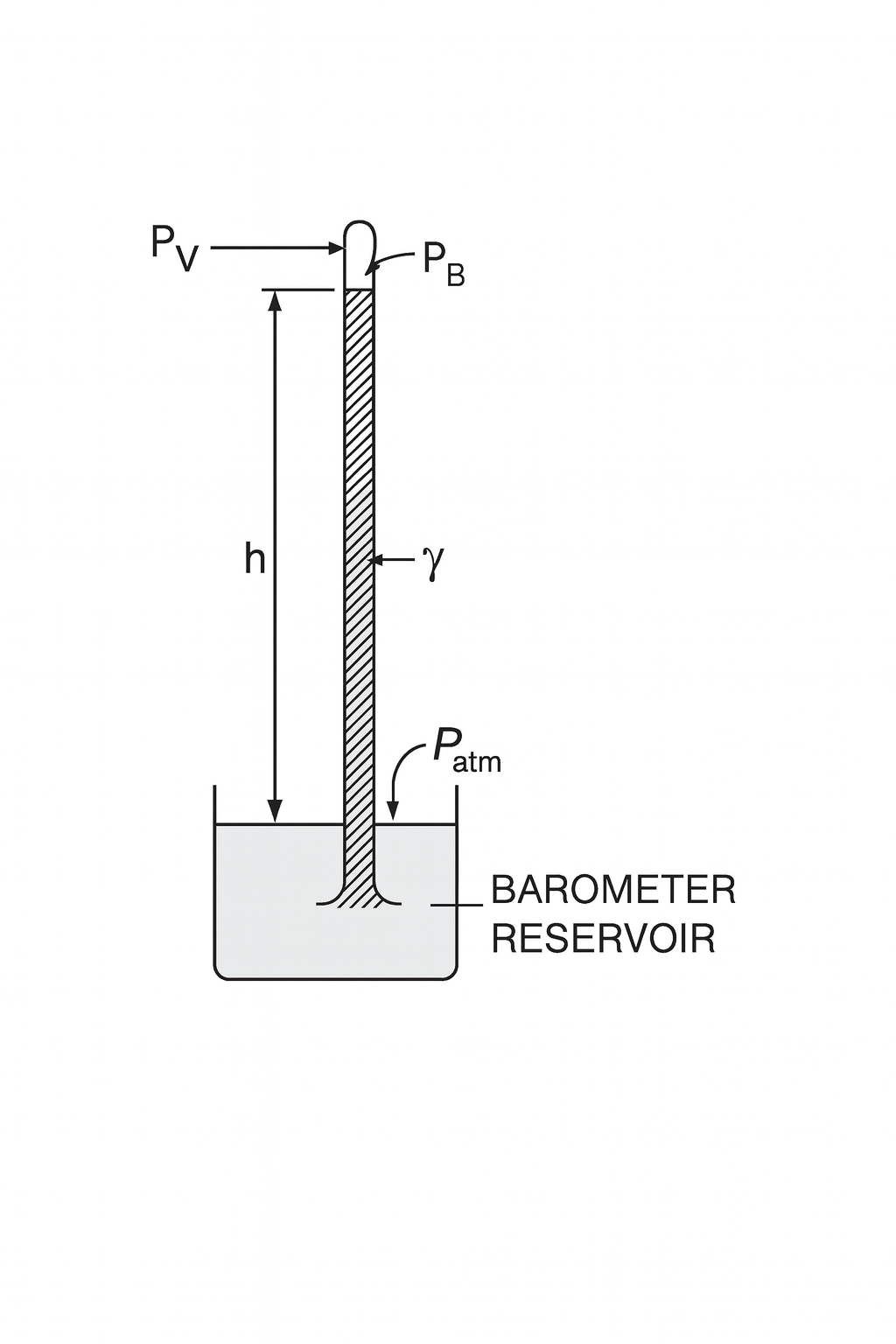
Another device that works on the same principle as the manometer is the simple barometer.
Refer to the textbook to view this data.
Where:
- = pressure at the level of the reservoir’s free surface, which is open to the atmosphere
- = pressure in the space at the top of the column, which holds only the fluid’s vapor, so
- = vapor pressure of the barometer fluid
- = specific weight of the barometer fluid
- = height of the liquid column above the reservoir’s free surface
Forces on submerged surfaces and the center of pressure
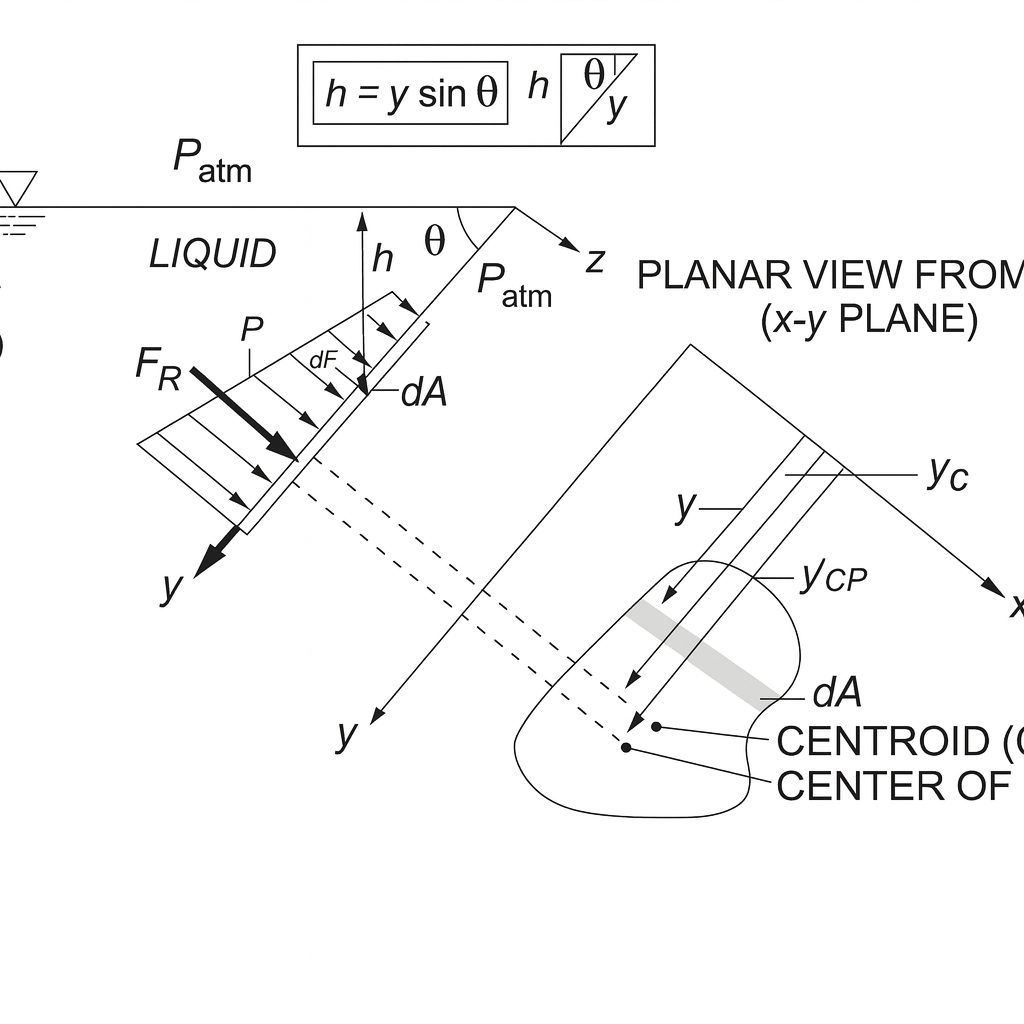
The pressure at a point a vertical distance below the surface is:
Refer to the textbook to view this data.
where:
- = pressure
- = atmospheric pressure
- = pressure at the centroid of area
- = pressure at the center of pressure
- = slant distance from liquid surface to the centroid of area,
- = vertical distance from liquid surface to centroid of area
- = slant distance from liquid surface to center of pressure
- = vertical distance from liquid surface to center of pressure
- = angle between liquid surface and edge of submerged surface
- = moment of inertia about the centroidal x-axis
If atmospheric pressure acts above the liquid surface and on the nonwetted side of the submerged surface:
or,
Wetted side force:
If acts on both sides:
Example: Force on an inclined submerged gate
A rectangular gate holds back water in an open channel. The gate is wide and long (measured along its slant), inclined at to the water surface. The centroid of the gate is below the surface, and atmospheric pressure acts on both sides of the gate. Find the resultant hydrostatic force and the slant distance to the center of pressure .
Given
- Width: , slant length:
- ,
Solution
First find the slant distance to the centroid and the area:
Since atmospheric pressure acts on both sides, the net resultant force is:
To find the center of pressure, first compute the moment of inertia of the rectangular gate about its own centroidal axis:
Therefore,
So , acting at (slant distance from the surface) - below the centroid, as expected.
Buoyancy and Archimedes principle
-
The buoyant force exerted on a submerged or floating body is equal to the weight of the fluid displaced by the body.
-
A floating body displaces a weight of fluid equal to its own weight; i.e., a floating body is in equilibrium.
-
The center of buoyancy is located at the centroid of the displaced fluid volume.
where:
- = buoyancy force ( or )
- = specific weight of fluid ( or )
- = volume of displaced fluid ( or )