


Achievable logoAchievable logo
FE Civil
Sign in
Sign up
Purchase
Textbook
Practice exams
Support
How it works
Exam catalog
Mountain with a flag at the peak
Textbook
Introduction
1. Mathematics
2. Combinatorics, probability and statistics
3. Engineering economics
4. Statics
5. Materials
6. Dynamics
7. Mechanics of materials
8. Fluid mechanics
9. Soil mechanics
10. Structural engineering
11. Concrete structure design
12. Water resources engineering
13. Environmental engineering
13.1 Water quality
13.2 Water treatment and distribution
14. Transportation engineering
15. Surveying, construction, ethics and professional practice
16. Wrapping up
(change me)
Achievable logoAchievable logo
13.1 Water quality
Achievable FE Civil
13. Environmental engineering
Our FE Civil course is currently in development and is a work-in-progress.

Water quality

6 min read
Font
Discuss
Share
Feedback

This chapter covers the following:

  • Biochemical oxygen demand (BOD)
  • BOD exertion
  • Kinetic temperature corrections
  • Stream modeling - Streeter Phelps
  • Oxygen saturation
  • Dilution purification of wastewater streams

Biochemical oxygen demand (BOD)

Biochemical oxygen demand (BOD) measures how much dissolved oxygen microorganisms need to biologically oxidize biodegradable organic matter under aerobic conditions. In practice, BOD is most commonly reported as the 5-day test at 20°C, written as BOD5​.

Because BOD reflects the amount of biodegradable organic pollution present, it’s widely used in:

  • wastewater treatment design
  • regulatory compliance
  • evaluating impacts on receiving waters

Basic BOD testing/sampling equation

BOD (mg/L)=PD1​−D2​​

When the dilution water is seeded:

BOD (mg/L)=P(D1​−D2​)−(B1​−B2​)f​

Where:

  • D1​ = dissolved oxygen of diluted sample immediately after preparation (mg/L)
  • D2​ = dissolved oxygen of diluted sample after 5-day incubation at 20°C (mg/L)
  • B1​ = dissolved oxygen of seed control before incubation (mg/L)
  • B2​ = dissolved oxygen of seed control after incubation (mg/L)
  • f = fraction of seeded dilution water volume in sample to volume of seeded dilution water in seed control
  • P = fraction of wastewater sample volume to total combined volume

BODt​:

BODt​ is the BOD exerted after t days of incubation, based on the difference between the blank and the sample, scaled by the dilution factor.

BODt​=(DOb,t​−DOs,t​)×dilution factor

Where:

  • DOb,t​ = dissolved oxygen concentration in blank after t days in incubation (mg/L)
  • DOs,t​ = dissolved oxygen concentration in sample after t days in incubation (mg/L)

Dilution factor:

Dilution factor=volume of undiluted samplevolume of bottle or diluted sample​

Volume of seed, undiluted (mL):

=estimated BOD of sampleallowable depletion×volume of bottle​

BOD exertion

BOD exertion describes how oxygen demand is applied over time as microorganisms decompose organic matter. The demand isn’t used up instantly; it increases gradually as biochemical reactions proceed. Under ideal conditions, this behavior is modeled with first-order kinetics.

BODt​=L0​(1−e−kt)

Where:

  • BODt​ = amount of BOD exerted at time t (mg/L)
  • k = BOD decay rate constant, base e (day⁻¹)
  • k=2.30K
  • K = rate constant, base 10 (day⁻¹)
  • L0​ = ultimate BOD (mg/L)
  • t = time (days)

Kinetic temperature corrections

Reaction rates in water quality processes depend strongly on temperature. To model conditions at temperatures other than the standard reference of 20°C, you adjust the rate constant using a temperature correction.

kT​=k20​θT−20

Where:

  • T = temperature of interest (°C)
  • kT​ = BOD rate constant at the temperature of interest (day⁻¹)
  • k20​ = BOD rate constant determined at 20°C (day⁻¹)
  • θ = temperature coefficient
  • Reaeration: θ=1.024

Stream modeling - Streeter Phelps

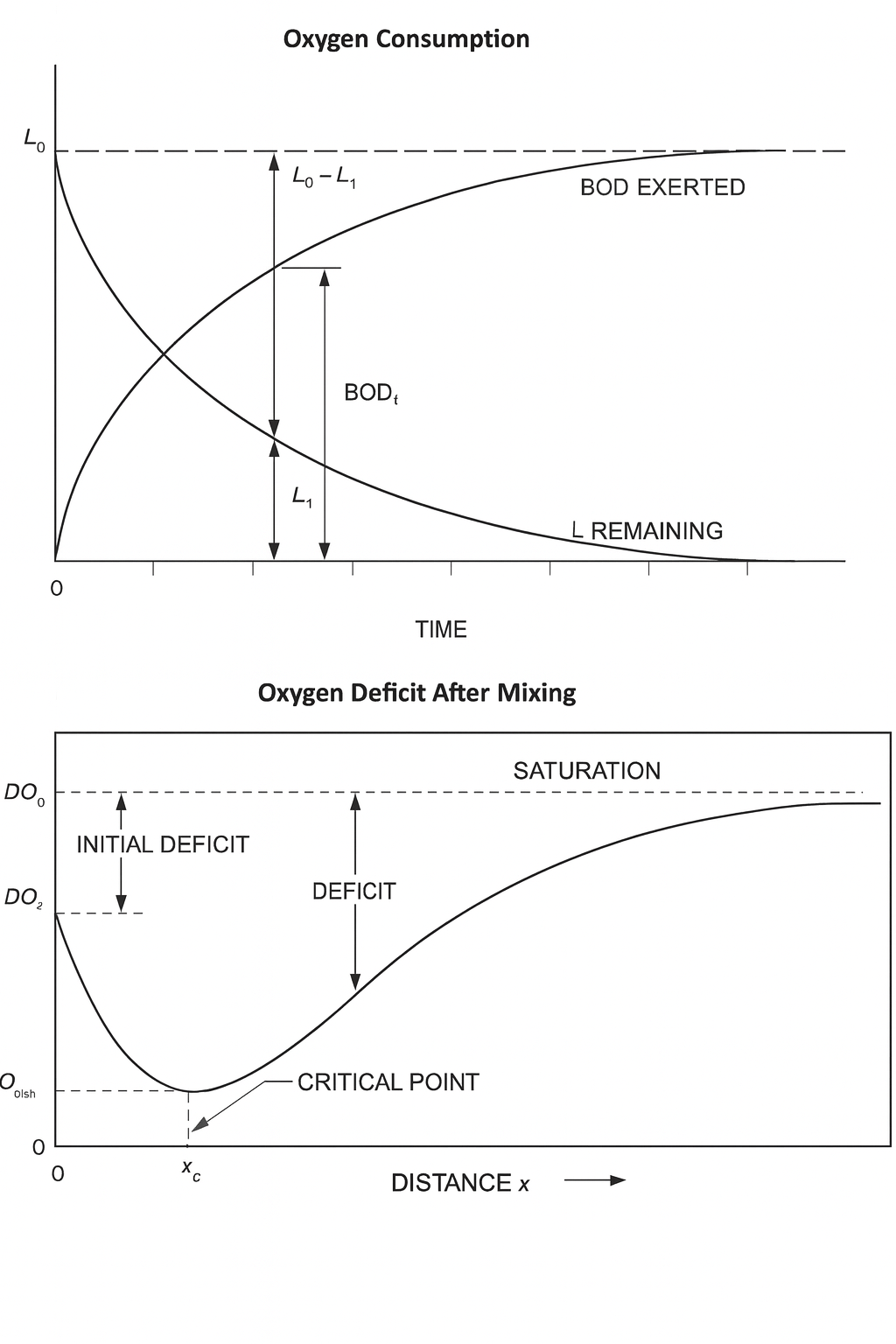
The Streeter-Phelps model describes dissolved oxygen (DO) changes in a stream after an organic waste discharge. It combines two competing processes:

  • oxygen depletion from BOD exertion (deoxygenation)
  • oxygen replenishment from the atmosphere (reaeration)

The model predicts the DO deficit downstream, including the critical point where DO reaches its minimum before recovering toward saturation.

A two-part diagram showing BOD oxygen consumption over time and the resulting dissolved oxygen sag curve (Streeter-Phelps model) with initial deficit, critical point, and recovery to saturation downstream of discharge.
Stream modeling with Streeter Phelps

D=kr​−kd​kd​La​​[e−kd​t−e−kr​t]+Da​e−kr​t

tc​=kr​−kd​1​ln(kd​kr​​(1−Da​kd​La​kr​−kd​​))

DO=DOsat​−D

Where:

  • D = dissolved oxygen deficit (mg/L)
  • DO = dissolved oxygen concentration (mg/L)
  • Da​ = initial dissolved oxygen deficit in mixing zone (mg/L)
  • DOsat​ = saturated dissolved oxygen concentration (mg/L)
  • kd​ = deoxygenation rate constant, base e (day⁻¹)
  • kr​ = reaeration rate constant, base e (day⁻¹)
  • La​ = initial ultimate BOD in mixing zone (mg/L)
  • t = time (days)
  • tc​ = time at which minimum dissolved oxygen occurs (days)

Oxygen saturation

Oxygen saturation is the maximum dissolved oxygen concentration water can hold when it’s in equilibrium with the atmosphere. It depends mainly on:

  • temperature
  • atmospheric pressure
  • salinity

Saturation is a key reference value because it sets the upper limit for DO and helps define the oxygen deficit used in stream modeling.

DOsat​=KH​⋅PO2​​

Where:

  • KH​ = Henry’s Law constant (moles/L·atm)
  • PO2​​ = partial pressure of oxygen (atm)

D=DOstream​−DO

Where:

  • D = oxygen deficit (mg/L)
  • DOstream​ = saturation concentration of dissolved oxygen at the temperature of the stream after mixing (mg/L)
  • DO = actual concentration of dissolved oxygen in stream (mg/L)

Dilution purification of wastewater streams

Dilution and natural purification control what happens to wastewater after it enters a receiving water.

  • Dilution lowers pollutant concentrations through mixing with cleaner water.
  • Purification reduces pollutants through processes such as biodegradation, sedimentation, and reaeration.

Together, these processes determine a stream’s assimilative capacity and help guide discharge permit limits.

If untreated or partially treated sewage is instantly mixed upon discharge into a large water body, the resulting parameter levels (e.g., temperature, DO, BOD, suspended solids) can be estimated using a weighted average. If the mixed conditions meet water quality standards, pretreatment may not be required.

Consider a wastewater flow rate Qw​ with ultimate BOD Lw​ and dissolved oxygen DOw​ mixing with a river with flow rate Qr​, ultimate BOD Lr​, and dissolved oxygen DOr​.

The initial (immediately after mixing) ultimate BOD of the river-wastewater mix is:

Lo​=Qw​+Qr​Qw​Lw​+Qr​Lr​​

Initial dissolved oxygen immediately after mixing DOo​ is given by:

DOo​=Qw​+Qr​Qw​DOw​+Qr​DOr​​

Temperature immediately after mixing To​ is given by:

To​=Qw​+Qr​Qw​Tw​+Qr​Tr​​

Initial oxygen deficit after mixing Do​ is given by:

Do​=DOsat​−Qw​+Qr​Qw​DOw​+Qr​DOr​​

Biochemical oxygen demand (BOD)

  • Measures oxygen needed by microbes to oxidize organic matter
  • Key for wastewater treatment design, compliance, and impact assessment
  • Main formula: BOD=PD1​−D2​​
    • Adjust for seeded dilution: BOD=P(D1​−D2​)−(B1​−B2​)f​
  • BODt​ after t days: (DOb,t​−DOs,t​)×dilution factor

BOD exertion

  • Describes time-dependent oxygen demand as organics decompose
  • Modeled by first-order kinetics: BODt​=L0​(1−e−kt)
    • L0​ = ultimate BOD, k = decay rate constant
  • k=2.30K (base 10 to base e conversion)

Kinetic temperature corrections

  • Reaction rates increase with temperature
  • Adjust rate constant: kT​=k20​θT−20
    • θ=1.024 for reaeration
    • k20​ = rate at 20°C, T = temperature of interest

Stream modeling - Streeter Phelps

  • Predicts DO changes after waste discharge
    • Deoxygenation (BOD exertion) vs. reaeration (atmospheric O2​)
  • DO deficit: D=kr​−kd​kd​La​​[e−kd​t−e−kr​t]+Da​e−kr​t
  • Critical point (minimum DO): tc​=kr​−kd​1​ln(kd​kr​​(1−Da​kd​La​kr​−kd​​))
  • DO=DOsat​−D

Oxygen saturation

  • Maximum DO water can hold at equilibrium with atmosphere
    • Depends on temperature, pressure, salinity
  • DOsat​=KH​⋅PO2​​
  • Oxygen deficit: D=DOstream​−DO

Dilution purification of wastewater streams

  • Dilution: lowers pollutant concentration by mixing
  • Purification: pollutant reduction via biodegradation, sedimentation, reaeration
  • Initial mixed values (after discharge):
    • Ultimate BOD: Lo​=Qw​+Qr​Qw​Lw​+Qr​Lr​​
    • DO: DOo​=Qw​+Qr​Qw​DOw​+Qr​DOr​​
    • Temperature: To​=Qw​+Qr​Qw​Tw​+Qr​Tr​​
    • Oxygen deficit: Do​=DOsat​−Qw​+Qr​Qw​DOw​+Qr​DOr​​

Sign up for free to take 5 quiz questions on this topic

Previous
Next  | 13.2 Water treatment and distribution
All rights reserved ©2016 - 2026 Achievable, Inc.

Water quality

This chapter covers the following:

  • Biochemical oxygen demand (BOD)
  • BOD exertion
  • Kinetic temperature corrections
  • Stream modeling - Streeter Phelps
  • Oxygen saturation
  • Dilution purification of wastewater streams

Biochemical oxygen demand (BOD)

Biochemical oxygen demand (BOD) measures how much dissolved oxygen microorganisms need to biologically oxidize biodegradable organic matter under aerobic conditions. In practice, BOD is most commonly reported as the 5-day test at 20°C, written as BOD5​.

Because BOD reflects the amount of biodegradable organic pollution present, it’s widely used in:

  • wastewater treatment design
  • regulatory compliance
  • evaluating impacts on receiving waters

Basic BOD testing/sampling equation

BOD (mg/L)=PD1​−D2​​

When the dilution water is seeded:

BOD (mg/L)=P(D1​−D2​)−(B1​−B2​)f​

Where:

  • D1​ = dissolved oxygen of diluted sample immediately after preparation (mg/L)
  • D2​ = dissolved oxygen of diluted sample after 5-day incubation at 20°C (mg/L)
  • B1​ = dissolved oxygen of seed control before incubation (mg/L)
  • B2​ = dissolved oxygen of seed control after incubation (mg/L)
  • f = fraction of seeded dilution water volume in sample to volume of seeded dilution water in seed control
  • P = fraction of wastewater sample volume to total combined volume

BODt​:

BODt​ is the BOD exerted after t days of incubation, based on the difference between the blank and the sample, scaled by the dilution factor.

BODt​=(DOb,t​−DOs,t​)×dilution factor

Where:

  • DOb,t​ = dissolved oxygen concentration in blank after t days in incubation (mg/L)
  • DOs,t​ = dissolved oxygen concentration in sample after t days in incubation (mg/L)

Dilution factor:

Dilution factor=volume of undiluted samplevolume of bottle or diluted sample​

Volume of seed, undiluted (mL):

=estimated BOD of sampleallowable depletion×volume of bottle​

BOD exertion

BOD exertion describes how oxygen demand is applied over time as microorganisms decompose organic matter. The demand isn’t used up instantly; it increases gradually as biochemical reactions proceed. Under ideal conditions, this behavior is modeled with first-order kinetics.

BODt​=L0​(1−e−kt)

Where:

  • BODt​ = amount of BOD exerted at time t (mg/L)
  • k = BOD decay rate constant, base e (day⁻¹)
  • k=2.30K
  • K = rate constant, base 10 (day⁻¹)
  • L0​ = ultimate BOD (mg/L)
  • t = time (days)

Kinetic temperature corrections

Reaction rates in water quality processes depend strongly on temperature. To model conditions at temperatures other than the standard reference of 20°C, you adjust the rate constant using a temperature correction.

kT​=k20​θT−20

Where:

  • T = temperature of interest (°C)
  • kT​ = BOD rate constant at the temperature of interest (day⁻¹)
  • k20​ = BOD rate constant determined at 20°C (day⁻¹)
  • θ = temperature coefficient
  • Reaeration: θ=1.024

Stream modeling - Streeter Phelps

The Streeter-Phelps model describes dissolved oxygen (DO) changes in a stream after an organic waste discharge. It combines two competing processes:

  • oxygen depletion from BOD exertion (deoxygenation)
  • oxygen replenishment from the atmosphere (reaeration)

The model predicts the DO deficit downstream, including the critical point where DO reaches its minimum before recovering toward saturation.

D=kr​−kd​kd​La​​[e−kd​t−e−kr​t]+Da​e−kr​t

tc​=kr​−kd​1​ln(kd​kr​​(1−Da​kd​La​kr​−kd​​))

DO=DOsat​−D

Where:

  • D = dissolved oxygen deficit (mg/L)
  • DO = dissolved oxygen concentration (mg/L)
  • Da​ = initial dissolved oxygen deficit in mixing zone (mg/L)
  • DOsat​ = saturated dissolved oxygen concentration (mg/L)
  • kd​ = deoxygenation rate constant, base e (day⁻¹)
  • kr​ = reaeration rate constant, base e (day⁻¹)
  • La​ = initial ultimate BOD in mixing zone (mg/L)
  • t = time (days)
  • tc​ = time at which minimum dissolved oxygen occurs (days)

Oxygen saturation

Oxygen saturation is the maximum dissolved oxygen concentration water can hold when it’s in equilibrium with the atmosphere. It depends mainly on:

  • temperature
  • atmospheric pressure
  • salinity

Saturation is a key reference value because it sets the upper limit for DO and helps define the oxygen deficit used in stream modeling.

DOsat​=KH​⋅PO2​​

Where:

  • KH​ = Henry’s Law constant (moles/L·atm)
  • PO2​​ = partial pressure of oxygen (atm)

D=DOstream​−DO

Where:

  • D = oxygen deficit (mg/L)
  • DOstream​ = saturation concentration of dissolved oxygen at the temperature of the stream after mixing (mg/L)
  • DO = actual concentration of dissolved oxygen in stream (mg/L)

Dilution purification of wastewater streams

Dilution and natural purification control what happens to wastewater after it enters a receiving water.

  • Dilution lowers pollutant concentrations through mixing with cleaner water.
  • Purification reduces pollutants through processes such as biodegradation, sedimentation, and reaeration.

Together, these processes determine a stream’s assimilative capacity and help guide discharge permit limits.

If untreated or partially treated sewage is instantly mixed upon discharge into a large water body, the resulting parameter levels (e.g., temperature, DO, BOD, suspended solids) can be estimated using a weighted average. If the mixed conditions meet water quality standards, pretreatment may not be required.

Consider a wastewater flow rate Qw​ with ultimate BOD Lw​ and dissolved oxygen DOw​ mixing with a river with flow rate Qr​, ultimate BOD Lr​, and dissolved oxygen DOr​.

The initial (immediately after mixing) ultimate BOD of the river-wastewater mix is:

Lo​=Qw​+Qr​Qw​Lw​+Qr​Lr​​

Initial dissolved oxygen immediately after mixing DOo​ is given by:

DOo​=Qw​+Qr​Qw​DOw​+Qr​DOr​​

Temperature immediately after mixing To​ is given by:

To​=Qw​+Qr​Qw​Tw​+Qr​Tr​​

Initial oxygen deficit after mixing Do​ is given by:

Do​=DOsat​−Qw​+Qr​Qw​DOw​+Qr​DOr​​

Key points

Biochemical oxygen demand (BOD)

  • Measures oxygen needed by microbes to oxidize organic matter
  • Key for wastewater treatment design, compliance, and impact assessment
  • Main formula: BOD=PD1​−D2​​
    • Adjust for seeded dilution: BOD=P(D1​−D2​)−(B1​−B2​)f​
  • BODt​ after t days: (DOb,t​−DOs,t​)×dilution factor

BOD exertion

  • Describes time-dependent oxygen demand as organics decompose
  • Modeled by first-order kinetics: BODt​=L0​(1−e−kt)
    • L0​ = ultimate BOD, k = decay rate constant
  • k=2.30K (base 10 to base e conversion)

Kinetic temperature corrections

  • Reaction rates increase with temperature
  • Adjust rate constant: kT​=k20​θT−20
    • θ=1.024 for reaeration
    • k20​ = rate at 20°C, T = temperature of interest

Stream modeling - Streeter Phelps

  • Predicts DO changes after waste discharge
    • Deoxygenation (BOD exertion) vs. reaeration (atmospheric O2​)
  • DO deficit: D=kr​−kd​kd​La​​[e−kd​t−e−kr​t]+Da​e−kr​t
  • Critical point (minimum DO): tc​=kr​−kd​1​ln(kd​kr​​(1−Da​kd​La​kr​−kd​​))
  • DO=DOsat​−D

Oxygen saturation

  • Maximum DO water can hold at equilibrium with atmosphere
    • Depends on temperature, pressure, salinity
  • DOsat​=KH​⋅PO2​​
  • Oxygen deficit: D=DOstream​−DO

Dilution purification of wastewater streams

  • Dilution: lowers pollutant concentration by mixing
  • Purification: pollutant reduction via biodegradation, sedimentation, reaeration
  • Initial mixed values (after discharge):
    • Ultimate BOD: Lo​=Qw​+Qr​Qw​Lw​+Qr​Lr​​
    • DO: DOo​=Qw​+Qr​Qw​DOw​+Qr​DOr​​
    • Temperature: To​=Qw​+Qr​Qw​Tw​+Qr​Tr​​
    • Oxygen deficit: Do​=DOsat​−Qw​+Qr​Qw​DOw​+Qr​DOr​​

More from Environmental engineering

  • Water treatment and distribution