


This browser is too old to run Achievable.

Update it, or open this page in a current version of Chrome, Safari, Firefox or Edge. On an iPhone or iPad, update iOS: every browser there runs on the version of Safari that comes with it.

Achievable logoAchievable logo
CMA Part 1
Sign in
Sign up
Purchase
Textbook
Practice exams
Support
How it works
Resources
Exam catalog
Mountain with a flag at the peak
Textbook
Introduction
1. External financial reporting decisions
2. Planning, budgeting, and forecasting
3. Performance management
4. Cost management
5. Internal control
6. Technology and analytics
Wrapping up
Achievable logoAchievable logo
2.5.1.1 Introduction to operational budgets
Achievable CMA Part 1
2. Planning, budgeting, and forecasting
2.5. Annual profit plan and supporting schedules
2.5.1. Operational budgets
Our CMA Part 1 course is currently in development and is a work-in-progress.

Introduction to operational budgets

4 min read
Font
Discuss
Share
Feedback

The operating budget

Definitions
Operating budget
A comprehensive plan detailing the projected revenue and expenses needed to achieve a company’s operational goals over a specific period, often a fiscal year.

As a critical component of the annual profit plan, the operating budget aligns production, labor, and resource allocations with expected sales, ensuring each department contributes effectively to overall profitability.

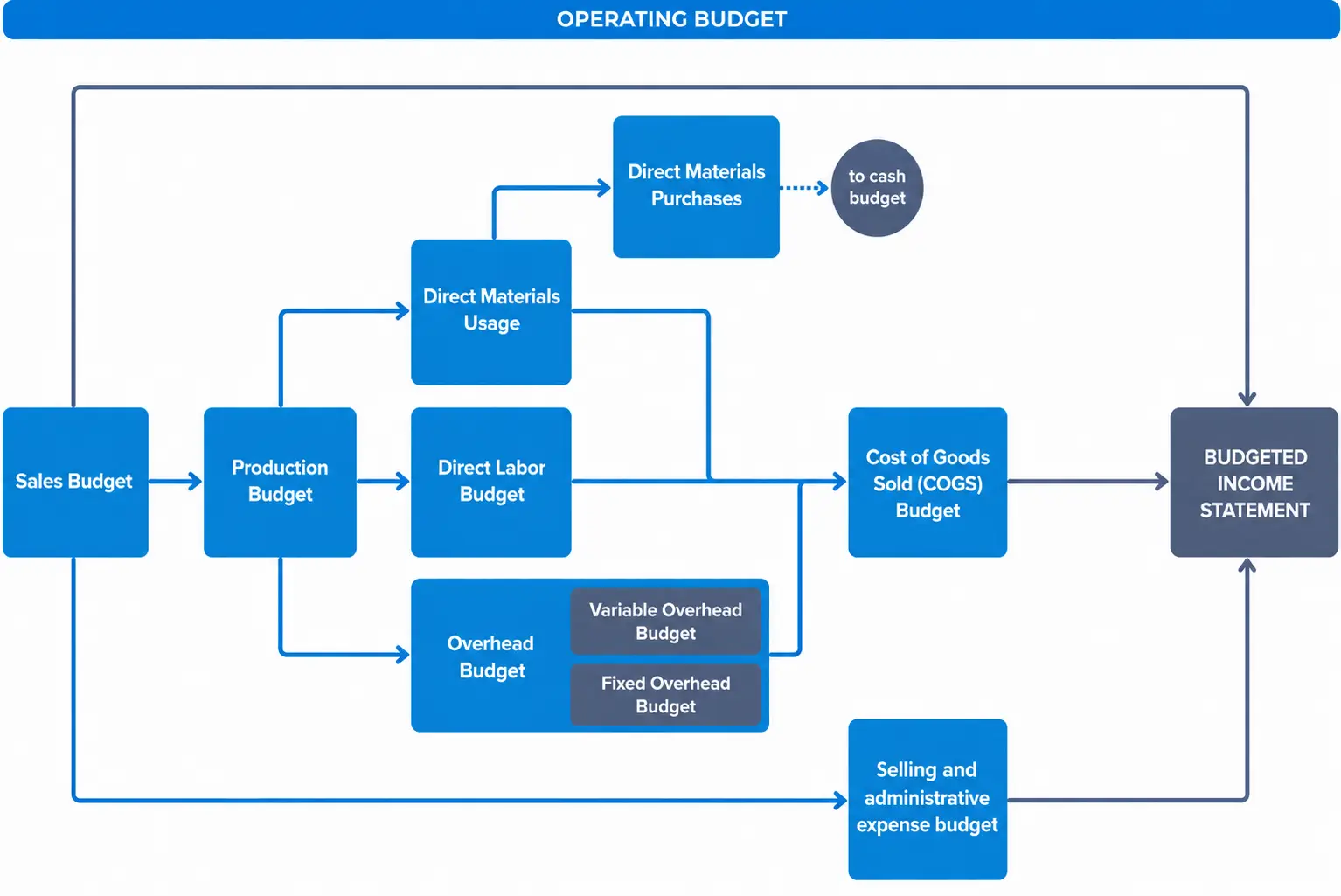
The operating budget is built in a sequence of steps, each producing a supporting schedule:

The operating budget from sales budget through cost of goods sold to income statement.
Operating Budget Process
Achievable

Notice how the pieces connect: the sales budget’s forecasted unit sales drive the production budget, the production budget’s required units drive the direct materials, direct labor, and overhead budgets, and those costs flow into the cost of goods sold budget. Sales volume also drives the selling and administrative expense budget, which adds the non-production costs. The budgeted income statement, the last schedule of the operational budget, brings all of these schedules together. In the following sections, each budget type will be explored in detail, starting with the sales budget and building toward the comprehensive operational budget.

1. Sales budget

The foundation of the operating budget, the sales budget forecasts expected sales volume and revenue, setting the target for subsequent production and cost-related budgets.

CMA insight: Every other budget is built from the sales forecast, so a forecasting error cascades through production, materials, labor, overhead, and cost of goods sold. That is why the sales budget is called the cornerstone of the operating budget.

2. Production budget

Following the sales budget, the production budget determines the units required to meet sales targets, taking into account beginning inventory and desired ending inventory levels: units to produce equal budgeted unit sales plus desired ending finished goods inventory minus beginning finished goods inventory. Units to produce then drive the direct materials, direct labor, and overhead budgets.

3. Direct materials budget

This budget outlines the materials needed for production, linking production needs to material costs and inventory policies. Materials to purchase equal the materials needed for production plus desired ending materials inventory minus beginning materials inventory; the cost of materials used feeds the cost of goods sold budget, and the cost of purchases feeds the cash budget.

4. Direct labor budget

Estimating labor hours and costs required to meet production targets, this budget ensures the right workforce allocation to achieve production goals.

5. Overhead budget

The overhead budget captures all indirect costs associated with production, divided into variable and fixed components for better control and analysis.

6. Cost of goods sold (COGS) budget

Combining direct materials, direct labor, overhead and changes in finished goods inventory levels, this budget calculates the total cost of producing goods sold during the period.

7. Selling and administrative expense budget

This budget projects costs for non-production activities, including marketing, administrative salaries, and other operating expenses. Its variable portion, such as sales commissions and shipping, is driven by sales volume and reduces contribution margin; its fixed portion does not.

8. Contribution margin and operational budget

These final sections consolidate the budgets above into the budgeted income statement, the operational budget’s last schedule, which highlights anticipated profitability and guides managers in assessing the feasibility of meeting profit goals.

Contribution margin is sales minus all variable costs, including variable selling and administrative costs, so it does not come from the cost of goods sold budget alone. Sales minus cost of goods sold is gross margin, an absorption-costing figure that includes fixed manufacturing overhead and excludes all selling and administrative costs.

Example: Contribution margin vs. gross margin

Budgeted sales are $100,000, variable manufacturing costs $40,000, variable selling and administrative costs $10,000, and fixed manufacturing overhead $20,000. Every unit produced is sold. What are the budgeted contribution margin and gross margin?

Answer: Contribution margin is $100,000 − $40,000 − $10,000 = $50,000. Gross margin is $100,000 − ($40,000 + $20,000) = $40,000. The two differ because each deducts costs the other leaves out.

Operating budget overview

  • Projects revenue/expenses to meet operational goals over a fiscal year
  • Core of annual profit plan; aligns production, labor, resources with sales
  • Built sequentially, each budget feeding the next, ending in budgeted income statement

Budget sequence and linkages

  • Sales budget: forecasts unit sales/revenue; cornerstone driving all other budgets (errors cascade downstream)
  • Production budget: units to produce = budgeted sales + desired ending FG inventory − beginning FG inventory
  • Direct materials budget: purchases = production needs + desired ending materials inventory − beginning inventory
    • Materials used cost → COGS budget; purchase cost → cash budget
  • Direct labor budget: estimates labor hours/costs for production targets
  • Overhead budget: indirect costs, split into variable/fixed

Cost consolidation budgets

  • COGS budget: combines materials, labor, overhead, and FG inventory changes
  • Selling & admin expense budget: non-production costs
    • Variable (commissions, shipping) scales with sales, reduces contribution margin
    • Fixed portion unaffected by sales volume

Contribution margin vs. gross margin

  • Contribution margin = sales − all variable costs (mfg + selling/admin); variable-costing view
  • Gross margin = sales − COGS (absorption costing); includes fixed mfg overhead, excludes all S&A costs
  • Example: sales $100,000, variable mfg $40,000, variable S&A $10,000, fixed mfg overhead $20,000 → contribution margin $50,000; gross margin $40,000
  • Budgeted income statement consolidates all schedules to gauge profitability feasibility

Sign up for free to take 12 quiz questions on this topic

Previous
Next  | 2.5.1.2 Sales budget
All rights reserved ©2016 - 2026 Achievable, Inc.

Introduction to operational budgets

The operating budget

Definitions
Operating budget
A comprehensive plan detailing the projected revenue and expenses needed to achieve a company’s operational goals over a specific period, often a fiscal year.

As a critical component of the annual profit plan, the operating budget aligns production, labor, and resource allocations with expected sales, ensuring each department contributes effectively to overall profitability.

The operating budget is built in a sequence of steps, each producing a supporting schedule:

Notice how the pieces connect: the sales budget’s forecasted unit sales drive the production budget, the production budget’s required units drive the direct materials, direct labor, and overhead budgets, and those costs flow into the cost of goods sold budget. Sales volume also drives the selling and administrative expense budget, which adds the non-production costs. The budgeted income statement, the last schedule of the operational budget, brings all of these schedules together. In the following sections, each budget type will be explored in detail, starting with the sales budget and building toward the comprehensive operational budget.

1. Sales budget

The foundation of the operating budget, the sales budget forecasts expected sales volume and revenue, setting the target for subsequent production and cost-related budgets.

CMA insight: Every other budget is built from the sales forecast, so a forecasting error cascades through production, materials, labor, overhead, and cost of goods sold. That is why the sales budget is called the cornerstone of the operating budget.

2. Production budget

Following the sales budget, the production budget determines the units required to meet sales targets, taking into account beginning inventory and desired ending inventory levels: units to produce equal budgeted unit sales plus desired ending finished goods inventory minus beginning finished goods inventory. Units to produce then drive the direct materials, direct labor, and overhead budgets.

3. Direct materials budget

This budget outlines the materials needed for production, linking production needs to material costs and inventory policies. Materials to purchase equal the materials needed for production plus desired ending materials inventory minus beginning materials inventory; the cost of materials used feeds the cost of goods sold budget, and the cost of purchases feeds the cash budget.

4. Direct labor budget

Estimating labor hours and costs required to meet production targets, this budget ensures the right workforce allocation to achieve production goals.

5. Overhead budget

The overhead budget captures all indirect costs associated with production, divided into variable and fixed components for better control and analysis.

6. Cost of goods sold (COGS) budget

Combining direct materials, direct labor, overhead and changes in finished goods inventory levels, this budget calculates the total cost of producing goods sold during the period.

7. Selling and administrative expense budget

This budget projects costs for non-production activities, including marketing, administrative salaries, and other operating expenses. Its variable portion, such as sales commissions and shipping, is driven by sales volume and reduces contribution margin; its fixed portion does not.

8. Contribution margin and operational budget

These final sections consolidate the budgets above into the budgeted income statement, the operational budget’s last schedule, which highlights anticipated profitability and guides managers in assessing the feasibility of meeting profit goals.

Contribution margin is sales minus all variable costs, including variable selling and administrative costs, so it does not come from the cost of goods sold budget alone. Sales minus cost of goods sold is gross margin, an absorption-costing figure that includes fixed manufacturing overhead and excludes all selling and administrative costs.

Example: Contribution margin vs. gross margin

Budgeted sales are $100,000, variable manufacturing costs $40,000, variable selling and administrative costs $10,000, and fixed manufacturing overhead $20,000. Every unit produced is sold. What are the budgeted contribution margin and gross margin?

Answer: Contribution margin is $100,000 − $40,000 − $10,000 = $50,000. Gross margin is $100,000 − ($40,000 + $20,000) = $40,000. The two differ because each deducts costs the other leaves out.

Key points

Operating budget overview

  • Projects revenue/expenses to meet operational goals over a fiscal year
  • Core of annual profit plan; aligns production, labor, resources with sales
  • Built sequentially, each budget feeding the next, ending in budgeted income statement

Budget sequence and linkages

  • Sales budget: forecasts unit sales/revenue; cornerstone driving all other budgets (errors cascade downstream)
  • Production budget: units to produce = budgeted sales + desired ending FG inventory − beginning FG inventory
  • Direct materials budget: purchases = production needs + desired ending materials inventory − beginning inventory
    • Materials used cost → COGS budget; purchase cost → cash budget
  • Direct labor budget: estimates labor hours/costs for production targets
  • Overhead budget: indirect costs, split into variable/fixed

Cost consolidation budgets

  • COGS budget: combines materials, labor, overhead, and FG inventory changes
  • Selling & admin expense budget: non-production costs
    • Variable (commissions, shipping) scales with sales, reduces contribution margin
    • Fixed portion unaffected by sales volume

Contribution margin vs. gross margin

  • Contribution margin = sales − all variable costs (mfg + selling/admin); variable-costing view
  • Gross margin = sales − COGS (absorption costing); includes fixed mfg overhead, excludes all S&A costs
  • Example: sales $100,000, variable mfg $40,000, variable S&A $10,000, fixed mfg overhead $20,000 → contribution margin $50,000; gross margin $40,000
  • Budgeted income statement consolidates all schedules to gauge profitability feasibility

More from Operational budgets

  • Sales budget
  • Production budget
  • Direct materials budget
  • Direct labor budget
  • Overhead budget